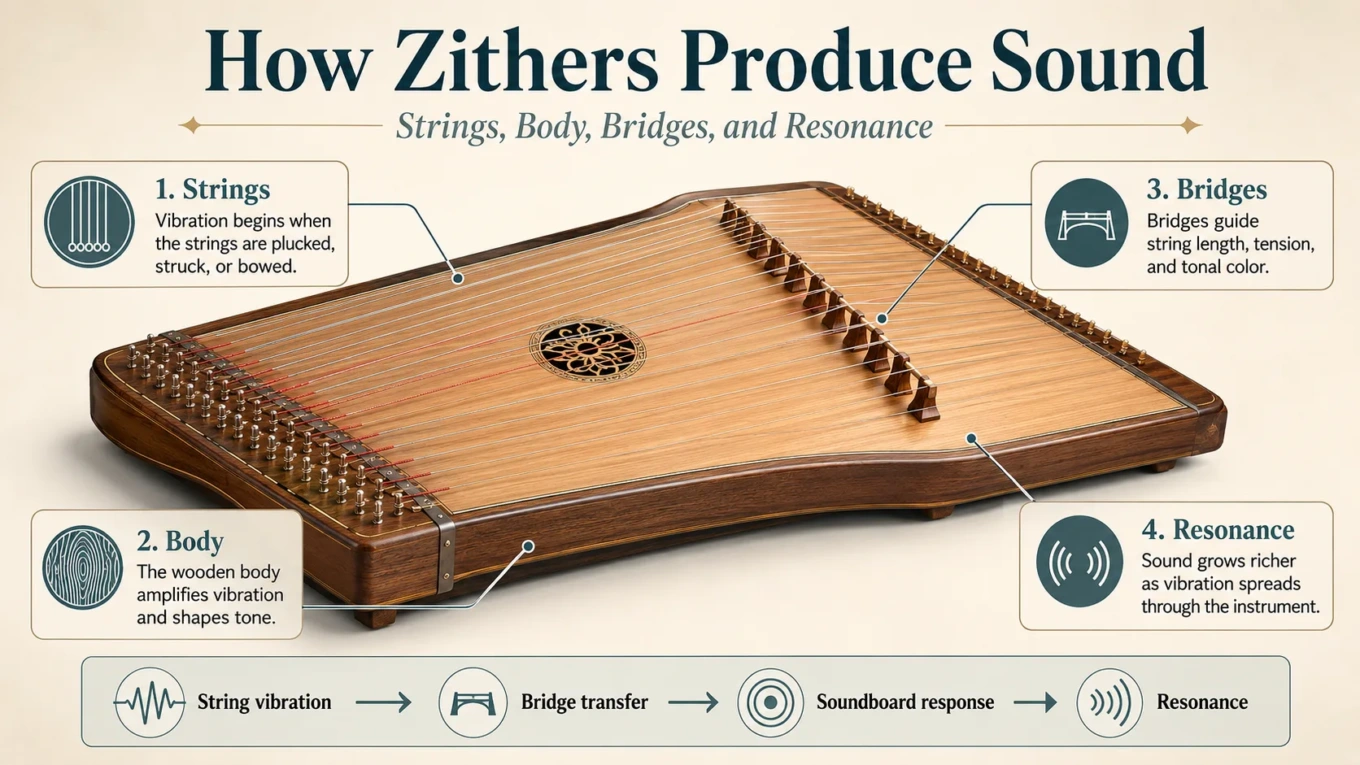
How Zithers Produce Sound: Strings, Body, Bridges, and Resonance
A zither produces sound when a stretched string is set in motion and its vibration is carried into a resonating body[1]. The string alone makes only a small sound. The body, soundboard[2], bridge[3], air space, and playing method shape that vibration into the tone listeners recognize as a zither.
The word zither can mean two things. In a narrow European sense, it may refer to the concert zither or Alpine zither. In a wider organological sense, it describes a broad group of chordophones[4] whose strings run along the same general plane as the body, rather than rising from a separate neck. That wider family includes many different designs: board zithers, box zithers, tube zithers, trough zithers, psalteries, qanun, kantele, gusli, guzheng, koto, gayageum, đàn tranh, santur, hammered dulcimer forms, autoharp, and others depending on classification context.
This makes zither sound production varied, but the main physical chain is shared: string movement, bridge transfer, body resonance, and radiation of sound into the air.
How a Zither Sound Begins
A zither sound begins with a string under tension[5]. When the player plucks, strikes, bows, or strums the string, the string moves away from rest and then vibrates back and forth. That vibration contains a main pitch plus overtones[6], which help give the instrument its color.
Several details affect the pitch and tone of that vibrating string:
- Length: a shorter vibrating length usually gives a higher pitch.
- Tension: a tighter string usually gives a higher pitch.
- Mass: a thicker or heavier string usually gives a lower pitch at the same length and tension.
- Material: gut, silk, nylon, steel, brass, bronze, and synthetic strings respond differently under the fingers, plectrum, or hammer.
- Attack: a hard pluck, light touch, hammer stroke, or nail contact changes the first moment of the sound.
The sound is not created by the string alone. A string moving in open air has too little surface area to move much air. The body of the instrument makes the string audible.
Luthier’s Note: The first moment of contact matters. A bare finger softens the attack, a plectrum[7] can make it brighter, and a hammer can bring a clear strike with a fast decay. These differences explain why a guqin, qanun, santur, and autoharp do not sound alike even though they may all be described within the zither family.
The Basic Sound Chain
Most zithers follow a simple acoustic chain, even when their forms look very different.
| Part | What It Does | How It Shapes Sound |
|---|---|---|
| String | Vibrates after being plucked, struck, bowed, or strummed. | Sets pitch, attack, sustain, and overtone pattern. |
| Bridge | Transfers string vibration into the body. | Changes clarity, energy transfer, sustain, and balance between strings. |
| Soundboard | Receives vibration and moves air. | Helps create volume, warmth, brightness, and response. |
| Body Cavity | Supports air resonance in box and trough forms. | Can add depth, projection, and low-frequency support. |
| Playing Contact | Controls how the string is set in motion. | Affects attack, loudness, articulation, and tone color. |
This chain can be direct or complex. In a simple board zither[8], the string energy may pass into a flat wooden board. In a box zither[9], the vibration enters a hollow body. In a tube zither[10], the body itself may be a natural or shaped tube. In a concert zither[11], melody strings, accompaniment strings, frets, and a hollow resonating body work together in a more mechanically divided layout.
Why the Body Matters
The body of a zither gives the vibrating string a larger surface through which to move air. It does not simply make the sound louder. It also shapes the frequency balance, decay, and feel of the tone.
Many zithers use a wooden body. The exact wood, thickness, arching, bracing, finish, and age can shape resonance, though there is rarely one fixed recipe across the whole family. A guzheng, a kantele, a psaltery, and a concert zither may all use wood, but their body proportions and string loads differ.
Three body features are especially important:
- Surface area: a larger vibrating surface can move more air.
- Stiffness and flexibility: a soundboard must resist string pressure while still responding to vibration.
- Air space: hollow bodies can support resonance in ways a plain board cannot.
Some instruments in the wider zither family have a strong, box-like voice. Others have a dry, close, or intimate sound. The difference often comes from body design as much as from string choice.
Soundboards and Resonance
The soundboard is the part of the body most directly involved in radiating sound. On many box zithers, it is the upper plate beneath the strings. It receives vibration through the bridge and moves in small, complex patterns.
A soundboard that is too stiff may feel resistant and quiet. A soundboard that is too weak may distort under string pressure or lose clarity. Makers therefore balance thickness, grain direction, bridge placement, and internal support. In documented traditional forms, these decisions vary by region, workshop, material access, and playing style.
Resonance[12] is not one single effect. It includes the way the body reinforces some frequencies, softens others, and controls how long the sound continues after the string is played. A zither with a quick response may suit fast ornamentation. Another with longer sustain may support slow melodic lines or shimmering textures.
Material Note: Wood choice can shape response, but it does not act alone. Body size, construction, string tension, bridge design, and playing technique all affect the final sound. Claims that one wood species alone creates a fixed tone should be treated with care.
How Bridges Transfer Vibration
A bridge is the contact point where string vibration enters the body. It may be a long shared bridge, a set of individual movable bridges, a small saddle-like support, or a more complex structure depending on the instrument.
The bridge has two main jobs. It defines the speaking length[13] of the string, and it passes energy into the resonating surface. Its height, weight, hardness, and placement all affect tone.
Fixed Bridges
Fixed bridges[14] are common in many European and folk zither forms. The bridge stays in one position, so tuning is controlled mainly by string tension and sometimes by fretting. This design can give stable string geometry and a clear transfer path into the soundboard.
Movable Bridges
Movable bridges[15] are used in instruments such as guzheng, koto, gayageum, and đàn tranh. Each bridge can set the vibrating length of a string. Moving the bridge changes pitch relationships and string response, although players usually adjust these bridges within the normal tuning practice of that instrument.
Movable bridges also create two string segments: the main playing length and the shorter afterlength[16]. On some instruments, the player can press the string section beyond the bridge to bend pitch or add ornamentation.
Shared and Individual Bridges
Some zithers use a bridge shared by many strings. Others give each string its own support. A shared bridge can help unify the sound across the instrument, while individual bridges allow more control over each string’s length and position. Neither system is automatically better; each belongs to a different playing logic.
Strings: Pitch, Tension, and Timbre
Strings create the first vibration, so their material and layout strongly shape the instrument’s voice. Traditional and modern zithers may use metal, gut, silk, nylon, fluorocarbon, or other synthetic materials. Some use a mixture.
Metal strings often support a bright attack and longer sustain. Silk and gut can feel more flexible and may produce a softer attack, depending on construction and playing style. Nylon and other synthetics can offer stable tuning and a controlled response. These descriptions are broad; the exact result depends on gauge, length, tension, body design, and contact method.
Open Strings
An open string[17] sounds without being stopped by a finger, fret, or key. Many zithers rely heavily on open strings. This is one reason they can produce ringing textures and layered resonance.
Melody Strings and Drone Strings
Some zithers divide strings by musical role. Melody strings[18] carry the tune. Drone strings[19] sustain a repeated pitch or tonal center. Accompaniment strings may provide chords, bass motion, or rhythmic support.
Concert zithers often separate fretted melody strings from open accompaniment strings. Autoharps use chord bars to mute selected strings. Qanun and santur layouts use courses and repeated pitch groups in ways that differ from fretted European zithers.
Courses
A course[20] is a group of strings sounded as one musical unit. Some instruments use single strings; others use double, triple, or multiple-string courses. Courses can add volume, shimmer, and tuning complexity. On struck zithers, courses can also affect the thickness of the hammer sound.
Fretted and Fretless Sound Production
Not every zither has frets. This is one of the most common points of confusion.
A fretted string[21] is shortened by pressing it against a fret, giving controlled pitch positions. The concert zither uses fretted melody strings, allowing the player to form notes with the left hand while plucking with the right. Some related forms also use frets or fret-like stopping systems.
Many other zithers are fretless. On a guzheng or koto, pitch is organized by tuning and bridge placement, with expression added through pressing or bending the string. On a guqin, the player stops and slides on the surface without raised frets, creating a different kind of articulation. On a kantele or gusli, open strings often carry much of the musical structure.
| Design Type | Pitch Control | Typical Sound Effect |
|---|---|---|
| Fretted zither | String is stopped against frets. | Clear pitch positions, melodic control, chordal options. |
| Movable-bridge zither | Bridge placement and tuning set the pitch. | Open-string resonance, bends, ornamented pitch movement. |
| Open-string board or box zither | Each string is tuned to a set pitch. | Ringing texture, drones, modal or chordal support. |
| Struck zither | Strings are hit with light hammers. | Fast attack, bright decay, rhythmic clarity. |
| Autoharp-type zither | Chord bars mute unwanted strings. | Strummed chords with selective ringing. |
Playing Method and the First Moment of Sound
The way a player sets a string in motion changes the sound before the body even begins to respond. This first contact is called the attack[22].
Plucked Zithers
Plucked zithers[23] are played with fingers, nails, picks, rings, or plectra. The pluck pulls the string sideways and releases it. A soft fingertip gives one kind of sound; a hard pick gives another. Instruments such as kantele, guzheng, koto, qanun, psaltery, and concert zither can all involve plucking, though their techniques differ.
Struck Zithers
Struck zithers[24] use hammers or beaters. Santur and hammered dulcimer forms are common examples. The hammer gives a quick attack, and the string rings after the strike. The hammer material, weight, and angle affect brightness and sustain.
Strummed and Muted Zithers
Autoharp-type instruments are often strummed while chord bars mute strings that do not belong to the chosen chord. This means the sound is shaped not only by vibration, but also by controlled silence. Felt or other damping material stops selected strings from ringing.
Bowed Zither Forms
Some regional or modern zither-related instruments may be bowed. Bowing keeps energy entering the string while the note continues, so the tone behaves differently from a plucked note. These forms are not the default image of a zither, but they show how wide the classification can be.
Sustain, Decay, and Damping
After a string sounds, the note does not last forever. Its energy moves into the bridge, body, air, and nearby strings. The way that sound fades is called decay[25]. Sustain[26] describes how long the note remains audible and musically useful.
A zither with long sustain can create a halo of overlapping notes. This is common in many open-string instruments. A zither with shorter sustain can sound clearer in fast passages. Makers and players manage sustain through string choice, body design, bridge material, muting, hand position, and tuning.
Damping[27] is just as important as resonance. A player may stop a string with the hand, let it fade naturally, or use a mechanical mute. Without damping, some zithers can blur when many strings ring together.
Listening Note: When comparing zithers, listen to the space after each note. A guqin may reveal subtle slides and stopped tones, a santur may show a bright struck decay, and an autoharp may create broad chordal ringing shaped by muting.
Sympathetic Vibration and Ringing Texture
Some zither sounds include sympathetic vibration[28]. This happens when an unplayed string vibrates because it shares a pitch or related frequency with a played string. The effect can add shimmer, depth, or a gentle background ring.
Not every zither has dedicated sympathetic strings[29]. In many cases, ordinary open strings vibrate sympathetically because they are close to the active note. Instruments with many open strings can create a dense sound even when the player touches only a few strings.
This is one reason open-string zithers can feel larger than their physical size suggests. The instrument is not only sounding the played note; nearby strings and body resonances may answer it.
Why Zither Types Sound So Different
Zithers do not share one fixed tone. The family includes instruments with different bodies, string counts, bridge systems, and playing techniques. A small psaltery, a large guzheng, a concert zither, and a santur may all be classed near the zither family in different contexts, but their sound production is not the same.
Concert Zither
The concert zither usually combines fretted melody strings with open accompaniment strings on a flat, hollow body. The fretted side supports melodic playing, while the open strings add harmony, bass, or texture. Its sound depends on careful balance between stopped notes and ringing open strings.
Guzheng, Koto, Gayageum, and Đàn Tranh
These long zithers often use movable bridges for individual strings. The bridges set speaking length, and the player can press strings to shape pitch, vibrato, and ornament. Although these instruments can look related in outline, each belongs to its own musical tradition, construction practice, and playing technique.
Qanun
The qanun is a plucked trapezoid zither associated with several Middle Eastern and Mediterranean traditions. It often uses courses of strings and may include small levers or other pitch-adjusting devices depending on the regional and modern form. Its sound is bright, articulate, and highly responsive to right-hand technique.
Santur and Hammered Dulcimer Forms
Santur and hammered dulcimer instruments are struck rather than plucked in normal playing. Their bridges divide and organize strings into pitch areas, and their hammers create a clear attack. The body supports a ringing, percussive tone.
Autoharp
The autoharp is often discussed as a chorded zither. Its chord bars mute selected strings while the player strums. The result is not simply a free ringing field of strings; it is a controlled chordal texture shaped by a damping mechanism.
Body Shape and Air Resonance
Body shape changes how string energy becomes audible sound. A shallow box, deep box, flat board, tube, trough, or trapezoid body each responds differently.
Box zithers often use enclosed air space. The air inside the body interacts with the vibrating soundboard and can support certain frequency areas. Larger bodies may offer more low-frequency support, but size alone does not decide tone. A well-built smaller instrument can respond quickly and clearly, while a larger instrument can sound uneven if bridge load, soundboard thickness, or string tension are poorly balanced.
Tube zithers and trough zithers use body forms that differ from the flat box image many readers expect. In these cases, the resonating body may be carved, split, or shaped from a natural material. The classification rests on the relation of strings to the body, not on whether the instrument looks like a European concert zither.
Classification Note: A zither is not defined by one sound, one country, or one string count. The term describes a structural relationship between strings and body. That is why the same family can include plucked, struck, fretted, fretless, simple, and mechanically assisted instruments.
How Tuning Changes Resonance
Tuning[30] affects more than pitch. It changes which strings reinforce each other, which intervals ring freely, and how easily sympathetic vibration appears. A tuning with many shared pitch relationships can create more audible resonance between strings. A tuning built for clear separation may sound cleaner but less blended.
Many zithers are tuned to support a specific repertory or playing method. Some use diatonic[31] layouts, some use chromatic[32] systems, and others use modal or regional tunings. Instruments with movable bridges may be retuned by changing both string tension and bridge position. Instruments with fixed bridges rely more on tuning pins and string tension.
Because zither types vary so widely, there is no single zither tuning. A concert zither, guzheng, kantele, qanun, and santur use different tuning ideas. Treating them as one tuning system hides the detail that makes each instrument work.
What the Player Can Control
The maker builds the acoustic system, but the player controls how it comes alive. On many zithers, small changes in touch can alter tone clearly.
- Plucking point: playing near the bridge often sounds brighter; playing nearer the middle of the string can sound rounder.
- Finger angle: nail, fingertip, and pick angle change attack and clarity.
- Pressure: pressing a string can bend pitch, add vibrato, or change tension on certain instruments.
- Muting: stopping extra strings can clean the texture.
- Stroke direction: outward, inward, up, down, or crossed strokes can produce different articulation.
This is why two players can make the same zither sound different. The instrument supplies the vibrating system; the player controls energy, timing, and touch.
Common Misunderstandings About Zither Sound
“The More Strings, the Louder the Instrument”
More strings can add range, texture, and resonance, but they do not automatically make an instrument louder. Volume depends on string energy, body response, bridge transfer, and playing force.
“All Zithers Ring in the Same Way”
Some zithers ring for a long time. Others have a dry or short voice. Struck zithers, fretted zithers, and open-string zithers can behave very differently.
“A Zither Is Just a Flat Harp”
A harp usually has strings running from a neck or frame to a soundbox in a different structural arrangement. A zither’s strings lie along the body or across a body-related surface. The sound chain and playing posture often differ.
“Wood Alone Decides the Tone”
Wood matters, but it is only one part of the system. Soundboard thickness, bridge design, string tension, body shape, tuning, and player touch all matter.
Glossary of Technical Terms
Resonating Body: The part of a zither that receives string vibration and helps turn it into audible sound. It may be a box, board, tube, trough, or other body form depending on the instrument.
Soundboard: The vibrating surface that helps radiate sound. On many box zithers, it is the upper wooden plate under the strings.
Bridge: A support that holds the string above the body and transfers vibration into the instrument. Bridges may be fixed, movable, shared, or individual.
Chordophone: A musical instrument that produces sound through vibrating strings. Zithers are one branch within this wider string-instrument classification.
String Tension: The pulling force placed on a string between its anchor points. Tension affects pitch, feel, sustain, and stress on the body.
Overtone: A higher vibration that sounds along with the main pitch. Overtones help create the color or timbre of a zither note.
Plectrum: A small pick or picking device used to pluck strings. Some zither traditions use fingerpicks, rings, or plectra instead of bare fingers.
Board Zither: A zither type in which strings are stretched over a board-like body. The body may be simple compared with a hollow box form.
Box Zither: A zither with a hollow box-like body that supports resonance. Concert zithers, many psalteries, and related forms can fall near this category depending on design.
Tube Zither: A zither type whose body is tube-shaped or made from a tubular material. The classification describes body form and string relationship, not a single musical tradition.
Concert Zither: A European zither form often associated with fretted melody strings and open accompaniment strings on a flat hollow body. Its construction differs from long Asian bridge zithers and struck dulcimer forms.
Resonance: The way an instrument body responds to and reinforces vibration. In zithers, resonance shapes volume, sustain, tone color, and the way nearby strings may ring.
Speaking Length: The active vibrating length of a string between its two sounding points. Changing this length changes pitch.
Fixed Bridge: A bridge that remains in one set position. Instruments with fixed bridges usually change pitch through tuning tension or by stopping strings with frets or fingers.
Movable Bridge: A bridge that can be repositioned to change string length and pitch setup. Guzheng, koto, gayageum, and đàn tranh commonly use individual movable bridges.
Afterlength: The short section of string beyond the main playing length, often found past a bridge. On some zithers, this area can influence feel, resonance, or pitch bending technique.
Open String: A string sounded without being pressed, stopped, or fretted. Many zithers rely on open strings for ringing texture and resonance.
Melody String: A string mainly used to carry the tune. In concert zithers, melody strings are often fretted, while other strings support accompaniment.
Drone String: A string used to provide a repeated or sustained pitch. Drone strings can support a tonal center or background resonance.
Course: A group of strings treated as one musical unit. Courses can add volume, shimmer, or thickness to plucked and struck zither sounds.
Fretted String: A string whose vibrating length can be shortened by pressing it against frets. This allows controlled pitch positions on instruments such as the concert zither.
Attack: The first audible moment of a note. In zithers, attack changes with fingers, picks, hammers, bowing, strumming, or muting.
Plucked Zither: A zither played by pulling and releasing the strings with fingers, nails, plectra, or picks. Many well-known zither forms are plucked.
Struck Zither: A zither played by hitting the strings with hammers or beaters. Santur and hammered dulcimer forms are common examples.
Decay: The way a note fades after it is played. Zither decay depends on string material, body response, damping, and playing method.
Sustain: The length of time a note continues to sound. Open-string zithers can have long sustain, but this varies by instrument and construction.
Damping: The act of stopping or reducing string vibration. Players may damp strings by hand, while some instruments use mechanical mutes.
Sympathetic Vibration: The vibration of an unplayed string caused by another sounding string. It can add extra resonance and a soft ringing background.
Sympathetic String: A string included mainly to vibrate in response to other notes. Not every zither has dedicated sympathetic strings, though many open strings can vibrate sympathetically.
Tuning: The pitch arrangement of an instrument’s strings. In zithers, tuning affects pitch, resonance, chord shapes, and sympathetic response.
Diatonic: A pitch arrangement based mainly on the notes of a scale rather than all twelve chromatic pitches. Many open-string instruments use diatonic or modal layouts.
Chromatic: A pitch arrangement that includes all twelve semitones in an octave. Some zithers use chromatic systems or devices that allow chromatic alteration.
FAQ
How do zithers make sound?
Zithers make sound when their strings vibrate and send energy through bridges into a resonating body. The body and soundboard move air, making the string vibration louder and more colorful.
Does the body of a zither really change the tone?
Yes. Body shape, soundboard thickness, bridge placement, air space, and material all shape the tone. The body affects volume, sustain, brightness, warmth, and response.
Why do some zithers sound bright while others sound soft?
The difference can come from string material, playing method, bridge design, body construction, and tuning. A metal-strung struck zither may sound bright and clear, while a softly plucked instrument with different strings and body design may sound warmer or quieter.
Do all zithers have bridges?
Many zithers use bridges, but bridge design varies widely. Some have fixed bridges, some have movable bridges, and some use body structures that support strings in less familiar ways.
Do more strings make a zither sound better?
More strings can add range and resonance, but they do not automatically improve the sound. A good tone depends on the balance between string tension, bridge transfer, body response, tuning, and playing technique.
Why do open-string zithers ring so much?
Open strings can continue vibrating after they are played, and nearby strings may vibrate sympathetically. This creates the ringing texture heard in many zither-family instruments.