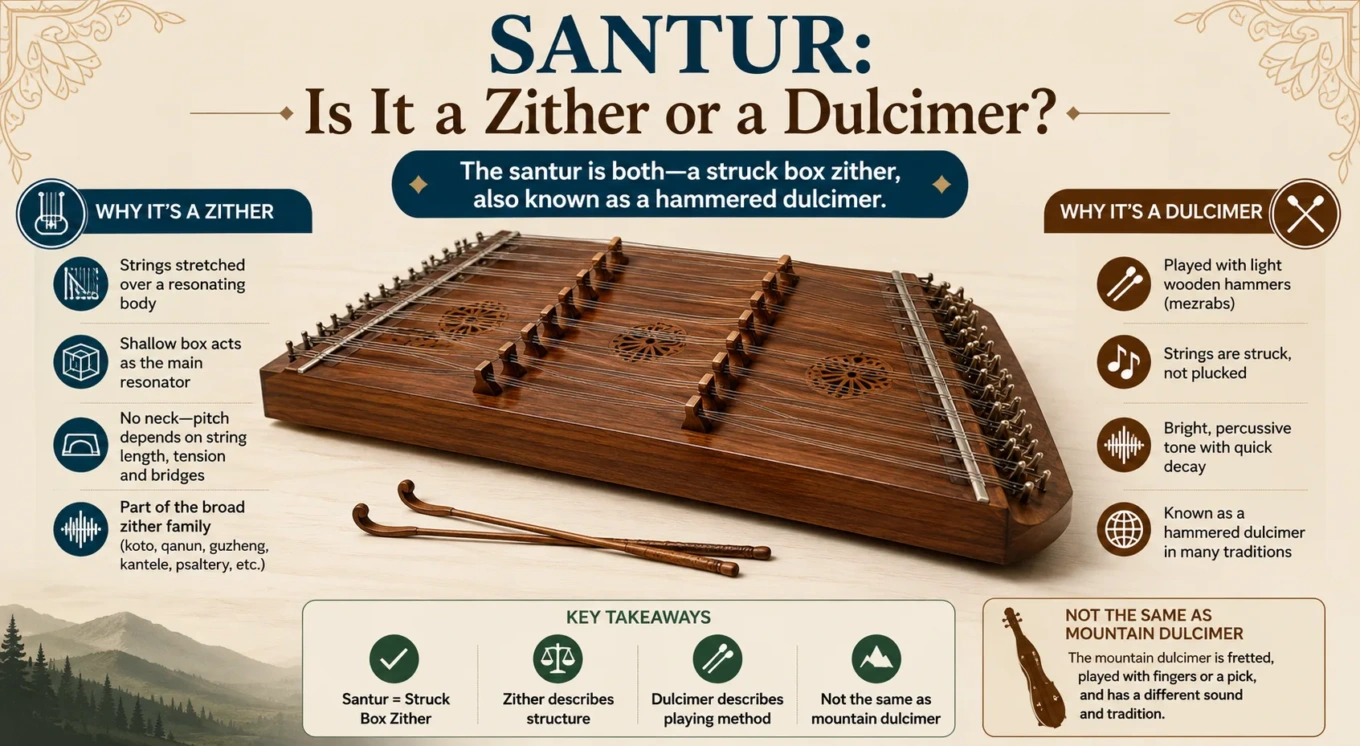
Santur: Is It a Zither or a Dulcimer?
The santur is usually described as a hammered dulcimer, but organologically it also belongs within the wider zither family. Its strings run across a resonating body, and the player sounds them with light wooden hammers rather than plucking them by hand. That double identity is the source of the common question: is the santur a zither or a dulcimer? The careful answer is that it is both, depending on how narrowly each term is being used.
Santur, Zither, and Dulcimer: The Short Answer
A santur is a struck box zither, and in many English-language descriptions it is also called a hammered dulcimer. These labels do not cancel each other out. They describe the instrument from different angles.
Zither is the broader organological term. It describes a family of [1] instruments in which the strings are stretched across, along, or over the body of the instrument rather than attached to a separate neck. Hammered dulcimer is a more specific performance-based term for certain zithers whose strings are struck with small hammers.
| Question | Best Answer | Why It Matters |
|---|---|---|
| Is the santur a zither? | Yes, in the broad instrument-family sense. | Its strings lie over a resonating body without a separate neck. |
| Is the santur a dulcimer? | Yes, when “dulcimer” means hammered dulcimer. | It is played with small hammers rather than mainly plucked. |
| Is it the same as a mountain dulcimer? | No. | The mountain dulcimer is a fretted American zither played very differently. |
| Is every santur built the same way? | No. | Regional forms vary in tuning, string count, bridge layout, size, and musical role. |
Why the Same Instrument Gets Two Labels
The word zither can be used in two ways. In a narrow European context, it may refer to the concert zither or related Alpine instruments. In a broader classification sense, it covers a large group of instruments whose strings are carried by the body itself. That broad use includes board zithers, box zithers, tube zithers, trough zithers, plucked zithers, bowed zithers, and struck zithers.
The santur fits the broad sense because it is built around a shallow [2] with many strings stretched over it. It does not have a lute-like neck, a violin-like fingerboard, or a harp-like open frame. The body is not just a support; it helps create and project the sound.
The word dulcimer is more tangled. In English, it may refer to a hammered dulcimer, a mountain dulcimer, or other regional instruments whose names entered English through different histories. When people call the santur a dulcimer, they almost always mean a hammered dulcimer-type instrument, not a fretted lap dulcimer.
Classification Note: “Zither” tells where the strings sit in relation to the body. “Hammered dulcimer” tells how the strings are sounded. The santur can carry both labels because its structure and playing method point to both categories.
What Makes the Santur a Zither?
A santur is a zither because its strings are stretched over a body that acts as the main resonator. In instrument classification, this matters more than the player’s hand position, cultural setting, or surface resemblance to other instruments.
The santur is commonly described as a [3], because its resonating body is a hollow wooden box rather than a flat board alone. Its top plate functions as the [4], receiving string vibration through the bridges and helping shape the tone.
That structure links the santur to a wide zither family that also includes instruments such as qanun, koto, guzheng, gayageum, kantele, gusli, psaltery, and hammered dulcimer. These instruments are not the same, and they should not be treated as variants of one model. Their shared feature is the relationship between strings and resonating body.
Strings Over the Body, Not Along a Neck
On a necked instrument, such as a lute or guitar, the player changes pitch by stopping strings along a neck. On a santur, the strings are arranged across the instrument’s top. Pitch depends on string length, tension, gauge, and bridge placement rather than a long stopped neck.
Most santur playing uses [5] pitches. The player strikes strings that are already tuned to the needed notes. Some regional techniques may involve damping or ornamentation, but the core pitch layout comes from the instrument’s stringing and tuning system.
A Box Body That Shapes Resonance
The santur’s hollow body gives the instrument more projection than a simple board. The soundboard vibrates, the air inside the body responds, and the bridges transfer string energy into the wooden structure.
Wood choice, thickness, bridge fitting, and internal construction can shape resonance, but santurs do not follow one universal recipe. Regional makers and modern workshops may use different woods and dimensions. Careful descriptions should leave room for that variation.
What Makes the Santur a Dulcimer?
The santur is called a dulcimer because it belongs to the hammered dulcimer branch of struck zithers. The player uses a pair of small wooden hammers, often light and curved, to strike the strings. These hammers may be plain or lightly padded depending on the tradition, player, and desired tone.
This playing method gives the santur a quick attack, bright decay, and flowing ornamental character. Unlike a plucked zither, the sound begins with the impact of the hammer. Unlike a piano, the player directly controls the touch, spacing, rebound, and rhythmic pattern of each stroke.
Hammered Dulcimer Does Not Mean Mountain Dulcimer
The main confusion comes from the English word dulcimer. A hammered dulcimer is a struck zither with strings stretched over a resonating body. A mountain dulcimer is usually a fretted lap zither associated with Appalachian music and played by plucking or strumming.
Both can be called dulcimers, but they do not share the same playing logic. The santur belongs with the hammered dulcimer side of the term.
Construction Details That Shape the Instrument
The santur is often recognized by its trapezoidal wooden body, rows of strings, and small bridges. The exact layout can differ between Persian santur, Indian santoor, Iraqi santur, Turkish and Greek-related forms, and other regional or modern versions. Some examples are compact and finely voiced for solo performance; others are built for ensemble use or local repertoire.
Body Shape and Soundboard
Many santurs have a shallow trapezoid body. The wider and narrower sides affect string length, bridge placement, and playing layout. The player usually places the instrument on a stand, table, lap support, or playing surface, depending on the tradition and context.
The soundboard must carry string tension while staying responsive. It needs enough strength to resist deformation, yet enough flexibility to vibrate. That balance is one reason santur making is a craft of careful thicknessing, bridge fitting, and tuning stability rather than only external decoration.
Bridge Layout
The santur uses small [6] supports that divide the strings into tuned speaking lengths. In many forms, a bridge may create usable pitches on both sides, so one string group can contribute more than one tonal area. The exact arrangement depends on the regional design.
Some bridges are movable in the practical sense that a maker or skilled player can adjust them. That does not mean they are casual controls like keys on a keyboard. Bridge position affects pitch, tension feel, and tone; small changes can matter.
Courses and String Groups
Santur strings are often arranged in [7] groups, with several strings tuned together or in close relationship to produce one note area. This grouping gives the instrument a shimmering sound because multiple strings vibrate almost as one.
String count varies by regional form and individual design. Persian santurs are often discussed through bridge count and grouped strings, while Indian santoor traditions may use larger string arrays. A single fixed number would be misleading across the whole family of santur-type instruments.
Tuning and Pitch Layout
Santur tuning depends on regional repertoire, modal practice, maker design, and the number of bridges and strings. Some instruments are set for modal systems in which certain pitches need delicate adjustment. Others are adapted for stage performance, teaching, recording, or ensemble tuning.
The tuning process usually involves many tuning pins, because multiple strings may serve one course. A player must tune not only individual pitches but also the relationship among strings in the same course. Even a small mismatch can change the shimmer, clarity, and beating effect of the sound.
Luthier’s Note: On a santur, tuning stability is not only about the strings. Pin fit, bridge contact, soundboard movement, humidity, and playing force all affect how reliably the instrument holds pitch.
Why Santur Tuning Can Feel Complex
A plucked zither with fewer strings may be easier for a beginner to check by ear. A santur has many more contact points. Each course must speak cleanly, and neighboring bridges must keep their pitch relationships clear.
That is why santur tuning is often learned gradually. The player first learns the note layout, then the repeated string groups, then the modal or scale adjustments used in a particular tradition.
Playing Style and Sound
The santur is played with two light hammers, sometimes called mallets in English descriptions. The player strikes, alternates, rolls, ornaments, and dampens according to the musical style. The technique can look simple from a distance, but the sound depends on touch.
A clean santur tone needs controlled rebound. If the hammer stays too long on the string, the sound can choke. If the stroke is too hard, the attack may become harsh. Skilled players use weight, wrist motion, spacing, and damping to shape phrasing.
What to Listen For
The santur’s tone often has a clear attack followed by a ringing decay. Because courses may contain several strings, the sound can have a gentle shimmer. Fast patterns can blur into a bright texture, while slow strokes reveal the wood, bridge contact, and tuning quality.
- Attack: the first sound made when the hammer strikes the string.
- Decay: the way the sound fades after the strike.
- Resonance: the response of the body and nearby strings after the note begins.
- Articulation: how clearly each hammered note speaks in a phrase.
Regional Forms and Naming
The spelling santur is often used for Persian and related Middle Eastern contexts. Santoor is common in Indian classical music contexts. Other spellings and local names appear in different languages and catalogues.
These names should be handled with care. Similar spellings do not always mean the same tuning, technique, repertoire, or construction. A museum catalogue may classify an object by region and maker, while a musician may identify it by repertoire, lineage, or playing style.
Persian Santur
The Persian santur is one of the best-known forms. It is associated with Persian art music and modal performance practice. Descriptions often mention its trapezoidal body, multiple bridges, grouped strings, and delicate hammer technique.
Its tuning is not best understood as one permanent layout. Players may retune for different modal needs, and the instrument’s bridge and string arrangement support that musical flexibility.
Indian Santoor
The Indian santoor is strongly associated with Hindustani classical music, though its regional history and modern concert role should not be flattened into one story. It is commonly played with curved wooden mallets and may have a larger string layout than many Persian examples.
In performance, the instrument has been adapted to melodic development, rhythmic cycles, and ornamented phrasing. These adaptations show how a hammered zither can be shaped by a musical system that values pitch nuance and expressive movement.
Other Related Hammered Zithers
Related struck zithers appear across several regions, including instruments described in English as hammered dulcimers. They may share a trapezoidal body and hammer technique, but differences in tuning, string grouping, bridge layout, and repertoire are not minor details. They define how the instrument works in music.
How the Santur Differs from Related Zithers
The santur sits near several instruments in the wider zither family, yet it has its own playing logic. It should not be treated as a plucked qanun, a smaller piano, or a general “Eastern dulcimer.” Those shortcuts hide the details that make it distinct.
| Instrument | Main Sounding Method | Main Difference from Santur |
|---|---|---|
| Qanun | Plucked | Usually played with plectra and often uses levers or other pitch-adjusting devices in modern forms. |
| Guzheng | Plucked | Uses movable bridges and hand techniques for bending and ornamenting strings. |
| Koto | Plucked | Has a long body, movable bridges, and Japanese playing traditions with finger picks. |
| Hammered Dulcimer | Struck | Very close in classification; the name often depends on region, repertoire, and English usage. |
| Mountain Dulcimer | Plucked or strummed | A fretted lap zither with a very different body, tuning logic, and playing style. |
Common Misunderstandings
“Santur” and “Dulcimer” Are Not Always Interchangeable
In a broad English description, calling the santur a hammered dulcimer is understandable. In a regional music context, however, santur or santoor carries more precise cultural and technical meaning. The safer wording is: the santur is a regional hammered zither often grouped with hammered dulcimers.
It Is Not a Small Piano
The santur and piano both involve strings being struck, but the comparison should stop there. A piano uses a keyboard action, dampers, a heavy frame, and a complex mechanical system. The santur gives the player direct contact through handheld hammers.
It Is Not One Standard Instrument Everywhere
The santur family includes regional forms with different string counts, bridge systems, tunings, materials, and performance roles. A beginner searching for one universal chart may quickly run into conflicting answers because the instrument is not standardized across all traditions.
How Museums and Musicians Usually Describe It
Museums often classify the santur as a zither or box zither because collection catalogues focus on structure. Musicians may describe it through repertoire, lineage, region, or playing method. Both views are useful.
A catalogue entry might emphasize body shape, materials, strings, bridges, and region. A performer might emphasize tuning, touch, modal use, and the feel of the hammers. A full understanding needs both: the object on the table and the music it is built to serve.
Collector’s Note: When identifying a santur, do not rely on shape alone. Look at bridge count, string grouping, tuning pins, hammer style, region of origin, maker information, and signs of later repair or adaptation.
What Beginners Should Know
A beginner should think of the santur as a tuned map of strings rather than a chromatic keyboard. The first challenge is orientation: which string group gives which pitch, how the bridges divide the layout, and how the hammers rebound.
Starting on santur also means accepting tuning as part of the instrument. Many strings need care, and the instrument may respond to room conditions. Beginners who already play piano or guitar may find the layout unfamiliar, but the clear visual arrangement of strings can become intuitive with practice.
Good First Skills
- Learn the note layout used on the specific instrument.
- Practice relaxed hammer rebound before playing fast patterns.
- Tune one course cleanly before trying to tune the whole instrument quickly.
- Listen for uneven string pairs or groups within the same pitch area.
- Keep the instrument in a stable environment when possible.
Care, Materials, and Handling
A santur is sensitive to tuning pressure, wood movement, and bridge placement. The soundboard carries many strings, and small shifts can affect tone. The instrument should be moved carefully, especially if its bridges are not fixed in place.
Dry or damp conditions may affect wood and tuning stability. This does not mean every santur is fragile, but it does mean that storage matters. A stable room, careful cover, and gentle handling help protect both sound and structure.
Cleaning should be simple. Dust can be removed with a soft cloth or brush around the strings and bridges. Strong chemicals, heavy pressure, or careless movement near bridges can create problems that are harder to fix than ordinary dust.
So, Is the Santur a Zither or a Dulcimer?
The most accurate answer is: the santur is a hammered box zither, and it may also be called a hammered dulcimer in English classification. “Zither” names the wider structural family. “Dulcimer” names a related struck-zither tradition and English naming habit.
For readers comparing instrument families, zither is the broader and more precise technical category. For players and listeners familiar with hammered dulcimers, dulcimer gives a useful clue about how the santur is played. The best description uses both terms without reducing the instrument to either one alone.
Glossary of Technical Terms
Chordophone: A musical instrument whose sound begins with vibrating strings. In the zither family, the strings are carried by the body itself rather than by a separate neck or frame.
Soundbox: A hollow resonating body that helps amplify and color string vibration. On a santur, the box body supports the strings and gives the instrument much of its projection.
Box Zither: A zither built with a hollow box-like body. The santur belongs here because its strings stretch over a shallow resonating box rather than a solid board alone.
Soundboard: The vibrating top plate of the instrument. On a santur, the bridges transfer string vibration into the soundboard, helping shape volume, tone, and sustain.
Open String: A string sounded at its tuned pitch without being stopped against a fingerboard or fret. Santur playing relies heavily on open string pitches arranged across the instrument.
Bridge: A small support that holds strings at a set height and helps define their vibrating length. On the santur, bridges also transfer vibration into the soundboard and play a major role in pitch layout.
Course: A group of strings treated as one note or pitch area. Many santur forms use courses with multiple strings, which adds brightness and a slight shimmer to the tone.
FAQ
Is a santur a zither?
Yes. In broad instrument classification, the santur is a zither because its strings are stretched over a resonating body rather than along a separate neck.
Is a santur the same as a hammered dulcimer?
It is closely related and is often described as a hammered dulcimer in English. The name santur is more specific to particular regional traditions, while hammered dulcimer is a wider English category.
Why is the santur not just called a dulcimer?
The word dulcimer can refer to different instruments, including the mountain dulcimer. Calling it a santur gives more precise information about its regional identity, construction, and playing tradition.
Does every santur have the same number of strings?
No. String count and bridge layout vary by regional form, maker, and musical use. It is safer to describe a specific santur by its own bridge arrangement and string grouping.
Is the santur plucked or struck?
The santur is struck with small handheld hammers. This separates it from plucked zithers such as the qanun, guzheng, koto, and many psalteries.
Is santur tuning difficult for beginners?
It can be demanding because many strings and courses need to be tuned cleanly. Beginners usually learn the layout and tuning process step by step rather than trying to master the whole instrument at once.