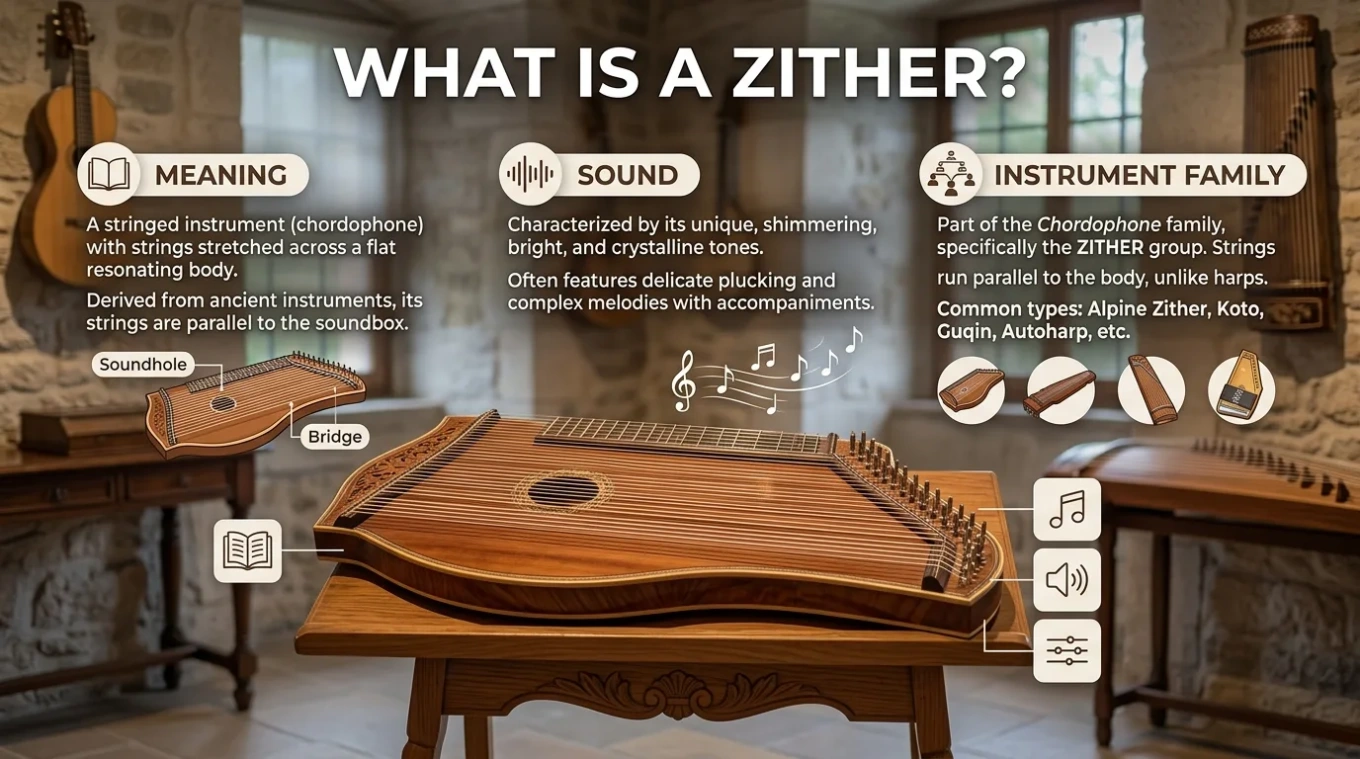
What Is a Zither? Meaning, Sound, and Instrument Family
A zither is a stringed instrument in which the strings run across, along, or over the instrument’s own body rather than extending along a separate neck. In narrow everyday use, the word often points to the European concert zither. In organology, it also names a much wider instrument family that includes many plucked, struck, bowed, fretted, and fretless forms.
The easiest way to understand a zither is to look at the path of its strings. A guitar has a neck that projects from the body. A harp has strings set in a frame. A zither places its strings on a body, board, box, tube, trough, or frame that acts as the main string bearerString bearer. That single detail explains why a concert zither, kantele, gusli, guzheng, koto, gayageum, guqin, qanun, santur, psaltery, hammered dulcimer, and autoharp can all appear in zither-related discussions while still remaining very different instruments.
What a Zither Means in Music
The word zither has two useful meanings. The first is a specific one: a European table or lap instrument with a shallow body, strings stretched across it, and often a fretted melody section. This is the meaning many players have in mind when they say “zither” in an Alpine, Austrian, German, or concert-music setting.
The second meaning is broader. In instrument classification, a zither is a type of chordophoneChordophone: an instrument that produces sound through vibrating strings. In this broad sense, the word does not describe one exact shape, string count, tuning, or playing method. It describes a design idea.
Classification Note: A zither is not defined by being small, folk, European, or easy to play. It is defined by how the strings relate to the body. The strings are carried by the instrument’s body itself, not by a separate projecting neck.
Main Details Worth Knowing
| Feature | What It Usually Means | Why It Matters |
|---|---|---|
| Instrument Class | Chordophone | The sound comes from vibrating strings. |
| Body Relationship | Strings are stretched across, along, or over the body. | This separates zithers from necked lutes such as guitars, citterns, and many mandolins. |
| Resonator | May be a board, soundbox, tube, trough, frame, or attached resonator. | The body shape changes volume, sustain, and tone color. |
| Playing Method | May be plucked, strummed, struck, bowed, or damped by chord bars. | Zither is a family term, not a single technique. |
| Pitch Control | May use open strings, frets, movable bridges, fixed bridges, levers, or chord mechanisms. | This affects melody, harmony, tuning, and playing logic. |
| Common Confusion | The same word can mean a European concert zither or a wide family of related instruments. | Context decides whether the word is narrow or broad. |
Why the Definition Can Feel Confusing
The confusion starts because zither is both a named instrument and a classification word. That is like using “violin” for one instrument, while also using another word to describe a whole group of string instruments. With zither, both uses have become common in English.
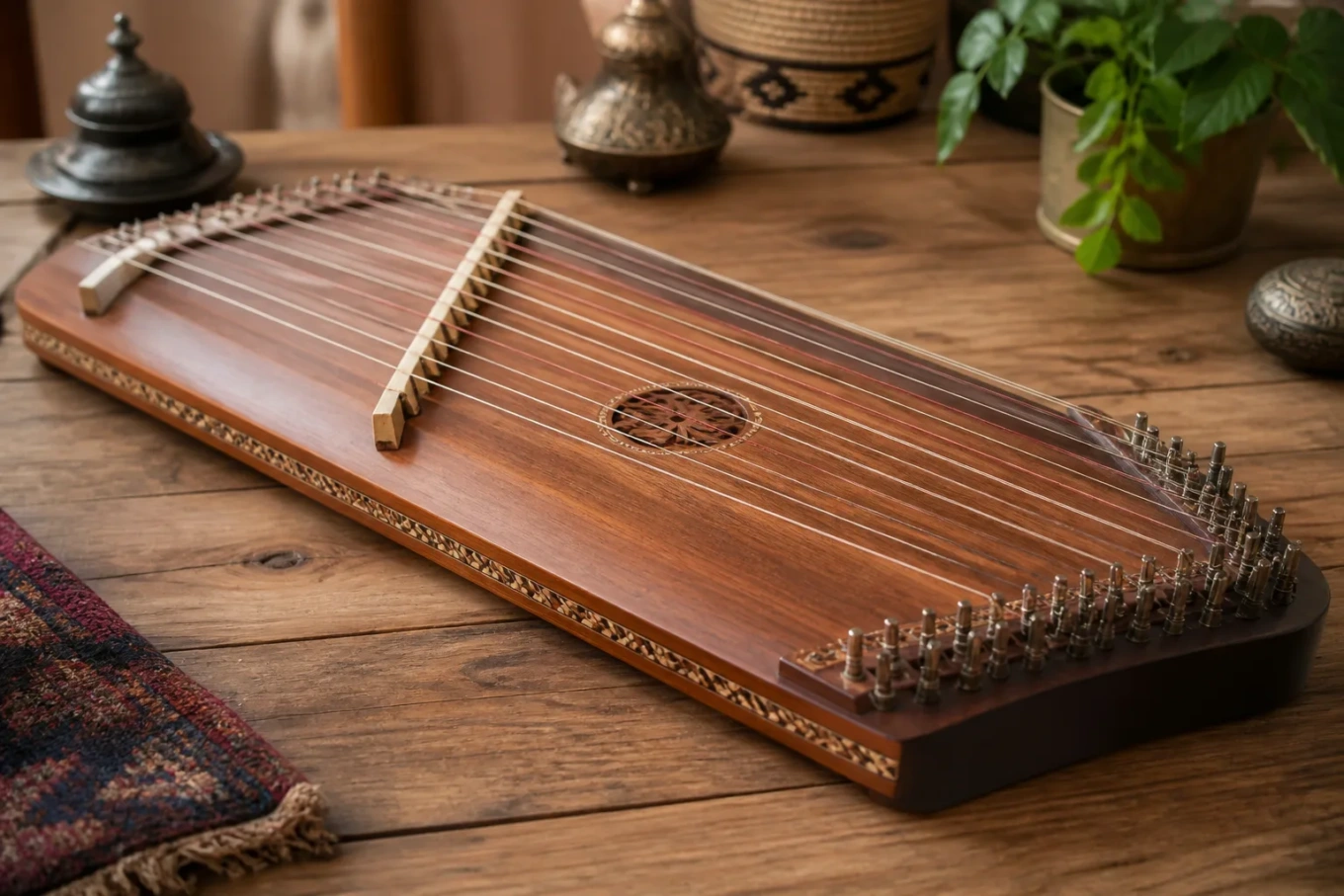
When a museum label says Chordophone-Zither-plucked, it may refer to a specific object from Germany, Japan, East Asia, Africa, Europe, or another region. The label is not saying those instruments are culturally the same. It is naming a structural relationship between strings and body.
When a musician says “I play zither,” the meaning is usually narrower. They may mean the European concert zither, an Alpine zither, a chord zither, or another local form. The intended meaning depends on the musical setting.
How a Zither Produces Sound
A zither produces sound when a string is set into motion. The string may be plucked with a fingertip, struck with a small hammer, brushed with a pick, bowed, or activated by a mechanism. The vibrating string passes energy into the bridgeBridge, soundboardSoundboard, and resonating bodyResonating body.
The body does not simply “hold” the strings. It helps shape the sound. A shallow wooden soundbox can add warmth and projection. A board zither can give a direct, clear tone. A tube zither may use the natural hollow or semi-hollow form of bamboo or another plant material. A frame or box structure can support many strings and allow more complex tuning layouts.
Wood choice, string material, bridge placement, body depth, and soundboard thickness can all shape resonance. Still, no single material rule applies to every zither. A concert zither with metal and gut strings, a silk-strung koto, a nylon-strung learning instrument, and a wire-strung santur do not behave in the same way.
What a Zither Sounds Like
The sound of a zither depends on its type. Some zithers sound bright and bell-like. Others sound dry, soft, nasal, shimmering, deep, or percussive. A plucked board zither can give clear individual notes. A struck zither such as a santur or hammered dulcimer can create fast attacks and ringing decay. A bowed zither can produce a sustained tone that feels closer to a bowed string instrument than a plucked one.
A European concert zither often combines melody and accompaniment. Melody strings near the player may pass over a fretted fingerboardFret, while open accompaniment strings provide harmony and bass. That layout gives the instrument a layered sound: stopped melody notes on one side, ringing open strings on the other.
Listening Note: Do not expect one universal “zither sound.” Listen for the playing method first. A plucked guzheng, a bowed ajaeng, a hammered dulcimer, and an autoharp all belong to zither-related discussions, but their attacks, sustain, and musical roles differ.
The Zither as an Instrument Family
In the broad sense, zither is a family of chordophones. This family includes several structural forms. The names below describe body design more than musical style.
Board Zithers
A board zither has strings carried by a board-like body. Some board zithers are flat and simple; others are long, curved, or fitted with bridges. East Asian long zithers such as guzheng, koto, gayageum, and đàn tranh are often discussed in this area, though each has its own history, construction, tuning habits, and performance tradition.
Box Zithers
A box zither uses a hollow box or soundbox. The European concert zither, many chord zithers, some psalteries, and several fretted European folk instruments fit near this idea. The soundbox increases resonance and gives the instrument a more contained, table-ready shape.
Tube Zithers
A tube zither uses a tube-like body, often associated with bamboo or similar plant material in many documented regional forms. In some types, the string may be cut from the tube itself and raised by small bridges. In others, separate strings are attached to the body. These details matter because they change both classification and sound.
Trough and Raft Zithers
Trough zithers use a hollowed or channel-like form. Raft zithers use several pieces joined into a raft-like string bearer. These terms appear more often in organology and museum description than in everyday player language.
Frame Zithers
Frame zithers carry strings on a frame rather than a solid box or board. Some psaltery and dulcimer-related instruments can be described in this area, depending on their exact build and classification context.
How Zithers Are Played
Zithers are not all played the same way. Some are placed on the lap. Others rest on a table, stand, floor, or dedicated support. Some are held close to the body. A few regional forms use positions that do not match the usual “table zither” image.
- Plucked zithers use fingers, fingernails, fingerpicks, thumb picks, or small plectraPlectrum.
- Struck zithers use hammers or beaters to set the strings in motion.
- Bowed zithers use a bow to create sustained tones.
- Fretted zithers allow certain strings to be stopped against frets for melody notes.
- Fretless zithers often rely on open strings, movable bridges, pressure, bending, or tuning layout.
- Chord zithers and autoharps may use chord bars or damping systemsDamping to simplify harmony.
This variety is why “How do you play a zither?” has no single answer. The playing method belongs to the specific instrument, not to the family name alone.
Strings, Bridges, and Tuning
Zithers may have only a few strings or many dozens. Some use single strings for each pitch. Others use coursesCourse, where two or three strings sound together as one note. Some instruments separate melody, drone, bass, and accompaniment areas; others use a more even pitch layout across the body.
Bridges may be fixed, movable, individual, shared, tall, low, straight, curved, or paired. On long zithers such as guzheng, koto, gayageum, and đàn tranh, movable bridges can shape pitch layout and playing feel. On many dulcimer or santur-type instruments, bridges divide or organize courses for struck playing. On a concert zither, bridge and fretboard design supports a different logic: stopped melody strings plus open accompaniment strings.
Tuning also varies. Some zithers use diatonicDiatonic layouts. Some support chromaticChromatic playing. Some are tuned for a mode, a regional repertoire, a teaching system, or a specific ensemble role. It is safer to ask “Which zither?” before asking “What tuning does a zither use?”
Narrow Meaning: The European Concert Zither
In its narrower English use, zither often means the European concert zither. This instrument is usually played flat across the lap or on a table. It has a shallow soundbox and a mix of melody and accompaniment strings. The melody strings nearest the player commonly pass over a fretted fingerboard, while other strings remain open for accompaniment.
Historical European examples may use wood, metal, gut, and other string materials depending on period, maker, and restoration state. Many 19th-century museum examples show a compact but carefully built instrument with a shallow body and a clear separation between melody and accompaniment zones.
The concert zither is not the same thing as every zither. It is one highly developed branch of the family. Its fretted melody section, thumb plectrum use, and accompaniment layout give it a playing logic that differs from guzheng, koto, qanun, santur, psaltery, or autoharp.
Broad Meaning: Related Zither Instruments
Many instruments can be called zithers in a broad classification sense. That does not erase their own names or traditions. A guzheng is not a koto. A koto is not a gayageum. A qanun is not a santur. A hammered dulcimer is not an autoharp.
The zither family label helps explain structural kinship. It should not flatten musical identity.
| Instrument | Common Region or Tradition | Why It Relates to the Zither Family |
|---|---|---|
| Concert Zither | Central European and Alpine traditions | Strings run across a shallow soundbox, with fretted melody strings and open accompaniment strings in many forms. |
| Kantele | Finnic and Baltic-related traditions | A plucked zither with strings carried by a resonating body, with forms that vary by period and region. |
| Gusli | Eastern European and Russian traditions | A plucked zither-like instrument with regional body forms and string layouts. |
| Guzheng | Chinese tradition | A long plucked zither with movable bridges in many modern forms. |
| Koto | Japanese tradition | A long plucked zither with movable bridges and its own repertoire and playing methods. |
| Gayageum | Korean tradition | A plucked long zither with regional and modern variants. |
| Qanun | Middle Eastern, North African, and related art-music settings | A trapezoidal plucked zither often arranged in courses, with tuning devices on many modern examples. |
| Santur | Persian, Indian, and related regional traditions | A struck zither played with light hammers, with forms that vary by tradition. |
| Autoharp | European-American and popular music settings | A chord zither with a damping-bar system for selecting chords. |
Where Zithers Differ from Guitars, Harps, and Dulcimers
A zither differs from a guitar because a guitar has a neck that extends from the body. The player changes many pitches by pressing strings along that neck. In a zither, the body itself carries the string layout. Some zithers have frets, but those frets do not create a guitar-like neck.
A zither differs from a harp because harp strings are held in a frame and usually run at an angle between the neck and soundboard. Zither strings lie across, along, or over the body or string bearer.
The dulcimer question needs care. Some dulcimers are often treated as zither-family instruments, especially hammered dulcimers and certain fretted dulcimer forms. But “dulcimer” is not a perfect synonym for “zither.” It names particular instruments and traditions. The exact relationship depends on the type of dulcimer and the classification being used.
Materials and Construction Details
Many zithers use wood for the body or soundboard, but the type of wood, thickness, bracingBracing, and body depth vary widely. Some regional instruments use bamboo, plant fiber, skin, gut, metal wire, silk, nylon, synthetic strings, or mixed materials. Museum records often describe these materials carefully because they reveal both construction and period practice.
On a luthier’s bench, the most revealing details are often small: the height of a bridge, the angle of a string over the bridge, the stiffness of the soundboard, the way tuning pins are set, and the contact between the string and the resonating surface. These details help explain why two instruments with a similar outline can feel and sound different.
Luthier’s Note: A zither should not be judged by string count alone. Bridge geometry, body depth, soundboard response, string material, and playing method may tell more about the instrument than the number of strings printed in a short description.
How Museums and Organologists Describe Zithers
Museums often describe zithers with layered labels. A label may include the object name, region, date, culture, materials, dimensions, and classification. For example, a museum might identify an object as a “zither” while also describing it as a plucked chordophone, a bowed zither, or a regional instrument with a more specific name.
This layered method helps avoid a common mistake. The label “zither” can describe structure, while the local name describes cultural and musical identity. Both are useful. Neither should replace the other.
Common Misunderstandings About Zithers
One misunderstanding is that all zithers are European. They are not. The European concert zither is only one branch of a much larger family.
Another misunderstanding is that all zithers are plucked. Many are, but not all. Some are struck with hammers. Some are bowed. Some use damping systems or chord mechanisms. Playing method should be checked instrument by instrument.
A third misunderstanding is that every zither is simple. Some are simple in construction. Others are technically demanding, with many strings, tuning systems, bridge positions, ornaments, and repertoire-specific techniques.
There is also a translation issue. In some contexts, a local instrument name may be translated as “zither” because it fits the structural family. That does not mean the local name is optional or less precise. For a serious description, both the local name and the classification can matter.
What Beginners Should Know
Beginners should first identify which zither they mean. Learning concert zither is not the same as learning guzheng, koto, kantele, autoharp, or hammered dulcimer. Each has its own tuning habits, posture, hand technique, repertoire, and maintenance needs.
For a first instrument, the most useful questions are practical:
- Is the instrument plucked, struck, bowed, or chord-bar based?
- Does it use frets, movable bridges, fixed bridges, or open strings?
- How many strings must be tuned before playing?
- Are replacement strings easy to find?
- Does the instrument need a table, stand, lap position, or strap?
- Is the tuning system beginner-friendly?
A small kantele, a simple lap zither, an autoharp, and a student guzheng all present different learning paths. The best choice depends on the sound, repertoire, and physical playing setup the learner wants.
Care and Handling Basics
Zithers carry string tension across a body that may be shallow, thin, or lightly built. That makes stable humidity, gentle tuning, and careful transport useful for many instruments. Older instruments deserve extra caution, especially when the glue, soundboard, tuning pins, or bridges show wear.
Do not force old tuning pins, raise pitch sharply on fragile strings, or assume a museum-age instrument can handle modern concert pitch. For collectible or antique examples, a qualified repairer should inspect the body, bridge, string path, and tuning system before the instrument is brought back into playing condition.
Collector’s Note: A zither’s value as an object is not only about decoration. Original bridges, string layout, maker labels, regional body shape, tuning hardware, and repair history can all affect how the instrument should be identified and cared for.
Glossary of Technical Terms
Chordophone
A musical instrument that produces sound from vibrating strings. Zithers, lutes, harps, bowed strings, and many keyboard string instruments can all fall under this broad class. Back to term
String Bearer
The part of an instrument that physically carries or supports the strings. In a zither, the body or board usually acts as the main string bearer. Back to term
Soundboard
The resonant surface that receives vibration from the strings, often through the bridge. It helps project and color the sound. Back to term
Resonating Body
The part of the instrument that strengthens, shapes, or projects the vibration of the strings. It may be a box, board, tube, trough, frame, or attached resonator. Back to term
Bridge
A support that holds strings at a set height and transfers vibration into the body or soundboard. Some zither bridges are fixed, while others are movable. Back to term
Fret
A raised marker or strip used to stop a string at a chosen pitch. Some zithers have frets for melody strings, while many others are fretless. Back to term
Plectrum
A pick used to pluck or strike strings. Some zither players use a thumb plectrum, fingerpicks, small hand-held picks, or bare fingers. Back to term
Damping
The act of stopping or muting a string’s vibration. Autoharps and some chord zithers use damping bars to silence strings that do not belong to a selected chord. Back to term
Course
A group of two or more strings treated as one musical pitch. Qanun, santur, and dulcimer-type instruments may use courses, though layouts vary. Back to term
Diatonic
A pitch layout based mainly on the notes of a scale rather than all twelve chromatic pitches. Many beginner or folk instruments use diatonic layouts. Back to term
Chromatic
A pitch layout that can include all twelve semitones within an octave. Some zithers support chromatic playing through tuning, extra strings, levers, frets, or other design choices. Back to term
Bracing
Internal or structural support used to strengthen a soundboard or body. Bracing can affect stability, resonance, and response. Back to term
FAQ
Is a zither a single instrument or a family of instruments?
It can be both. In narrow use, zither often means the European concert zither. In broad classification, it means a family of chordophones whose strings are carried by the instrument’s body rather than a projecting neck.
What does a zither sound like?
There is no single zither sound. A plucked zither may sound clear and ringing, a struck zither may sound bright and percussive, and a bowed zither may produce sustained tones. Body shape, string material, bridges, and playing method all shape the result.
Is a guzheng a type of zither?
Yes, in broad organological classification, the guzheng is a long plucked zither. It should still be described by its own name, tradition, construction, and playing style rather than treated as the same instrument as a concert zither or koto.
Does every zither have frets?
No. Some zithers have frets, especially certain European forms. Many others are fretless and use open strings, movable bridges, pressure techniques, tuning systems, or courses to organize pitch.
What is the difference between a zither and a dulcimer?
Some dulcimers can be described as zither-family instruments, especially hammered dulcimers and certain fretted dulcimers. But dulcimer and zither are not perfect synonyms. Dulcimer names specific instrument traditions, while zither can be either a specific instrument name or a broader structural class.
Is an autoharp the same as a zither?
An autoharp is commonly treated as a chord zither because its strings run across a resonating body and chord bars damp unwanted strings. It is not the same as a European concert zither, even though both belong in zither-related classification.