How Many Strings Does a Zither Have?
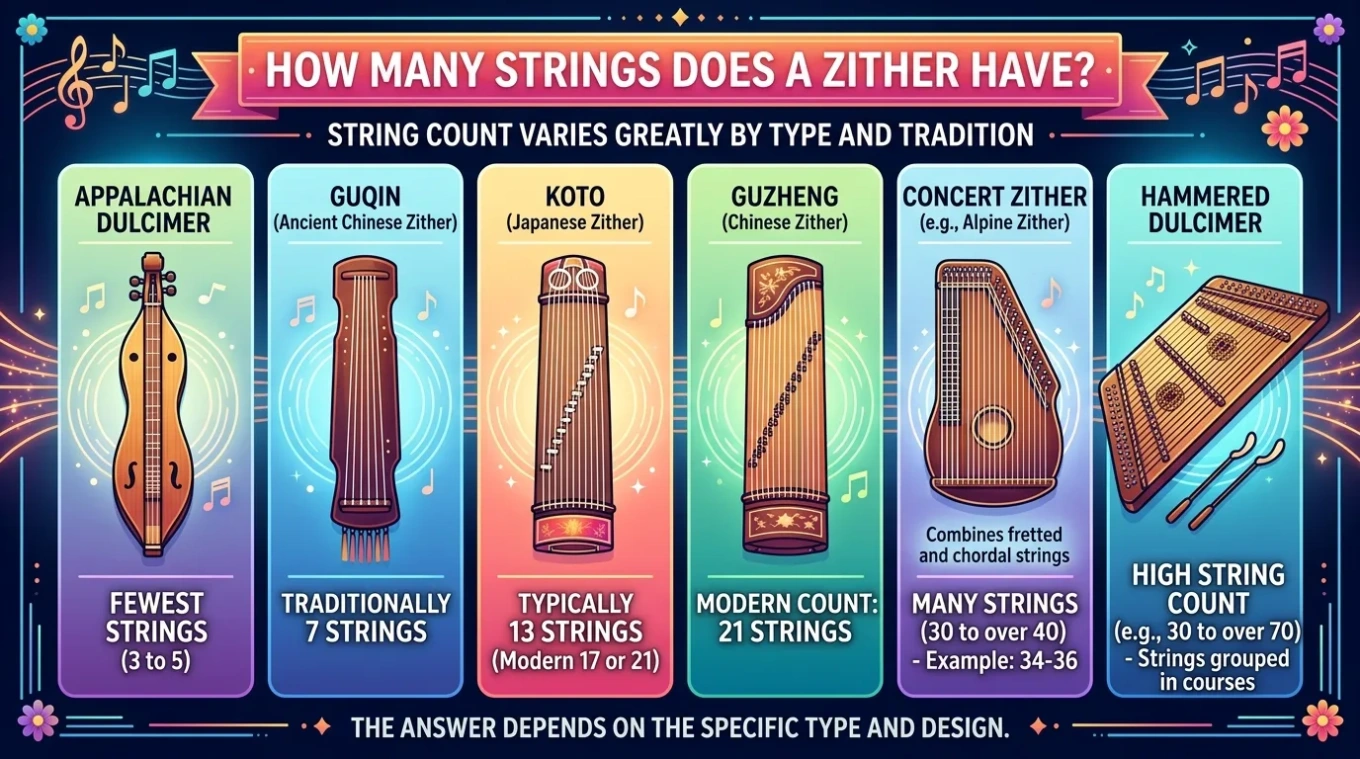
A zither† can have only a few strings, more than forty strings, or even several dozen strings arranged in grouped sets. In the narrow European sense, a concert or Alpine zither usually has about 30 to 40 strings. In the broader instrument-family sense, the answer changes: a guqin has seven strings, a koto commonly has thirteen, a modern guzheng usually has twenty-one, and some hammered or trapezoidal zithers use many more physical strings because several strings may share one pitch.
The best answer is therefore not one number. It is: the string count depends on the zither type, the regional tradition, the tuning system, and whether the instrument counts single strings or grouped courses†.
Classification Note: The word “zither” is used in two ways. It can mean a specific European table zither with fretted melody strings and many open accompaniment strings. It can also mean a wider chordophone† family in which strings run across a body, board, frame, tube, box, or other string-bearing surface without a projecting neck like a guitar or lute.
The Short Answer by Zither Type
For a reader asking about a typical European zither, the practical answer is usually around 30 to 40 strings. Many concert zithers divide those strings into a small melody section and a larger group of open accompaniment, bass, and contrabass strings.
For the wider zither family, the range is much broader. Some instruments are built around a small set of open strings. Others use many strings so the player can reach a wider pitch range without stopping the strings with the left hand.
| Instrument or Type | Typical String Count | How the Count Works |
|---|---|---|
| Concert or Alpine Zither | Usually about 30–40; some examples have 32, 36, 38, or 42 | Several fretted melody strings plus many open accompaniment, bass, and contrabass strings |
| Guqin | 7 | Seven open strings on a fretless Chinese board zither |
| Koto | Commonly 13 | Thirteen strings, each with a movable bridge |
| Modern Guzheng | Usually 21 | Twenty-one strings with individual movable bridges in many modern teaching and concert settings |
| Gayageum | Often 12 in older court and folk forms; modern forms may use more | Strings usually run over movable bridges; count varies by type and repertory |
| Đàn Tranh | Often 16, 17, 19, or 21, depending on form | Vietnamese long zither with movable bridges; modern versions vary |
| Small Kantele | Often 5 to 15 | Open strings on a Baltic-Finnic board or box zither form; concert models may have many more |
| Autoharp | Often around 36 or 37 | Open strings are selectively muted by chord bars |
| Mountain Dulcimer | Usually 3 to 5 | Fretted folk zither with a narrow body and melody/drone string layout |
| Qanun | Often counted by courses; physical strings may be many more | Trapezoidal plucked zither, commonly with multiple strings tuned together for each pitch |
| Santur or Hammered Dulcimer | Varies widely | Many physical strings are often grouped into courses and struck with light hammers |
Why There Is No Single Zither String Count
The number changes because “zither” does not describe one fixed construction. It describes a way of arranging strings in relation to the body of the instrument.
On a lute, such as a guitar or oud, the neck projects from the soundbox. On a zither, the strings usually lie across the body, board, frame, or tube itself. That one design idea can produce very different instruments: a narrow fretted dulcimer, a wide concert zither, a long East Asian board zither, a trapezoidal qanun, or a box-like hammered dulcimer.
Three design choices shape the string count more than the name does:
- Pitch layout: Some zithers give each pitch its own open string. Others let the player stop or press a smaller number of strings to create many notes.
- Bridge system: Fixed bridges, movable bridges†, and grouped courses change how many strings the player needs.
- Musical role: An instrument used for melody and drone may need fewer strings than one built for melody, accompaniment, bass lines, and chordal texture.
This is why a seven-string guqin can be musically demanding, while a thirty-six-string autoharp can be designed for chordal playing with mechanical damping. More strings do not automatically mean a more advanced instrument. They often mean a different playing logic.
How String Count Works on a Concert Zither
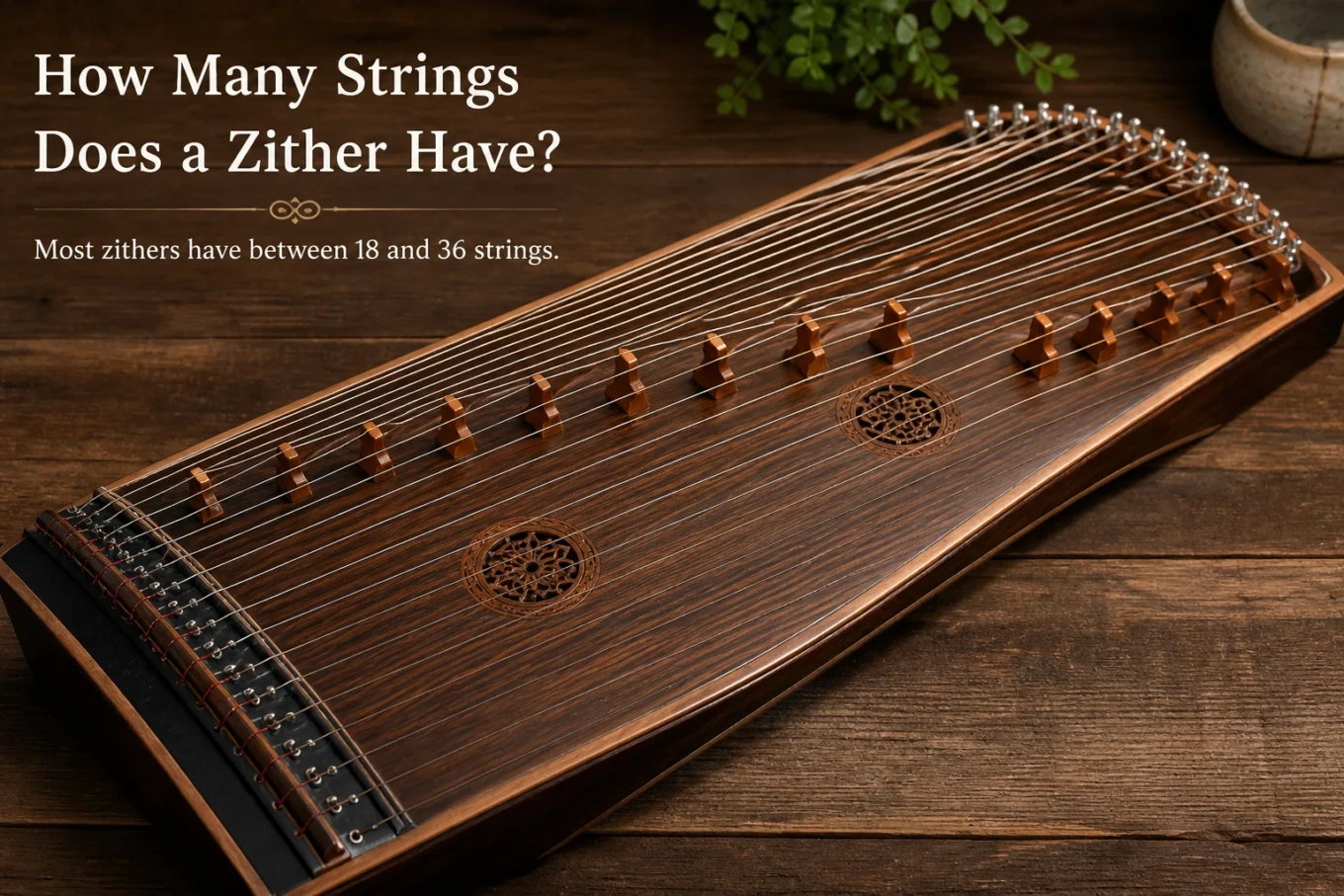
When many people ask, “How many strings does a zither have?”, they are thinking of the European concert zither. This instrument usually sits on a table or the player’s lap, with the strings running across a flat or shallow resonating body†.
A concert zither normally has two main string areas:
- Melody strings: A small group, often five, runs over a fretted fingerboard†. The left hand stops these strings to change pitch.
- Open strings: A larger group provides accompaniment, bass, and sometimes contrabass notes. These are not stopped on a fingerboard during normal playing.
That layout explains why the instrument may have thirty or more strings without being played like a harp. The melody section behaves partly like a fretted instrument. The open strings act more like a built-in harmonic field around it.
Melody Strings and Accompaniment Strings
The melody strings sit nearest the player. They are the most visibly “guitar-like” part of the instrument because they pass over frets. A thumb plectrum† or finger action plucks them while the left hand shapes notes on the fingerboard.
The remaining strings are usually arranged in pitch groups. Some are close to the melody range. Others sit lower and provide bass support. On larger models, additional contrabass strings extend the lower register†.
Luthier’s Note: A higher string count affects more than range. It changes the load on the soundboard†, the spacing between strings, the size of the tuning area, and the way the player visually navigates the instrument. Makers must balance resonance, stability, and playability rather than simply adding more strings.
Why 32, 36, 38, or 42 Strings Can All Be Correct
Concert zither counts vary by model, period, maker, and tuning pattern. A museum catalogue may describe one instrument as having thirty-two strings: five melody strings and twenty-seven accompaniment strings. Another example may have thirty-eight strings, with five melody strings and the rest used for accompaniment and bass functions.
Older references often mention thirty-six, thirty-eight, or forty-two as familiar counts. Modern makers and players may still use related layouts, though exact stringing depends on the instrument’s design and intended repertory.
The safer wording is not “a zither has 36 strings.” It is: many European concert zithers have roughly 30 to 40 strings, with five fretted melody strings on many common models.
String Counts in the Wider Zither Family
The wider zither family contains instruments that look, sound, and function very differently. They are connected by the relationship between strings and body, not by one shared string count.
Seven-String Zithers: The Guqin Example
The guqin is a fretless Chinese board zither with seven strings. Its small string count can mislead beginners because much of the instrument’s range comes from open tones, stopped tones, and harmonics rather than from many separate strings.
Here, seven strings do not mean a narrow musical language. The player changes color and pitch through left-hand pressure, sliding, stopping positions, and harmonic touch points. A guqin is therefore a useful reminder that string count and musical depth are not the same thing.
Thirteen-String Zithers: The Koto Example
The Japanese koto is commonly described with thirteen strings. Each string normally has its own movable bridge, so tuning can be changed by shifting the bridges before performance or between pieces.
The koto’s count is easy to remember, but it should not be treated as a rule for all long zithers. Related East Asian board zithers may use different counts, different bridge shapes, and different tuning habits.
Twenty-One-String Zithers: The Modern Guzheng Example
Modern guzheng instruments usually have twenty-one strings. Many are built with individual movable bridges and a long arched soundboard. The right side of each bridge is commonly plucked, while the left side allows pitch bends, vibrato-like motion, and other expressive changes.
Older zheng-family instruments and regional forms did not all use the same number. The twenty-one-string count is best understood as a widely used modern format, not as a timeless rule for every documented zheng type.
Variable-Count Zithers: Kantele, Gusli, and Related Baltic Forms
Small kanteles may have only a handful of strings, often suited to simple melodies and drones. Larger concert kanteles can have many more strings and may include mechanisms that support wider chromatic playing. Gusli and related regional zithers also vary in shape and count.
This variation is normal. In many local traditions, builders adapted string count to available materials, tuning habits, repertory, and the player’s needs.
Grouped-String Zithers: Qanun, Santur, and Hammered Dulcimer
Some zithers are not best understood by counting pitches one by one. A qanun may use several strings tuned together for a single pitch. A santur or hammered dulcimer may also group strings in courses. The ear hears one pitch group, while the instrument may contain two, three, or four physical strings for that pitch.
This is why a string count on these instruments can sound much higher than the number of playable notes. A player may think in courses, registers, bridge positions, or modal tuning patterns rather than in isolated strings.
Physical Strings and Courses Are Not the Same
A string count can mean two different things: the number of physical strings on the instrument, or the number of courses. A course is a group of strings treated as one musical unit. The strings in a course are often tuned to the same pitch, though some instruments may use octave or other pairings depending on tradition.
This distinction matters most for qanun, santur, hammered dulcimer, psaltery-like instruments, and some historical or regional zithers. A catalogue might count every physical string. A player might describe the instrument by courses or pitches.
Collector’s Note: On old instruments, the string count written in a listing may describe the instrument’s designed layout, not its present condition. Missing strings, replaced tuning pins, altered bridges, or later repairs can make a surviving zither look different from its original setup.
Why More Strings Do Not Always Mean a Harder Instrument
A higher string count can give an instrument a wider range, fuller resonance, or easier access to accompaniment notes. It can also make tuning slower and visual navigation harder. But difficulty depends on the playing system.
An autoharp may have many strings, yet its chord bars mute unwanted strings and simplify harmonic playing. A mountain dulcimer may have only three to five strings, yet the player still needs control of rhythm, drone balance, and intonation. A guqin has seven strings, but its touch, sliding tones, and quiet timbral changes require close attention.
The number of strings describes the instrument’s layout. It does not describe the whole technique.
What the String Count Tells You About the Instrument
String count gives useful clues, but it should be read with other details. A zither with many open strings may be designed for a broad harmonic field. A zither with fewer strings and a fingerboard may rely more on stopping technique. A zither with movable bridges may use bridge placement as part of tuning and tonal design.
Look at these features together:
- Does the instrument have frets? Frets suggest that a few strings may produce many stopped pitches.
- Does each string have a movable bridge? Movable bridges often point to open-string tuning systems and pitch bending on one side of the bridge.
- Are strings grouped in courses? If yes, the physical string count may be much higher than the pitch count.
- Are there chord bars or damping mechanisms? Autoharps and chord zithers use mechanical muting to shape harmony.
- Is the instrument plucked, struck, bowed, or strummed? Playing method affects how many strings are useful and how they are arranged.
How String Count Shapes Sound and Playing Feel
String count affects the instrument’s timbre†, but it is only one part of the sound. Body depth, soundboard wood, string material, bridge pressure, tuning tension, and playing method all matter.
More strings can add shimmer, density, and sympathetic vibration. A wide open-string layout may leave notes ringing around the melody. On a hammered zither, grouped strings can make a struck note sound brighter and more sustained than one single string alone.
Fewer strings can create a more exposed sound. The player may hear every touch more clearly. This is one reason low string-count instruments are not automatically simpler; they often give the player less cover.
Listening Note: When comparing zithers, listen for how long the notes ring after being plucked or struck. A concert zither’s open strings, a guzheng’s bending area, a guqin’s sliding tones, and a santur’s hammered courses all create different kinds of resonance.
How Museums and Makers Usually Describe String Count
Museums often describe zither string count in direct object language: number of strings, materials, dimensions, date, place, maker, and classification. A careful description may say something like “thirty-two strings, five melody strings and twenty-seven accompaniment strings.” That is more useful than a bare number because it explains function.
Makers and teachers may describe the same instrument in playing terms: tuning system, melody section, bass range, chord layout, or bridge setup. Both approaches are valid. A museum record helps identify the object. A teacher’s description helps explain how the player uses it.
For organology†, the most useful description combines both: physical count and musical layout.
What Beginners Should Know Before Choosing by String Count
A beginner should not choose a zither only by asking for the highest number of strings. More strings mean more tuning, more visual orientation, and often a larger instrument. The better question is what kind of music the player wants to learn.
For European concert zither, the melody-and-accompaniment layout matters. For guzheng, the modern twenty-one-string format is common in many learning settings. For koto, thirteen strings are a familiar standard. For autoharp, the chord-bar setup may matter more than the exact count. For mountain dulcimer, three to five strings can be enough for a clear and rewarding start.
String count should guide the choice, not decide it alone.
Common Misunderstandings About Zither String Counts
“A Zither Always Has 36 Strings”
Some zithers have thirty-six strings, but that is not a universal rule. It is more accurate to say that many European concert zithers sit in the 30-to-40-string range.
“Every Zither Is Played the Same Way”
Zithers can be plucked with fingers, played with a thumb plectrum, struck with hammers, strummed, or used with damping bars. The string count often reflects the playing method.
“More Strings Mean a Better Zither”
More strings may offer more range or fuller resonance, but they do not automatically make an instrument better. A well-made seven-string instrument can be more refined than a poorly built instrument with many strings.
“String Count and Pitch Count Are Always Equal”
They are not always equal. On instruments with courses, several physical strings may produce one musical pitch. Counting strings and counting playable pitch groups can give different numbers.
Technical Term Glossary
- Zither
- A stringed instrument type in which strings run across a body, board, frame, tube, or other string-bearing surface. In common European use, the word can also refer more narrowly to the concert or Alpine zither.
- Chordophone
- An instrument that produces sound mainly through vibrating strings. Zithers, lutes, harps, lyres, and bowed string instruments all belong to the wider chordophone category.
- Course
- A set of two or more strings treated as one musical unit. The strings in a course are often tuned together so the player hears one pitch group rather than separate notes.
- Soundboard
- The vibrating top surface of many string instruments. It helps transmit string vibration into the body and shapes the instrument’s resonance.
- Resonating Body
- The body or soundbox that helps amplify and color string vibration. On zithers, the strings often run across or along this body rather than along a separate neck.
- Fretted Fingerboard
- A playing surface with raised frets that help set pitch when a string is stopped. Concert zithers often use a fretted melody section.
- Movable Bridge
- A bridge that can be shifted to adjust string length and tuning. Koto, guzheng, gayageum, and đàn tranh commonly use movable bridges in many forms.
- Plectrum
- A small pick used to pluck strings. Some zither players use a thumb plectrum, fingerpicks, nail picks, or hand-held picks depending on the instrument.
- Register
- A pitch area, such as low, middle, or high. Zithers with many strings may divide their layout into melody, accompaniment, bass, and contrabass registers.
- Timbre
- The tone color of an instrument. Timbre is shaped by string material, body design, bridge placement, playing method, tuning, and resonance.
- Organology
- The study of musical instruments, including their classification, construction, materials, playing methods, and cultural use.
FAQ
How many strings does a standard zither have?
A European concert or Alpine zither often has about 30 to 40 strings. Many examples use a few fretted melody strings and a larger group of open accompaniment, bass, and contrabass strings.
Can a zither have only seven strings?
Yes. The guqin is a seven-string fretless board zither. Its small string count does not make it simple; much of its music depends on touch, stopping positions, slides, and harmonics.
Why do some zithers have more than forty strings?
Some zithers use many open strings to provide range, harmony, bass notes, or grouped courses. On instruments such as qanun, santur, and hammered dulcimer, several physical strings may share one pitch.
Is a koto a type of zither?
Yes. The koto is commonly classified as a Japanese long board zither. It usually has thirteen strings, each supported by a movable bridge.
Are zither strings counted one by one or by courses?
Both methods appear in descriptions. Museum records often count physical strings, while musicians may also describe courses or pitch groups. For instruments with grouped strings, those numbers are not always the same.
How many strings should a beginner zither have?
That depends on the instrument style. A beginner guzheng is often a modern twenty-one-string model, a koto commonly has thirteen strings, a mountain dulcimer may have three to five, and a concert zither usually has many more.