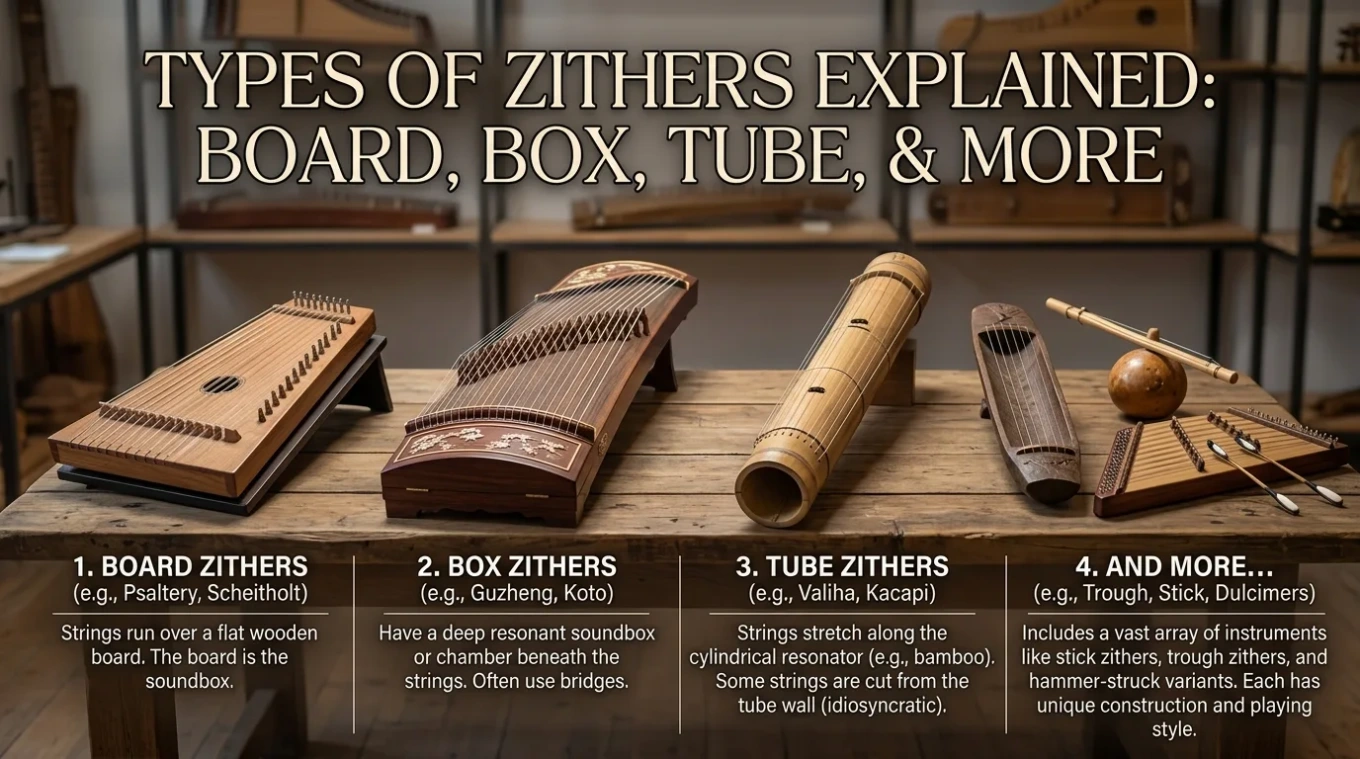
Types of Zithers Explained: Board, Box, Tube, and More
Zither types are not defined by one sound, one region, or one playing style. They are mainly defined by how the strings sit on the body: across a board, over a hollow box, along a bamboo tube, across a trough, or through an open frame. That is why a concert zither, guzheng, koto, kantele, qanun, santur, hammered dulcimer, autoharp, and even some keyboard instruments can appear near each other in organology while still remaining very different instruments.
The word zither has two common meanings. In everyday English, it often points to the European concert zither. In instrument classification, it has a wider meaning: a group of simple chordophones[g1] in which the strings run along, across, or over the main body rather than along a separate neck. This wider use explains why zither types can look so different from one another.
What a Zither Type Really Describes
A zither type describes the string-bearing body[g2]. The question is not only “How is it played?” but “What carries the strings?” A flat board, a hollow box, a bamboo tube, a trough-shaped body, or an open frame can all support strings in different ways.
This is why two instruments can both belong to the zither family while sounding and feeling unrelated. A guqin may be plucked with bare fingers on a long wooden body. A santur may be struck with light hammers. An autoharp may use chord bars. A concert zither may combine fretted melody strings with open accompaniment strings. The family link comes from structure, not from one shared repertoire or one shared technique.
Classification Note: In the Hornbostel–Sachs system, zithers sit under simple chordophones. The broad subgroups include bar zithers, tube zithers, raft zithers, board zithers, trough zithers, and frame zithers. Common terms such as “box zither” often sit inside the wider board-zither branch because the strings are still carried by a board-like surface.
Main Types of Zithers
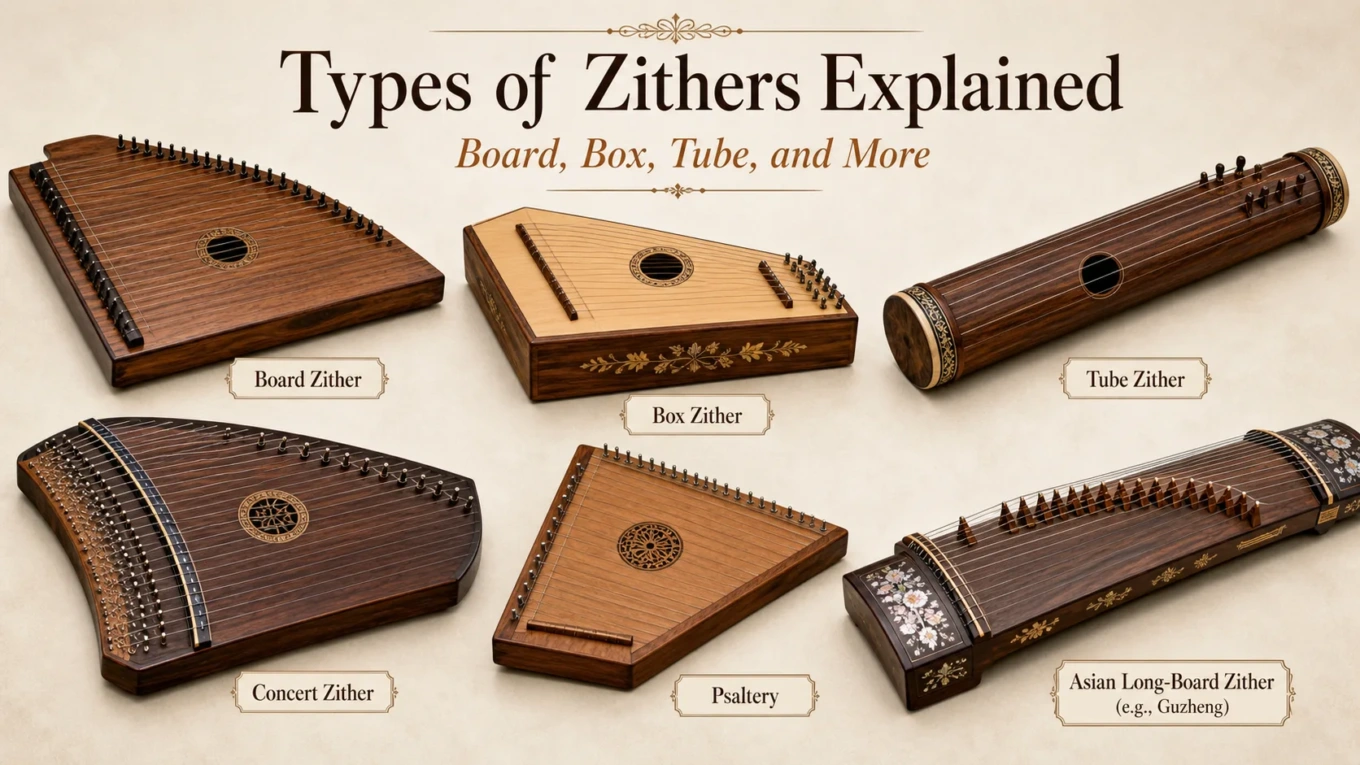
The table below keeps the categories separate without pretending that every instrument fits neatly into one modern English label. Museum records, makers, and musicians may describe the same instrument from different angles: shape, region, playing method, tuning, or local name.
| Zither Type | Body or String Support | Usual Sound Support | Examples and Notes |
|---|---|---|---|
| Board Zither | Strings are carried by a board or board-like body. | The board may be solid, hollowed, or paired with a resonating body. | Includes many long East Asian zithers and several European or northern Eurasian forms, depending on the exact instrument. |
| Box Zither | Strings sit over a hollow box-shaped body. | The box acts as a resonator[g3]. | Concert zither, autoharp, qanun, psaltery, santur, and hammered dulcimer are often discussed in this area, though details vary. |
| Tube Zither | Strings run along a tube or vaulted surface, often bamboo. | The tube itself helps carry and color the sound. | Often associated with bamboo construction, including idiochordic forms in which strings are cut from the same material as the body. |
| Raft Zither | Several canes, rods, or tubes are bound together like a raft. | The bound body supports the strings; extra resonators may be added. | Most often encountered in organology and museum classification rather than beginner instrument lists. |
| Trough Zither | Strings stretch across the opening of a trough-like body. | The trough shape can deepen resonance and shape projection. | Classification depends on construction; some regional instruments may be described this way in collection records. |
| Frame Zither | Strings stretch across an open frame. | The frame carries tension; resonance may come from added parts or the playing setting. | Less familiar to many players, but useful in classification because it separates open-frame construction from boards and boxes. |
| Bar or Stick Zither | A bar, stick, or bow-like carrier holds the string. | Resonance may come from a gourd, mouth cavity, or added chamber. | Musical bows and related forms show why the zither family is wider than flat tabletop instruments. |
Board Zithers
A board zither[g4] uses a board as the main string carrier. The body may be long and narrow, short and wide, flat, slightly arched, hollowed, or paired with a resonating chamber. The shared idea is simple: the strings run over a board-like body rather than along a separate neck.
Many well-known zithers sit close to this category. The guqin is a fretless Chinese board zither with seven strings and pitch markers rather than raised frets. The guzheng, koto, gayageum, and đàn tranh are long zithers with movable bridges in many forms, though their string counts, tunings, body details, and musical traditions are not the same. They should not be treated as copies of one another.
Board zithers also appear in northern and eastern European contexts. The kantele and gusli are often discussed as board or box-related zithers, depending on their body shape and period. Some older forms are small and simple; some modern concert forms are larger, with more strings and more complex construction.
What Makes Board Zithers Distinct
Board zithers usually make the player think in terms of string layout. The hand often moves across a row of parallel strings, and the instrument’s shape guides the player’s reach. On some types, each string may represent one pitch. On others, pressing, bending, stopping, or retuning changes pitch during performance.
The soundboard[g5] matters because it receives energy from the strings and helps spread the sound. Wood choice, thickness, arching, internal structure, and bridge contact can all shape resonance. These effects vary by instrument, maker, and regional design; there is no single “board zither sound.”
Bridge Systems on Board Zithers
Some board zithers use fixed bridges. Others use movable bridges[g6] that support each string and help set pitch. On instruments such as guzheng, koto, gayageum, and đàn tranh, movable bridges are central to setup and playing feel. Small bridge changes can affect tuning, tension, and hand response.
Not every board zither has bridges that move. The guqin uses a very different approach: it has no raised frets, and the player stops or touches strings against the surface to produce open tones, stopped tones, and harmonics. That design places touch, pressure, and surface contact at the center of the instrument’s identity.
Luthier’s Note: A long board zither is not just a plank with strings. The relationship between string tension, board thickness, bridge height, and body cavity can change sustain, brightness, and playing comfort. Good construction balances strength with vibration.
Box Zithers
A box zither[g7] has strings stretched over a hollow box. The box supports the strings and helps amplify them. This group is especially useful for understanding European concert zithers, autoharps, psalteries, qanuns, santurs, and many dulcimer-type instruments, though each has its own structure and playing logic.
In organology, “box zither” often works as a more specific form within board-zither classification. In plain language, it is a helpful term because many players can see the difference at once: the instrument has a closed, hollow, box-like body instead of a simple board, tube, or open frame.
Concert Zither
The European concert zither is one of the clearest examples for English readers because the word “zither” often points to it in everyday use. It usually has melody strings over a fretted fingerboard[g8] and additional open strings for accompaniment. The player may stop the fretted strings with the left hand while plucking with the right hand.
This makes the concert zither different from many fretless board zithers. It does not simply offer one string for one pitch. It combines stopped melody playing with open-string harmony, which gives it a layout closer to a small tabletop chordal instrument than to a long movable-bridge zither.
Autoharp
The autoharp is a box zither with chord bars. When the player presses a bar, felt dampers mute selected strings and leave a chord sounding. The name can mislead beginners because the instrument is not a harp in the strict structural sense. It belongs closer to the zither family because the strings run over the body rather than away from it in a harp frame.
Its playing method also shows why classification and musical use are different questions. A player may strum an autoharp in a song setting, but the body plan remains zither-like.
Qanun, Santur, Psaltery, and Dulcimer-Type Instruments
The qanun is often described as a plucked box zither with many strings arranged in courses. Many modern qanuns use small levers that help alter pitch by small steps. The santur and hammered dulcimer are struck zithers in which light hammers set the strings in motion. The psaltery can refer to several historical and modern plucked or bowed forms, often with a shallow box body.
These names should not be flattened into one type. A qanun, santur, hammered dulcimer, and autoharp may all sit near “box zither” in structure, but they differ in string grouping, tuning habits, playing tools, regional use, and repertoire.
Classification Note: “Dulcimer” is not always a single classification label. A hammered dulcimer is commonly treated as a struck zither. A mountain dulcimer has a fretted fingerboard on a box body and is usually discussed differently. The word depends on context.
Tube Zithers
A tube zither[g9] uses a tube or curved, vaulted surface as the string carrier. Bamboo is common in many documented examples because it naturally offers a hollow tube, a strong surface, and a resonant body in one material.
Tube zithers can be idiochordic[g10], meaning the strings are cut from the same material as the body and lifted slightly from it. Other forms are heterochordic[g11], meaning separate strings are attached to the body. This difference is small in wording but large in construction.
A tube zither does not always project like a box zither. Its sound can be close, dry, bright, or lightly resonant depending on tube size, wall thickness, string material, bridge arrangement, and whether an extra resonator is used. Some are made for local musical settings rather than large rooms.
Why Bamboo Tube Zithers Matter
Bamboo tube zithers help explain how old the zither idea may be as a construction principle. A tube can hold tension, provide a vibrating surface, and form a natural resonating chamber. For a maker, that means the body and string support can come from one piece of material.
Still, it is better not to treat all bamboo zithers as one instrument. Regional forms differ in number of strings, playing position, string preparation, decoration, and musical role. A museum label may identify the structure as a tube zither while the local name carries the musical identity.
Raft Zithers
A raft zither[g12] uses several canes, rods, or tubes bound together. The image is practical: the string bearer is not one solid board or one tube, but a set of pieces tied in a raft-like form.
This type is less familiar to many modern learners because it rarely appears in beginner shop categories. It appears more often in organology, museum records, and regional instrument studies. That does not make it minor; it simply means the English label is a classification term, not usually the musician’s first name for the instrument.
Raft construction changes the way vibration passes through the body. Each cane or rod may respond differently, and the bindings affect how the instrument holds together and vibrates. Extra resonators may be used in some forms, but they are not always part of the basic definition.
Trough Zithers
A trough zither[g13] has strings stretched across the mouth of a trough-like body. The hollowed form can support resonance while keeping the strings over an open cavity.
The term is useful because not every hollow zither is a flat box. A trough shape may be carved, shaped, or assembled in a way that changes the internal air space. That body form can affect how the instrument responds under the hand, though the exact result depends on material, depth, string tension, and playing method.
Some instruments that look box-like at first may be better understood through their open or trough-shaped construction. This is where collection records can be more exact than casual labels.
Frame Zithers
A frame zither[g14] stretches strings across an open frame. It is not the same as a harp just because it has a frame. The structural question is how the strings relate to the carrier and whether the instrument functions as a simple chordophone.
Frame zithers are useful in classification because they mark the point where a zither no longer depends on a board, box, tube, raft, or trough. The frame carries tension while sound support may come from attached parts, the frame itself, or the playing environment.
For most readers, this category matters less for shopping or learning and more for understanding museum labels. It shows that the zither family reaches beyond the familiar flat instruments placed on a table or lap.
Bar and Stick Zithers
Bar and stick zithers can surprise readers because they do not look like the common image of a zither. In this category, the string bearer is a bar, stick, or bow-like structure. A musical bow may belong here in classification because the string is carried by a simple support rather than a necked resonating body.
Resonance may come from a gourd, the player’s mouth, or another added chamber. This makes the category useful for organology, but it should not be confused with the everyday use of “zither” for European tabletop instruments.
Listening Note: Zither type does not predict tone by itself. A struck box zither, a plucked long board zither, and an idiochordic tube zither all use strings, but their attack, sustain, volume, and color can differ sharply.
Playing Method Is Not the Same as Body Type
A zither may be plucked, struck, bowed, strummed, stopped, damped, or played through a keyboard action. These methods describe how the string starts vibrating. They do not replace the body classification.
A plectrum[g15] may pluck a qanun or concert zither. Hammers may strike a santur or hammered dulcimer. A bow may sound certain psaltery or bowed-zither forms. A keyboard may trigger hammers inside a piano. The body may still be classified in zither terms even when the player’s technique looks unrelated.
Plucked Zithers
Plucked zithers include many board and box forms. Players may use bare fingers, fingernails, fingerpicks, rings, or separate plectra. The plucking point can change tone: playing near a bridge often gives a brighter sound, while playing nearer the center of the vibrating length may sound rounder.
Examples include guzheng, koto, gayageum, guqin, đàn tranh, qanun, kantele, gusli, psaltery, autoharp, and concert zither in different ways. The shared action is plucking; the instruments remain distinct.
Struck Zithers
Struck zithers use hammers or beaters. The santur, hammered dulcimer, cimbalom, and yangqin are often discussed in this area. The player does not pull the string; a small hammer transfers energy quickly, giving a clear attack.
Hammer shape, weight, covering, and playing angle matter. A light wooden hammer can give a bright response. A covered hammer may soften the attack. Regional designs differ, so one description should not be forced across every struck zither.
Bowed Zithers
Bowed zithers are less common in general zither discussions, but they exist. In these instruments, a bow sets the string in continuous vibration. Some bowed psalteries and regional bowed zithers show how body type and playing method can cross in unexpected ways.
Because bowing produces sustained tone, the body must handle a different kind of energy than a short pluck or hammer strike. The result depends on string material, bridge angle, bow contact, and resonance.
Frets, Bridges, and Pitch Control
Not every zither has frets. Not every zither has movable bridges. Not every zither is tuned the same way across all regions. These differences shape how the instrument feels under the hands.
Frets allow a player to stop strings at fixed pitch points, as seen on many concert zithers and some dulcimer-related instruments. Movable bridges set string length and pitch on many long East Asian zithers. Open-string zithers may rely on a separate string for each pitch. Some instruments allow pitch bending by pressing the string segment behind a bridge.
These details matter more than the broad family label. Saying “zither” does not tell a beginner whether they will learn fretted fingering, bridge tuning, chord-bar damping, hammer patterns, or open-string plucking.
How Zither Types Differ from Related Instruments
The easiest way to separate a zither from a lute is to look for a neck. A lute-type instrument, such as a guitar, oud, or violin, has strings running along a neck attached to a resonating body. A zither usually has strings running over the body or string carrier itself.
Harp comparison needs care. A harp has strings stretched between a neck and a resonator in a different plane. An autoharp is not a harp in that structural sense, even though its name includes “harp.” A frame zither may have an open frame, but that does not automatically make it a harp.
Dulcimer comparison also depends on the specific dulcimer. A hammered dulcimer is commonly treated as a struck zither. A mountain dulcimer is fretted and has its own playing logic. The word “dulcimer” alone is not enough to classify the instrument safely.
How Museums and Musicians Name Zithers
Museum labels often describe structure. Musicians usually use local or tradition-based names. Both are useful, but they answer different questions.
A museum may group a qanun, autoharp, and hammered dulcimer near box zithers because their strings run over hollow bodies. A musician would not treat them as interchangeable. The qanun has its own tuning devices, playing technique, and repertory setting. The autoharp has chord bars. The hammered dulcimer uses hammers. The label helps with structure, not with full musical identity.
Regional names also carry language history. Guzheng, koto, gayageum, đàn tranh, kantele, gusli, qanun, and santur are not decorative synonyms for “zither.” They name instruments with their own materials, tunings, techniques, and cultural settings.
Materials and Body Shape
Materials can shape sound, but the claim must stay careful. Wood species, bamboo wall thickness, string material, bridge density, and body depth can all affect resonance. So can construction skill, age, climate, setup, and playing touch.
Wooden board and box zithers often depend on a balance between strength and vibration. The body must hold string tension without becoming so stiff that it stops responding. Bamboo tube zithers use a different logic: the natural tube can provide both structure and resonance. Metal strings often bring brightness and sustain, while silk, gut, nylon, or other materials can give a different response depending on the instrument.
Decoration may also tell part of the story. In museum collections, surface finish, carving, lacquer, inlay, painted detail, tuning hardware, and wear patterns can reveal how an instrument was made, handled, repaired, or displayed. Decorative detail should not be confused with sound function, but it can help identify origin, period, or craft tradition.
What Beginners Should Know About Zither Types
A beginner should not choose a zither only by family name. The practical question is more direct: which playing system do you want to learn?
- Choose a concert zither if the goal is fretted melody with open accompaniment strings in a European zither tradition.
- Choose a guzheng, koto, gayageum, or đàn tranh if the goal is a long movable-bridge zither tradition, while recognizing that each one has separate technique and repertoire.
- Choose an autoharp if chord-bar damping and strummed accompaniment are the appeal.
- Choose a hammered dulcimer, santur, cimbalom, or yangqin if struck strings and hammer technique are the focus.
- Choose a kantele or gusli if the interest is in northern or eastern European plucked zither traditions, with attention to the exact form and string layout.
Setup is part of learning. Some zithers need careful bridge placement. Some need many strings tuned one by one. Some use regional tunings that do not match a beginner’s default expectation of Western major and minor scales. Some are simple to start but harder to tune well.
Collector’s Note: For older or handmade zithers, the label “zither” is only a starting point. Check body shape, string count, bridge type, frets, tuning pins, repair marks, and local name before assuming how the instrument was played.
Common Misunderstandings About Zither Types
“All Zithers Are Flat Boxes”
Many familiar zithers are flat or shallow boxes, but the family is wider. Tube, raft, trough, frame, bar, and stick forms show that zither classification is not limited to tabletop instruments.
“Guzheng, Koto, and Gayageum Are the Same Instrument”
They share the broad idea of long plucked zithers with movable bridges in many forms, but they differ in construction, stringing, tuning habits, right-hand and left-hand technique, repertoire, and cultural setting. Treating them as one instrument erases the details that make each one teachable.
“If It Has Hammers, It Is Not a Zither”
Hammered zithers exist. The hammer describes how the string is sounded, not whether the instrument belongs to the zither family. Santur, hammered dulcimer, cimbalom, and yangqin are often discussed as struck zithers.
“Autoharp Means Harp”
The autoharp is structurally closer to a box zither because its strings run across the body. The chord-bar system is its special feature, not a reason to classify it as a harp in the strict structural sense.
How to Read Zither Type Names
Most zither type names become easier when read in layers. Start with the body. Then add the playing method. Then add regional name, tuning, and construction details.
- Body type: board, box, tube, raft, trough, frame, bar, or stick.
- Sounding method: plucked, struck, bowed, strummed, damped, or keyboard-operated.
- Pitch layout: fretted, fretless, movable bridge, fixed bridge, chord-bar, or open-string.
- Regional identity: the local instrument name, language spelling, repertoire, and craft tradition.
- Setup details: string count, tuning pattern, bridge placement, string material, and body size.
This layered reading prevents confusion. A qanun is not just a box zither; it is a plucked, course-strung box zither with its own tuning devices in many modern forms. A concert zither is not just a box zither; it is a fretted and open-string instrument with a specific European playing layout. A guqin is not just a board zither; it is a fretless seven-string instrument with its own touch system and pitch markers.
FAQ
What are the main types of zithers?
The main zither types include board zithers, box zithers, tube zithers, raft zithers, trough zithers, frame zithers, and bar or stick zithers. These categories describe the body or string support, not one shared sound or playing style.
Is a box zither different from a board zither?
Yes, but the terms can overlap in classification. A box zither has strings over a hollow box-shaped body, while a board zither uses a board as the string carrier. In organology, many box zithers are treated as a specific kind of board zither with a resonator box.
Is a piano really a type of zither?
In organology, a piano can be classified near zithers because its strings are stretched across a board-like support and sounded by hammers. In everyday use, it is normally treated as a keyboard instrument rather than called a zither.
Are guzheng, koto, and gayageum the same type of zither?
They are related as long plucked zithers with movable bridges in many forms, but they are not the same instrument. Each has its own construction details, tuning habits, technique, repertoire, and cultural setting.
Do all zithers have frets?
No. Some zithers have frets, some use movable bridges, and some are fully fretless. Concert zithers often use fretted melody strings, while guqin, guzheng, koto, gayageum, and many other zithers follow different pitch systems.
Why do museum labels use names like 314.122?
Numbers such as 314.122 come from instrument classification systems that describe structure. In this case, the number points to a true board zither with a resonator box. The number helps museums group instruments by construction, while the local name explains musical identity.
Technical Glossary
Simple Chordophone
A string instrument in which the main structure is a string or group of strings with a string bearer. In this category, a resonator may be present, but the basic instrument is still understood through the strings and their carrier.
String Bearer
The part of an instrument that physically carries the strings and holds their tension. In zithers, this may be a board, box, tube, raft, trough, frame, bar, or stick-like structure.
Resonator
A body, chamber, tube, box, gourd, or surface that helps reinforce and color the vibration of the strings. A resonator can make the sound louder, fuller, or more shaped, depending on design.
Board Zither
A zither in which the strings are carried by a board or board-like surface. Some board zithers are flat, while others are hollow, arched, or paired with resonating parts.
Soundboard
The vibrating surface that receives energy from the strings and helps project sound. On many wooden zithers, the soundboard is one of the main parts shaping resonance and response.
Movable Bridge
A bridge that can be shifted to change string length, tension relationship, or pitch setup. Many long East Asian zithers use movable bridges, though the exact design differs by instrument.
Box Zither
A zither with strings stretched over a hollow box-shaped body. Concert zithers, autoharps, psalteries, qanuns, santurs, and hammered dulcimers may be discussed near this category depending on construction.
Frets
Raised markers or strips that divide a string’s playing length into pitch positions. Some zithers use frets for stopped melody playing, while many others are fretless.
Tube Zither
A zither in which the string bearer is a tube or vaulted surface. Bamboo tube zithers are well-known examples in organology because the body can support strings and resonance at the same time.
Idiochordic
A construction type in which the strings are made from the same material as the body, often by cutting and lifting strips from bamboo or a similar surface.
Heterochordic
A construction type in which separate strings are attached to the body rather than cut from the body material itself.
Raft Zither
A zither made from several canes, rods, or tubes bound together like a raft. The bound pieces form the string-bearing structure.
Trough Zither
A zither in which the strings stretch across the opening of a trough-like body. The hollowed shape can help support resonance.
Frame Zither
A zither in which the strings stretch across an open frame. It differs from board, box, tube, and trough forms because the carrier is frame-based rather than surface-based.
Plectrum
A small tool used to pluck strings. It may be held in the hand, worn on a finger, or shaped as part of a regional playing technique.