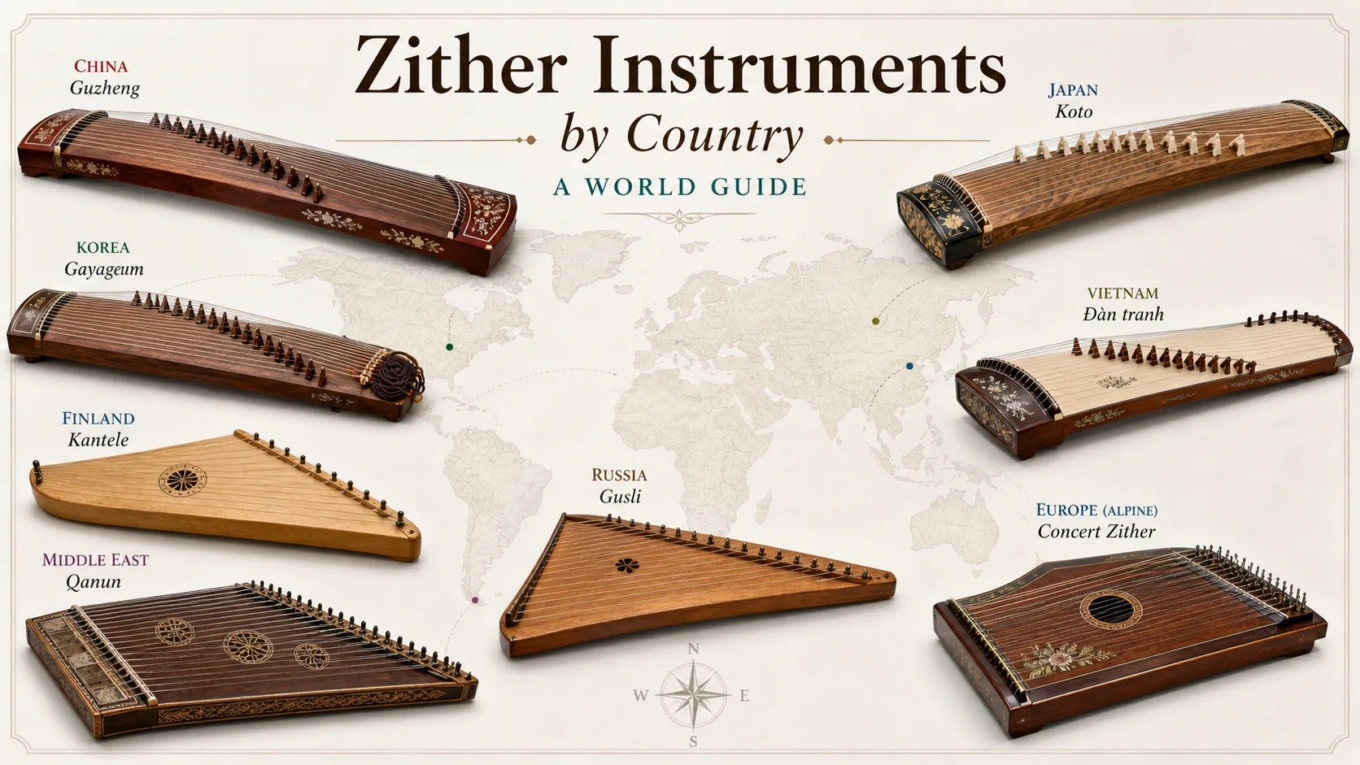
Zither Instruments by Country: A World Guide
A country-based map of zither instruments is useful only when one rule stays clear: zither can mean a narrow European instrument or a much wider organological family of string instruments. In the wider sense, a zither is a chordophone1 in which the strings run across, along, or over the body rather than along a separate neck. That broad idea connects instruments as different as the Austrian concert zither, Chinese guzheng, Japanese koto, Korean gayageum, Finnish kantele, Turkish kanun, Iranian santur, American Appalachian dulcimer, and Madagascan valiha.
Country names help organize the family, but they should not be read as ownership labels. Many zither instruments cross borders, languages, courts, folk traditions, diasporas, and modern teaching systems. A country may be the place where an instrument is strongly associated, carefully preserved, often taught, widely built, or commonly named in museum records.
Zither Instruments by Country: Main Details Worth Knowing
The table below keeps the focus on country association, instrument identity, and playing logic. It does not try to list every local variant. That would turn the topic into a full catalog, and the zither family is too large for a single flat list.
| Country or Region | Zither Instruments Commonly Associated | General Type | Usual Playing Logic |
|---|---|---|---|
| Austria | Concert zither, Alpine zither | Fretted box zither | Melody strings are stopped on a fingerboard; open strings provide harmony and bass. |
| Germany | Concert zither, chord zither, scheitholt-related forms | Box zither and fretted drone-zither traditions | Plucked with fingers, thumb ring, or simple plectrum depending on the form. |
| Switzerland | Alpine zither and related regional zithers | Fretted zither | Used in Alpine and domestic music settings, with regional repertory differences. |
| Finland and Karelia | Kantele | Plucked board or box zither | Small kanteles may have few strings; concert kanteles use larger ranges and more complex tuning systems. |
| Estonia | Kannel | Baltic psaltery-type zither | Plucked, strummed, or arranged for modern ensemble playing. |
| Latvia | Kokle | Baltic plucked zither | Often associated with regional song traditions and modern staged performance. |
| Lithuania | Kanklės | Baltic plucked zither | Played in folk, educational, and modern concert settings. |
| Russia, Ukraine, and Belarus | Gusli and related forms | Wing-shaped, helmet-shaped, or box-like zither forms | Plucked or strummed; form and repertory vary by region and period. |
| Norway | Langeleik | Fretted drone zither | One melody string is stopped; drone strings ring openly. |
| Sweden | Hummel | Fretted drone zither | Related in playing idea to northern European drone zithers. |
| Iceland | Langspil | Long zither, often bowed or plucked | Used in Icelandic folk settings; construction details vary across documented examples. |
| France | Épinette des Vosges | Fretted box zither | Melody strings are stopped while open strings act as drones. |
| Hungary | Cimbalom | Hammered dulcimer-type zither | Strings are struck with beaters; concert models may be large and pedal-equipped. |
| Romania | Țambal | Hammered zither | Used in regional ensemble settings; size and tuning layout vary. |
| China | Guzheng, guqin, yangqin | Plucked board zithers and hammered zither forms | Guzheng uses movable bridges; guqin is fretless with pitch markers; yangqin is struck. |
| Japan | Koto, ichigenkin, taishōgoto | Plucked long zither and related forms | Koto uses movable bridges; modern forms may add strings or mechanical aids. |
| Korea | Gayageum, geomungo, ajaeng | Plucked, fretted, and bowed zither forms | Right hand or stick excites the strings; the left hand often shapes pitch and ornament. |
| Vietnam | Đàn tranh, đàn bầu | Plucked zither and monochord zither | Movable bridges or pitch-bending systems support sliding, bending, and ornament. |
| Mongolia | Yatga | Plucked long zither | Often compared with other East and Central Asian long zithers, while keeping its own repertory. |
| Turkey | Kanun | Trapezoidal plucked zither | Courses of strings are plucked with plectra; small levers allow fast pitch changes. |
| Iran | Santur | Hammered trapezoidal zither | Light hammers strike grouped strings across bridges. |
| Egypt, Syria, Lebanon, Iraq, and Nearby Arab Traditions | Qanun | Trapezoidal plucked zither | Used in art-music ensembles; pitch levers support modal movement. |
| Greece | Kanonaki, santouri | Plucked and hammered zither forms | Names and usage overlap with Eastern Mediterranean traditions. |
| India | Santoor, swarmandal | Hammered and plucked zither forms | Santoor is struck with light mallets; swarmandal is often used for shimmering accompaniment. |
| Indonesia | Kacapi, siter, celempung, sasando | Board, box, and tube zither forms | Plucked instruments appear in several regional music systems. |
| Philippines | Kolitong and other bamboo tube zithers | Tube zither | Strings may be cut from, or attached to, a bamboo body depending on the form. |
| Madagascar | Valiha | Bamboo tube zither | Strings run around a cylindrical body and are plucked with the fingers. |
| United States | Appalachian dulcimer, hammered dulcimer, autoharp | Fretted, hammered, and chorded box zither forms | Used in folk, home, teaching, and modern acoustic settings. |
Classification Note: A country list works best when it treats each instrument as a local tradition, not as a copy of one “standard zither.” The body shape, bridge system, stringing, tuning, and playing position can change the instrument’s musical behavior as much as its name does.
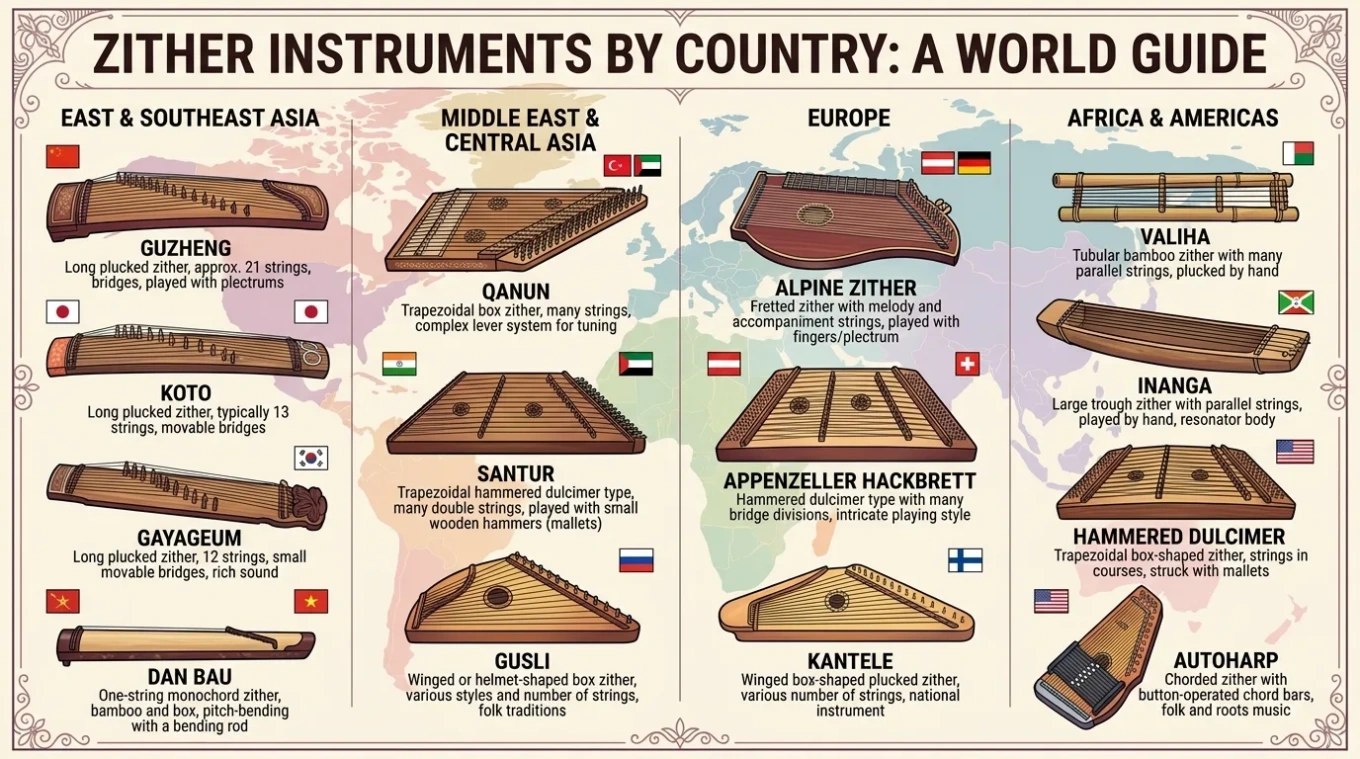
How to Read a Country-Based Zither Map
In everyday English, zither often points to the European concert zither. In organology, it can also mean a much wider group called simple zithers2. These are instruments where the string bearer and the resonating structure are not separated into a long neck and body in the way a guitar, lute, or violin is built.
This is why a guzheng, koto, gayageum, kantele, gusli, qanun, santur, and Appalachian dulcimer can sit under the same broad family name while sounding, looking, and functioning very differently.
A careful country guide has to answer three questions at the same time:
- Which instrument name is commonly tied to the country?
- Which zither type does the instrument belong to in construction terms?
- How does the player actually make music on it?
The last question matters most. A plucked long zither with movable bridges does not behave like a fretted drone zither. A hammered dulcimer-type instrument does not behave like a kanun with pitch levers. A tube zither carved from bamboo does not behave like a European concert zither with a fingerboard and accompaniment strings.
European Countries and Their Zither Traditions
Europe holds several zither lines that are easy to confuse: the concert zither, fretted drone zithers, Baltic psaltery-type instruments, gusli forms, hammered dulcimers, and chord zithers. They share the broad family idea, yet they do not share one shape or one playing system.
Austria, Germany, and Switzerland: Concert and Alpine Zithers
The concert zither is the instrument many English speakers picture when they hear the word zither in a narrow sense. It is strongly associated with Austria, southern Germany, Switzerland, and neighboring Alpine regions. It usually has a flat resonating body, melody strings over a fretted fingerboard, and many open accompaniment and bass strings.
The player normally places the instrument on a table or lap. The left hand stops the fretted melody strings, while the right hand plucks both melody and open strings. Some players use a thumb ring or other plectrum aids. The result is not simply “strumming a box.” It is a split system: stopped melody on one side, open harmony and bass on the other.
The Alpine zither may include extended bass ranges or body shapes that support longer strings. Historic and regional models differ, so one description cannot cover every surviving instrument. Still, the core idea remains clear: a European fretted box zither with a strong table-playing tradition.
Luthier’s Note: On concert zithers, the soundboard3 must support many strings while still responding to light plucking. Wood choice, thickness, bracing, bridge pressure, and age can all shape the response, but no single wood guarantees one fixed tone.
France, Norway, Sweden, and Iceland: Fretted Drone-Zither Lines
Several northern and western European instruments use a more direct playing plan: one or more melody strings are stopped against frets, while other strings ring as open drones. France has the épinette des Vosges. Norway has the langeleik. Sweden has the hummel. Iceland has the langspil, which may be plucked or bowed depending on the form and documented practice.
These instruments help show why “zither” is not only a shape word. It can also describe a playing layout. The instrument may look long and narrow, the music may rely on a drone bed, and the melody may move along a fretted path. That makes it very different from the qanun or guzheng, even though the broad family name can still apply.
Finland, Estonia, Latvia, and Lithuania: Baltic Psaltery-Type Zithers
The Finnish kantele, Estonian kannel, Latvian kokle, and Lithuanian kanklės are often discussed together because they belong to a northern and Baltic family of plucked zithers. They are not one instrument under four names, though. Each has its own language context, shape history, repertory, and modern teaching path.
Small traditional forms may have a limited number of strings and a direct plucking style. Modern concert versions may have larger ranges, mechanisms, or more developed stage repertory. In many examples, the body acts as a resonating body4, and the player shapes texture through plucking, damping, and chord patterns.
Russia, Ukraine, and Belarus: Gusli Families
Gusli is a broad name rather than a single fixed blueprint. Museum and historical descriptions may refer to wing-shaped, helmet-shaped, trough-like, or box-like forms. Some are held against the body, some sit on a surface, and some later versions use keyboard-like mechanisms.
For country-based reading, gusli is best understood as an East Slavic zither family with many regional forms. A short label such as “Russian zither” can help a beginner, but it hides the real variety of shapes and playing positions.
Hungary, Romania, Slovakia, and Neighboring Areas: Cimbalom and Țambal
The cimbalom and related names such as țambal belong to the hammered dulcimer side of the zither family. The player strikes the strings with small beaters rather than plucking them. Large concert cimbaloms can have a heavy frame, wide range, and pedal damping; smaller folk instruments may be more portable.
This is an area where country labels overlap. Similar hammered-zither traditions appear across Central and Eastern Europe, often under related names. The safest way to describe them is by region, construction, and use, rather than by claiming one single national form.
East Asian Zither Instruments by Country
East Asia has some of the best-known long zither traditions. The guzheng, koto, gayageum, geomungo, guqin, and đàn tranh are often grouped visually because many have long bodies and strings running over the top. That visual link is useful, but it can also mislead. Bridge systems, string counts, playing gestures, tone ideals, and repertory differ sharply.
China: Guzheng, Guqin, and Yangqin
China is associated with several major zither forms. The guzheng is a plucked long zither with a curved top and movable bridges5. Modern guzheng instruments often have 21 strings, but historical string counts changed over time. The bridges set speaking length and tuning, while the player’s left hand can press strings to bend pitch or create ornaments.
The guqin is a different Chinese zither. It is usually described as a seven-string fretless board zither. It does not use movable bridges in the guzheng manner. Instead, the player uses surface markers and left-hand technique to produce stopped tones, slides, and harmonics.
The yangqin is a hammered zither now used in many Chinese musical settings. It belongs closer to the struck zither or hammered dulcimer side of the family. It should not be confused with the plucked guzheng simply because both may be translated with “zither.”
Japan: Koto and Related Zither Forms
The koto is Japan’s best-known plucked long zither. The standard historical image is a long wooden body, often paulownia, with movable bridges called ji. The familiar form has 13 strings, though modern koto practice also includes larger instruments such as 17-string bass koto and other expanded designs.
Koto playing depends on bridge placement, plucking technique, and left-hand pressure. The player may tune by moving the bridges, then shape the pitch after plucking. That is why the koto is not simply “a Japanese guzheng.” It shares a broad long-zither idea but belongs to its own musical language.
Japan also has other zither-related forms such as ichigenkin, a one-string zither, and taishōgoto, a modern keyed zither. These belong to different historical and performance settings, so they should not be folded into the koto name.
Korea: Gayageum, Geomungo, and Ajaeng
Korea has several important zither instruments. The gayageum is a plucked zither with movable bridges. Traditional forms are often described with 12 strings, while modern versions may use expanded string counts. A player plucks with one hand and shapes pitch with the other, creating bends, vibrato-like movement, and expressive ornaments.
The geomungo has a different construction and playing feel. It uses frets or raised supports for part of its playing area and is commonly played with a short bamboo stick. The ajaeng is a bowed zither; its sound comes from drawing a bow-like stick across strings rather than from ordinary plucking.
These three Korean instruments show how one country can hold more than one zither logic: plucked movable-bridge zither, fretted zither, and bowed zither.
Vietnam: Đàn Tranh and Đàn Bầu
The Vietnamese đàn tranh is a plucked zither with movable bridges. It is often compared with guzheng, koto, and gayageum because of its long body and bridge layout, but the comparison should stay limited. Vietnamese tuning practice, ornament, repertory, and touch give the instrument its own identity.
The đàn bầu is a one-string instrument often described as a monochord zither. It uses a flexible pitch-control system that allows wide bending and vocal-like movement. It does not look or behave like a multi-string board zither, yet it belongs in a country guide because it shows another way a zither can be built around string, body, and controlled resonance.
Mongolia: Yatga
The yatga is a Mongolian plucked long zither. It is often placed near the East and Central Asian long zither group because of its shape and bridge system. Modern yatga instruments may use different string counts and performance formats, especially in staged, conservatory, or ensemble settings.
A careful description should not treat yatga as merely a local name for guzheng. Shared family features do not erase regional playing style, repertoire, decoration, or instrument-making choices.
Southeast Asian and Island Zither Traditions
Southeast Asia adds another layer to the country map because the region includes board zithers, box zithers, tube zithers, and crocodile-shaped zithers. Some are tied to court or ensemble traditions. Others are linked to bamboo craft and local performance settings.
Indonesia: Kacapi, Siter, Celempung, and Sasando
Indonesia has several zither-associated instruments. The kacapi is closely tied to Sundanese music and appears in boat-shaped or box-like forms. The siter and celempung appear in Javanese gamelan-related settings and are plucked zithers with strings running over a resonant body.
The sasando, associated with Rote Island, is often described as a tube zither with a distinctive palm-leaf resonator arrangement. It does not follow the flat board-zither layout seen in koto or guzheng. Its country association belongs to Indonesia, but its local identity is more specific than the country name alone can show.
Philippines: Bamboo Tube Zithers
Several Philippine traditions include bamboo tube zithers, often associated with highland and regional communities. Names and construction vary by language and area. One often cited example is kolitong or related spellings, though terminology should be handled with care because local names can change across communities.
In some bamboo tube zithers, strings may be cut from the bamboo body itself; in others, separate string material may be used. This brings up the difference between idiochord6 and added-string construction. The instrument’s material is not only decorative. It shapes how the strings, body, and resonator act together.
Thailand, Cambodia, and Myanmar: Crocodile and Floor-Zither Forms
Mainland Southeast Asia includes several long floor zithers that may be shaped or named in relation to crocodiles. Thailand has the chakhe or jakhe. Cambodia has related krapeu or takhe forms. Myanmar has the mi gyaung, often described as a crocodile-shaped zither.
These instruments may have raised frets, plucked strings, and a body that sits horizontally for performance. They are not the same as guzheng or koto, even if English descriptions sometimes place them under the zither label.
Madagascar: Valiha
The valiha of Madagascar is one of the clearest examples of a tube zither. Its strings run around a cylindrical bamboo body, and the player plucks with the fingers. Older and local forms may use material from the bamboo itself, while other examples may use metal strings or later materials.
Valiha belongs in a world country guide because it breaks the common beginner assumption that a zither must be flat, rectangular, and table-played. A tube zither can be just as much a zither as a concert zither or board zither.
Middle Eastern, North African, and Eastern Mediterranean Zithers
The qanun or kanun family is one of the most important plucked zither lines in Turkey, Arab art music, and nearby Eastern Mediterranean traditions. The santur or santouri family belongs to the hammered side. Names move across languages, and spelling changes are common.
Turkey: Kanun
The Turkish kanun is a trapezoidal plucked zither. Its strings are arranged in grouped courses7, and the player usually plucks with plectra attached to the index fingers. Small levers, often called mandals8, allow pitch changes during performance.
This lever system matters because Turkish art music needs flexible pitch handling. The kanun can support modal movement without forcing the player to retune the whole instrument between every musical turn. The exact number of strings and levers can vary by maker, period, and modern design.
Egypt, Syria, Lebanon, Iraq, and Nearby Arab Traditions: Qanun
The Arabic qanun is closely related to the Turkish kanun in broad construction: a trapezoidal body, grouped strings, plucked performance, and small pitch-adjusting devices. It appears in many Arab ensemble settings, where it can outline melody, support singers, and move through modal patterns.
The word maqam9 is often needed here, but it should not be reduced to “scale.” A maqam includes pitch material, characteristic melodic movement, and ornament. The qanun’s construction helps it serve that musical language.
Iran: Santur
The Iranian santur is a hammered trapezoidal zither. Instead of plucking the strings, the player strikes them with light hammers. Bridges divide and organize the string layout, and groups of strings may sound together as one pitch.
Although santur is often translated as “hammered dulcimer,” that English label can be too broad. It helps explain the sound-production method, but it does not carry the full Iranian musical setting, tuning habits, or repertory attached to the instrument.
Greece and the Eastern Mediterranean: Kanonaki and Santouri
Greek traditions include kanonaki, a plucked qanun-type zither, and santouri, a hammered zither. These names show how instrument families travel through language zones. The same broad zither shapes can appear in different repertories, tuning habits, and ensemble roles.
For readers, the safest distinction is simple: kanonaki belongs to the plucked trapezoidal zither side; santouri belongs to the hammered zither side.
Central Asian and South Asian Zither Instruments
Central and South Asia include hammered zithers, plucked zithers, and revived or regional instruments whose names may vary in transliteration. It is better to describe the instrument’s construction and use than to rely on one spelling.
India: Santoor and Swarmandal
In India, the santoor is especially associated with Kashmir and with later classical performance settings. It is a hammered zither: the player strikes the strings with light mallets, and the sound is bright, fast, and bell-like.
The swarmandal is a plucked zither often used by vocalists for shimmering support. It is not played like a santoor. Its role is closer to color, pitch reference, and resonant accompaniment than to hammered melodic display.
Kazakhstan, Kyrgyzstan, and Nearby Traditions: Jetigen and Related Names
In parts of Central Asia, instruments called jetigen, zhetygen, or related spellings are associated with zither traditions. Some modern versions appear through revival, stage performance, or educational work. Because names, reconstructions, and regional claims can differ, careful wording is needed.
The useful country-guide point is that Central Asian zithers should not be skipped just because better-known East Asian and European instruments dominate search results. They show how zither identity can be carried through story, revival, and regional performance as well as through old surviving instruments.
American Zither-Related Instruments
The United States is not usually the first country a beginner connects with the word zither, yet several American instruments sit comfortably inside the wider family. Some came through European roots and changed in local settings. Others became linked to home music, teaching, or folk revival contexts.
United States: Appalachian Dulcimer
The Appalachian dulcimer, also called mountain dulcimer, is a fretted zither. It usually has a long, narrow body and a diatonic fret pattern, though modern instruments may add extra frets. A player may strum across the strings while stopping a melody string, or use more chordal and fingerstyle methods.
The instrument is called a dulcimer, but it is not the same as the hammered dulcimer. This is one of the common naming traps in zither research.
United States and Canada: Hammered Dulcimer
The hammered dulcimer10 is a struck zither. Strings run over a resonant body and bridges, and the player strikes them with small hammers. Similar hammered-zither principles appear in many regions, but American hammered dulcimer traditions developed their own repertory and instrument-making lines.
In a country guide, this instrument belongs beside cimbalom, santur, yangqin, and santouri only at the broad family level. Each has different tuning layouts, repertory, and performance practice.
United States: Autoharp
The autoharp is a chorded box zither. It has many strings and a set of chord bars that mute unwanted notes when pressed. This makes it different from a plain chord zither, because the mechanism shapes which strings ring.
It is often associated with home music, folk song accompaniment, and American vernacular performance. Organologically, it fits the zither family because the strings run across the body rather than along a separate neck.
Construction Types That Explain the Country Differences
Country names are easy to remember, but construction tells the real story. Most zither instruments in this world guide can be grouped by how their strings relate to the body and how the player changes pitch.
| Construction Type | How It Works | Country Examples |
|---|---|---|
| Board zither | Strings run across or along a board-like body. The body may be flat, curved, hollowed, or box-like. | China: guzheng and guqin; Japan: koto; Korea: gayageum; Finland: kantele. |
| Box zither | The body includes a resonant box under the strings. | Austria and Germany: concert zither; United States: autoharp; Russia and nearby areas: some gusli forms. |
| Tube zither | The string bearer is a cylindrical or tube-like body, often bamboo. | Madagascar: valiha; Philippines: bamboo tube zithers; Indonesia: some sasando descriptions. |
| Fretted drone zither | One or more melody strings are stopped on frets, while open strings act as drones. | Norway: langeleik; France: épinette des Vosges; United States: Appalachian dulcimer. |
| Hammered zither | Strings are struck with small hammers or beaters. | Iran: santur; Hungary: cimbalom; China: yangqin; United States: hammered dulcimer. |
| Plucked trapezoidal zither | A flat trapezoidal body carries grouped strings, often with pitch-adjusting levers. | Turkey: kanun; Arab traditions: qanun; Greece: kanonaki. |
The terms board zither11, box zither12, and tube zither13 are useful because they describe construction without forcing different traditions into one cultural story.
How Bridges, Frets, and Drones Change the Instrument
Two countries may both have “zithers,” but their instruments may solve pitch in completely different ways. This is why a country guide should include bridge and fret information whenever possible.
Movable Bridges
Movable bridges appear on instruments such as guzheng, koto, gayageum, đàn tranh, and many related long zithers. A bridge supports each string and helps set the speaking length. Moving the bridge changes tuning; pressing the string on the other side of the bridge can bend pitch after plucking.
This construction makes the instrument highly responsive to left-hand motion. The sound is not only the plucked note. It includes bends, slides, pressure ornaments, and damping.
Frets
Frets14 appear on instruments such as the concert zither, langeleik, Appalachian dulcimer, and some crocodile-shaped Southeast Asian zithers. Frets give fixed pitch points under a melody string or string group. This makes them useful for clear melodies, drones, and repeated patterns.
Frets do not make the instrument less subtle. A player can still shape rhythm, damping, attack, and ornament. But the pitch system feels different from a bridge-bending instrument such as the koto or gayageum.
Drones
Drone strings15 are open strings that ring without being stopped for each melody note. They are common in many fretted European and American zither-related instruments. Drones can support a mode, create a pedal tone, or give the music a stable ringing base.
Drone use is one reason the Appalachian dulcimer, langeleik, hummel, and épinette des Vosges feel different from the guzheng or qanun, even though the broad zither label can apply.
Plucked, Struck, Bowed, and Keyed Zithers
A zither is not always plucked with bare fingers. The method used to excite the strings changes the instrument’s sound and role.
- Plucked zithers include guzheng, koto, gayageum, kantele, qanun, kanun, đàn tranh, and autoharp.
- Struck zithers include santur, cimbalom, yangqin, hammered dulcimer, and santouri.
- Bowed zithers include instruments such as Korean ajaeng and some less common bowed zither forms.
- Keyed or chorded zithers include autoharp and taishōgoto-type instruments, where a mechanism helps select pitch or harmony.
The plectrum16 can also define the playing feel. A qanun player’s finger plectra, a koto player’s picks, and a concert zither player’s thumb ring all create different attacks and different hand positions.
Why Country Lists Often Disagree
Country-based zither lists often disagree because they mix several kinds of evidence. One list may follow museum geography. Another may follow living performance. Another may follow language family. Another may follow instrument construction alone.
Disagreement also comes from translation. The same instrument may be labeled “zither,” “psaltery,” “dulcimer,” “kanun,” “qanun,” “long zither,” “board zither,” or “chordophone” depending on the cataloging habit. Some labels describe shape. Others describe playing method. Others are local names.
There is also a difference between country association and origin. The qanun, for example, appears across Turkey, Arab music traditions, Greece, and nearby regions. A country guide can show where it is used and named, but it should not turn that into a narrow ownership claim.
Collector’s Note: A label such as “Chinese zither,” “Turkish zither,” or “Finnish zither” may be useful on a sales tag, but it is not enough for identification. Body shape, string path, bridge type, tuning hardware, playing wear, decoration, and local name all matter.
Country Groups That Beginners Commonly Mix Up
Guzheng, Koto, Gayageum, and Đàn Tranh
These instruments are often grouped because they are long plucked zithers with movable bridges. That grouping is useful at the family level. It becomes inaccurate when it suggests that they are the same instrument in different countries.
The guzheng, koto, gayageum, and đàn tranh differ in construction details, hand technique, string materials, repertory, notation habits, and ornament. A beginner can compare their outline, but a player must learn each one on its own terms.
Kanun, Qanun, and Kanonaki
Kanun, qanun, and kanonaki point to closely related plucked trapezoidal zithers across Turkish, Arabic, Greek, and neighboring music settings. Spellings shift by language. Lever systems, tuning choices, and repertory differ by tradition and maker.
The shared shape should not hide local musical language. The instrument may look similar across countries, but its modal use, ensemble role, and teaching tradition can vary.
Santur, Santoor, Santouri, Cimbalom, and Hammered Dulcimer
These instruments share a struck-string idea: hammers or beaters set strings into motion. The family resemblance is real. The details are not interchangeable.
A Persian santur, Indian santoor, Greek santouri, Hungarian cimbalom, Chinese yangqin, and American hammered dulcimer may all be described as hammered zithers or hammered dulcimer-type instruments. Still, tuning layout, bridge pattern, hammer shape, tone ideal, and music setting can differ strongly.
Kantele, Kannel, Kokle, and Kanklės
These northern and Baltic names are closely related in broad instrument type, but they belong to different languages and traditions. Modern concert instruments can look more standardized than older local forms, which may cause confusion.
When comparing them, it is better to ask about region, string count, body shape, tuning method, repertory, and performance setting rather than treating the names as simple translations.
What to Listen For across Countries
The timbre17 of a zither instrument depends on more than country. It comes from string material, body shape, bridge pressure, plucking or striking tool, damping, and performance style.
Still, some listening clues are useful:
- Movable-bridge long zithers often allow clear pitch bends after the string is plucked.
- Hammered zithers often produce fast attacks and shimmering decay.
- Fretted drone zithers often keep a stable ringing base under the melody.
- Trapezoidal qanun-type instruments often have bright, crisp plucked attacks and flexible pitch adjustment.
- Tube zithers often have a more intimate relationship between string, body material, and hand position.
These are tendencies, not fixed rules. A skilled player, a different tuning, or a modern instrument design can change the result.
How Museums and Musicians Describe Zithers by Country
Museums often use classification labels such as “chordophone-zither,” “board zither,” “box zither,” or “tube zither.” Musicians usually use local instrument names first: koto, guzheng, kantele, kanun, santur, gayageum, or dulcimer. Both approaches are useful.
The museum label explains structure. The musician’s name explains tradition. A good country guide needs both.
For example, “Japanese chordophone-zither-plucked-long zither” may help catalog a koto. But the word koto carries playing technique, repertory, material memory, and social use. The same is true for kantele in Finland, qanun in Arab music, kanun in Turkey, santur in Iran, and Appalachian dulcimer in the United States.
What Beginners Should Know before Choosing a Country Tradition
A beginner should not pick a zither only by country name. The playing system matters more. A person who wants chordal song accompaniment may enjoy autoharp or Appalachian dulcimer. A person drawn to pitch bending and ornament may prefer guzheng, koto, gayageum, or đàn tranh. A player who likes struck strings may look toward santur, santoor, yangqin, cimbalom, or hammered dulcimer.
Access also matters. Teachers, string supply, tuning tools, replacement bridges, and reliable instruments can be easier to find for some traditions than others. Rare or regional zithers may need more patient research and care.
For collecting, the most useful questions are practical:
- What is the local or maker-given name?
- Does the body match a known regional form?
- Are the strings, bridges, pegs, levers, or frets complete?
- Is the instrument playable, decorative, or a damaged museum-style object?
- Does the label describe the country, the culture, the family type, or only a seller’s guess?
These questions keep the focus on evidence rather than vague country labels.
Mini FAQ
What countries have zither instruments?
Many countries have zither instruments or zither-related traditions. Well-known examples include Austria, Germany, Finland, Estonia, Latvia, Lithuania, Russia, China, Japan, Korea, Vietnam, Turkey, Iran, India, Indonesia, Madagascar, and the United States.
Is zither one instrument or a family of instruments?
Zither can mean one narrow European instrument, especially the concert zither, or a wider family of chordophones where the strings run across or along the body rather than along a separate neck.
Is guzheng the same as koto or gayageum?
No. Guzheng, koto, and gayageum are related long zithers with movable bridges, but they belong to different country traditions, playing techniques, repertories, and construction habits.
Are hammered dulcimers part of the zither family?
In broad organological classification, hammered dulcimers are often treated as struck zithers because their strings run over a resonant body and are sounded with small hammers.
Which countries are most associated with the concert zither?
The concert zither is strongly associated with Austria, southern Germany, Switzerland, and nearby Alpine or Central European regions, though instruments and repertory have also traveled through migration and modern teaching.
Why do zither country lists disagree?
They disagree because some lists follow local names, some follow museum classification, some follow modern performance, and some follow broad construction type. A careful list has to separate country association from strict origin claims.
Technical Term Glossary
1. Chordophone
A musical instrument that produces sound mainly through vibrating strings. Zithers, lutes, harps, lyres, violins, and guitars are all chordophones, though they use different construction plans.
2. Simple Zither
A broad organological category for instruments where the strings are stretched across, along, or over a string bearer without a separate neck acting like a lute or guitar neck.
3. Soundboard
The vibrating surface of an instrument body that helps transmit string energy into audible sound. In many zithers, the soundboard is part of the main body under the strings.
4. Resonating Body
The part of an instrument that helps amplify and color the string vibration. It may be a box, board, tube, trough, or other body form depending on the zither type.
5. Movable Bridge
A bridge that can be shifted to alter string length and tuning. Guzheng, koto, gayageum, and đàn tranh are well-known movable-bridge zithers.
6. Idiochord
A construction term for instruments whose strings are cut from the same material as the body, often seen in some bamboo tube-zither traditions. Separate added strings are not idiochord.
7. Course
A group of strings treated as one musical pitch or unit. Qanun and kanun instruments often use grouped strings in courses rather than one single string per pitch.
8. Mandal
A small pitch lever used on Turkish kanun instruments. Mandals let the player adjust pitch quickly during performance without fully retuning the instrument.
9. Maqam
A melodic mode system used in several Middle Eastern and nearby music traditions. A maqam includes pitch material, melodic behavior, and characteristic ornaments, not only a scale.
10. Hammered Dulcimer
A struck zither with strings stretched across a resonant body and sounded with small hammers. Related hammered-zither instruments include santur, santoor, cimbalom, yangqin, and santouri.
11. Board Zither
A zither whose strings are supported by a board-like body. Some board zithers are hollowed or box-like, while others have flatter or more curved surfaces.
12. Box Zither
A zither with a resonant box body under the strings. Concert zithers, autoharps, and some gusli or dulcimer forms may be described this way depending on construction.
13. Tube Zither
A zither whose string-bearing body is tube-like, often cylindrical bamboo. The Madagascan valiha is a widely known example.
14. Fret
A raised marker or strip that gives a stopped string a fixed pitch point. Frets appear on instruments such as concert zither, Appalachian dulcimer, langeleik, and some Southeast Asian floor zithers.
15. Drone String
An open string that rings as a steady pitch while the melody moves elsewhere. Drone strings are common in several European and American fretted zither traditions.
16. Plectrum
A small pick used to pluck strings. It may be handheld, worn on the finger, or shaped for a particular tradition, such as koto picks or qanun finger plectra.
17. Timbre
The tone color of a sound. In zithers, timbre is shaped by string material, body design, bridge pressure, plucking or striking method, damping, and playing technique.