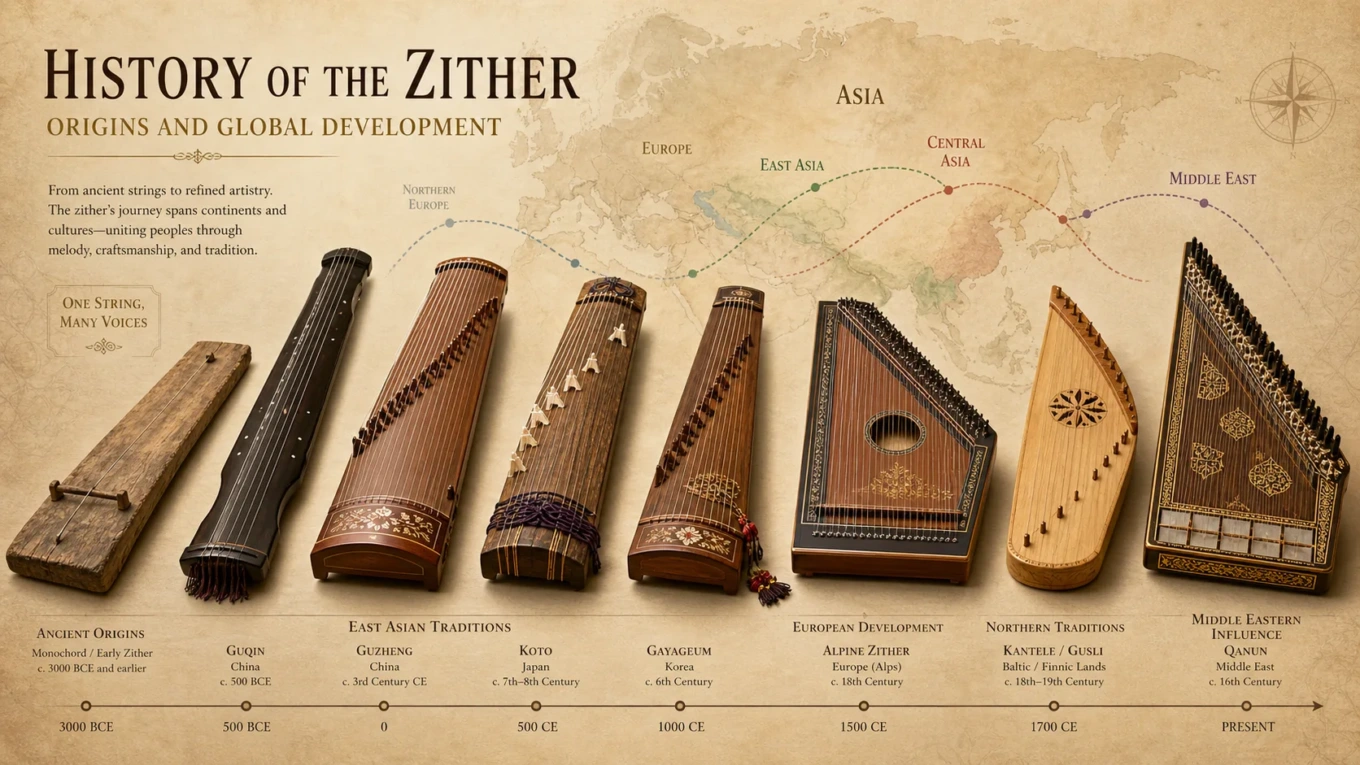
History of the Zither: Origins and Global Development
The history of the zither does not begin with one inventor, one country, or one neat family tree. It begins with a simple musical idea: stretch strings across a resonating surface, let the body carry the vibration, and shape pitch by tuning, stopping, bridging, plucking, striking, or bowing the strings. That idea appears in many places, and it produced instruments as different as the Chinese guqin, the Japanese koto, the Central European concert zither, the qanun, the santur, the kantele, the gusli, the autoharp, and several tube and board zithers from regional craft traditions.
The word zither can cause confusion because it has two main uses. In a narrow sense, it often means the Central European concert zither with a shallow wooden sound box, fretted melody strings, and open accompaniment strings. In a wider organological sense, it refers to a broad group of simple chordophonessimple chordophone in which the strings run along, across, or over the body rather than away from it on a neck.
That wider use is the better starting point for history. It explains why instruments with very different sounds can still be described as zithers in museum catalogs, instrument classification systems, and musicological writing. A hammered dulcimer, a guzheng, and a concert zither are not the same instrument. They share a structural principle: the string-bearing body is part of the instrument’s sounding design.
The history of the zither is therefore not a straight line. It is a set of related solutions developed across East Asia, Central and Western Asia, Europe, the Indian Ocean region, and several folk and domestic music settings. Some forms became court or classical instruments. Others remained closely tied to household music, storytelling, dance, ritual, or local craft.
Why the Zither Has No Single Origin Story
A zither is easier to define by structure than by one place of birth. A maker can create a basic zither by stretching a string over a board, a hollow tube, a box, a trough, or a frame. This is why zither-like instruments appear in many cultures without needing one shared ancestor.
The oldest surviving examples are unevenly distributed because wood, fiber, gut, silk, and early string materials often decay. Archaeology preserves some traditions better than others. Written references also favor literate courts and archives, not every local instrument that may have existed in village, household, or seasonal music.
Among the earliest well-documented long zithers are Chinese qin and se-type instruments from early elite tomb contexts, including finds dated to the 5th century BCE. These do not prove that all zithers came from China. They show that complex board zithers were already developed in early East Asian musical life.
Other regions developed their own zither forms with different materials and playing logic. Bamboo tube zithers, box zithers, trough zithers, psalteries, dulcimers, qanun-family instruments, santur-family instruments, and Alpine concert zithers all belong to this wider story, but they should not be flattened into one “ancient zither” type.
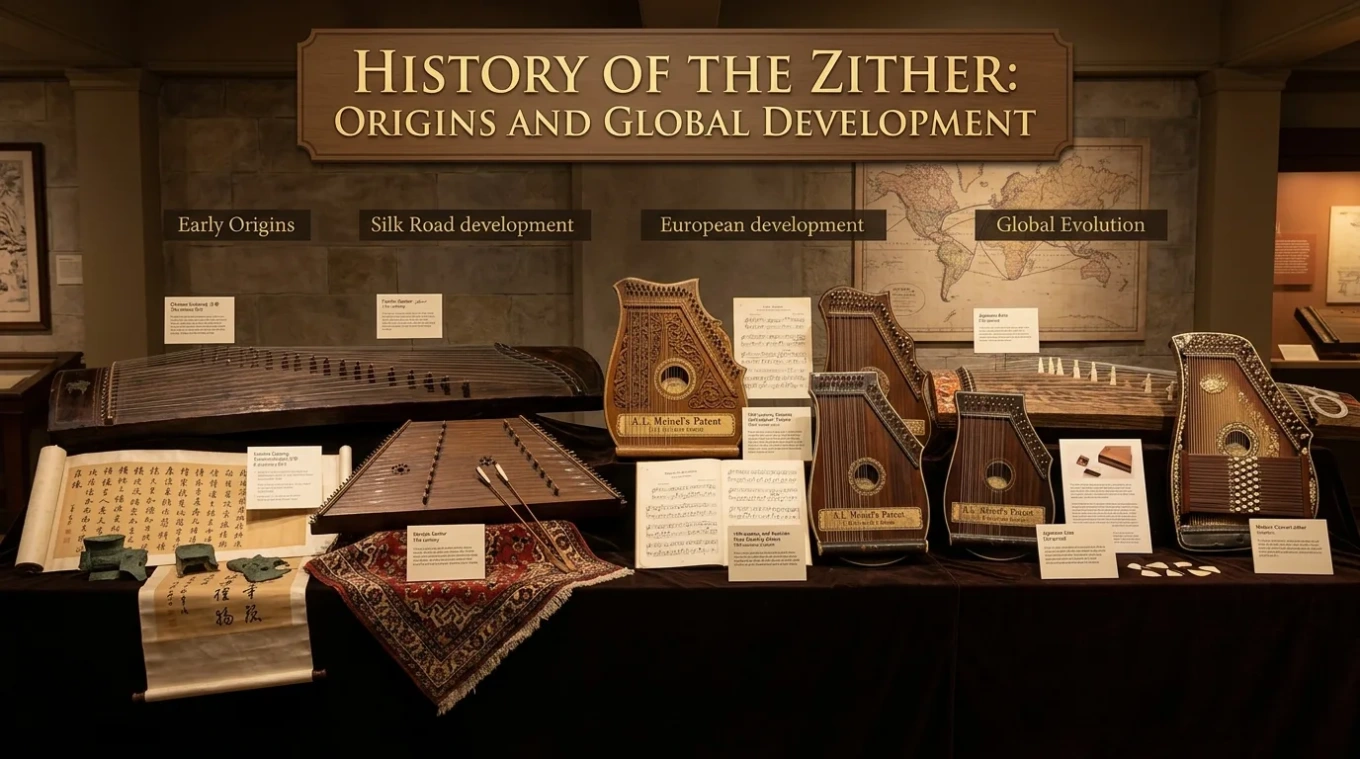
The Core Historical Idea
The earliest zither idea was probably practical: a stretched string needs a support, and a resonating bodyresonating body helps make that string audible. Once makers discovered how the body, string length, tension, and bridge placement changed sound, the family could develop in many directions.
Some makers added more strings. Some added bridges. Some used movable bridgesmovable bridges to set scale patterns. Some stopped the strings with fingers. Some struck the strings with light hammers. Others added chord bars, frets, or mechanical devices. Each change gave the instrument a new role.
Main Historical Lines of Development
The zither family developed through several structural lines rather than one universal model. The table below shows the main historical patterns without treating them as a strict timeline.
| Development Line | Common Structure | Historical Direction |
|---|---|---|
| Tube Zithers | Strings run along a hollow tube, often bamboo or a similar resonant material. | Often tied to local craft traditions where the body and string support come from the same natural form. |
| Board Zithers | Strings stretch over a flat or slightly curved board. | Developed into long zithers such as guqin, koto, guzheng-related forms, kantele, and gusli-type instruments. |
| Box Zithers | A hollow box supports the strings and amplifies vibration. | Led to many plucked and struck forms, including psaltery, dulcimer, santur, and some European domestic zithers. |
| Trough Zithers | The body has a hollowed or trough-like form. | Shows how carving and resonance design shaped regional instrument making. |
| Frame Zithers | Strings are held by a frame rather than a full box body. | Often cataloged separately when the frame, not a box or board, is the main string support. |
| Fretted Concert Zithers | A shallow sound box combines fretted melody strings and open accompaniment strings. | Grew strongly in Central European folk, salon, and concert settings during the 19th century. |
| Chord Zithers and Autoharps | Open strings are paired with chord bars or labeled chord groups. | Became useful for domestic accompaniment and amateur music making in the 19th and 20th centuries. |
This variety is the reason zither history needs careful language. A museum may place two instruments under the same broad zither heading even when one is plucked with fingerpicks, another is struck with hammers, and another uses frets for melodic stopping.
Classification Note: In organologyorganology, “zither” is not only a name for one European instrument. It can also describe a structural class of string instruments. The musical identity of each instrument still depends on its region, repertory, tuning, materials, and playing method.
Early East Asian Zithers and Long-Board Design
East Asia gives some of the clearest early evidence for refined long-board zithers. Chinese qin and se-type instruments show that makers were already using long wooden bodies, carefully placed strings, and controlled resonance more than two thousand years ago. These instruments were not simple folk toys; they belonged to learned, ritual, court, and later literati settings.
The guqin is especially useful for understanding how a zither can become a highly specialized art instrument. It is a fretless long zitherfretless played with the fingers. Its sound depends on open strings, stopped tones, sliding gestures, and harmonics. Later standard guqin forms use seven strings, though early excavated instruments show that string counts and shapes changed across time.
The Chinese zheng family developed along a different path. Its later relatives and neighboring long zithers, such as the Japanese koto, Korean gayageum, and Vietnamese đàn tranh, are known for movable bridges, plucked strings, and scale patterns set by bridge placement and tuning. These instruments share a long zither profile, but each tradition has its own repertory, touch, ornament, and sound ideal.
The Japanese koto, for example, is often described as a long zither with movable bridges. It is not simply a copy of another instrument in modern use; it has its own schools, tunings, repertories, and performance etiquette. The Korean gayageum and Vietnamese đàn tranh also show how a related structural idea can become culturally distinct.
What Changed in East Asian Zither Design
Several changes shaped East Asian zither history. Makers adjusted body length, wood thickness, string material, bridge height, string count, and playing posture. Silk strings were historically important in some traditions, while modern instruments may use metal, nylon, or composite strings depending on the instrument and regional practice.
Movable bridges also changed the musical logic. A bridge is not only a support. It can divide string length, help set pitch, and affect how the string transfers vibration into the body. In many long zithers, the player can press or bend the string on one side of the bridge to change pitch color, ornament, or vibrato.
Listening Note: In many long zithers, the most expressive sound does not come only from the plucked note. It also comes from after-touch: bending, sliding, damping, and letting the soundboardsoundboard release the vibration in a controlled way.
Tube, Raft, and Local Zither Forms
Not every zither history starts with a flat board. In several regions, makers used bamboo or cane-like materials as both body and string support. A tube zithertube zither may use the hollow tube as the resonator, while strings run along its length. Some instruments use separate strings; others are linked to older idiochord principles, where the string material is raised from the body itself.
The Malagasy valiha is often discussed as a tube zither. It shows how a cylindrical body can produce a bright, ringing sound when strings are arranged around or along the tube. Similar design logic appears in other local traditions, though the names, tunings, playing positions, and social uses vary.
These instruments matter because they prevent a narrow reading of zither history. The family was not only shaped by courts, written theory, or European salon music. It also grew through practical craft, available plants and woods, regional tuning habits, and music learned by ear.
Zithers in Central and Western Asian Traditions
Box zithers became highly developed in Central and Western Asian musical settings. Two names often appear in this area of zither history: qanun and santur. They are related through broad zither classification, but their playing methods are different.
The qanun is usually a plucked trapezoidal box zither. It is commonly played with plectraplectra attached to or held by the fingers. Many modern qanuns use small levers or mandal systems to adjust pitch during performance. These details allow the instrument to support modal music with fine pitch control.
The santur, by contrast, is a struck box zither. The player uses light hammers to set the strings in motion. Related hammered zither traditions appear across several regions under names such as santur, santoor, yangqin, cimbalom, and hammered dulcimer, but these names should not be treated as interchangeable. Shape, string courses, tuning, hammer design, and repertory can differ greatly.
Historically, these instruments show another path in zither development: more strings, grouped courses, wider pitch range, and a move toward ensemble use. A plucked zither can articulate melody with crisp detail. A struck zither can create shimmering repeated tones and fast patterns. The same family principle leads to different musical behavior.
European Psalteries, Dulcimers, and Domestic Zithers
European zither history includes psalteries, dulcimers, drone zithers, chord zithers, and the later concert zither. The word “psaltery” is often used for plucked box or board instruments with strings stretched across a soundboard. The word “dulcimer” can refer to different instruments depending on region; some are struck, while some are fretted and played on the lap.
This is where naming becomes tricky. A hammered dulcimer can be classified as a zither because its strings stretch over a resonating box. A mountain dulcimer can also be placed near zither discussion because it is a fretted box instrument played flat, although regional language may call it a dulcimer rather than a zither. The label depends on whether the speaker is using local instrument names or structural classification.
European drone zithers and related folk instruments often used a few melody strings and several drone stringsdrone strings. This made them suitable for dance tunes, song accompaniment, and home music. Their forms varied by region, maker, and available material.
The Rise of the Concert Zither
The Central European concert zither became more defined in the 19th century, especially in Alpine and urban musical settings connected with Austria and southern Germany. It combined a shallow wooden sound box with fretted melody strings and a larger group of open accompaniment strings. This made it different from many fretless board zithers and from hammered zithers.
The player usually stops the fretted melody strings with the left hand while the right hand plucks melody and accompaniment. A thumb ring or plectrum may be used for the melody strings, while other fingers handle accompaniment patterns. This playing logic gives the concert zither a hybrid feel: part melody instrument, part self-accompaniment instrument.
Concert zithers were made in many shapes and string layouts. Some have roughly 30 to 40 or more strings, but the exact number depends on maker, model, period, and playing tradition. This variation matters. A single string count should not be treated as the definition of the instrument.
Luthier’s Note: On a concert zither, the fretted section and open-string field place different demands on the sound box. The body must support clear melody attack, ringing accompaniment, stable tuning pins, and enough resonance without becoming muddy.
The Zither in the 19th and 20th Centuries
The 19th century brought wider production of European zithers, chord zithers, and related domestic instruments. Printed music, home entertainment, music shops, and instrument factories helped spread them beyond local makers. Some instruments were designed for trained players. Others were made for simpler chordal accompaniment.
The autoharp belongs to this later story. It is often described as a chord zither because its strings are mounted over a body and chord bars mute unwanted strings. Pressing a chord bar allows selected strings to ring when strummed. This is different from a concert zither, where melody and accompaniment are played through direct string selection rather than a chord-bar mechanism.
The 20th century also changed how listeners met zither sounds. Recordings, radio, film, education, and museum collections moved regional instruments into wider public hearing. The concert zither gained a memorable international association through Anton Karas’s music for The Third Man in 1949, while Asian long zithers, hammered zithers, and autoharps reached new audiences through concerts, recordings, and teaching communities.
Modern use is not one trend. Some musicians preserve older repertories. Some adapt instruments for new compositions. Some builders use modern strings and tuning hardware. Museums preserve historical examples, while players keep living techniques active outside display cases.
How Materials Shaped Zither Development
Material choice shaped zither history, but not in a magical or fixed way. Wood species, body thickness, string material, bridge design, and finishing methods can all affect response. Still, sound also depends on construction quality, tuning, player touch, room acoustics, and musical style.
Wooden boards and boxes allowed makers to control resonance more carefully than a plain stick or frame. A thin soundboard can respond quickly, but it also needs enough strength to hold string tension. Thicker bodies can offer stability, though they may respond differently under the hand. Regional makers solved this balance in different ways.
String materials also changed the family. Silk, gut, brass, iron, steel, nylon, and composite strings each bring a different feel and sound. Many historic instruments now survive with replacement strings, so museum examples do not always show the exact sound a player would have heard when the instrument was new.
Bridge Systems and Pitch Control
Bridgesbridges are one of the main reasons zither types diverged. A fixed bridge can anchor a stable layout. A movable bridge can set scale length and allow retuning by placement. A row of bridges can divide courses in hammered zithers. A bridge can also shape how vibration reaches the body.
Fretsfrets created another path. The concert zither and some dulcimer-like forms use fretted melody strings, which allow the player to stop pitch with more fixed reference points. Fretless zithers depend more on string placement, finger pressure, bridges, and listening skill.
How Museums Describe Zithers
Museum catalogs often use layered names. An object may be called “zither” in the title, “chordophone” in the classification, and “plucked long zither” or “bowed zither” in a more detailed field. This is not random. It helps separate the object’s local name from its structural type and playing method.
A guqin may be cataloged as a plucked long zither. A Japanese koto may also be cataloged as a plucked long zither. A bowed zither will be marked differently because the sound is started by bowing. A hammered dulcimer or santur-like object may sit in a struck zither category. These labels help researchers compare instruments without erasing local names.
For readers, the best approach is to keep two labels in mind. The first is the instrument’s cultural or regional name: guqin, koto, qanun, kantele, gusli, santur, autoharp, concert zither. The second is the structural description: board zither, box zither, tube zither, plucked zither, struck zither, fretted zither, or long zither.
Where Related Instruments Differ
Zither history is full of relatives that look similar from a distance but behave differently in the hands. The guzheng and koto both use movable bridges and long bodies, yet their repertories, playing gestures, and modern instrument setups are not the same. The qanun and santur may both be box zithers, but one is typically plucked and the other struck.
The concert zither and autoharp are also often confused. Both can have many strings over a shallow body. The concert zither uses fretted melody strings and open accompaniment strings. The autoharp uses chord bars that mute selected strings, making chordal accompaniment easier for many players.
The dulcimer comparison needs similar care. A hammered dulcimer is a struck box zither in structural terms. A mountain dulcimer is usually fretted and played flat, with a different musical layout. Both may appear near zither discussions, but they do not share one playing method.
What the Zither Family Shows About Instrument History
The zither family shows how one structural idea can produce many musical identities. A string stretched over a resonating support can become a quiet literati instrument, a bright dance accompaniment, a hammered ensemble instrument, a salon instrument, a teaching instrument, or a museum object with complex regional meaning.
Its global development also shows why instrument history needs both craft detail and cultural care. Body shape, string material, bridge design, and tuning tell part of the story. Local names, playing settings, teaching lineages, and repertory tell the rest.
The most accurate way to read zither history is not to ask which instrument is “the real zither.” It is better to ask what kind of zither is being discussed, how its strings are supported, how sound is produced, and how musicians have used it in a particular place.
FAQ
Did the zither start in one country?
No. The zither is better understood as a family of related string instruments rather than a single invention from one country. Several regions developed zither-like instruments using boards, boxes, tubes, troughs, or frames as string supports.
What is the oldest known zither?
Some of the earliest well-documented surviving long zithers come from early Chinese archaeological contexts, including qin and se-type instruments dated to the 5th century BCE. This does not mean every zither descends from those instruments.
How did Asian long zithers differ from European concert zithers?
Many Asian long zithers, such as guzheng, koto, gayageum, and đàn tranh, use movable bridges and are played mainly as plucked long zithers. The European concert zither usually combines fretted melody strings with open accompaniment strings on a shallow box body.
Why do museums classify many different instruments as zithers?
Museums often use “zither” as a structural classification. If the strings run along or across the body rather than on a separate neck, the instrument may be cataloged as a zither even when its local name and playing style are very different.
Did dulcimers and psalteries develop from the same zither idea?
They are related through broad zither design because their strings are stretched over a resonating body. A psaltery is usually plucked, while many dulcimers are struck or fretted depending on regional type.
Is the modern concert zither the original zither?
No. The concert zither is one later European branch of the wider zither family. It became especially visible in Central European music, but zither-like instruments existed in many forms long before the modern concert zither took shape.
Technical Term Glossary
Simple Chordophone
A string instrument in which the body or string bearer supports the strings directly. In this sense, many zithers are simple chordophones because the strings do not depend on a separate neck in the way a lute, guitar, or violin does.
Resonating Body
The part of an instrument that helps amplify and color string vibration. In many zithers, this may be a wooden box, board, tube, trough, or frame-based structure.
Movable Bridge
A bridge that can be repositioned to change string length, pitch, or scale layout. Movable bridges are central to many long zithers, including several East Asian types.
Organology
The study of musical instruments, including their structure, classification, materials, history, playing methods, and cultural use.
Fretless
A design without fixed frets under the strings. Fretless zithers rely on open strings, stopping, sliding, bridge placement, or tuning rather than fixed fret positions.
Soundboard
A resonant surface that receives vibration from the strings and helps project sound. On many zithers, the soundboard is also part of the visible upper body.
Tube Zither
A zither type in which the strings run along a hollow tube-like body, often made from bamboo or a similar natural material. The tube acts as both support and resonator.
Plectrum
A small pick used to pluck strings. Some instruments use hand-held plectra, while others use finger-mounted plectra or thumb rings.
Drone String
A string tuned to provide a repeating or sustained pitch under a melody. Drone strings are common in several folk zither and dulcimer-related traditions.
Bridge
A support that holds a string at a set height and helps transfer vibration into the body. Bridges may be fixed, movable, individual, grouped, low, tall, plain, or shaped depending on the instrument.
Fret
A raised marker or strip that gives the player fixed pitch positions when a string is pressed down. Frets are central to the melody section of many concert zithers.