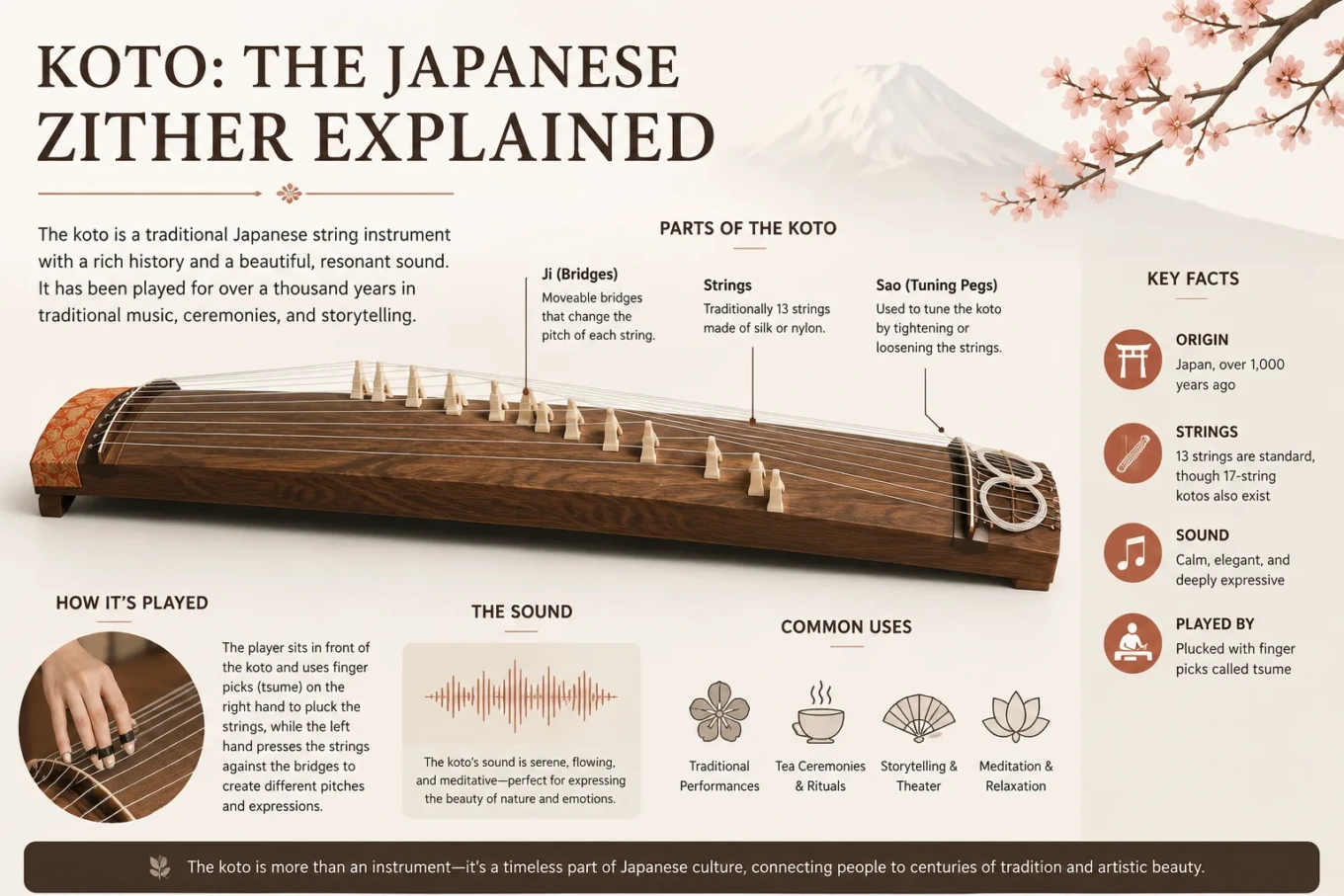
Koto: The Japanese Zither Explained
The koto is a Japanese plucked zither[1] with a long wooden body, movable bridges, and strings that run along the length of the instrument rather than away from the player like a harp. Its best-known form has thirteen strings, but modern and regional forms can use other string counts, different materials, and altered playing setups. What makes the koto especially clear as a zither-family instrument is not only its shape, but its playing logic: each string sounds from the body itself, and the bridge position helps decide pitch, tension feel, and tonal color.
What Is a Koto?
The koto is a Japanese chordophone[2] usually classified as a long board zither[3]. The player places it horizontally, plucks the strings with finger picks, and changes pitch or expression by pressing, bending, or damping the strings with the other hand.
In everyday English, “koto” usually means the Japanese thirteen-string plucked zither used in classical, ensemble, and modern repertories. In Japanese music history, however, the word can be broader. Older naming can distinguish the sō no koto, the long zither now commonly meant by “koto,” from other stringed instruments that once shared related naming habits.
Classification Note: The koto is not a harp, lute, dulcimer, or guitar. Its strings run over a resonating wooden body, and the body supports the vibrating strings directly. That is why organologists place it within the zither family, while still treating it as a distinct Japanese instrument rather than a generic “Asian zither.”
| Feature | Typical Description |
|---|---|
| Instrument family | Plucked zither within the chordophone family |
| Best-known form | Long Japanese thirteen-string koto |
| Body | Long hollow wooden body, often associated with paulownia in traditional making |
| Pitch system | Strings are tuned by movable bridges and adjusted by hand pressure during playing |
| Playing tools | Finger picks worn on the right hand in many classical styles |
| Sound character | Clear attack, ringing decay, flexible pitch bends, and a dry-to-bright wooden resonance |
Why the Koto Is a Zither
A zither is defined by the relationship between strings and body. The strings are stretched across, over, or along a body that supports their vibration. On the koto, the player does not hold a neck, stop strings against a fingerboard, or change pitch by shortening a string with frets. Instead, each string has its own sounding length, shaped by a movable bridge[4].
This separates the koto from necked lutes such as the shamisen, from bowed instruments such as the violin, and from harps, where the strings rise from the resonator in a different structural layout. The koto belongs more closely beside instruments such as the guzheng, gayageum, đàn tranh, and other East Asian long zithers, although each of those has its own construction, repertory, posture, tuning habits, and cultural setting.
Names, Spelling, and Historical Use
The English spelling “koto” is a romanized form of a Japanese word. In older or more technical writing, the instrument may be identified more specifically as sō or sō no koto, especially when writers need to separate it from other Japanese string instruments. For general readers, “koto” is usually clear enough, but museum labels and musicology texts may use more exact wording.
The koto is often connected with court music, classical chamber music, teaching lineages, and later modern concert works. It has also moved into contemporary ensembles, film music, cross-cultural projects, and solo performance. Those newer settings do not erase its older identity; they show how flexible the instrument can be when makers, players, and composers adapt it with care.
Historical claims about the koto should be handled with precision. The instrument is commonly linked to earlier continental zither models, especially Chinese zheng-type instruments, but the Japanese koto developed its own body form, bridge setup, repertory, playing technique, and aesthetic language over time. A koto should not be described simply as a Japanese copy of another instrument.
Body Shape and Construction
The koto has a long, slightly arched body that acts as both frame and resonating chamber. In many traditional examples, the body is made from paulownia, a light wood valued for its low weight and acoustic response. Wood choice can shape resonance[5], but the final sound also depends on thickness, hollowing, bridge placement, string material, and the player’s touch.
The upper surface functions as the soundboard[6]. It receives string vibration through the bridges and spreads that vibration across the body. The underside usually includes sound openings, and the inner cavity helps the instrument speak with more depth than a solid plank could offer.
Many koto descriptions use poetic body-part names, sometimes comparing parts of the instrument to a dragon. These terms can appear in teaching and instrument-making contexts. They are useful for orientation, but they should not be confused with mechanical parts in the Western lutherie sense. The acoustic work still comes from wood, strings, bridge pressure, and air movement inside the body.
Materials Commonly Associated with the Koto
Traditional koto making is closely linked with wood selection, drying, carving, and surface finishing. Paulownia is widely associated with the instrument because it is light, workable, and responsive. Some modern or student instruments may use different construction choices, especially when cost, durability, or transport matters.
- Body wood: often paulownia in traditional and higher-grade examples.
- Strings: historically silk strings[7]; many modern instruments use synthetic strings.
- Bridges: traditionally separate pieces placed under each string; modern bridge materials vary.
- Finger picks: worn on the thumb, index finger, and middle finger in many playing styles.
Luthier’s Note: A koto’s tone should not be reduced to one material claim. Wood species matters, but so do drying, carving, bridge fit, string tension, and how firmly the bridges transfer vibration to the body.
Strings, Bridges, and Tuning Logic
The most familiar koto has thirteen strings, each passing over its own bridge. These bridges can be moved along the body to tune the string. Moving a bridge changes the string’s sounding length and tension relationship, which changes pitch. This is one reason the koto can be retuned for different pieces without changing the body itself.
The bridge is not just a tuning tool. It also affects touch and tone. A bridge that sits securely allows cleaner transfer of vibration. A bridge placed too near an extreme point of the string can make the pitch awkward, the tension uncomfortable, or the tone less balanced. Skilled players and teachers adjust bridge placement with both pitch and feel in mind.
Unlike fretted zithers, the standard koto does not use fixed frets. Its pitch layout comes from bridge placement and string tuning. During performance, the left hand can press the string on the far side of the bridge to create pitch bends, ornaments, and expressive inflections.
Common Tuning Ideas
Koto tuning is not one fixed system. Pieces may use named tunings such as hira-jōshi or other modal arrangements depending on school, repertory, and musical context. These tunings arrange the open strings[8] into patterns that support the melody and the expected hand techniques.
In practical terms, the player or teacher places the bridges, checks the pitches, then fine-adjusts the layout so the instrument responds well under the hands. The result is both musical and physical. A tuning must sound right, but it also needs to feel playable.
How the Koto Is Played
The koto is usually played from one side, with the instrument lying horizontally on the floor or on a stand. In many classical settings, the right hand plucks with finger picks called tsume[9]. The left hand works on the other side of the bridges, pressing, bending, muting, and shaping the sound after the string has been plucked.
This division of labor gives the koto much of its identity. The right hand creates attack, rhythm, arpeggiation, and articulation. The left hand brings pitch shading, vibrato-like movement, slides, damping, and small changes in tension. A written note on a koto score may therefore represent more than a pitch; it may also imply timing, pressure, and after-sound.
Basic Playing Actions
- Plucking: a string is struck or pulled with a finger pick to create a clean attack.
- Pressing: the left hand pushes the string to raise pitch after plucking.
- Bending: pressure is varied to shape a flexible pitch movement.
- Damping: the player stops or shortens the ringing sound.
- Glissando: the hand sweeps across several strings for a flowing effect.
These actions make the koto different from instruments where pitch is mostly fixed at the moment of attack. On a koto, a note can continue to change after it begins.
Sound and Listening Character
The koto has a clear plucked attack, but its sound is not only bright. Depending on string material, bridge setup, body quality, room acoustics, and playing style, it can sound dry, ringing, soft, sharp, or warm. The sound often carries a strong sense of space because the initial attack and the decay are both musically active.
Left-hand pressure is one of the main details to listen for. A pitch may rise gently after the pluck, dip back toward the original note, or stop quickly. The motion can be small, but it changes the emotional and melodic shape of a phrase.
Listening Note: When hearing a koto, listen for the difference between the plucked note and the shaped note. The first comes from the right hand; the second often comes from the left hand changing the string after it begins to ring.
How Tatami Can Affect Koto Resonance
A 2026 acoustics study tested how floor material can change the very low-frequency response of a thirteen-string koto when the instrument is played in direct contact with the floor. The measurements compared tatami, a wooden floor, and ceramic tile rather than treating the supporting surface as acoustically neutral.
In that experimental setup, recordings made on tatami showed strong low-frequency components near 29 Hz and 50 Hz. The same components were weaker and faded sooner on the wooden floor, while the researchers did not detect the same sub-bass content on ceramic tile. The results point to mechanical coupling between the koto body and the supporting floor: vibration can pass from the instrument into the surface, allowing the combined instrument-and-floor system to respond at very low frequencies.
The researchers also compared the result with a shamisen and a classical guitar held by their players. Those instruments did not show the same low-frequency components, supporting the interpretation that direct contact between the koto and the floor was part of the measured effect. A mass-spring model used in the study reproduced the observed frequencies with physically plausible values.
Research Note: The 29 Hz and 50 Hz values belong to the specific instrument, floor materials, placement, and measurement conditions reported by Kenji Kita and Kotaro Seo in “Sub-Bass Resonance in Koto Performance on Tatami”, published online in Acoustical Science and Technology on May 9, 2026. They should not be treated as fixed frequencies that every koto will produce on every tatami floor.
Thirteen-String Koto and Modern Larger Forms
The thirteen-string koto is the form most learners first meet. It supports classical pieces, school repertory, ensemble works, and many modern arrangements. Its thirteen strings allow melodic lines, broken chords, ornaments, and flowing patterns without turning the instrument into a fully chromatic keyboard-like device.
Modern Japanese music also uses larger koto-family instruments. The seventeen-string bass koto, often called jūshichigen[10], is especially known for adding lower range to ensembles. Other multi-string versions also exist in modern performance contexts. These instruments are related to the koto but should not be treated as identical to the standard thirteen-string form.
| Form | Main Use | What Changes |
|---|---|---|
| Thirteen-string koto | Classical, teaching, ensemble, and solo repertory | Standard long-body playing layout with movable bridges |
| Seventeen-string bass koto | Lower ensemble range and modern works | More strings, deeper register, larger physical presence |
| Other modern extended forms | Concert experimentation and new repertory | String count, range, and technical demands may vary |
How the Koto Differs from Related Zithers
The koto is often compared with the guzheng, gayageum, and đàn tranh because all are long plucked zithers with bridges. This comparison is useful, but only when it stays precise. The instruments share a broad family resemblance; they do not share one identical tuning method, body standard, string material, repertory, or performance history.
Koto and Guzheng
The guzheng is a Chinese plucked zither with movable bridges and a long body. Modern guzheng instruments often have more strings than a traditional thirteen-string koto, and their repertory, playing nails, hand positions, and ornament systems differ. The koto has historical links with continental zither culture, but it developed a Japanese playing identity.
Koto and Gayageum
The gayageum is a Korean long zither, also played with hand techniques that shape pitch and tone. Some forms use movable bridges and silk or other string materials depending on period and type. Its repertory, construction details, and performance posture are tied to Korean musical traditions, so it should not be treated as a renamed koto.
Koto and Đàn Tranh
The đàn tranh is a Vietnamese plucked zither. It shares the broad idea of strings over bridges, but its string count, tuning habits, ornaments, repertory, and ensemble role differ from the koto. The comparison helps explain the zither family, not a single shared instrument type.
Koto and Autoharp
The autoharp is also often classified within the zither family, but it uses chord bars[11] that mute selected strings. That mechanical logic is far from the koto’s movable-bridge and hand-pressure system. Both may be zithers in a broad organological sense, yet their playing methods are very different.
Notation, Learning, and Repertory
Koto notation can be unfamiliar to players trained only in Western staff notation. Traditional systems often refer to strings by number or named positions rather than placing every pitch on a five-line staff. This makes sense because the pitch of each string depends on the tuning chosen for the piece.
For beginners, the first challenge is not only learning melodies. It is learning the physical map of the strings. A student must connect string number, bridge position, right-hand attack, left-hand pressure, and the tuning used for the piece. Once that layout becomes familiar, the instrument begins to feel more logical.
The koto can be learned by ear, by teacher-led notation, by modern printed scores, or through a mix of systems. The best path depends on repertory. Classical pieces, ensemble arrangements, and modern compositions may ask for different reading skills.
What Beginners Should Know
A beginner does not need to understand every historical layer before touching the instrument. The first useful idea is simple: the koto is tuned through bridge placement, and each piece may need its own setup.
The second useful idea is that the left hand is not passive. Even when the right hand plucks the note, the left hand can change how that note lives. This is one of the main reasons early lessons often focus on posture, bridge side awareness, and controlled pressure rather than speed.
- Expect tuning and bridge placement to be part of practice.
- Do not assume every koto uses the same string material or tension feel.
- Learn string numbers and hand positions before trying difficult speed patterns.
- Listen for decay and pitch movement, not only the first pluck.
- Use a teacher or reliable method when learning named tunings.
Museum and Heritage Context
In a museum collection, a koto may be described by body material, string count, bridge type, decorative features, maker, school, period, or performance use. A label may also note whether the object is playable, restored, ceremonial, educational, or preserved mainly as material culture.
Curators usually avoid treating the koto only as a sound-producing object. Its construction, lacquer or surface finish, wood grain, bridge set, storage case, and inscriptions can all help explain how it was made, owned, taught, and valued. Some examples are plain working instruments. Others show refined craftsmanship or association with a named performer, teacher, or school.
Collector’s Note: A koto without bridges is not automatically incomplete in a museum or collection setting, because bridges can be separate movable parts. Condition should be judged by the body, soundboard, stringing setup, fittings, provenance, and whether original accessories are present.
Common Misunderstandings About the Koto
The most common misunderstanding is that every long Asian zither is “basically a koto.” That wording hides real differences. The koto, guzheng, gayageum, and đàn tranh share broad structural ideas, but they belong to different musical cultures and have different playing systems.
Another misunderstanding is that the koto has one permanent tuning. It does not. The bridge layout can be changed for a piece, and named tunings are part of the instrument’s musical grammar.
A third misunderstanding is that the koto is defined only by the thirteen-string form. That form is central, but modern Japanese music also uses larger related instruments. The thirteen-string koto remains the usual reference point, not the only possible member of the wider koto family.
Care, Handling, and Setup
A koto should be handled as a long wooden acoustic instrument, not as a decorative shelf object. The body can react to dryness, humidity, pressure, and careless storage. Bridges should be placed with attention, not forced into position.
Players usually protect the soundboard from knocks, avoid unstable humidity, and keep the bridges and strings organized. If an older instrument needs repair, it is safer to consult someone familiar with koto construction rather than treating it like a guitar, harp, or dulcimer.
Practical Handling Points
- Support the long body evenly when moving it.
- Do not press bridges into the soundboard with unnecessary force.
- Keep strings, bridges, and picks together if the instrument is stored.
- Avoid sudden humidity changes where possible.
- Check bridge stability before tuning or playing.
Glossary of Technical Terms
- Zither: A string instrument in which the strings run across, over, or along a body that supports the vibration. In the koto’s case, the strings stretch along a long wooden body and sound through that body rather than through a separate neck.
- Chordophone: An instrument class in which sound comes from vibrating strings. The koto is a chordophone because its musical tone begins with strings set into motion by plucking.
- Board Zither: A zither type with strings arranged along a board-like body. The koto fits this idea broadly, although its hollow body and arched construction give it more acoustic depth than a flat board alone.
- Movable Bridge: A bridge that can be repositioned to change a string’s sounding length and pitch. On the koto, each string has its own movable bridge, making tuning and setup part of the instrument’s normal use.
- Resonance: The way an instrument’s body responds to string vibration and helps shape sound. On a koto, resonance depends on the wooden body, soundboard, hollow space, string tension, and bridge contact.
- Soundboard: The vibrating top surface of an acoustic string instrument. On the koto, the soundboard receives vibration from the strings through the bridges and helps project the instrument’s tone.
- Silk Strings: Traditional strings made from silk fibers. Older koto practice is strongly associated with silk strings, while many modern instruments use synthetic alternatives for durability, cost, or tuning stability.
- Open String: A string sounded without stopping it against a fret or fingerboard. On the koto, the open-string pitch is shaped by the string’s tuning and bridge position.
- Tsume: Finger picks worn by koto players, commonly on the thumb, index finger, and middle finger of the right hand. Their shape and use can vary by school and playing style.
- Jūshichigen: A seventeen-string bass koto developed for lower range and modern ensemble use. It is related to the koto but has its own scale, body size, and musical role.
- Chord Bars: Mechanical bars on an autoharp that mute selected strings to form chords. This system differs sharply from the koto, where pitch is organized through bridge placement and hand technique.
Frequently Asked Questions About the Koto
Is a koto a type of zither?
Yes. The koto is a Japanese plucked zither because its strings run along a resonating body and are not attached to a neck like a guitar or lute. Its movable bridges and long wooden body make the classification especially clear.
How many strings does a koto have?
The best-known koto has thirteen strings, but other forms exist. Modern Japanese music also uses larger related instruments, including the seventeen-string bass koto.
Does a koto have frets?
A standard koto does not use fixed frets. Its pitches are set mainly by movable bridges, and the player can change pitch during performance by pressing the strings with the left hand.
What is the difference between a koto and a guzheng?
Both are long plucked zithers with bridges, but they are not the same instrument. The koto is Japanese, while the guzheng is Chinese, and they differ in repertory, string setup, playing technique, notation habits, and modern performance practice.
Is the koto hard for beginners to learn?
Beginners can learn simple koto patterns, but the instrument takes patience because tuning, bridge placement, right-hand plucking, and left-hand pitch shaping all matter. Good early instruction helps the layout feel much less confusing.
What gives the koto its sound?
The koto’s sound comes from the strings, movable bridges, wooden body, soundboard, and the player’s touch. The right hand creates the plucked attack, while the left hand can bend, press, damp, or color the note after it begins to ring. When the instrument is supported directly by a floor, the contact surface can also affect part of its measured low-frequency response under some playing conditions.