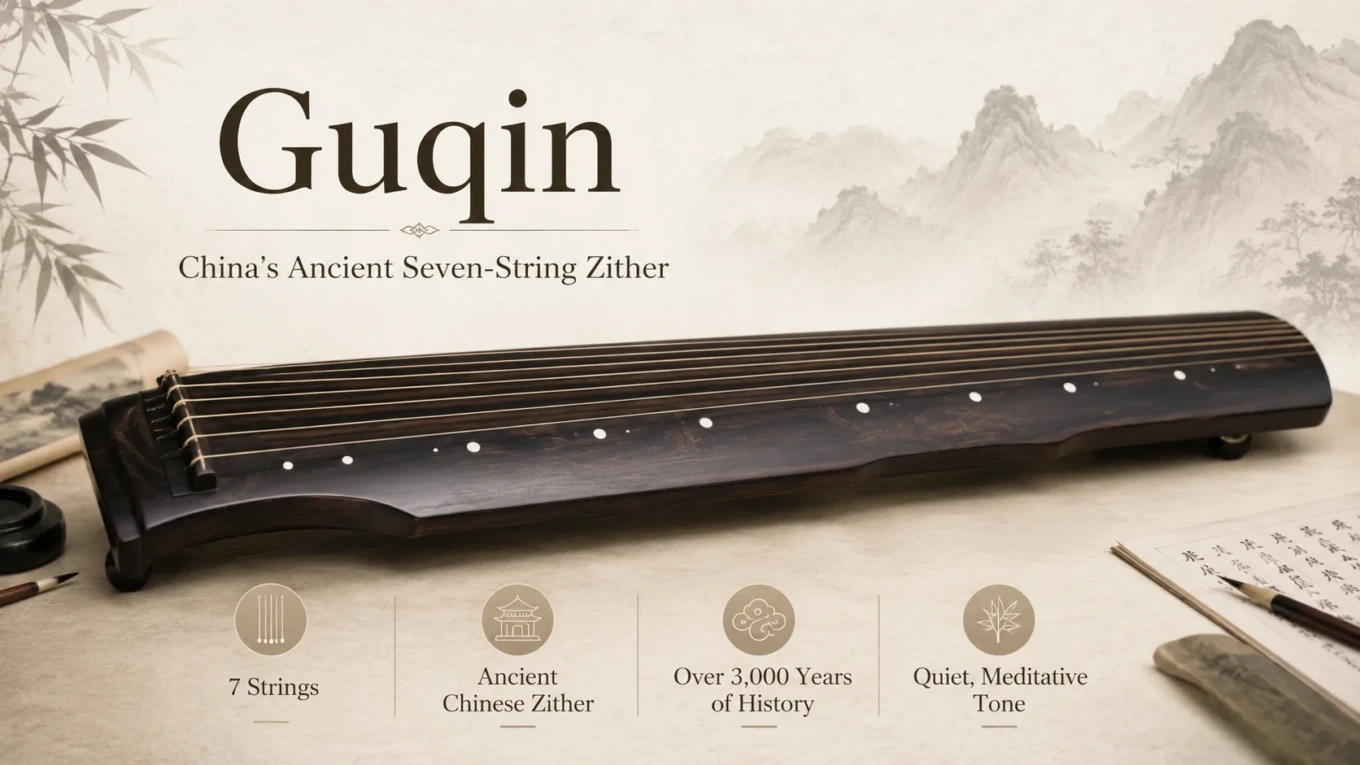
Guqin: China’s Ancient Seven-String Zither
The guqin is a quiet, fretless seven-string zither[1] from China, played with bare fingers while it rests flat on a table. Its long wooden body, smooth playing surface, thirteen position markers, and highly controlled sliding tones make it very different from bridge-based zithers such as the guzheng, koto, or gayageum. The guqin is not a general name for every Chinese string instrument. It is a specific instrument with its own construction, notation, repertoire, playing posture, and listening culture.
What Is the Guqin?
The guqin, often shortened to qin in historical contexts, is a Chinese plucked chordophone[2] whose strings run lengthwise over a long resonating body[3]. In modern English, it is usually described as a seven-string zither because its strings are stretched over the body rather than over a separate neck, as they would be on a lute or guitar.
The word guqin means “ancient qin.” The prefix gu helps separate this instrument from other Chinese instrument names that contain the character qin, such as yangqin, huqin, or gangqin (piano). In older writing, especially before modern naming became settled, qin often meant the guqin specifically.
The instrument is closely linked with cultivated solo playing, poetry, calligraphy, self-discipline, and refined listening. That cultural image matters, but the guqin should not be treated only as a symbol. It is also a carefully built sound object: a shallow wooden soundbox, lacquered surface, fixed string path, no raised frets, and a playing method that depends on pressure, touch, timing, and resonance.
| Feature | Typical Description |
|---|---|
| Instrument family | Plucked zither within the wider chordophone family |
| Strings | Seven strings in the modern standard form |
| Frets | Fretless surface; pitch is shaped by finger placement and sliding |
| Markers | Thirteen hui marks show important pitch and harmonic positions |
| Playing posture | Placed horizontally on a table and played with bare fingers |
| Sound character | Quiet, intimate, resonant, and rich in slides and harmonics |
Why the Guqin Is a Zither, Not a Lute or Harp
The guqin is sometimes loosely called a “Chinese lute” in older English writing, but that label is organologically[4] misleading. A lute normally has a neck and a separate resonating body. A harp has strings set at an angle to a frame. The guqin’s strings run along the top of the body itself, which places it in the zither family.
More precisely, the guqin is often treated as a form of board zither[5] or, in some classification systems, a half-tube zither[6]. These labels focus on structure, not musical style. They describe how the strings relate to the body.
Classification Note: The guqin belongs to the broad zither family, but not every East Asian zither is built or played like it. The guzheng, koto, gayageum, and đàn tranh use movable bridges under the strings. The guqin does not.
Names, Spelling, and Cultural Context
The most common modern spelling is guqin, based on pinyin romanization. Older texts may use spellings such as ku-ch’in, and many museum labels use qin when the context is clear. The name qixianqin, meaning “seven-string qin,” also appears in some contexts.
Historically, the guqin has been associated with scholars, literati, private study, and self-cultivation. Its sound is not designed to dominate a large ensemble. It is closer to a chamber instrument of quiet attention, where small changes of touch can matter more than volume.
This quietness helps explain why the guqin is often discussed through listening habits rather than stage spectacle. It invites close hearing: the start of a note, the slight scrape of a finger, the decay of a harmonic, and the movement of pitch as the left hand slides along the surface.
Body Shape and Construction
A guqin has a long, narrow wooden body with a slightly rounded upper board and a flatter underside. The upper surface acts as the soundboard[7], helping the vibration of the strings spread into the body. The underside normally includes sound holes and fittings for string attachment and tuning.
The body is not deep like many box zithers. Its shallow form is one reason the instrument sounds intimate rather than loud. The strings sit close to the surface, which allows the left hand to press and slide directly on the board.
Traditional descriptions often connect the rounded top and flat bottom with heaven-and-earth symbolism. These ideas belong to the instrument’s cultural history, but they also sit beside practical acoustics: the instrument needs a stable body, a resonant top, and a surface smooth enough for controlled left-hand motion.
Wood, Lacquer, and Surface Feel
Older descriptions often name woods such as Chinese parasol wood for the upper board and catalpa for the lower board. Modern makers may use other suitable timbers, depending on availability, workshop practice, and tonal preference. It is safer to speak of documented traditions and maker choices rather than one universal recipe.
The surface is commonly finished with lacquer[8]. This finish protects the wood and gives the player’s left hand a controlled sliding surface. A guqin that feels too rough can interfere with slides; one that is too slick or poorly set up can feel unstable under the fingers.
Luthier’s Note: Wood choice can shape resonance[9], but the final sound also depends on body carving, hollowing, lacquer thickness, string choice, setup, age, and playing touch. No single material explains the whole tone of a guqin.
Strings and String Path
The modern guqin has seven strings[10]. They run from the head end across the upper surface and continue to the underside, where they are secured and adjusted. The strings are arranged from thicker to thinner, giving the instrument a low, calm register and a wide range of pitch positions along each string.
Traditional guqin strings were made of twisted silk. Many modern instruments use metal-nylon or other composite strings because they are often louder, more stable, and easier for many players to maintain. Silk strings are still valued by some performers for their feel, touch noise, and softer response.
The change from silk to modern strings is not a simple upgrade story. Each material changes the playing experience. Silk can encourage a delicate attack and subtle left-hand motion. Modern strings may offer more projection and tuning stability. Players often choose based on repertoire, teacher preference, instrument setup, and listening taste.
Open Strings, Pressed Notes, and Harmonics
Guqin playing uses three main sound types. Open strings[11] sound when a string is plucked without the left hand stopping it. Pressed notes[12] are made when the left hand presses a string against the surface to define a pitch. Harmonics[13] are produced by lightly touching the string at exact points and releasing cleanly after plucking.
These sound types are not decorative extras. They shape the language of the instrument. A single phrase may move from an open bass note to a bright harmonic and then into a pressed, sliding tone that bends slightly before settling.
The Hui Markers and the Fretless Surface
The guqin has thirteen small markers called hui[14] set along the upper surface. They are not frets. They mark important positions, especially for harmonics and left-hand reference points.
Because the guqin is fretless[15], the player must learn pitch through distance, touch, ear, and marker awareness. The left hand does not simply press behind a metal fret as on a guitar. It contacts the string directly and can slide between positions, letting the pitch move smoothly.
This is one of the guqin’s defining features. The instrument makes room for glissando[16], small pitch inflections, and expressive decay after the pluck. A note can begin as one pitch and become another through left-hand motion.
Bridge, Nut, and Why the Guqin Does Not Use Movable Bridges
The string path passes over fixed end supports, including the yueshan[17] near one end and another support at the opposite end. These parts set the active vibrating length of the strings. Unlike the guzheng or koto, the guqin does not use a movable bridge[18] under each string.
This difference changes almost everything. On a guzheng, movable bridges help set pitch for each string, and the player often bends notes by pressing the string section beyond the bridge. On a guqin, pitch is mainly shaped by pressing and sliding on the main playing surface itself.
The absence of movable bridges gives the guqin its smooth visual field. It also means the player’s left hand has a long uninterrupted surface for stopped tones, slides, and ornaments.
Tuning and Pitch Logic
The guqin is commonly taught with a pentatonic tuning[19] often represented in relative pitch terms rather than a single fixed concert pitch. A frequently cited standard pattern is 5–6–1–2–3–5–6 in numbered notation. In modern teaching, this may be mapped to notes such as C–D–F–G–A–c–d, but historical and practical pitch can vary.
That point matters. The guqin tradition does not depend only on the modern Western idea of fixed absolute pitch. Players may tune to the instrument, the voice, the teacher’s practice, the string material, or the needs of a piece.
Alternative tunings are created by changing string tension[20]. Some tunings lower or raise a particular string to fit a mode, piece, or lineage practice. A learner should not assume that one tuning covers the whole repertory.
How the Guqin Is Played
The guqin is usually placed on a table, with the player seated behind it. The right hand plucks the strings, while the left hand presses, touches, slides, and releases. Players use bare fingers rather than the large picks common on some other East Asian zithers.
The instrument’s technique is built around control rather than force. A strong attack is possible, but much of the music depends on measured movement: when the finger lands, how long a note rings, how far the left hand slides, and whether the sound is allowed to fade naturally.
Three Main Sound Types
- San yin[21]: open-string sounds, clear and direct.
- Fan yin[22]: harmonic sounds, light and bell-like when touched cleanly at marked points.
- An yin[23]: pressed sounds, often shaped with slides and pitch movement.
These three sound types give the guqin a wide expressive range without needing high volume. The contrast between them can make a short phrase feel spacious: a dry open note, a glowing harmonic, then a pressed note that moves under the finger.
Listening Note: A guqin recording should not be judged only by loudness or speed. Listen for the attack of the pluck, the length of decay, the clarity of harmonics, and the way slides arrive at pitch.
Notation and Repertoire
Guqin music is strongly tied to tablature[24]. Traditional qin notation often tells the player which string to use, where to place the left hand, and what right-hand stroke to apply. It does not always behave like staff notation, where pitch and rhythm are laid out in the same way as modern Western scores.
This is one reason guqin learning often needs a teacher, a lineage, or careful study of performance practice. The notation can preserve finger actions with great care, but the living sound depends on timing, touch, phrasing, and interpretation.
Pieces associated with the instrument often leave space around notes. Silence is not empty filler. It lets the resonance, gesture, and decay become part of the musical line.
What the Guqin Sounds Like
The guqin is known for a restrained, intimate timbre[25]. It can sound dry, woody, rounded, glassy, or vocal depending on the string type, instrument, room, and player. It is not built to fill a large hall without support.
Its low strings can have a dark and breath-like quality. Harmonics can sound clean and bright. Pressed notes may carry the soft friction of the finger sliding along the string and surface. These details are not flaws; they are part of the instrument’s identity.
The guqin also rewards close listening because the start and end of a note can be as meaningful as the pitch itself. A small slide, delayed release, or fading vibration may carry much of the phrase.
What 2026 Conservation Science Revealed About Historic Guqin Construction
A study published in the Journal of Archaeological Science in February 2026 examined Qing Dynasty guqin body coatings and silk strings at molecular and microstructural scales. The research, titled Multimodal micro-area analysis deciphers Qing Dynasty guqin lacquer technology and acoustic design principles, used several analytical methods to separate and identify materials that can be difficult to distinguish by visual inspection alone.
The analyzed guqin coatings showed a three-layer lacquer structure rather than a single uniform finish. Within the urushi-based lacquer system, the researchers detected additions including oils, proteins, starches, and resins. Their results show that historic guqin lacquer could be a deliberately layered composite in which the wooden body, ground layers, and surface coating worked together as one material system.
The silk-string sample also preserved evidence of controlled processing. Perilla oil, tannins, and other treatment materials were identified in the string, adding physical evidence to the study of how historic guqin strings were prepared. These findings give conservators and instrument researchers a more exact material record for comparing surviving instruments, old craft descriptions, and changes caused by age or restoration.
The study also considers how material choices may relate to acoustic behavior, including stiffness, damping, and vibration. These links are best read as evidence from the analyzed Qing-period material rather than as a fixed formula for how every historic guqin was built or how every ingredient affected the sound.
Conservation Note: The materials identified in this research belong to specific historic samples and analytical observations. They should not be read as a modern guqin maintenance recipe or as proof that every Qing Dynasty instrument used the same lacquer and string treatments.
2026 Robotics Research Used the Guqin to Test a Haptic Finger
A robotics study posted on August 7, 2026 and accepted by IEEE Transactions on Haptics, titled A Haptic Robot Finger Designed for Guqin Instrument Playing, used the guqin as a demanding test case for a biomimetic tactile-sensing finger. The design combines a soft fingertip with a human-like nail structure and senses both static pressure and dynamic vibration, two forms of feedback that matter when a finger contacts, presses, or releases a guqin string.
The researchers integrated the finger into a proof-of-concept dual-arm system and tested selected guqin tasks rather than a complete piece. Their experiments included open-string comparisons against a human reference, stopped-note contact tests, harmonic tuning, and tactile-event-triggered coordination between the two robotic hands. The guqin is useful for this kind of test because its technique depends on small differences in pressure, contact position, nail and fingertip use, string vibration, and timing between the hands.
Three fingertip structures were compared during the experiments. The most human-like version used a curved soft pad with a nail, allowing front, side, and fingertip contact. Among the tested configurations, side contact using part nail and part fingertip produced acoustic features closest to the human reference. That result applies to the reported setup and does not mean the robotic finger reproduces a player’s full range of touch or musical control.
The system also used tactile contact as a trigger for a planned pluck by the other robotic hand and tested parameters for producing harmonics. The tactile signal controlled the timing of the next action rather than continuously correcting pressure, finger position, or release. The work is therefore better understood as a robotics and haptics experiment carried out on the guqin than as a demonstration of autonomous guqin performance.
Robotics Note: The study does not show a robot learning or performing complete guqin repertoire. It validates a haptic fingertip on selected open-string, stopped-note, harmonic, and two-hand coordination tasks. Fast multi-string techniques and expressive interpretation remain outside the demonstrated scope.
How the Guqin Differs from Related Zithers
The guqin shares family traits with other zithers, but its playing logic is distinct. It is quieter than many stage zithers, lacks movable bridges, and uses a fretless surface for sliding stopped tones.
| Instrument | Main Structural Difference | Playing Logic |
|---|---|---|
| Guqin | Seven strings, fretless surface, no movable bridges | Open notes, harmonics, pressed sliding tones |
| Guzheng | Many strings with individual movable bridges | Plucked strings with pitch bending beyond the bridge |
| Koto | Long zither with movable bridges | Plucked with picks; bridge placement shapes tuning |
| Gayageum | Korean zither with movable bridges | Plucking, pressing, and ornamented melodic motion |
| Qanun | Trapezoid zither with many courses and levers in modern forms | Plucked with plectra; pitch systems vary by tradition |
Guqin and Guzheng
The guqin and guzheng are often confused because both are Chinese zithers. The difference is easy to see once the top of the instrument is visible. The guzheng has a row of movable bridges. The guqin has a smooth surface with thirteen hui markers and no bridge row.
The guzheng generally has a brighter and more projecting sound. The guqin is quieter and more inward in playing style. Neither is the “better” instrument; they serve different musical roles and require different technique.
Guqin and Koto
The Japanese koto is also a long zither, but it uses movable bridges and a different playing method. The koto’s bridge placement is central to tuning each string. The guqin’s pitch work happens through tuning, left-hand stopping, harmonics, and sliding over the fretless surface.
Guqin and Psaltery or Dulcimer
The guqin can be placed near psalteries and dulcimers in broad zither discussions, but it should not be folded into them without care. Some dulcimers are struck with hammers. Some psalteries are plucked. The guqin is a specific plucked, fretless Chinese zither with its own body form and notational tradition.
Museum and Heritage Context
Museums often describe the guqin as one of China’s most respected historical instruments, but collection labels usually focus on more than age. They may identify body style, lacquer condition, maker, period, inscriptions, hui materials, or the instrument’s named identity.
Some guqin bodies have named shapes or styles. A double-waisted outline is familiar in many classic examples, while other forms may have straighter sides or more flowing contours. These shape names should be read as part of a workshop and cultural vocabulary, not as proof that every guqin must look identical.
Collectors and curators also pay attention to surface wear, cracks in the lacquer, inscriptions, repairs, and fittings. These details can reveal use, restoration, taste, and ownership history. They should be interpreted carefully; visible age alone does not prove musical quality or authenticity.
Collector’s Note: A guqin is not judged only by decoration. Setup, sound response, structural condition, lacquer stability, string spacing, and provenance all matter. For older instruments, expert inspection is far safer than relying on appearance alone.
Beginner Learning Notes
The guqin can be learned by beginners, but it asks for patience. Early study often focuses on posture, right-hand strokes, clean open strings, correct left-hand pressure, and accurate hui positions. Speed is not the first goal.
Because the instrument is fretless, pitch training matters from the beginning. A learner must hear whether a pressed note arrives in tune, not only place the finger near a marker. This is one reason teacher guidance can be very helpful.
Beginners should also understand that tuning and string choice affect comfort. Modern strings may feel firmer and louder. Silk strings may feel softer under some hands but can require different care and listening habits. The best choice depends on the instrument and the learning setting.
Common Misunderstandings
The guqin is not the same as the guzheng. Both are Chinese zithers, but their structure, tuning method, sound, and technique differ clearly.
The guqin is not a harp. Its strings run along the body rather than across a harp frame.
The guqin is not simply an old decorative object. Many examples are collected and displayed, but the instrument remains a living performance tradition.
The guqin does not have frets. The hui markers guide placement; they do not stop the strings like raised frets.
The guqin is not normally a loud ensemble instrument. Its character is tied to close listening, controlled touch, and subtle resonance.
Care, Handling, and Practical Respect
A guqin should be handled as both a musical instrument and a lacquered wooden object. Sudden humidity changes, careless pressure, and poor storage can affect tuning, surface condition, and body stability.
Players normally avoid placing heavy objects on the soundboard and keep the surface clean enough for smooth left-hand movement. String tension should be adjusted with care, especially on older instruments or instruments with unknown repair history.
For playable modern instruments, regular use can help the player understand how the body responds. For older collected instruments, conservation concerns may limit playing. A museum-grade guqin and a student practice guqin should not be treated in exactly the same way.
Glossary of Technical Terms
[1] Zither
A zither is a string instrument whose strings run across or along the body without a separate neck. In the guqin, the body itself supports the strings and helps produce the sound.
[2] Chordophone
A chordophone is any instrument that produces sound through vibrating strings. The guqin is a chordophone because its tone begins with plucked strings.
[3] Resonating Body
The resonating body is the part of the instrument that receives string vibration and helps amplify and color the sound. On a guqin, this is the long, shallow wooden body.
[4] Organology
Organology is the study and classification of musical instruments. In zither studies, it helps separate instruments by structure rather than only by region or name.
[5] Board Zither
A board zither is a zither whose strings are stretched over a board-like body. The guqin is often discussed this way because of its long, flat playing surface.
[6] Half-Tube Zither
A half-tube zither has a body form related to a curved or hollowed surface rather than a deep box. Some classification systems place the guqin in this area because of its vaulted upper body form.
[7] Soundboard
The soundboard is the vibrating top surface that helps transmit string energy into the body. On the guqin, it also serves as the smooth surface where the left hand presses and slides.
[8] Lacquer
Lacquer is a hard protective finish used on many guqin surfaces. It affects durability, touch, and the feel of sliding left-hand technique.
[9] Resonance
Resonance is the way an instrument’s body responds to string vibration. In a guqin, resonance is shaped by the wood, hollowing, lacquer, strings, setup, and playing touch.
[10] String Course
A string course is a string or group of strings treated as one playing line. The guqin has seven single string courses rather than paired or triple courses.
[11] Open String
An open string sounds without the left hand pressing it against the surface. Guqin open-string tones are one of the main sound types in the instrument’s technique.
[12] Pressed Note
A pressed note is made when the left hand stops a string against the guqin surface to create a pitch. These notes can slide, bend, and decay in very controlled ways.
[13] Harmonic
A harmonic is a clear overtone produced by lightly touching a vibrating string at a precise point. On the guqin, many harmonic positions are guided by the hui markers.
[14] Hui
Hui are the thirteen small position markers on the guqin’s upper surface. They guide the player’s left hand, especially for harmonics and pitch reference.
[15] Fretless
A fretless instrument has no raised strips to stop the strings at fixed pitches. The guqin’s fretless surface allows smooth slides and fine pitch control.
[16] Glissando
Glissando is a sliding movement between pitches. In guqin playing, slides are central to the sound of pressed notes and left-hand expression.
[17] Yueshan
The yueshan is a fixed raised support near one end of the guqin string path. It helps define the vibrating length of the strings.
[18] Movable Bridge
A movable bridge is an adjustable support placed under a string to set pitch or string length. The guqin does not use individual movable bridges, unlike the guzheng or koto.
[19] Pentatonic Tuning
Pentatonic tuning uses a five-note pitch collection. A common guqin tuning is often explained through a pentatonic pattern, though actual pitch practice can vary.
[20] String Tension
String tension is the tightness of a string after tuning. On a guqin, changing tension changes pitch and can also affect touch and response.
[21] San Yin
San yin refers to open-string sounds on the guqin. These tones are produced by plucking a string without stopping it with the left hand.
[22] Fan Yin
Fan yin refers to harmonic sounds. The player lightly touches the string at a precise point, plucks, and releases to produce a clear overtone.
[23] An Yin
An yin refers to pressed sounds. The left hand presses the string against the surface, allowing stopped notes, slides, and pitch movement.
[24] Tablature
Tablature is notation that shows playing actions, finger positions, or string use. Guqin tablature is closely tied to technique and performance practice.
[25] Timbre
Timbre is the color or quality of a sound beyond pitch and volume. The guqin’s timbre can include woody attack, soft decay, bright harmonics, and audible sliding texture.
FAQ
Is the guqin the same as the guzheng?
No. The guqin is a seven-string fretless zither with no movable bridges, while the guzheng has many strings and individual movable bridges. Their sound, tuning logic, and playing techniques are different.
How many strings does a guqin have?
The modern standard guqin has seven strings. Historical traditions sometimes mention earlier forms with fewer strings, but the seven-string form is the recognized standard today.
Does the guqin have frets?
No. The guqin is fretless. Its thirteen hui markers guide finger placement, but they do not stop the strings like raised frets.
Is the guqin difficult for beginners?
The guqin can be learned by beginners, but it requires patient work on posture, tone, pitch placement, and left-hand sliding. Its quiet sound and fretless surface make careful listening very important.
What makes the guqin sound different from other zithers?
The guqin’s sound comes from its shallow wooden body, seven strings, fretless surface, lack of movable bridges, and use of open tones, harmonics, and pressed sliding notes. It is usually quieter and more intimate than many bridge-based zithers.