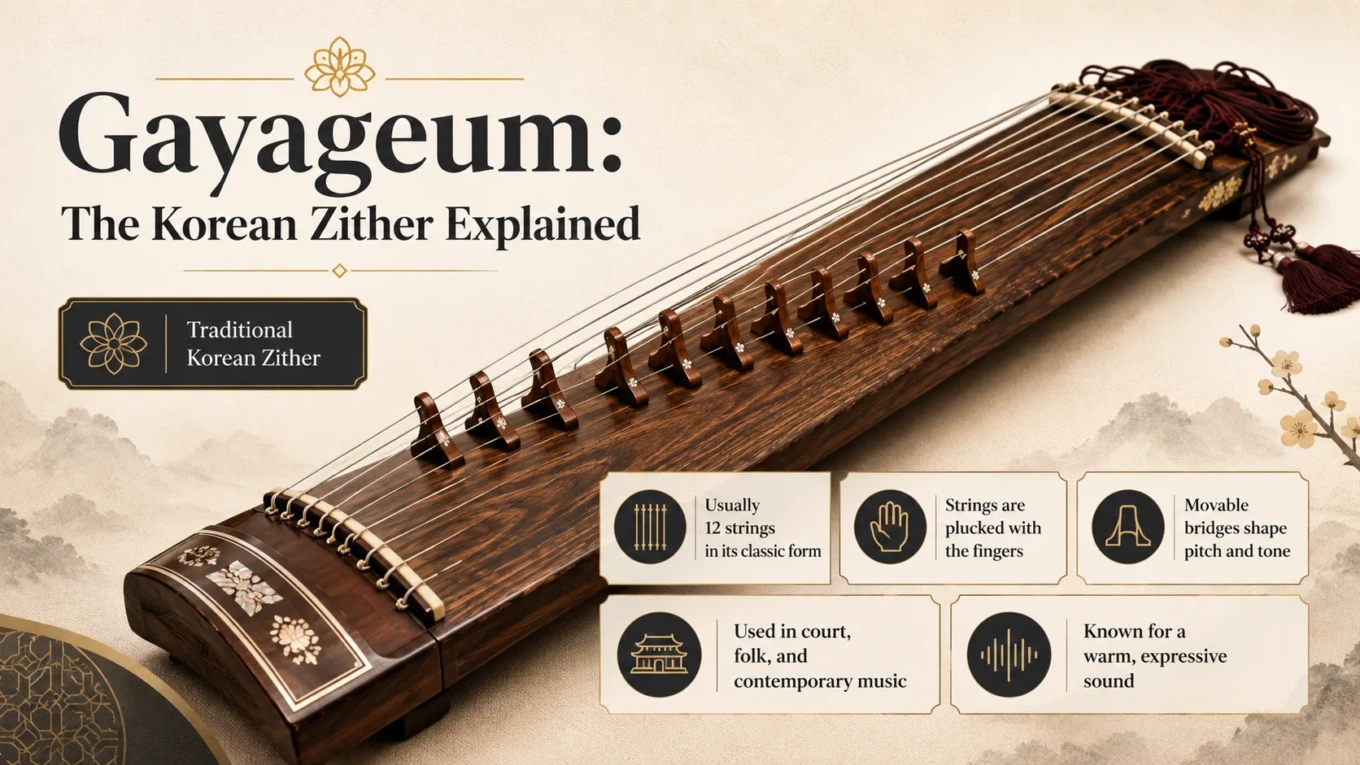
Gayageum: The Korean Zither Explained
The gayageum is a Korean plucked zither: a long wooden instrument with strings stretched across a resonant body and supported by individual movable bridges[1]. Its sound is shaped not only by plucking, but also by pressing, bending, and shaking the strings after they have been sounded. That left-hand control gives the gayageum much of its vocal, flexible character.
In organological terms, the gayageum belongs to the zither family because its strings run over the body of the instrument rather than away from a neck as on a lute. In Korean musical life, however, it is not just a category example. It is a living concert instrument used in court-related repertory, sanjo, ensemble music, new compositions, education, and cross-genre performance.
What Is a Gayageum?
The gayageum is a Korean long zither[2] traditionally associated with twelve strings, though modern forms may use more. It is normally placed horizontally before the player. The right hand plucks or strums the strings, while the left hand presses the string segment on the other side of the bridge to shape pitch, vibrato, and ornament.
The instrument is often described in English as a “Korean zither,” but that phrase should be read carefully. A gayageum is not a generic zither with a Korean label; it has a particular construction, playing technique, repertory, and sound ideal. Its bridges, body curve, string spacing, and hand technique all matter.
Classification Note: The word “zither” can be broad. It may describe a large family of chordophones[3] whose strings are stretched across a resonating body. In that broad sense, the gayageum, guzheng, koto, đàn tranh, and several other East Asian instruments can all be discussed as zithers, but they are not the same instrument.
Main Details Worth Knowing
| Feature | Gayageum Detail |
|---|---|
| Instrument family | Plucked zither in the wider chordophone family. |
| Traditional string count | Most often twelve strings in older and traditional forms, with modern versions using expanded string counts. |
| Bridge system | Each string usually rests on its own movable bridge, called an anjok[4]. |
| Body material | Paulownia wood is widely associated with the soundboard[5]; other woods may be used for parts of the body depending on type and maker. |
| Playing method | Right hand plucks; left hand presses, bends, shakes, and ornaments the strings. |
| Related Korean zither | The geomungo is another Korean zither, but it has different strings, frets, technique, and musical identity. |
Name, Spelling, and Cultural Setting
The common romanized form is gayageum. Older spellings and scholarly forms may appear as kayagum, kayagŭm, or related variants. These differences usually reflect romanization systems rather than different instruments.
The Korean name is 가야금. The final element, geum, is connected with zither-like string instruments in Sino-Korean naming. The first part is commonly associated with Gaya, a historical confederacy linked in tradition to the instrument’s early story. Historical accounts place the gayageum within Korea’s older musical heritage, but exact origin narratives should be treated with care because they often mix historical memory, court record, and later cultural interpretation.
The gayageum appears in several performance settings. It can serve as a solo instrument, a chamber instrument, an accompaniment to singing, or part of a larger Korean traditional ensemble. Modern performers also use it in newly composed music, amplified stages, intercultural collaborations, and university training.
How the Gayageum Is Classified
The gayageum is usually classified as a plucked board zither[6] or long zither. It has no projecting neck. Its strings run along the length of a wooden body, and the sound comes from the vibration of the strings passing into the resonant body through the bridge system.
This matters because the gayageum is sometimes casually compared with harps, lutes, or guitars. The playing experience is different. A guitar player stops strings against a fingerboard. A harp player plucks open strings arranged in a frame. A gayageum player works with open strings[7], movable bridges, and pitch shaping after the pluck.
Why It Belongs to the Zither Family
In the broad zither sense, the body of the instrument supports the strings directly. The gayageum fits that description well. The strings do not stretch from a separate neck to a soundbox. They run over the instrument’s body and are supported by bridges placed on the top surface.
Yet the gayageum should not be reduced to a “Korean version” of another zither. It shares family traits with the guzheng and koto, but its repertory, string feel, bridge use, hand motion, and ornaments are distinct.
Body Shape and Resonance
A traditional gayageum has a long, narrow body with a slightly convex upper surface in many documented examples. The body works as a resonating body[8], helping the string vibration become audible and colored. The player hears not just the pitch of each string, but the way the wood, hollow space, bridge contact, and string tension interact.
Paulownia is strongly associated with the gayageum soundboard. It is valued in several East Asian zither traditions because it is light and responsive when prepared well. That does not mean wood alone “creates” the tone. The final sound also depends on thickness, drying, internal shaping, bridge placement, string material, and playing touch.
Luthier’s Note: A gayageum is not simply a plank with strings. The soundboard, back, hollowing, bridge pressure, and string path all affect response. Small changes in bridge position or string tension can change both pitch and feel under the fingers.
Strings and Bridge Layout
The older, well-known form of the gayageum uses twelve strings. Traditionally, these were silk strings[9], though modern instruments may use synthetic materials depending on style, maker, and performance needs. Expanded modern gayageum types may use 18, 21, 25, or other string counts, especially for wider range and contemporary repertory.
Each string is usually supported by a separate bridge. These bridges are not fixed like a guitar bridge. They can be moved to adjust tuning and spacing. The Korean term anjok is often translated as “goose foot,” a reference to the bridge’s shape.
Why Movable Bridges Matter
Movable bridges allow the instrument to be tuned by changing the vibrating string length[10]. Moving a bridge slightly changes where the string speaks from, which affects pitch and sometimes the playing feel. This is one reason gayageum tuning is a physical process rather than only a peg-turning process.
The bridge also divides the string into two functional areas. On one side, the right hand plucks the string. On the other side, the left hand presses or shakes the string to raise pitch, add vibrato[11], or create expressive ornaments. This division of labor is central to gayageum technique.
Types of Gayageum
Several gayageum types exist, and the terms can vary in translation. The most common distinction is between older court-related forms, sanjo forms, and modern expanded instruments. These should not be treated as small cosmetic variations. They can differ in size, string spacing, repertory, and playing response.
Beopgeum or Pungnyu Gayageum
The beopgeum or pungnyu gayageum is often linked with older literati and court-related music. It is commonly described as a twelve-string form with a larger body and wider spacing than the sanjo type. Its playing style favors controlled tone, measured gesture, and subtle inflection.
Some museum examples and traditional descriptions note features such as a long wooden body, silk strings, movable bridges, and a distinctive head area. The exact details can vary by maker and period.
Sanjo Gayageum
The sanjo gayageum is closely tied to sanjo[12], a solo instrumental genre that pairs melodic improvisatory development with rhythmic cycles. Compared with the larger court-related form, sanjo gayageum instruments are often described as smaller, with strings set closer together for faster passagework.
This form supports quick plucking, sharp bends, flowing ornaments, and marked changes in tempo and intensity. The instrument’s design helps the performer move through changing rhythmic patterns while keeping control of pitch color.
Modern Expanded Gayageum
Modern gayageum instruments may have more strings than the traditional twelve. Versions with 18, 21, or 25 strings are used by many contemporary performers and composers. More strings can offer a wider pitch range and easier access to notes used in newer compositions.
Expanded instruments do not replace the older gayageum. They answer different musical needs. A 25-string gayageum, for example, may suit ensemble writing, new tonal language, and stage arrangements, while a twelve-string sanjo gayageum remains closely tied to older technique and repertory.
How the Gayageum Is Played
The gayageum is usually played while seated, with the instrument placed horizontally. Traditional floor posture remains important in many settings, though chair and stand arrangements are also used in modern teaching and performance. The right side of the instrument is usually closer to the player’s plucking hand, while the left hand works the string length beyond the bridges.
The right hand plucks with bare fingers in many traditional approaches. Unlike qanun performance, which often uses plectra attached to rings, gayageum touch depends heavily on direct finger contact. This helps the performer vary attack, release, and tone color.
Right-Hand Sound Production
The right hand may pluck single notes, repeat tones, strum across adjacent strings, or create rhythmic patterns. The exact approach depends on repertory. Slow court-related music may give each sound space to develop. Sanjo playing may require faster figures, accents, and agile movement between strings.
Because the gayageum has open strings, changing notes is not the same as fretting a lute. The player chooses a string, controls the pluck, then shapes the tone through timing, pressure, and left-hand response.
Left-Hand Pitch Shaping
The left hand is one of the most expressive parts of gayageum playing. Pressing the string segment on the far side of the bridge can raise the pitch. Shaking the string can create vibrato. Sliding pressure can produce bends and ornaments that make the tone feel flexible rather than fixed.
This means a written pitch may not describe the whole musical event. The after-sound matters. A note can move upward, settle, fluctuate, or carry controlled tension before the next pluck.
Listening Note: When hearing gayageum music, listen after the pluck. The first attack is only part of the sound. The left hand can turn a single tone into a shaped pitch gesture through bends, vibrato, and pressure changes.
Tuning and Pitch Organization
Gayageum tuning depends on the instrument type, repertory, mode, teacher, and performance setting. It is not safe to give one universal tuning for all gayageum music. Traditional twelve-string practice often uses modal organization[13], while modern expanded instruments may support wider pitch collections for newer works.
Movable bridges are part of the tuning system. A player or teacher may shift bridges to set the instrument for a piece. Fine control also comes from left-hand pressing, which can raise pitch after the string is plucked. This makes the gayageum a flexible pitch instrument rather than a purely fixed-pitch zither.
Why Tuning Is More Than String Names
A list of string pitches can be useful, but it does not explain gayageum intonation[14]. The expressive pitch often sits in the movement around a note. In many traditional styles, the exact color of a bend or vibrato may be learned by ear, imitation, and long contact with repertory.
For beginners, tuning usually starts with a teacher, tuner, or reference recording. Moving bridges without care can affect string alignment, tension, and response.
Why Digital Tuners and Pitch Trackers Can Misread Nonghyeon
Nonghyeon[19] is a Korean term for controlled pitch shaping created by the left hand after or around a plucked note. On the gayageum, this can involve pressing or shaking the string segment beyond the bridge so that string tension rises and the sounding pitch moves upward from its starting point.
A 2026 study in the Journal of Art and Technology, “Acoustical Structure of Gayageum Nonghyeon and Limitations of Digital Pitch Detection Algorithm”, examined this motion acoustically and compared it with assumptions commonly used for Western vibrato. In the analyzed gayageum performances, nonghyeon followed an asymmetric pitch path: the movement developed upward from a floor or base pitch rather than fluctuating evenly above and below a central pitch.
That difference can affect digital pitch analysis. The study found that mean- or center-based pitch estimates could place nonghyeon higher than the pitch intended by the performer because those methods treat the moving pitch as if its reference should sit near the middle of the fluctuation. The researchers tested gayageum and cello recordings with Praat and Melodyne and proposed the floor pitch, lower envelope, and statistical mode as more suitable reference measures for this type of gayageum pitch motion.
Acoustics Note: This does not mean digital tuners are unusable for gayageum tuning. The issue arises when software tries to summarize an expressive nonghyeon gesture as one central pitch. A stable open string and an ornamented note are different measurement tasks.
Timbre and Musical Character
The gayageum is known for a clear plucked tone, but its character is broader than “bright” or “soft.” Depending on the instrument and playing style, it can sound rounded, dry, ringing, percussive, warm, or sharply articulated. String material, nail or fingertip contact, bridge placement, and room acoustics all affect the result.
Traditional silk strings can offer a textured attack and a supple response under the fingers. Modern synthetic strings may feel different and can support performance needs such as durability, projection, or stable tuning. Neither should be treated as automatically better; each belongs to a playing context.
Resonance and Decay
The gayageum’s resonance[15] is tied to its wooden body and bridge pressure. A plucked note does not last in the same way as a bowed tone. Its level changes after the attack as the pitch is bent and the vibration decays. Skilled players use that decay as part of phrasing.
In ensemble settings, this decay helps the gayageum sit between melody, rhythm, and color. It can lead a line, support a singer, or answer a drum pattern without filling every moment with continuous sound.
Gayageum in Korean Music
The gayageum appears in several areas of Korean music, often grouped under the broad term gugak[16]. Its role changes with repertory. In court-related music, it may support a refined and measured sound. In sanjo, it becomes a solo instrument with changing tempo, rhythmic cycles, and dense ornamentation.
Gayageum byeongchang[17] is another important setting, where a performer sings while playing the gayageum. This pairing shows how the instrument can support text, breath, and melodic gesture at the same time.
Solo, Ensemble, and Modern Stage Use
In solo performance, the gayageum can carry melody, rhythm, ornament, and tone color without accompaniment. In ensemble music, it may interact with instruments such as janggu, daegeum, haegeum, geomungo, and other Korean instruments, depending on the repertory.
Modern performers also use microphones, stands, new tunings, and expanded-string instruments. These changes are part of current gayageum performance practice alongside older forms and repertories.
Recent concert programming shows the instrument in several current settings. Seoul’s Mixed Orchestra 26 on April 16, 2026 placed gayageum and piri within a Korean traditional orchestra that also used beatboxing. On May 12, 2026, the Korean Cultural Center in Brussels presented Shamanic Sensibility of Gayageum, an experimental concert connecting Korean shamanic musical material with contemporary composition.
How It Differs from Related Instruments
The gayageum is often compared with the guzheng, koto, and geomungo. Those comparisons help beginners orient themselves, but they can also create confusion if they erase local technique and repertory.
| Instrument | Shared Feature | Main Difference |
|---|---|---|
| Guzheng | Long East Asian zither with movable bridges. | The guzheng belongs to Chinese musical traditions and uses its own tunings, techniques, string materials, and repertory. |
| Koto | Japanese long zither with movable bridges. | The koto has a separate Japanese history, playing posture, notation, schools, and tonal practice. |
| Geomungo | Korean zither with a long body. | The geomungo has fewer strings, frets[18], and is often played with a bamboo stick rather than the gayageum’s direct finger-plucking technique. |
| Đàn tranh | Vietnamese long zither with movable bridges. | It belongs to Vietnamese musical practice and has its own stringing, ornament, tuning, and repertory traditions. |
Gayageum and Geomungo
The gayageum and geomungo are both Korean zithers, but their playing logic differs. The gayageum is usually associated with plucking by the fingers and expressive bending around movable bridges. The geomungo commonly uses a short bamboo stick and includes fretted string areas. Its tone is often described as deeper and more restrained, though actual sound depends on instrument and performer.
This difference is useful for museum labels and beginner learning. A long Korean zither is not automatically a gayageum. Bridge layout, frets, strings, and playing tools must be checked.
Construction Details That Shape the Sound
Several construction features shape how the gayageum responds:
- Soundboard wood: Paulownia is widely used because it can respond well to string vibration when properly prepared.
- Bridge height and placement: The bridges set string length, affect tension, and influence the pressure transmitted to the body.
- String material: Silk and modern synthetic strings can differ in texture, attack, durability, and tuning behavior.
- Body size: Larger and smaller gayageum types can feel different under the hands and respond differently in various repertories.
- String spacing: Wider spacing may support older repertory and tone control; closer spacing can help faster sanjo-style movement.
These features work together. A change in one part can affect the whole instrument. For example, a bridge moved for tuning also changes the distance the left hand must press and the tension the player feels.
What Beginners Should Know
For beginners, the gayageum may look simple because the strings are visible and open. The first sounds can come quickly. Control takes longer.
The main challenge is not only finding the right string. It is learning how each note moves after the pluck. Left-hand pressure, timing, and release are central from the beginning. A beginner who treats the gayageum like a fixed-pitch keyboard will miss much of the instrument’s character.
Common Beginner Questions
- Do beginners need to read Korean notation? Not always at first. Some teachers use staff notation, numbered systems, oral teaching, or mixed methods.
- Can a beginner tune it alone? Basic tuning can be learned, but bridge movement is best taught carefully.
- Is a 25-string gayageum easier? It depends on the music. More strings can help with modern pitch access, but they also add layout complexity.
- Is sanjo a beginner style? Sanjo can be studied in stages, but mature sanjo performance requires strong rhythm, ornament, and tone control.
Care, Storage, and Handling
A gayageum should be handled as a wooden acoustic instrument. Humidity, heat, direct sunlight, and sudden temperature changes can affect the body, bridges, and strings. Traditional silk strings may be especially sensitive to environment and wear.
The bridges should be kept upright and aligned. If a bridge falls, forcing it back without understanding the string tension can cause tuning problems or damage. A soft dry cloth is usually safer than liquid cleaners for routine dust removal.
Collector’s Note: On an older gayageum, check the bridge set, string condition, cracks, body warping, replaced parts, and evidence of repair. A playable instrument and a display object may need different evaluation.
How Museums and Collections Describe the Gayageum
Museums often describe the gayageum by material, region, string count, maker if known, and cultural use. A label may identify it as a Korean zither, a board zither, or a plucked chordophone. Better descriptions also note the bridge system and the type of gayageum represented.
Curatorial language can vary. One collection may use kayagum, another gayageum. Some labels emphasize court music, while others highlight sanjo or modern performance. These differences do not always signal disagreement; they may reflect romanization, collection history, or the type of instrument on display.
Where Confusion Often Starts
Three misunderstandings appear often in basic descriptions of the gayageum.
- Calling every long East Asian zither the same instrument. The gayageum, guzheng, koto, and đàn tranh share a broad zither structure, but each has its own music and technique.
- Treating twelve strings as the only possible form. Twelve strings are central to traditional identity, but modern expanded forms are widely used.
- Describing the left hand as decoration. Left-hand pressure and vibrato are not extra effects. They are part of the instrument’s musical grammar.
A careful explanation of the gayageum should include construction, bridge movement, left-hand expression, repertory, and the difference between traditional and modern forms.
Glossary of Technical Terms
[1] Movable Bridge
A movable bridge is a bridge that can be repositioned to change the vibrating length and pitch of a string. On the gayageum, each string commonly rests on its own bridge, allowing tuning and layout adjustments.
[2] Long Zither
A long zither is a zither with a long, narrow body and strings running along its length. The gayageum, guzheng, koto, and đàn tranh are often discussed within this broad shape category, though their traditions differ.
[3] Chordophone
A chordophone is any instrument whose sound is produced by vibrating strings. In the zither family, those strings are supported by the body rather than by a separate neck.
[4] Anjok
Anjok is the Korean term often used for the gayageum’s movable bridges. The term is commonly translated as “goose foot,” referring to the shape of the bridge.
[5] Soundboard
The soundboard is the upper vibrating surface that receives string energy through the bridges. In gayageum construction, paulownia wood is closely associated with this part of the instrument.
[6] Board Zither
A board zither is a zither in which strings run across a board-like resonant body. The gayageum is often described this way because its strings lie across a long wooden body rather than a neck.
[7] Open String
An open string sounds without being stopped against a fingerboard or fret. Gayageum players pluck open strings, then shape pitch and color through left-hand pressure near the bridges.
[8] Resonating Body
The resonating body is the wooden structure that helps amplify and color the string vibration. On the gayageum, body shape, wood, hollowing, and bridge pressure all influence the response.
[9] Silk String
A silk string is a traditional string material used on many older East Asian zithers. On the gayageum, silk strings are associated with traditional tone and touch, though modern instruments may use synthetic alternatives.
[10] Vibrating String Length
Vibrating string length is the active part of a string that produces the sounding pitch. Moving a gayageum bridge changes this length and therefore changes the pitch.
[11] Vibrato
Vibrato is a controlled pitch fluctuation. On the gayageum, it is often created by the left hand pressing or shaking the string segment beyond the bridge after the right hand plucks.
[12] Sanjo
Sanjo is a Korean solo instrumental genre often built through changing rhythmic cycles and expressive melodic development. The sanjo gayageum is shaped for this agile, ornament-rich repertory.
[13] Modal Organization
Modal organization refers to pitch patterns and melodic behavior that guide a piece beyond a simple scale list. In gayageum music, mode affects tuning, ornament, phrase direction, and expressive pitch treatment.
[14] Intonation
Intonation is the accuracy and expressive placement of pitch. On the gayageum, intonation includes both bridge tuning and left-hand pitch bending during performance.
[15] Resonance
Resonance is the way the instrument body responds to string vibration. In a gayageum, resonance depends on wood, body form, bridge contact, string material, and playing touch.
[16] Gugak
Gugak is a broad term for Korean traditional music. The gayageum appears in several gugak settings, including solo, ensemble, court-related, folk, and modern repertories.
[17] Byeongchang
Byeongchang refers to singing while playing an instrument. In gayageum byeongchang, the performer sings and plays the gayageum together, linking vocal line and plucked accompaniment.
[18] Fret
A fret is a raised point or surface that helps define pitch when a string is pressed. The gayageum is normally discussed through open strings and movable bridges, while the Korean geomungo includes fretted playing areas.
[19] Nonghyeon
Nonghyeon is controlled pitch movement and ornament created through left-hand pressure on a string. On the gayageum, the motion can raise pitch from a base note by increasing string tension rather than moving symmetrically around a central pitch.
FAQ
Is the gayageum a type of zither?
Yes. The gayageum is a Korean plucked zither because its strings run along a resonating body rather than over a separate neck. It is best understood as a specific Korean instrument within the wider zither family.
How many strings does a gayageum have?
Traditional gayageum forms are strongly associated with twelve strings. Modern gayageum instruments may have more, including 18, 21, or 25 strings, depending on the music and performance setting.
What are gayageum bridges called?
The movable bridges of the gayageum are commonly called anjok. Each bridge supports a string and can be moved to adjust pitch and string layout.
Is the gayageum the same as the guzheng?
No. The gayageum and guzheng are both long zithers with movable bridges, but they belong to different musical traditions. Their construction details, techniques, tunings, and repertories are not the same.
What is the difference between gayageum and geomungo?
Both are Korean zithers, but the gayageum is usually finger-plucked and uses movable bridges for its strings. The geomungo has a different string system, includes fretted areas, and is commonly played with a short bamboo stick.
Is the gayageum hard to learn?
A beginner can produce simple sounds fairly quickly, but expressive playing takes time. The hardest part is often left-hand control: pressing, bending, and shaping the note after it is plucked.