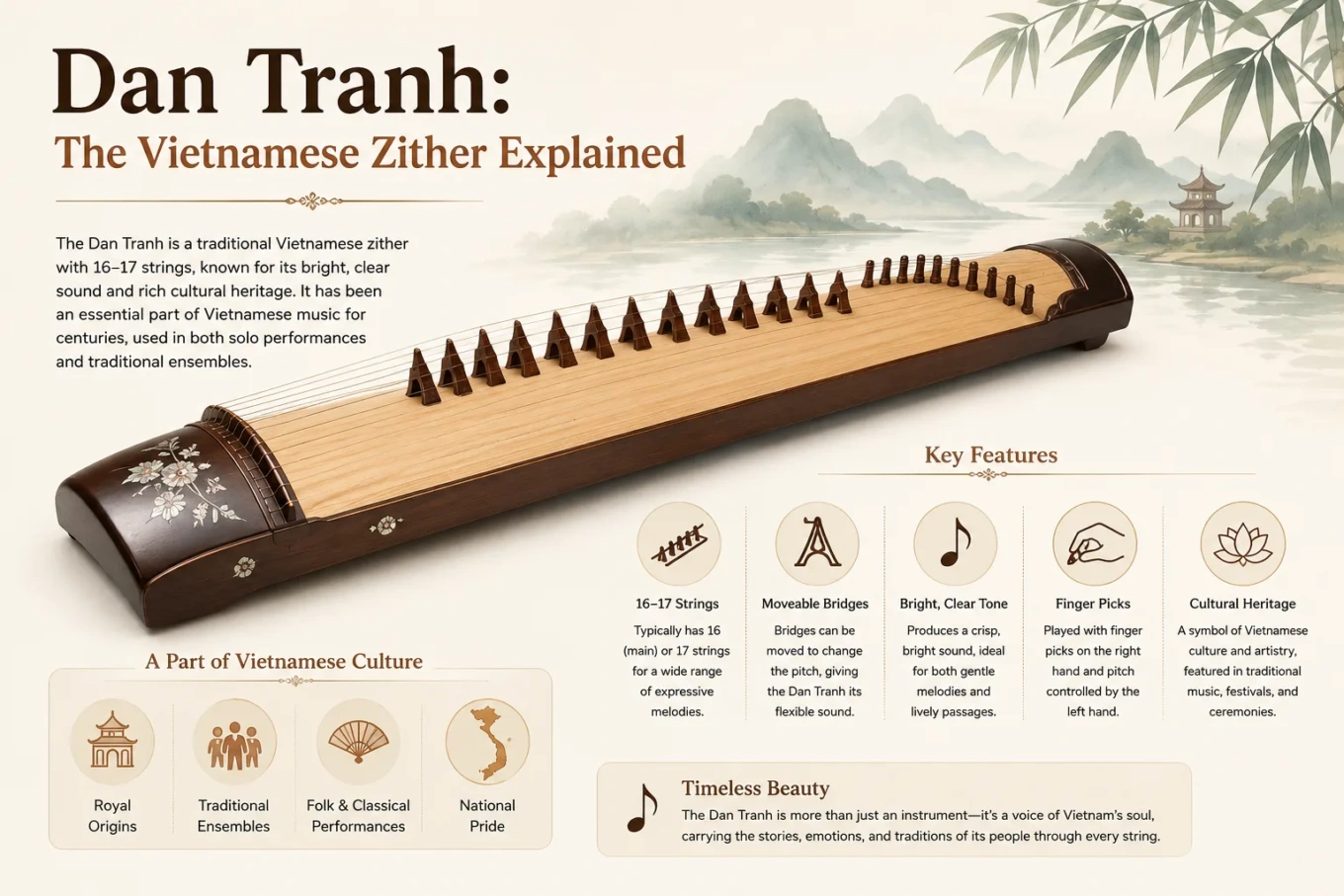
Đàn Tranh: The Vietnamese Zither Explained
The đàn tranh is a Vietnamese plucked zither[1] with a long wooden body, metal strings, movable bridges, and a bright singing tone shaped by the player’s two hands. It belongs to the wider zither family, but it is not simply a Vietnamese copy of the guzheng, koto, or gayageum. Its construction, ornamentation, repertory, and playing logic give it a clear identity within Vietnamese music.
What Is the Đàn Tranh?
Đàn tranh, often written without diacritics as dan tranh, is a Vietnamese long zither used in solo music, chamber music, theater, vocal accompaniment, and modern concert settings. In organology, it is usually described as a chordophone[2], because its sound comes from stretched strings rather than air columns, membranes, or struck solid materials.
The instrument is built as a long resonating body[3] with strings running along the top. Each string passes over a separate movable bridge[4]. The right hand plucks the sounding side of the string, while the left hand presses or releases the string on the other side of the bridge to bend pitch, add vibrato, and shape ornament.
That two-sided playing logic is one of the main reasons the đàn tranh can sound both clean and highly vocal. The open string gives a clear pitch. The left hand then gives the note motion.
Classification Note: The word “zither” can be broad or narrow. In a broad organological sense, the đàn tranh is a zither because its strings run along the body rather than away from a neck. In everyday English, some readers may think only of the European concert zither, but the đàn tranh belongs to a wider family of board and box zithers found across many regions.
Main Details Worth Knowing
| Feature | Usual Description | Why It Matters |
|---|---|---|
| Instrument Type | Vietnamese plucked long zither | Places it among zithers with strings stretched across a resonant body. |
| Body | Long wooden soundbox with a curved upper surface in many documented forms | Supports string tension and helps project the instrument’s tone. |
| Strings | Commonly metal on modern instruments; string counts vary by period and maker | Controls range, tension, brightness, and repertory options. |
| Bridges | One movable bridge for each string | Allows pitch placement and supports left-hand pitch bending. |
| Tuning | Often based on pentatonic tuning patterns[5] | Gives the instrument a flexible base for Vietnamese melodic modes and ornament. |
| Playing Method | Right-hand plucking, left-hand pressing and ornamenting | Creates slides, vibrato, pitch bends, and speech-like melodic motion. |
Names, Spelling, and Regional Use
The Vietnamese name đàn tranh combines đàn, a general Vietnamese word used for musical instruments, especially string instruments, with tranh, the instrument name. In English text, the spelling dan tranh is common because many keyboards and catalog systems omit Vietnamese diacritics.
The instrument is also linked with the name đàn thập lục, meaning “sixteen-string instrument.” This name reflects a familiar historical form with 16 strings, but it should not be treated as the only possible form. Modern instruments may have more strings, and some teaching or concert instruments use expanded ranges.
In Vietnamese cultural settings, the đàn tranh appears in several performance contexts. It may accompany singing, join small instrumental groups, support theater music, or stand alone as a solo instrument. The repertory and playing style may differ by teacher, region, ensemble type, and period.
How the Body Is Built
The đàn tranh usually has a long wooden body that functions as a soundbox[6]. In many described examples, the top is slightly curved and the bottom is flatter. This shape is often compared to a half-tube or shallow trough form, though actual profiles vary.
The upper plate works as the soundboard[7]. It receives vibration through the bridges and helps send the sound outward. The body must be strong enough to hold string tension but light enough to respond to vibration.
Wood choice can shape resonance[8], weight, and playing feel, but no single wood description fits every đàn tranh. Some sources describe softer resonant woods for the top and harder woods for pegs, side pieces, or bridges. Modern makers may adapt materials according to availability, durability, price, and the needs of students or performers.
Shape and Playing Position
The đàn tranh is normally placed horizontally in front of the player, either on a stand, on the lap, or on another support depending on context. The strings run from one end to the other. The bridges sit across the top, often arranged in a slight diagonal line rather than a perfectly straight row.
This layout gives each hand a clear role. The plucking hand works on one side of the bridges. The other hand works on the opposite string segments, changing pitch and color after the string has been sounded.
Strings, Bridges, and Tuning Logic
Many older references focus on the 16-string đàn tranh. Later instruments, including 17-string and wider-range versions, are also widely encountered. Some modern concert instruments extend beyond that. Because of this, it is safer to speak of common forms rather than a single fixed standard.
Each string usually has its own bridge. The bridge supports the string, sets the speaking length[9], and transfers vibration into the body. Moving the bridge changes the string’s vibrating length and helps place the pitch.
The đàn tranh is often tuned around pentatonic patterns, but the instrument’s music is not limited to five plain notes. Left-hand pressure can raise pitch, create inflections, and add ornaments between the main scale tones. That is why written tuning alone never fully explains the instrument’s sound.
Open Strings and Pressed Notes
An open string[10] rings without left-hand pressure. On the đàn tranh, open strings provide the basic pitch material of the tuning. The left hand then presses the non-speaking side of the string to raise the pitch, create vibrato, or lead into another note.
This system lets the player move between fixed tuning and flexible expression. The bridges set the base pitches; the hands animate them.
Luthier’s Note: A đàn tranh bridge is not only a support. Its height, mass, contact point, and fit against the soundboard can affect response. A poorly seated bridge may weaken tone or make tuning unstable, while a well-placed bridge helps the string speak clearly.
How the Đàn Tranh Is Played
The đàn tranh is most often plucked with the right hand using fingerpicks[11] or nail-like plectra. These may be worn on several fingers, commonly including the thumb, index finger, and middle finger. Materials can vary, especially between traditional practice, student instruments, and modern performance needs.
The left hand shapes the sound after the string is plucked. By pressing the string segment to the left of the bridge, the player can produce pitch bending[12], vibrato[13], slides, grace-note effects, and expressive releases.
These left-hand gestures are not decorative extras. They are central to the instrument’s voice. A note played without ornament can sound clear and direct; the same note shaped by the left hand can sound vocal, elastic, or more speech-like.
Right-Hand Work
The right hand gives attack, rhythm, and articulation. It may play single melodic notes, repeated tones, broken patterns, tremolo[14], or arpeggiated movement depending on the piece.
Clean right-hand plucking matters because the đàn tranh has a bright tone. Uneven attack can sound sharp quickly, while controlled plucking lets the resonance bloom without harshness.
Left-Hand Work
The left hand controls much of the instrument’s expressive detail. A small press can color a note. A deeper press can raise it to a nearby pitch. Repeated pressure can create vibrato, while a smooth press-and-release can make a note lean or sigh.
In many traditions of đàn tranh playing, a melody is not only a sequence of pitches. It is a line of tones that bend, settle, and breathe.
What the Đàn Tranh Sounds Like
The đàn tranh is often described as clear, bright, and ringing. Its metal strings give a focused attack, while the wooden body adds warmth and sustain. The exact sound depends on the instrument’s size, strings, bridges, setup, player, room, and recording method.
Compared with some larger long zithers, the đàn tranh can feel light and agile. It can cut through a small ensemble, but it can also soften into delicate melodic lines when the player uses lighter touch and careful damping.
What to Listen For
- Bright attack: the first sound of the plucked string is clear and immediate.
- Left-hand inflection: notes bend upward, shimmer, or relax after being plucked.
- Melodic ornament: small turns and slides often carry musical meaning.
- Open resonance: ringing strings can create a light halo around the melody.
- Contrast of stillness and motion: one note may remain pure, while the next may be shaped by pressure or vibrato.
Listening Note: A useful way to hear the đàn tranh is to follow the left hand. The plucking hand starts the note, but the left hand often tells the listener where the note is emotionally going.
How It Differs from Related Long Zithers
The đàn tranh is often compared with the Chinese guzheng, Japanese koto, Korean gayageum, and other Asian long zithers. The comparison is useful, but it can become misleading if it turns all of them into one instrument with different names.
These instruments share broad structural ideas: long bodies, stretched strings, bridges, and plucking techniques. Yet their tunings, repertories, bridge shapes, string materials, playing schools, ornament systems, and cultural roles differ.
| Instrument | Shared Feature | Main Difference to Notice |
|---|---|---|
| Guzheng | Long plucked zither with movable bridges | Chinese repertory, modern 21-string norms, and technique systems differ from Vietnamese đàn tranh practice. |
| Koto | Long zither with movable bridges | Japanese playing traditions, bridge setup, string feel, and repertory give it a different musical identity. |
| Gayageum | Korean plucked zither with bridges | String material, tone, hand technique, and Korean modal practice shape a separate sound world. |
| Qanun | Plucked zither-family instrument in broad classification | Uses a trapezoidal body and a different pitch-control system, so its playing logic is not the same. |
The closest visual comparison is often the guzheng, but the đàn tranh should still be understood through Vietnamese music. Its left-hand ornaments, melodic phrasing, and common performance roles are not interchangeable with guzheng technique.
Where the Confusion Starts
Several points cause confusion for English-speaking readers. The first is the word zither. It can mean a specific European instrument in one context and a broad family of chordophones in another. The đàn tranh belongs to the broad family, not to the European concert zither tradition.
The second point is string count. Calling it a “16-string zither” is historically meaningful, but it can be too narrow for modern use. A 16-string instrument may be called đàn thập lục, while 17-string and expanded instruments may still be called đàn tranh.
The third point is tuning. A pentatonic base does not mean the music is plain or limited. The left hand can add pitch movement, slides, and tonal shades that are not visible from a simple tuning chart.
Materials and Craft Details
Traditional and modern đàn tranh construction may include different woods, metal strings, wooden bridges, tuning pegs, and decorative surface work. Some instruments are made for students and durability. Others are built with more attention to tone, response, and visual finish.
The soundboard must be responsive but stable. The bridges must hold their place while still being adjustable. Pegs or tuning hardware must keep tension without making fine changes too difficult.
Decoration can include inlay, carved details, lacquer-like finishes, or simple polished wood. In a museum or collection setting, decoration should not be treated as a separate layer from craft. It can show regional taste, maker identity, period style, or the expected social setting of the instrument.
Care and Handling
The đàn tranh should be protected from sudden humidity and temperature changes. Wood moves, strings corrode, and bridges can shift if the instrument is handled roughly. The bridges also need care during transport, because their placement affects tuning and response.
Players often learn to check bridge alignment, string seating, and tuning before practice. Beginners should avoid forcing pegs or pressing strings too hard until they understand the tension of their own instrument.
Museum and Heritage Context
In museum language, the đàn tranh is usually described by construction, place, material, and playing method. A careful catalog entry may identify it as a Vietnamese plucked zither, note the number of strings, describe the movable bridges, and mention whether it is linked with a known maker or region.
This kind of description matters because visual similarity alone is not enough. A long zither with bridges may resemble several related instruments, but the details of body shape, tuning system, string material, local name, and performance practice help identify it more accurately.
For heritage interpretation, the đàn tranh is best presented as a living instrument rather than only an old object. It appears in teaching, performance, recordings, ensemble settings, and cross-cultural collaborations. Its form has changed in response to range, projection, pedagogy, and musical taste.
What Beginners Should Know
A beginner can start learning the đàn tranh, but the instrument is more demanding than its open layout may suggest. The strings are visible, and the basic plucking motion can be learned early. The deeper challenge is tone control and left-hand expression.
Students usually need to develop three habits:
- Accurate plucking: each note should speak cleanly without an unwanted scrape or weak attack.
- Controlled left-hand pressure: pitch bends should be intentional, not random.
- Careful listening: the player must hear how a note changes after it is plucked.
Beginners should also understand that tuning charts are only a starting point. Teacher guidance is helpful because regional style, repertory, and ornament can change how a piece should feel.
Common Misunderstandings
“The Đàn Tranh Is Just a Guzheng”
The đàn tranh is related to the guzheng in broad historical and structural terms, but it is not the same instrument in practice. Vietnamese naming, repertory, ornament, teaching lineages, and performance contexts give it a separate identity.
“Sixteen Strings Is Always the Standard”
Sixteen strings are strongly associated with the instrument’s older and familiar identity. Still, modern đàn tranh instruments may have more strings. The number should be checked for each instrument rather than assumed.
“Pentatonic Tuning Means Simple Music”
A pentatonic base can support highly detailed music. The đàn tranh uses pitch bending, vibrato, slides, and melodic decoration to create notes between and around the open-string pitches.
“All Zithers Are Played the Same Way”
Zithers can be plucked, struck, bowed, fretted, or fitted with chord mechanisms. The đàn tranh is best understood as a Vietnamese plucked long zither with movable bridges and strong left-hand pitch shaping.
Glossary of Technical Terms
[1] Plucked Zither: A zither whose strings are sounded by plucking rather than striking with hammers or bowing. In the đàn tranh, plucking starts the note while the other hand often shapes pitch and ornament.
[2] Chordophone: An instrument category in which stretched strings produce the primary sound. The đàn tranh is a chordophone because its tone comes from vibrating strings stretched across a resonant body.
[3] Resonating Body: The part of an instrument that receives string vibration and helps amplify it. On the đàn tranh, the long wooden body supports the strings and shapes the final tone.
[4] Movable Bridge: A bridge that can be shifted to alter string length and pitch placement. The đàn tranh uses separate movable bridges under the strings, allowing setup changes and left-hand pitch work.
[5] Pentatonic Tuning: A tuning approach based on five main scale tones. On the đàn tranh, pentatonic tuning gives the open strings a base pattern, while the player adds expressive pitch movement by pressing the strings.
[6] Soundbox: A hollow or resonant body that helps project string vibration. In the đàn tranh, the soundbox is the long wooden body beneath the strings and bridges.
[7] Soundboard: The vibrating top surface that helps transmit sound from the strings into the body. In many đàn tranh examples, the bridges stand on the soundboard and pass vibration into it.
[8] Resonance: The way an instrument body responds to vibration and supports sound. In zither-family instruments, resonance depends on body shape, wood, string tension, bridge contact, and setup.
[9] Speaking Length: The part of a string that vibrates freely to produce the main pitch. On the đàn tranh, the movable bridge helps define this length for each string.
[10] Open String: A string sounded without pressing it to change pitch. Đàn tranh open strings provide the main tuned notes before left-hand bending or ornament is added.
[11] Fingerpick: A small plectrum worn on a finger to pluck strings with a clear attack. Đàn tranh players commonly use fingerpicks to produce bright, controlled articulation.
[12] Pitch Bending: Raising or shaping a note by changing string tension after it is sounded. On the đàn tranh, the left hand presses the string segment beyond the bridge to bend pitch.
[13] Vibrato: A controlled wavering of pitch used to animate a note. Đàn tranh vibrato is often made by repeated left-hand pressure on the string.
[14] Tremolo: A rapid repetition of a note or sound. On the đàn tranh, tremolo can create sustained energy on a plucked string that would otherwise fade quickly.
FAQ
Is the đàn tranh a type of zither?
Yes. The đàn tranh is a Vietnamese plucked zither because its strings run along a resonating body and are sounded by plucking. It belongs to the broad zither family, not to the European concert zither tradition.
How many strings does a đàn tranh have?
The well-known traditional form has 16 strings, which is why the name đàn thập lục is often used. Modern đàn tranh instruments may have 17 or more strings, depending on maker, school, and performance need.
Is the đàn tranh the same as the guzheng?
No. The đàn tranh and guzheng are related long zithers with movable bridges, but they belong to different musical traditions. Their repertory, playing style, ornament, tuning practice, and modern instrument norms are not the same.
How is the đàn tranh played?
The player usually plucks the strings with the right hand, often using fingerpicks. The left hand presses the strings on the other side of the bridges to create pitch bends, vibrato, slides, and other ornaments.
Does the đàn tranh use movable bridges?
Yes. Each string normally has a movable bridge. These bridges help set pitch, support the string, and make the instrument’s left-hand pitch-shaping technique possible.
Is the đàn tranh hard for beginners?
Beginners can learn the basic plucking motion fairly early, but good tone and left-hand control take patient practice. The hardest part is often making pitch bends and ornaments sound intentional rather than accidental.