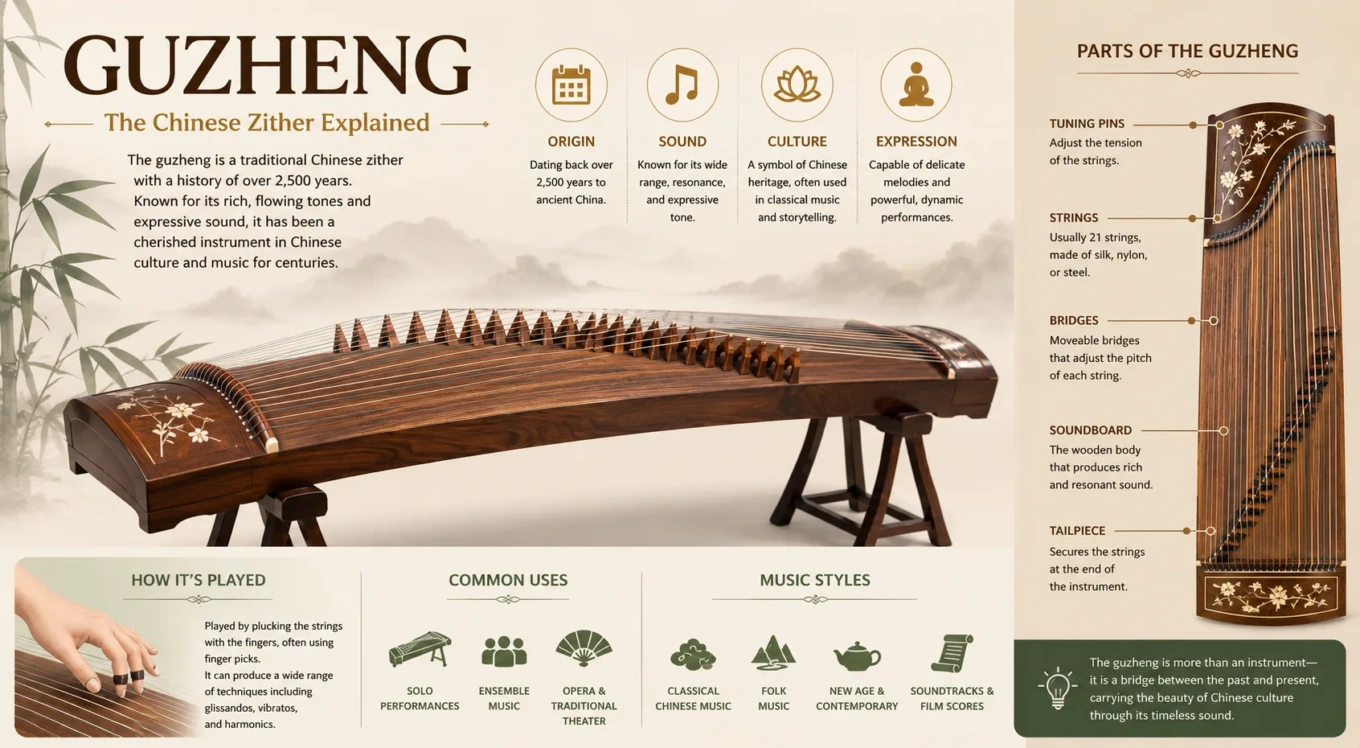
Guzheng: The Chinese Zither Explained
A guzheng is a Chinese plucked zither built around a long resonating body, a row of strings, and a separate movable bridge for each string. The form most often encountered today has 21 strings, but that number is not a fixed definition of the instrument. What makes the guzheng distinctive is the way its bridge layout divides each string into two working zones: one side is normally plucked to sound the note, while the other can be pressed to bend pitch, shape vibrato, and color the note after it has begun.
The instrument is also called zheng. The prefix gu means “ancient” or “old,” so guzheng is best understood as a modern name for the Chinese zheng tradition rather than the name of one unchanged historical model. Over centuries, zheng instruments have differed in string count, string material, construction, repertory, and regional playing practice.
What Kind of Zither Is the Guzheng?
In organological terms, the guzheng is a chordophone: its sound begins with vibrating strings. More specifically, it belongs to the broad zither family, in which the strings run across a body that supports their full sounding length rather than extending from a separate neck in the manner of a guitar or lute.
The guzheng has a resonating box with a broad upper soundboard. Strings run lengthwise over the top and pass across individual movable bridges. This layout is easy to recognize, but it should not be treated as a template for every zither. The guqin, Japanese koto, Korean gayageum, Vietnamese đàn tranh, Alpine concert zither, qanun, and many other instruments use different bridge systems, string layouts, playing methods, and musical vocabularies.
Classification Note: “Chinese zither” is a useful English description of the guzheng, but it is not interchangeable with “guqin.” Both are Chinese zithers, yet their structures and playing logic are different.
| Feature | Typical Form |
|---|---|
| Instrument family | Plucked zither and chordophone |
| String layout | Parallel strings running lengthwise across the body |
| Bridge system | One movable bridge for each string |
| Common modern string count | 21 strings, with other modern configurations also in use |
| Common modern string type | Steel-core strings with synthetic wrapping are widely used; historical strings included silk |
| Playing position | Horizontal, supported on stands or a suitable frame |
| Pitch shaping | Plucking on one side of the bridge and pressing the string on the other |
How the Body and Bridges Work Together
The Resonating Body
The guzheng body is long, hollow, and built to reinforce string vibration. Its upper board is curved rather than flat. Traditional and modern instruments use selected resonant woods for the upper board, while denser or more decorative woods may appear in structural and ornamental parts. Wood species and construction details vary among periods and makers, so a single timber specification should not be treated as universal.
The soundboard does more than provide a place to stretch the strings. Energy from a plucked string passes through its bridge into the body, allowing a much larger surface to vibrate. That interaction helps produce the guzheng’s projecting attack and lingering resonance.
Luthier’s Note: Moving a bridge changes the effective vibrating length of its string and therefore changes its open pitch. Bridge placement is part of tuning, not merely visual alignment.
One Movable Bridge for Each String
Each principal string rests on its own movable bridge. The bridge transfers vibration to the soundboard and also establishes the division between the plucking side and the pressure side of the string. Because the bridge can be repositioned, the maker or player can alter the sounding length when setting the instrument’s tuning.
This is one of the easiest ways to distinguish guzheng construction from a guqin. A guqin has no row of individual bridges. It uses open strings, stopped tones, harmonics, and finger slides directly on a long fretless surface. The two instruments may share the broad English label “Chinese zither,” but the mechanics under the hands are very different.
Two Sides of the String, Two Different Jobs
On a conventionally oriented guzheng, the player plucks the longer sounding section to the right of the bridge. The left hand can press the shorter section on the opposite side. Pressing increases string tension and raises the sounding pitch. Releasing the pressure allows it to return.
This makes pitch flexible after the initial pluck. A player can add controlled vibrato, create a bend toward another scale tone, or shape a slide-like inflection. The resulting note is not simply fixed at the moment of attack; its pitch contour can continue to change while the string is ringing.
Strings: From Silk to Modern Wound Construction
Historical zheng strings were made from silk. Modern guzhengs commonly use metal-core strings wrapped with synthetic material, a construction that supports stable tension and a different playing feel from silk. Not every instrument follows the same specification, and earlier steel-string forms are also part of the instrument’s modern development.
String design affects more than durability. Core material, wrapping, gauge, tension, bridge position, and the resonating body all influence attack, sustain, resistance under the fingers, and the ease of left-hand pitch bending. Claims that one material alone “creates” the guzheng sound are therefore too simple.
How Guzheng Tuning Actually Works
The modern guzheng is commonly set to a pentatonic tuning, meaning the open strings are organized around a five-note pitch collection repeated through several registers. D-based pentatonic tuning is widely encountered in teaching and performance, but the guzheng is not restricted to one permanent tuning.
A typical pentatonic pattern can be understood as scale degrees 1–2–3–5–6. The apparent absence of 4 and 7 from the open-string layout does not mean the instrument cannot produce those pitches. A player can press a string on the opposite side of its bridge to raise its pitch, and a piece may also call for retuning selected strings.
Why a Pentatonic Layout Does Not Limit the Instrument to Five Notes
The bridge system gives the performer access to pitch inflection between fixed open-string notes. If an open string sounds scale degree 3, for example, carefully increasing tension on the other side of its bridge can raise that pitch toward a neighboring note. The exact pressure depends on the string, register, setup, and musical context.
Modern repertory can also use altered tunings, chromatic passages, and techniques that require both hands in the main plucking area. For that reason, “the guzheng uses a pentatonic scale” is a useful starting point, not a complete description of its pitch resources.
How the Guzheng Is Played
Players typically sit at the instrument with the guzheng placed horizontally. Fingerpicks are commonly attached to several fingers with tape, especially on the plucking hand. Contemporary technique may use picks on both hands, depending on school, repertory, and performer.
Plucking and Articulation
Individual notes can be plucked with the thumb or fingers, and patterns can move quickly across adjacent strings. The angle of contact, pick position, string register, and force of the stroke all change the resulting articulation. Lower strings respond differently under the hand from the shorter, higher-pitched strings.
Left-Hand Pressing, Bending, and Vibrato
Left-hand pressure on the non-sounding side of the bridge is central to traditional guzheng expression. A slow, controlled pressure change can reshape the pitch after a note begins. Repeated pressure and release creates forms of vibrato, while deeper or more deliberate motion can produce recognizable pitch bends.
The technique is not an added effect placed on top of the melody. In many styles, the exact motion of a pressed note belongs to the phrase itself. Two players can strike the same open pitch yet shape it differently through timing, pressure, release, and ornament.
Glissando
A glissando is produced by moving rapidly across a sequence of strings so that many notes sound in close succession. Because the open strings often follow a pentatonic layout, the resulting sweep has a pitch pattern unlike a chromatic keyboard glissando.
Tremolo and Repeated-Note Technique
Rapid alternation or repeated strokes can sustain the impression of a long tone on a plucked instrument. Modern guzheng technique includes highly developed repeated-note methods, including thumb-based tremolo. These techniques help extend melodic lines beyond the natural decay of a single pluck.
Listening Note: Listen for what happens after the attack. A guzheng note may begin with a clear pluck, then change in pitch, width of vibrato, or tension while the string continues to resonate. That post-attack shaping is one of the instrument’s most identifiable traits.
Why the Guzheng Has Such a Recognizable Sound
The guzheng’s timbre comes from several interacting parts of the instrument rather than one feature. The bridge gives each string a direct path into the soundboard. The large resonating body supports sustain and projection. Wound strings provide a clear initial attack, and left-hand pressure allows pitch to move after that attack.
Register also matters. Lower strings can sound broad and weighty, while upper strings have a shorter, more focused response. Glissandi expose several registers in a single gesture, whereas pressed notes draw attention to the instrument’s flexible pitch behavior.
A useful way to hear the instrument is as a sequence of events: pluck, resonance, pressure, release. Not every note uses all four, but this pattern explains why a sustained guzheng phrase can feel more fluid than a simple row of separately plucked pitches.
The Guzheng’s Early History Is Not a Single Invention Story
The zheng tradition is documented in China for well over two millennia. Early written references and excavated zithers show that instruments associated with the zheng tradition were present by the late first millennium BCE. Archaeological finds of early multi-string zithers also make the instrument’s beginnings more complicated than later stories that assign it to one inventor.
Historical Evidence and Traditional Origin Stories
One traditional account connects the zheng with the Qin period and the military figure Meng Tian. Another tells of a larger se zither being divided, producing smaller instruments with different string counts. Such stories belong to the history of how the instrument was remembered and explained, but they should not be presented as proven construction records.
History Note: Archaeology, early texts, and later legends do not always tell the same story. The safest description is that the zheng has a long documented history in China and changed through multiple regional and historical forms rather than appearing as one finished design at a single moment.
From Earlier Zheng Forms to the 21-String Guzheng
Early zheng instruments did not have the same standardized appearance as the modern concert guzheng. Historical descriptions and surviving evidence show changes in string count and construction over time. Twelve- and thirteen-string forms are associated with early periods, while later instruments used larger string complements. Sixteen-string zhengs became well established before 20th-century designs expanded the range further.
The 21-string guzheng became one of the dominant modern forms during the 20th century. Its popularity does not erase other configurations. Instruments with more strings also exist, and makers continue to adapt dimensions, materials, fittings, and string systems for different performance needs.
The move from silk to modern wound strings also changed tension, projection, and touch. These material changes went together with new repertory and technique. The modern guzheng therefore carries an old instrumental idea in a form shaped by later workshops, conservatory practice, performers, and composers.
Regional Guzheng Traditions Shape Technique and Repertory
“Guzheng style” is not one uniform performance language. Regional zheng traditions developed different repertories, modal habits, ornaments, phrase shapes, and technical preferences. Commonly discussed schools include traditions associated with Henan, Shandong, Chaozhou, Hakka communities, Zhejiang, and Shaanxi, although lists and labels vary among teachers and historical sources.
| Tradition | What Commonly Differs |
|---|---|
| Henan | Regional repertory, melodic turns, ornaments, and links with local vocal and instrumental practice |
| Shandong | Distinct repertory and articulation patterns associated with northern zheng practice |
| Chaozhou | Detailed pitch inflection, modal treatment, and ornament shaped by the Chaozhou musical tradition |
| Hakka | Repertory and phrase treatment tied to Hakka musical practice |
| Zhejiang | Solo repertory and techniques that influenced later concert performance |
| Shaanxi | A revived and developed regional zheng tradition drawing on local musical material |
These labels describe living performance traditions rather than six mechanically fixed “types” of guzheng. A modern player may study more than one school, and concert repertory often crosses regional boundaries.
Guzheng, Guqin, and Koto: Similar Family, Different Instruments
The guzheng is sometimes confused with the guqin because both are Chinese zithers, and with the Japanese koto because guzheng and koto share a visually obvious row of movable bridges. Similarity of outline does not make them interchangeable.
| Instrument | Structural Clue | Playing Logic |
|---|---|---|
| Guzheng | Many strings, each with an individual movable bridge | Plucking combined with bridge-side pressing, bending, and retuning |
| Guqin | Seven strings and no individual movable bridges | Open tones, stopped tones, harmonics, and slides on a fretless surface |
| Koto | Traditionally 13 strings with movable bridges, alongside modern variants | Japanese tuning systems, technique, repertory, and bridge practice distinct from guzheng traditions |
The koto has historical connections with continental East Asian zither traditions, but it developed its own construction practice and musical history in Japan. Likewise, the guqin should be understood on its own terms rather than treated as a smaller or older guzheng.
Repertory Reveals What the Instrument Can Do
Traditional and modern pieces make different parts of the guzheng’s design audible. A lyrical piece may foreground pressed tones and carefully controlled vibrato. Fast repertory can use repeated notes, sweeping glissandi, rapid alternation between the hands, and sharply articulated patterns across several registers.
Pieces such as Fisherman’s Song at Dusk are widely associated with guzheng repertory and demonstrate the instrument’s melodic and resonant character. Works developed in the 20th-century concert tradition pushed further into denser textures, stronger rhythmic writing, and expanded two-hand technique. The instrument’s modern repertory therefore cannot be reduced to one “traditional sound.”
The Guzheng in Contemporary Performance and Music Technology
The guzheng remains an acoustic performance instrument, but contemporary composition has widened the ways its sound is used. Solo concert works, mixed ensembles, cross-cultural projects, amplified performance, and experimental composition can all place the instrument outside older regional repertory without changing its identity as a zheng.
Recent music-technology research has also treated guzheng performance as a machine-listening problem. Studies have tested automatic recognition of playing techniques, pitch and tone analysis, generated guzheng-like musical material, and interactive systems that model aspects of rhythm or performance style. Research published in 2026 includes neural-network approaches to guzheng tone analysis and real-time pitch-related processing, as well as computational work on rhythmic modeling.
These projects are useful because guzheng sound is difficult to reduce to note names alone. A single note may carry onset information, pitch movement, vibrato, bending, and technique-specific changes over time. Computational analysis therefore has to account for some of the same details that human listeners use to distinguish one guzheng gesture from another.
What to Look for When Identifying a Guzheng
- A long horizontal resonating body with a curved upper profile.
- A separate movable bridge supporting each string.
- A large group of parallel strings rather than a small set of seven or fewer.
- A main plucking area on one side of the bridge row.
- A second string area used for pressure, bends, and vibrato.
- Modern instruments commonly carrying 21 strings, while other string counts remain possible.
The bridge row is the clearest visual clue. On a playable instrument, however, the defining feature is more functional: the bridges organize both tuning and expression. They determine open-string length while also giving the player a separate area where pressure can reshape a sounding note.
Glossary of Technical Terms
Zither: A broad class of string instruments in which the strings extend across a body that supports their sounding length. The term can also be used more narrowly for certain European instruments, so context matters.
Movable Bridge: A bridge that is not permanently fixed in one location. On the guzheng, each string has its own bridge, and changing its position alters the effective sounding length used for tuning.
Vibrato: A controlled fluctuation around a pitch. Guzheng players can create it by repeatedly changing pressure on the string section beyond the movable bridge.
Chordophone: An instrument whose primary sound source is a vibrating string. Zithers, lutes, harps, and bowed string instruments all belong to this broad category, although their structures differ.
Soundboard: The resonant surface that receives string vibration through the bridges and helps radiate sound. On the guzheng it forms the broad upper part of the resonating body.
Open Pitch: The pitch produced when a string is sounded without using left-hand pressure to raise it. Guzheng open pitches are commonly arranged in a pentatonic pattern.
Pentatonic Tuning: A tuning organized around a five-note pitch collection. On modern guzhengs, this pattern commonly repeats through several registers, while pressed notes and retuning provide pitches outside the open-string set.
Glissando: A rapid sweep across a succession of pitches. On guzheng, the pattern follows the pitches available on the strings being swept rather than automatically forming a chromatic sequence.
Tremolo: Rapidly repeated or alternating strokes used to create the impression of a sustained or intensely repeated tone on a plucked string instrument.
Timbre: The quality that lets listeners distinguish sounds beyond pitch and loudness. Guzheng timbre reflects string construction, register, attack, body resonance, bridge behavior, and pitch shaping by the hands.