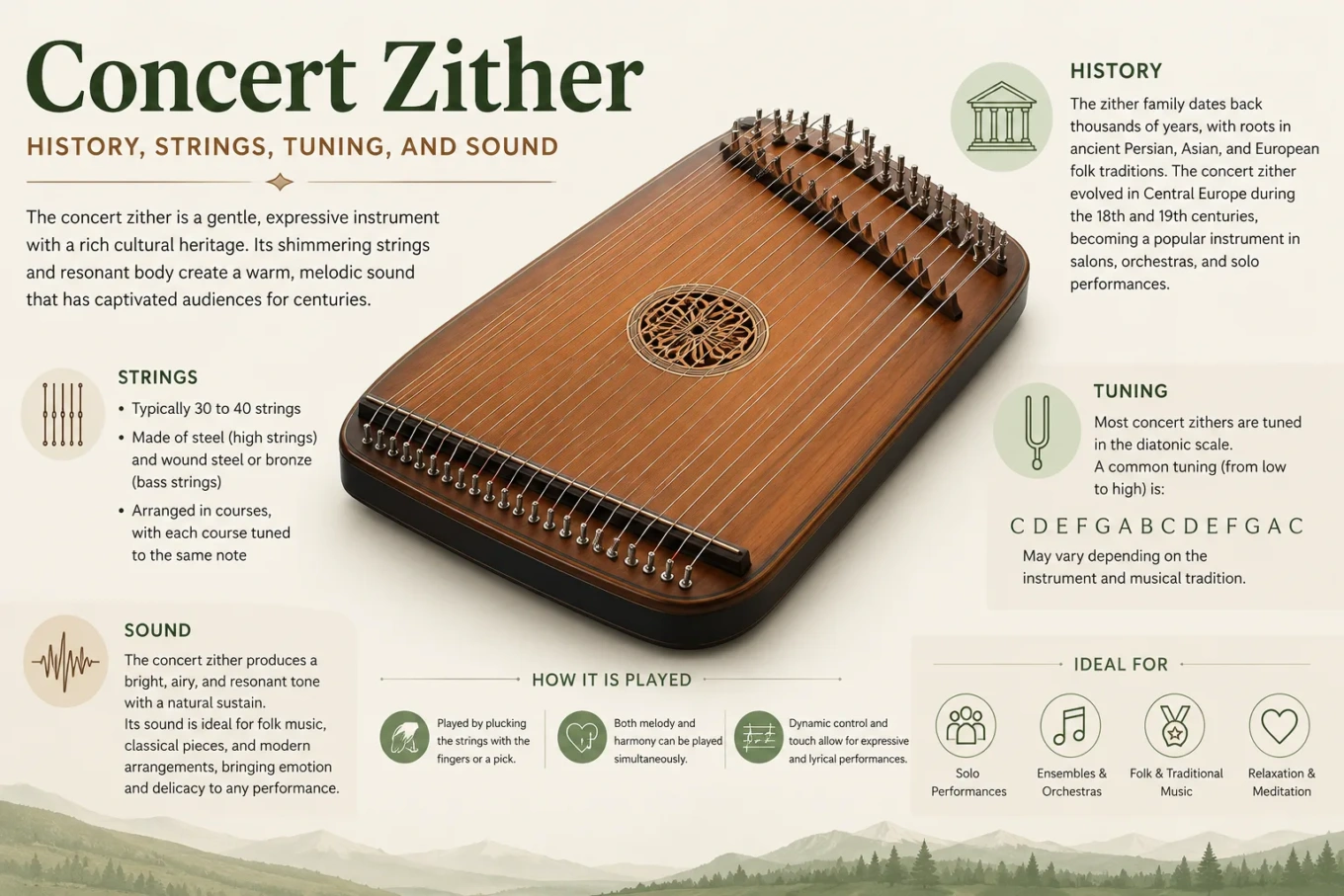
Concert Zither: History, Strings, Tuning, and Sound
A concert zither[1] is a European table zither with two working areas: a fretted melody side and a larger field of unstopped strings for harmony, bass, and color. Its left-hand fretboard[2] makes it different from many other zithers, yet its strings still run across the body rather than along a separate neck. The word zither[3] can describe a broad chordophone[4] family, but the concert zither is a more specific Alpine and Central European form.
What a Concert Zither Is
In organology[5], the concert zither is usually treated as a fretted zither[6]: the body supports the strings, and the player changes pitch on a small fretted area rather than on a long neck. This places it close to other board and box zithers, but not identical to guzheng, koto, kantele, qanun, santur, psaltery, dulcimer, or autoharp.
The instrument’s layout explains its special sound. The melody strings[7] sit nearest the player and pass over the fretted area. The open strings[8] lie beyond them and are plucked without being stopped by the left hand. This split design lets one player carry melody, harmony, and bass at the same time.
| Feature | Usual Description |
|---|---|
| Instrument Type | European fretted table zither, often linked with Alpine and Central European playing traditions. |
| String Layout | Usually four or five fretted melody strings, followed by unfretted accompaniment strings[9], bass strings[10], and sometimes contrabass strings[11]. |
| Common String Counts | Many concert zithers fall around 29 to 38 strings. Student and modern models may have 32 strings, while larger Alpine-related forms can carry more. |
| Playing Position | Flat on a table, stand, or lap, with the fretted side closest to the player. |
| Musical Role | Melody, chordal support, bass motion, arpeggios, and solo arrangements on one instrument. |
Classification Note: A concert zither should not be reduced to “any zither.” It is a particular fretted European design. The wider zither family includes plucked, struck, bowed, fretted, fretless, board, box, tube, and trough forms, depending on region and structure.
Names, Regional Use, and Common Confusion
The concert zither is often associated with German-speaking Alpine regions, especially Austria and southern Germany, though related instruments and repertories appear across parts of Central Europe. German terms such as Konzertzither may be used in maker catalogues, museum records, and teaching materials.
Two historical body styles are often named in older discussions: the Salzburg type, with one side more rounded, and the Mittenwald type, with rounded shaping on both sides. These names describe shape and making tradition more than a totally separate instrument family.
Confusion starts because “zither” has more than one use. In a narrow European context, it may mean the concert zither. In a wider instrument-family sense, it can include fretless board zithers, tube zithers, box zithers, struck dulcimers, and several Asian plucked zithers. That does not mean these instruments are built or played the same way.
How the Instrument Developed
The concert zither grew from older European fretted and drone-based table instruments. Earlier forms often had a small number of melody strings and drone strings[12], with a long, box-like body. They were practical folk instruments before the concert form became more refined for salon, teaching, and stage use.
During the nineteenth century, makers and players worked toward a more controlled instrument: more strings, a clearer bass layout, fixed bridges, and a fretted melody section that could handle a wider range of keys. Nikolaus Weigel of Munich is often linked with proposals for a more developed zither design in the 1830s, while Max Amberger is often named among the makers who helped bring the modern concert form into wider use in the 1860s.
Johann Petzmayer helped make the zither known beyond local folk settings. Later, Anton Karas brought the instrument to a wider public through the music for The Third Man. That film did not define the whole concert zither tradition, but it fixed the instrument’s sharp attack and shimmering decay in many listeners’ memory.
The concert zither should also be separated from instruments that use movable bridges[13], such as guzheng or koto. On a concert zither, the bridge layout is normally fixed, and the fretted section handles melodic pitch changes.
Body, Wood, and Resonating Design
A concert zither has a shallow wooden body. The top plate, or soundboard[14], carries much of the string vibration into the air. The wider resonating body[15] supports the top, shapes the response, and gives the instrument more carrying power than the strings alone would have.
Spruce is often used for soundboards in European string instruments because it can be light, stiff, and responsive. Backs and sides may use maple, mahogany, rosewood veneer, or other woods, depending on maker, age, region, and price level. Decorative veneers do not always reveal the acoustic wood beneath them.
The bridge[16] system has to do more than hold strings in place. It transfers vibration into the body and helps set string length. A poorly fitted bridge, loose pin, warped top, or cracked soundboard can change the instrument’s voice, tuning stability, and playability.
Luthier’s Note: Wood choice can shape response, but it should not be treated as a magic formula. Age, soundboard thickness, string tension, bridge condition, humidity, and setup can matter as much as the wood name printed in a listing.
Strings and Layout
The concert zither’s identity comes from its divided string field. The fretted strings[17] handle melody. The unfretted strings handle accompaniment, bass, and lower support. This lets the instrument behave partly like a small fretted instrument and partly like a harp-like table zither.
Many concert zithers have five melody strings, though some older or regional examples may use four. The five-string layout is often described from the player’s side outward, with two high strings followed by lower melody strings. These strings are not usually paired into a course[18] in the way mandolin-family instruments are; each melody string has its own role.
Beyond the melody strings, the accompaniment area usually includes a run of open strings arranged to support chords and arpeggios. The bass and contrabass strings extend the lower range. On larger instruments, the bass side can be more physically demanding because the player must reach farther across the soundboard.
Typical String Groups
- Melody area: fretted strings near the player, stopped by the left hand.
- Accompaniment area: open strings used for inner harmony and broken chords.
- Bass area: lower open strings used for harmonic weight and line movement.
- Contrabass area: the lowest open strings on larger or extended instruments.
String material may include plain steel, wound metal strings, and specialized zither sets made for specific scale lengths and tunings. Replacing strings without checking the intended tuning and scale can create uneven tension or poor response.
How It Is Played
The concert zither is normally played flat. The left hand stops the fretted melody strings, while the right hand plucks melody and open strings. Many players use a thumb plectrum[19] for the melody side, with fingers used for accompaniment and bass.
This technique creates a layered texture. The thumb can bring out a tune on the fretted side, while the fingers add open-string harmony. Skilled players can make the instrument sound as if two actions are happening at once: a clear melodic line and a flowing background of arpeggiated support.
The right-hand layout also shapes musical phrasing. Since the open strings are arranged in a set order, the player learns physical patterns as much as note names. Good technique depends on hand memory, clean damping, and careful balance between melody and accompaniment.
Pitch Layout and Tuning Systems
Tuning[20] is one of the hardest parts of understanding the concert zither because there is not one universal layout for every instrument. Munich tuning[21] is widely used on modern concert zithers. In many five-string examples, the fretted melody strings are commonly given as A, A, D, G, C, with octave placement depending on notation and instrument type.
Viennese tuning[22] is another documented system. It is often described with A, D, G, G, C on the fretted side. Some players and instruments mix ideas from different traditions, especially when dealing with older instruments, teaching methods, or regional repertory.
The unfretted strings are commonly arranged using a cycle of fifths[23] logic. This helps the hand find related harmonic areas. In extended layouts, lower strings may add a chromatic[24] descent or extra bass notes, but the exact pattern depends on the instrument.
| Term | What It Usually Refers To |
|---|---|
| Munich Tuning | A widely used concert zither system, often with fretted strings described as A, A, D, G, C. |
| Viennese Tuning | A documented alternative, often with the fretted side described as A, D, G, G, C. |
| Accompaniment Layout | Open strings arranged to support chords, arpeggios, and harmonic movement. |
| Bass and Contrabass Area | Lower open strings that extend the range and add depth. |
| Colored Reference Strings | Strings used as visual guideposts; patterns vary by maker and tuning set. |
Some instruments use colored guide strings. A separator string[25] helps the player locate pitches by sight and touch, much like colored strings on some harps. The color system should be read as a playing aid, not as proof that every zither follows the same tuning.
The Listening Character of the Concert Zither
The concert zither has a bright, detailed attack and a clear decay. Its timbre[26] can feel delicate when played softly, but it can also sound crisp and pointed when the melody string is plucked with a thumb pick. The open strings add resonance[27] around the fretted melody.
The instrument’s sustain[28] depends on string length, tension, wood response, damping, and room acoustics. A table or stand can also affect projection because the instrument is normally played lying flat. Players often learn to control ringing strings as much as they learn to make notes sound.
Although the concert zither is not normally built with a dedicated set of sympathetic strings[29], its open strings can still vibrate in response to related pitches. This sympathetic response is part of the shimmering quality heard in many solo arrangements.
Listening Note: The sound is not only “sweet” or “old-fashioned.” A well-set concert zither can produce sharp articulation, dry bass punctuation, soft arpeggios, and ringing harmonic color within a short phrase.
Concert Zither, Alpine Zither, Autoharp, and Dulcimer
The concert zither and Alpine zither are close relatives. The Alpine zither often has a larger body extension and more low strings, especially in forms with extended contrabass range. The concert zither is usually more compact, though size and string count vary by maker.
The autoharp is not the same instrument. It is a chord zither with bars that mute unwanted strings so the player can strum preset chords. A concert zither has a fretted melody area and requires the player to select individual strings more directly.
The hammered dulcimer also belongs near the wider zither family in classification, but its playing logic differs. It is struck with small hammers, not fretted by the left hand. A mountain dulcimer is another separate case: it has a fretted string layout and drone traditions, but it is not built like a concert zither.
What Beginners Should Know
The concert zither can be rewarding, but it is not the simplest zither to start without guidance. The player must learn two systems at once: left-hand fretting and right-hand open-string navigation. Tuning also takes patience because there are many strings and several accepted layouts.
Beginners should first identify the instrument type before changing strings. A 32-string concert zither in Munich tuning needs a different string plan than a larger Alpine model, a chord zither, or an older folk zither. Guessing from appearance alone can lead to wrong tension and poor tuning stability.
Practical first steps include:
- Count the strings and separate the fretted section from the open-string field.
- Check whether the instrument is set up for Munich or Viennese tuning.
- Look for loose tuning pins, cracked wood, lifting bridges, and missing strings.
- Use a tuning chart that matches the exact instrument type.
- Learn damping early so open strings do not blur every phrase.
Collector’s Note: Reading an Older Instrument
Older concert zithers often appear in attics, estate sales, and museum collections. Some are playable after careful setup; others are mainly historical objects. Ornament, inlay, and veneer can be attractive, but they do not prove that the instrument is concert-ready.
A useful inspection starts with structure. The top should not be badly sunken, the bridges should sit firmly, and the tuning pins should hold. Missing strings are common, but a missing string pattern can make it hard to identify the intended tuning. In that case, the number of fretted strings, body shape, scale length, and pin layout matter more than decoration.
Labels can help, but they can also mislead. Some instruments were sold under trade names or exported through dealers. Museum-style description should focus on construction, string layout, playing method, region, and maker evidence rather than a single romantic label.
FAQ About the Concert Zither
Is a Concert Zither the Same as a General Zither?
No. A concert zither is one specific European fretted zither. The wider zither family includes many other instruments with different bodies, tunings, bridges, and playing methods.
How Many Strings Does a Concert Zither Have?
Many concert zithers have around 29 to 38 strings, with 32-string student and modern models often seen. Larger Alpine-related instruments can have more, so the string count should always be checked on the actual instrument.
What Is Munich Tuning on a Concert Zither?
Munich tuning is a widely used concert zither tuning system. On many five-string fretted sections, it is commonly described as A, A, D, G, C, while the open strings follow a separate accompaniment and bass layout.
Does a Concert Zither Have Frets?
Yes. The melody side has a fretted area where the left hand stops the strings. The accompaniment, bass, and contrabass strings are usually open and are not stopped against frets.
Is a Concert Zither the Same as an Autoharp?
No. An autoharp uses chord bars that mute strings for strummed chords. A concert zither uses a fretted melody section with separate open strings for accompaniment and bass.
Why Does the Concert Zither Sound Both Melodic and Harp-Like?
The fretted strings carry the melody, while the open strings add harmony, bass, and ringing color. This split layout creates the instrument’s mix of clear melodic attack and shimmering resonance.
Glossary of Technical Terms
[1] Concert Zither
A European fretted table zither with melody strings over a fretted area and additional open strings for accompaniment and bass. It is more specific than the broad word “zither.”
[2] Fretboard
The fretted playing surface under the melody strings. On a concert zither, it sits on the side nearest the player rather than on a separate neck.
[3] Zither
A broad instrument-family term for chordophones whose strings run across or along a body without a separate neck in the guitar or lute sense. In some European contexts, the word may refer more narrowly to the concert zither.
[4] Chordophone
An instrument that produces sound through vibrating strings. Zithers, lutes, harps, and lyres are all chordophones, but their structures differ.
[5] Organology
The study and classification of musical instruments. For zithers, organology looks at body shape, string position, bridges, playing method, and sound production.
[6] Fretted Zither
A zither with at least one string area where the player changes pitch by pressing strings against frets. The concert zither is a main European example.
[7] Melody String
A string used mainly for the tune or lead line. On the concert zither, these strings sit over the fretboard and are stopped by the left hand.
[8] Open String
A string sounded without being pressed against a fret. Concert zither accompaniment, bass, and contrabass strings are usually played open.
[9] Accompaniment String
An open string used for chord tones, arpeggios, and harmonic support. These strings help the concert zither provide more than a single melody line.
[10] Bass String
A lower-pitched open string used to support harmony and rhythmic motion. Concert zithers often place bass strings beyond the accompaniment area.
[11] Contrabass String
An even lower open string found on larger or extended concert and Alpine zithers. These strings give the instrument a deeper range.
[12] Drone String
A string that sounds a repeated or sustained pitch rather than a full changing melody. Older European zither relatives often used drone strings more heavily than the modern concert zither.
[13] Movable Bridge
A bridge that can be repositioned to change string length and pitch. Concert zithers normally use fixed bridge layouts, unlike instruments such as guzheng or koto.
[14] Soundboard
The top plate that receives string vibration through the bridge. On a concert zither, the soundboard plays a large role in volume, response, and tonal color.
[15] Resonating Body
The hollow or chambered body that supports and amplifies string vibration. Its shape, depth, wood, and condition affect how the concert zither responds.
[16] Bridge
A part that supports the strings and transfers vibration into the soundboard. Bridge condition is vital for tuning stability and tone on older zithers.
[17] Fretted String
A string whose sounding length can be shortened by pressing it against frets. On the concert zither, the fretted strings are mainly used for melody.
[18] Course
A group of one or more strings treated as one musical unit. Concert zither melody strings are usually discussed as separate strings rather than paired courses.
[19] Plectrum
A small pick used to pluck a string. Concert zither players often use a thumb plectrum for the melody strings while the other fingers play open strings.
[20] Tuning
The pitch arrangement assigned to the strings. Concert zither tuning must match the instrument’s string count, scale length, and regional system.
[21] Munich Tuning
A widely used concert zither tuning system. The fretted side is often described as A, A, D, G, C on five-string instruments, with separate open-string layouts.
[22] Viennese Tuning
An alternative concert zither tuning tradition. It is often described with A, D, G, G, C on the fretted side, though exact use depends on instrument and player.
[23] Cycle of Fifths
A pitch relationship in which notes move by fifths. Concert zither open-string layouts often use this logic to organize harmonic areas under the right hand.
[24] Chromatic
Using all twelve semitones within an octave. In concert zither contexts, chromatic layouts help support playing in more keys.
[25] Separator String
A colored or otherwise marked string that helps the player locate pitches. On concert zithers, these visual guideposts can make the open-string field easier to navigate.
[26] Timbre
The tonal character of a sound beyond pitch and loudness. Concert zither timbre is shaped by plucking method, strings, wood, bridge setup, and damping.
[27] Resonance
The way the body and nearby strings respond to vibration. Concert zither resonance gives open-string passages their ringing, blended quality.
[28] Sustain
How long a note continues after it is plucked. On a concert zither, sustain varies across melody, accompaniment, bass, and contrabass strings.
[29] Sympathetic String
A string that vibrates in response to another note rather than being directly plucked. Concert zithers do not normally use a separate sympathetic-string bank, but their open strings can still respond sympathetically.