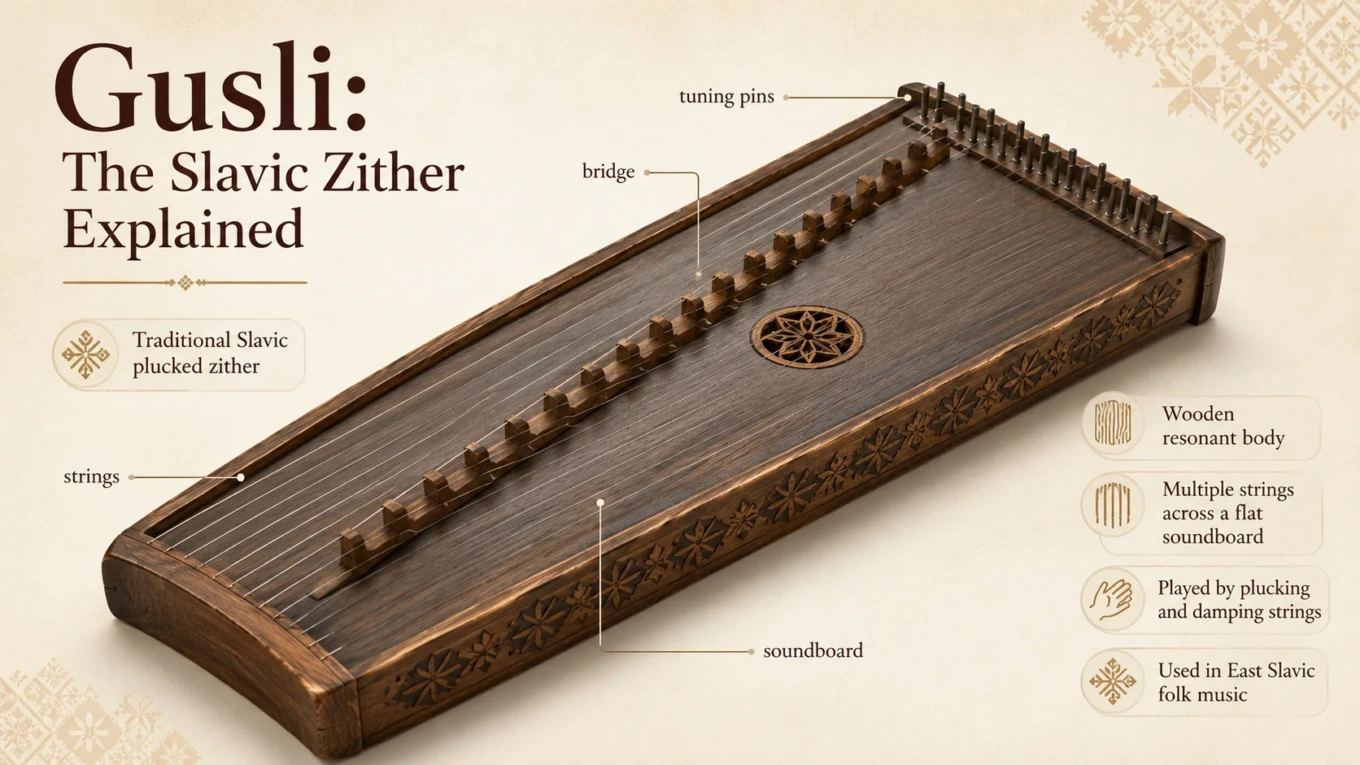
Gusli: The Slavic Zither Explained
The gusli is a Slavic plucked zither[1]: a string instrument whose strings lie across a wooden body rather than running along a neck. In organological language, it is a chordophone[2], but the zither label is more useful for understanding how it works. The player does not stop strings against a fingerboard like a violin or guitar; the sound comes from open, tuned strings set into vibration by the fingers or a small pick.
What Is the Gusli?
The gusli is best understood as a family of East Slavic and related regional zithers, not one fixed model. Small lap instruments, larger table forms, and later keyboard-linked instruments may all appear under the gusli name, depending on period, region, collection record, and musical setting.
Most gusli share a simple idea: strings stretch over a wooden soundboard[3], and the body beneath or around that board acts as a resonating body[4]. The result is a clear, ringing sound with a bright attack and a short-to-moderate sustain, shaped by the wood, string material, body depth, and playing touch.
The name is often associated with Russian musical culture, especially because many museum catalogues and modern ensembles describe Russian gusli. Related names and forms also appear in wider Slavic and neighboring musical traditions. Care is needed here: a gusli is not the same instrument as the Balkan gusle, which is usually a bowed instrument with a different body, neck, and musical role.
Classification Note: In a broad zither sense, the gusli belongs with instruments whose strings run across the body of the instrument. In a narrower cultural sense, gusli refers to a set of Slavic plucked instruments with their own names, shapes, and performance habits.
Main Details Worth Knowing
| Feature | Typical Pattern | What Varies |
|---|---|---|
| Instrument family | Plucked zither within the chordophone group | Some catalogue systems use more specific zither subtypes |
| Body shape | Flat, shallow wooden body; often wing-like, helmet-like, or table-like | Outline, depth, decoration, and size vary by regional form and maker |
| Strings | Several open strings stretched across the body | Older small forms may use fewer strings; modern ensemble forms may use more |
| Tuning | Often arranged for scale-based playing | No single tuning fits every gusli type |
| Playing method | Plucked, brushed, or strummed by hand or with a pick | Muting, melodic plucking, and accompaniment patterns differ by style |
| Musical role | Song accompaniment, folk ensemble use, solo playing, and staged performance | Role depends on local tradition, repertoire, and instrument size |
Why the Gusli Is a Zither
In organology[5], instruments are grouped by how they produce sound and how their vibrating parts are supported. The gusli is placed with zithers because its strings are stretched across a body without a separate neck. That is the same broad reason why kantele, kanklės, kokle, kannel, psaltery, guzheng, koto, qanun, and many dulcimer types can be discussed near the zither family, even though they are not the same instrument.
The Hornbostel-Sachs classification[6] gives another useful angle. Some gusli forms are described as a trough zither[7] when the resonating body is hollowed in a trough-like way. Other related zithers may be treated closer to a box zither[8] when the resonator is built as a box-like structure.
This is why the word “zither” can feel both exact and broad. It is exact in describing string layout. It is broad because it does not tell the whole story of playing method, repertoire, tuning, or cultural use.
Names, Spellings, and Common Confusion
The English word gusli is usually taken from Russian гусли. Ukrainian husla and other related forms may appear in discussions of regional string instruments. Transliteration can vary, and older collection labels may use spellings that reflect the cataloguing practice of their time.
The term can also be confusing because similar-looking words do not always name similar instruments. The Balkan gusle, for example, is commonly a bowed chordophone with a neck and a single main string in many forms. It belongs to a different playing world than the plucked lap gusli.
A second confusion comes from the word “zither.” In English, zither can refer to the European concert zither in a narrow sense, or to a broad family of instruments with strings stretched over a body. The gusli belongs to the second meaning. It should not be treated as a Russian version of the Alpine concert zither, nor as a direct copy of the guzheng or koto.
Body Forms: Wing, Helmet, Table, and Keyboard Gusli
Several named gusli forms appear in modern writing and museum description. The most familiar are often grouped by body outline and playing setup.
Wing-Shaped Gusli
Wing-shaped gusli are often described with an asymmetrical outline: one side broadens, while the other side narrows toward the tail end. Smaller examples can be held on the lap. The body may be carved or assembled from wood, depending on maker, period, and local habit.
These instruments are often the easiest for a newcomer to recognize as a folk zither. Their strings sit openly across the top, and the player can pluck, brush, or strum while controlling resonance with the other hand.
Helmet-Shaped Gusli
Helmet-shaped gusli have a broader, rounded outline. The name describes the visual impression more than a strict acoustical rule. Some examples are larger than compact wing-shaped forms and may offer a broader string field.
The extra width can change the player’s hand position and the way patterns fall under the fingers. It does not automatically mean one fixed tuning, one fixed string count, or one single repertoire.
Table and Keyboard Gusli
Table-like gusli and keyboard gusli belong more closely to staged, ensemble, and later adapted performance settings. They can be larger and may include mechanical features that help select or sound strings.
These forms show how the gusli name did not remain tied to only one rural lap instrument. It also entered arranged folk orchestra practice, teaching settings, and modern presentation. The basic zither idea remains, but the playing logic can change a great deal.
Construction and Materials
A gusli usually begins with a wooden body. Documented examples and later reconstructions may use woods such as spruce, pine, alder, maple, or other locally available materials, but no single wood defines the whole family. Wood choice can shape resonance, weight, stability, and touch response, yet the final sound also depends on body thickness, string tension, bridge placement, and workmanship.
The top surface carries the strings and vibrates with them. On some instruments the body may be carved from a single piece or made from joined parts. Small soundholes may appear in certain forms, but their size and placement are not uniform across the gusli family.
Luthier’s Note: A shallow wooden body does not make the gusli weak. It makes the instrument sensitive to string tension, top thickness, and bridge contact. A small change in those details can alter volume, sustain, and response under the fingers.
Strings, Tuning, and the Open-String Layout
Many gusli forms use metal strings today, while historical or reconstructed examples may be discussed with other string materials depending on period and maker. The strings are usually heard as open strings[9], meaning each string has a prepared pitch before the player touches it.
Gusli tuning is often described as scale-based, and many examples use some form of diatonic tuning[10]. That does not mean every gusli has the same notes. Singers, regional styles, ensemble needs, and instrument size can all affect tuning choice.
String count needs the same caution. Small older or folk-style instruments may have only a modest number of strings. Modern lap instruments can have more. Large table or keyboard forms may carry many strings for expanded range and arranged repertoire. Treating one number as “the” gusli string count would be misleading.
How the Gusli Is Played
The gusli may be plucked with bare fingers or with a plectrum[11]. In many lap styles, one hand can sound a group of strings while the other hand uses damping[12] to stop unwanted notes. This gives the instrument both melody and accompaniment possibilities without a fingerboard.
The technique often looks simple at first: strings are visible, the body sits close to the player, and the pitches are already tuned. The musical control is subtler. The player must manage ringing strings, avoid muddy overlap, and shape phrases through touch, timing, and selective muting.
Common Playing Gestures
- Single-note plucking: useful for melodies and clear pitch outlines.
- Brushed patterns: used for rhythmic support and chord-like sonorities.
- Selective damping: allows only chosen notes to ring after a strum.
- Alternating hands: helps separate melody, accompaniment, and resonance control.
Bridges, Pins, and String Path
The string path on a gusli is part of its identity. A bridge[13] or bridge-like rail helps define the vibrating string length and transfers energy into the wooden body. At the other end, a tuning pin[14] or peg adjusts the tension of each string.
Unlike instruments with paired or tripled string courses[15], many gusli forms treat each visible line as an individual string. This makes the layout easier to read visually, but it also means the player needs clean damping and confident tuning.
Most familiar lap gusli are fretless[16]. The player does not shorten the string with frets during performance. This separates the gusli from the European concert zither, where fretted melody strings play a major role.
Sound and Listening Character
The gusli has a bright, clear attack and a ringing surface. When brushed across several strings, it can create a shimmering bed of sound. When plucked one string at a time, it can sound direct and speech-like, especially in song accompaniment.
Its timbre[17] depends on scale, string material, body depth, and playing angle. A small lap gusli will not speak like a large table instrument. A modern metal-strung instrument will not respond exactly like a lightly built reconstruction.
Listening Note: The most telling feature is not only brightness. Listen for how long the open strings continue to ring after the player changes hand position. Good gusli playing often depends on controlling that after-sound.
How Gusli Differs from Related Zithers
The gusli belongs near several other zithers, but it should not be flattened into a single “European zither” type. Its layout, repertoire, and playing method give it a distinct identity.
Gusli and Kantele
The Finnish kantele and the gusli are often compared because both are northern or northeastern European plucked zithers with open strings. The comparison is useful, especially when discussing Baltic psaltery traditions, but each instrument has its own regional forms, tunings, and playing habits.
Gusli and Kanklės, Kokle, and Kannel
Lithuanian kanklės, Latvian kokle, and Estonian kannel sit close to the gusli in many family discussions. They share a broad psaltery-like idea: strings laid over a wooden body and sounded by plucking or strumming. The names, shapes, string counts, and repertoire should still be kept separate.
Gusli and Guzheng or Koto
The Chinese guzheng and Japanese koto are long board zithers that often use a movable bridge[18] under each string. Gusli instruments usually do not work that way. They are generally shorter, use different playing positions, and belong to different musical lineages.
Gusli and Hammered Dulcimer
Hammered dulcimers and santur-type instruments are struck with small hammers. Gusli are plucked or brushed. Both can be classed near zithers in a broad sense, but the hand motion, attack, and musical texture are different.
Melody, Accompaniment, and Drones
On many zithers, musical roles are divided between melody, harmony, and resonance. With the gusli, the same open-string field can support several roles. A player may pick out a melody string[19] while letting other strings ring softly around it.
Some open strings may act like drone strings[20] in a musical phrase, especially when they repeat or sustain a tonal center. This should not be read as a fixed rule for every gusli. The drone effect depends on tuning, repertoire, and damping.
The gusli usually does not rely on sympathetic strings[21] in the way some other instruments do. Its resonance comes mainly from strings that are directly available to the player, plus the response of the wooden body.
Historical and Cultural Setting
The gusli is strongly tied to East Slavic song, storytelling, and later folk ensemble presentation. Historical references and archaeological discussions often connect early forms with medieval urban and regional settings, including Novgorod-related finds. Exact lines from early forms to modern instruments should be described with care, because surviving instruments, written references, and later reconstructions do not always tell one simple story.
In cultural use, the gusli can appear as a solo instrument, a singer’s accompaniment, a teaching instrument, or a staged folk orchestra voice. A small lap gusli supports intimate playing. Larger adapted forms can serve arranged ensemble textures.
The player is sometimes called a guslar in English-language discussion, though related words can also refer to players of other instruments in different regions. Context matters. The same-looking word may not mean the same musical practice everywhere.
How Museums and Collectors Describe Gusli
Museum catalogues usually describe gusli through three lenses: material, place, and classification. A label may say “wood,” “Russia,” and “chordophone-zither-plucked.” That kind of record is useful, but it may leave out playing technique, tuning, and local name usage.
Collectors should be cautious with broad labels such as “Russian harp,” “lap harp,” or “zither harp.” These can be seller-friendly names rather than precise instrument descriptions. A gusli is not a harp in the strict structural sense, because its strings do not rise from a neck-and-frame system like a harp. It is better described as a plucked zither or psaltery-like instrument, depending on the form.
Collector’s Note
Useful identification details include the body outline, number of strings, type of pegs or pins, bridge layout, evidence of repairs, and whether the instrument was made for folk use, teaching, performance, or decoration. Decoration alone does not prove age or regional origin.
What Beginners Should Know
A beginner can understand the gusli faster by thinking in open strings rather than finger positions. The first task is not learning a fretboard. It is learning where each tuned string lies, how long it rings, and how to stop the strings that should not sound.
Three habits matter early:
- Tune slowly: open-string instruments reveal tuning problems immediately.
- Control ringing: damping is as musical as plucking.
- Learn one tuning well: changing tunings too early can make the layout feel unstable.
For modern players, recordings, teacher guidance, and clear notation or tablature can help. Still, gusli learning should not be reduced to a generic zither method. Regional style, instrument type, and repertoire all shape the learning path.
Common Misunderstandings
“Gusli Means One Exact Instrument”
The name covers several forms. A compact lap gusli, a helmet-shaped instrument, and a keyboard-linked ensemble instrument may all be called gusli, but they are not built or played in exactly the same way.
“It Is Just a Small Harp”
The harp comparison is common but structurally weak. The gusli’s strings lie across a body, while a harp uses a different frame relationship. “Plucked zither” gives a better first description.
“All Gusli Have the Same Tuning”
Many gusli are arranged around scale tones, but tuning can vary. Voice range, repertoire, instrument size, and modern adaptation all matter.
“It Is the Same as Kantele or Kanklės”
These instruments are related in broad zither and psaltery discussions, but they are not interchangeable. Their names, regional histories, and playing practices need separate treatment.
FAQ
Is the gusli a zither?
Yes. The gusli is normally described as a plucked zither because its strings run across a resonating body rather than along a neck. More specific classification can vary by body form.
Is gusli the same as gusle?
No. Gusli usually refers to a plucked Slavic zither, while gusle commonly refers to a bowed Balkan instrument with a different structure and playing method.
How many strings does a gusli have?
There is no single string count. Small older or folk-style gusli may have fewer strings, while modern lap, table, or keyboard forms may use more strings for wider range and ensemble use.
Is the gusli hard to learn?
The basic layout is approachable because the strings are open and visible. The harder skill is controlling resonance through clean plucking, accurate tuning, and selective damping.
Does the gusli have frets?
Most familiar lap gusli are fretless. The player normally sounds prepared open strings rather than pressing strings against frets to change pitch.
What instruments are related to the gusli?
Related or comparable zithers include the kantele, kanklės, kokle, kannel, psaltery, and some dulcimer-family instruments. They share broad structural ideas but remain separate traditions.
Glossary of Technical Terms
[1] Plucked Zither
A plucked zither is a string instrument whose strings lie across a body and are sounded by plucking or brushing. In the gusli context, this separates it from bowed instruments and from necked lutes such as guitars or balalaikas.
[2] Chordophone
A chordophone is any instrument whose sound comes mainly from vibrating strings. The gusli is a chordophone because its wooden body supports strings that produce the musical pitch.
[3] Soundboard
The soundboard is the vibrating top surface that helps project the sound of the strings. On gusli instruments, its thickness, wood, and contact with the string path strongly affect response.
[4] Resonating Body
The resonating body is the hollow or semi-hollow wooden structure that strengthens the string sound. In gusli forms, it may be shallow, carved, or box-like, depending on the type.
[5] Organology
Organology is the study and classification of musical instruments. It helps explain why gusli can be discussed with zithers even when its cultural role differs from other zither-family instruments.
[6] Hornbostel-Sachs Classification
Hornbostel-Sachs is a widely used system for grouping instruments by how they produce sound and how they are built. For gusli, it helps distinguish plucked zither forms from harps, lutes, and bowed instruments.
[7] Trough Zither
A trough zither has a resonating body shaped or hollowed in a trough-like way. Some gusli descriptions use this idea when the instrument body is carved or formed as a shallow resonating cavity.
[8] Box Zither
A box zither uses a box-like resonator under or around the strings. Some related zithers are described this way, and larger gusli-adjacent forms may invite comparison with this structure.
[9] Open String
An open string sounds at its tuned pitch without being pressed against a fret or fingerboard. Gusli playing relies strongly on open strings, so tuning and damping become central skills.
[10] Diatonic Tuning
Diatonic tuning arranges strings around the notes of a scale rather than giving every chromatic pitch. Many gusli forms use scale-based layouts, though exact notes vary by instrument and repertoire.
[11] Plectrum
A plectrum is a small pick used to pluck or brush strings. Some gusli playing uses fingers, while some styles or players use a pick for a sharper attack.
[12] Damping
Damping means stopping strings from ringing. On gusli, damping helps separate melody from accompaniment and prevents open strings from blurring together.
[13] Bridge
A bridge supports the string path and helps transfer vibration into the body. In gusli instruments, bridge design and placement affect string length, tone, and response.
[14] Tuning Pin
A tuning pin or peg changes string tension so each string can be tuned. Gusli players and makers must keep these parts stable because open-string instruments expose tuning drift clearly.
[15] String Course
A string course is a group of one or more strings treated as one musical unit. Many gusli layouts use single strings rather than paired courses, unlike some other plucked instruments.
[16] Fretless
A fretless instrument has no raised frets for changing pitch along a fingerboard. Familiar lap gusli forms are usually fretless, so the prepared tuning of each open string matters.
[17] Timbre
Timbre is the tone color of an instrument. Gusli timbre can shift from bright and glassy to warm and soft depending on string material, body form, and touch.
[18] Movable Bridge
A movable bridge can be repositioned to adjust pitch, string length, or playing response. The gusli is generally not organized like guzheng or koto, where individual movable bridges are central to the layout.
[19] Melody String
A melody string is used to carry the main tune. On gusli, a player may pick certain open strings as melodic notes while allowing others to support the harmony or resonance.
[20] Drone String
A drone string sustains or repeats a pitch that supports the tonal center. Gusli players can create drone-like effects with open strings, but not every gusli is built with fixed drone strings.
[21] Sympathetic String
A sympathetic string vibrates in response to another sounded note rather than being directly plucked. Gusli resonance usually comes from playable open strings and the wooden body, not from a separate bank of sympathetic strings.