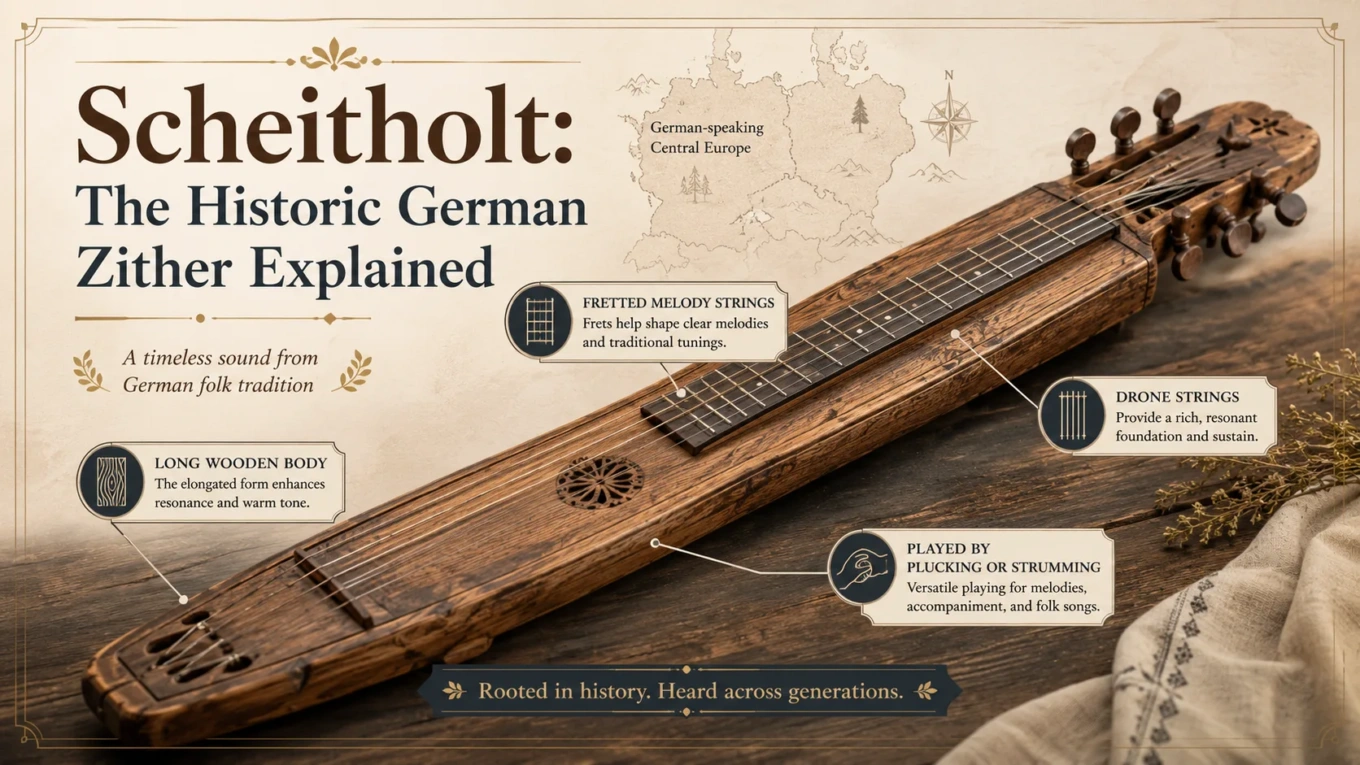
Scheitholt: The Historic German Zither Explained
The scheitholt is a historic German fretted zither: a narrow wooden instrument with strings stretched along the length of its body, some used for melody and others left to sound as drones. It sits inside the wider zither family[1], but it should not be confused with the later concert zither, the Appalachian dulcimer, or the many Asian board zithers that use different bridge systems, tunings, and playing traditions.
The scheitholt belongs to the older European tradition of simple chordophones[2] in which the body of the instrument also acts as the string carrier. Its form is usually long, narrow, and box-like, with frets under one or more melody strings and additional strings that can provide a steady harmonic background.
In organological terms, it is best understood as a fretted zither[3] rather than as a small guitar, lute, or harp. The strings do not run over a neck attached to a separate body. They run along the main body itself. That single detail explains much of the scheitholt’s playing logic, tone, and later influence on related European and American instruments.
Classification Note: The word “zither” can mean two different things. In a narrow European sense, it often points to the concert zither. In a wider instrument-family sense, it describes chordophones whose strings stretch across or along a body without a separate neck. The scheitholt belongs to this wider zither category.
Main Details Worth Knowing
| Feature | Typical Description |
|---|---|
| Instrument Type | Historic German fretted zither, often linked with drone-zither practice |
| Body Form | Long, narrow wooden soundbox[4], often rectangular or beam-like in documented examples |
| String Use | One or more melody strings, plus drone strings[5] or accompaniment strings |
| Frets | Metal or wire frets used under the melody area; number and spacing vary by period and maker |
| Playing Position | Played flat on a table, bench, or lap |
| Related Instruments | Hummel, hommel, langeleik, épinette des Vosges, Appalachian dulcimer, and early Alpine zither forms |
Surviving museum examples show that the scheitholt was not one fixed model. Some instruments have only a few strings, while later or regionally related examples may carry more. Frets, tuning hardware, body depth, and string layout also vary. A careful description should therefore speak of scheitholt-type instruments when the exact regional form is uncertain.
What a Scheitholt Is
A scheitholt is a long wooden zither in which the player uses melody strings[6] over frets[7] while other strings may sound as open drones. In many historical descriptions, the instrument has a narrow body, a simple sound-producing structure, and a practical folk-instrument character rather than a courtly or orchestral one.
The melody area may be fretted in a mostly diatonic[8] layout, meaning it supports a scale pattern closer to many traditional songs than to a fully chromatic keyboard. That is one reason the scheitholt can look simple while still requiring musical control. The player must shape rhythm, pressure, damping, and drone balance with care.
The sound is usually described as direct, dry, and buzzing or humming when drones are active. It is not meant to imitate the smooth sustain of a harp or the bright, rolling shimmer of a modern concert zither. Its charm lies in the close contact between wood, wire, hand movement, and repeating tonal center.
Name, Spelling, and Regional Meaning
The spelling appears in more than one form. Scheitholt and Scheitholz are both encountered in historical and modern discussions. The German words connect visually with the idea of a split piece of wood or log, and many writers have linked the name to the instrument’s long, plain, wooden shape.
Regional names complicate the picture. Related instruments have been called hummel, hommel, hümmelke, or by other local terms in northern and central European contexts. These names do not always describe identical instruments. Sometimes they point to a local drone zither; sometimes they point to a form that shares only part of the scheitholt’s structure.
Regional Note: A name found in one museum label, maker’s note, or folk tradition should not be treated as a universal label. Historic zithers often moved through local speech, workshop habits, and later museum classification before they reached modern readers.
How the Body Is Built
The scheitholt’s body is usually a narrow wooden resonating box. In many examples, the upper surface works as a soundboard[9], while the sides and back help enclose the air space. This plain construction supports a focused tone rather than a wide orchestral sound.
Some preserved examples have a beam-like body; others are slightly trapezoidal or shaped with small decorative details at the pegbox end. A few museum instruments show carved or shaped heads, round sound holes, dark varnish, or simple painted finishes. These details tell more about maker, region, and period than about a single “standard” scheitholt design.
Wood choice can shape resonance[10], weight, and response, but older folk instruments rarely follow the strict tonewood categories used in modern guitar marketing. A local maker may have used available hardwoods or softwoods, depending on region and workshop practice.
The Role of the Soundbox
The soundbox does not simply hold the strings. It gives the vibrating string energy a surface and air cavity through which to speak. On a scheitholt, this is especially clear because the strings run along the same body that amplifies them.
A shallow body can give a compact sound. A deeper box may add body and warmth, but documented instruments vary too much to state a single acoustic rule. Construction, string tension, bridge contact, and fretting quality all matter.
Sound Holes and Decoration
Sound holes may appear as simple round openings, small carved shapes, or plain functional cuts. Their role is acoustic and practical, but their placement also helps identify regional workshop taste. Decoration on scheitholts is often restrained compared with later salon zithers, though some examples show shaped pegboxes, varnished surfaces, or small ornamental touches.
Strings, Frets, and Bridge Layout
The scheitholt’s playing logic depends on a split between strings used for melody and strings used for support. The melody strings pass over the fretted area. The drone or accompaniment strings are often left as open strings[11], giving a repeated tonal base while the melody moves above or beside them.
The strings usually cross a nut[12] at one end and a bridge[13] at the other, with tuning pins or pegs providing tension. In some historic examples, wire or brass frets are set directly into the wood rather than into a raised modern fingerboard. Later related forms may show a more separate fingerboard-like area.
Scale length[14] differs from one instrument to another. Museum records of individual scheitholts show measured string lengths in the range one would expect for a lap-played zither, but a single measurement should not be treated as the rule for the whole type.
Melody Strings
The melody strings carry the tune. Some instruments have one main melody string; others may pair melody strings in unison[15] or use more than one course[16]. When two strings are tuned together, the sound gains thickness and a slight shimmer if the tuning is not perfectly exact.
The player may press these strings with a finger or with a small stick-like tool, depending on local practice and modern reconstruction. Because the frets guide the pitch, the scheitholt can produce clear scale steps even with a very simple body.
Drone and Accompaniment Strings
The drone strings provide a steady tonal ground. They may be tuned to the main pitch of the mode, to a fifth, or to another supporting interval, depending on the instrument and repertoire. It is safer to think of scheitholt tuning as a practice area, not as one fixed tuning chart.
The drone effect changes the way the melody is heard. A simple tune can feel fuller because the ear keeps returning to the same tonal center. This is one reason related names such as hummel or hommel are often associated with a humming or droning character.
Frets and Scale Layout
Fret placement is one of the most revealing parts of the instrument. Many scheitholt-type instruments use a scale pattern that favors folk melody rather than full chromatic movement. The frets may look uneven to a player used to guitar frets, but that spacing can reflect the scale system the instrument was built to serve.
Historic examples may have metal frets, brass frets, or wires fixed into the body. The exact number varies. Some recorded museum instruments have 14, 15, or 18 frets, while other related forms differ. The safest reading is that the scheitholt tradition allowed practical variation.
Luthier’s Note: On a scheitholt, small construction choices carry a large musical effect. A slightly high fret, a weak bridge contact, or an uneven string path can change both pitch clarity and drone balance.
How the Scheitholt Is Played
The scheitholt is played flat. The player places it on a table, bench, or lap, then sets the melody while sounding the strings with the other hand. This flat playing position connects it with many zithers, but its fretted melody system makes it different from fretless board zithers such as the guzheng or koto.
Historical and modern revival practice includes several playing methods:
- Plucking with bare fingers
- Strumming with a plectrum[17], quill, or small pick
- Pressing the melody string with a finger or noter[18]
- Allowing open drones to ring during the melody
- Damping unwanted strings when the music needs a cleaner texture
The right hand often supplies rhythm as much as pitch. A repeated strum can set the pulse, while the left hand selects melody notes along the frets. This gives the scheitholt a strong connection to song accompaniment and small domestic music settings.
What to Listen For
Listen for the contrast between the moving melody and the static drone. The melody may be narrow and clear, while the drone gives weight underneath. When the strings are close to the soundboard and the body is lightly built, the attack can feel immediate and tactile.
The instrument can also reveal small tuning differences. Paired melody strings may create a slight beating effect. Drones can thicken the sound or blur it, depending on how the player controls them.
Tuning and Musical Range
There is no single tuning that defines all scheitholts. Tuning depends on string count, local practice, song type, and whether the instrument uses one melody string, paired melody strings, or several accompaniment strings. Many players tune the melody area to serve a simple scale and tune drones to support the tonal center.
Modern players sometimes adapt dulcimer-like tunings, but that can blur history if presented as original practice. A reconstructed scheitholt may be tuned for practical playing; a museum scheitholt may preserve a physical layout without proving exactly how it was tuned in daily use.
Why Fixed Tuning Claims Can Mislead
Historic folk instruments often survive without full written instructions. A maker’s dimensions, fret layout, and string count can suggest musical use, but they do not always prove a fixed pitch standard. Pitch levels also changed across regions and periods.
For this reason, it is better to describe scheitholt tuning by function: melody strings carry the tune; drones support the tonal center; frets guide the available scale. Exact pitch names should be used only when tied to a documented instrument or a modern playing setup.
Materials and Workmanship
Scheitholts are usually wooden instruments with metal strings in many later examples. Earlier or related traditions may include other string materials, but surviving instruments and modern reconstructions often use wire because it offers bright attack, stable tension, and clear response on a small body.
Hardware may include wooden pegs, metal tuning pins, square iron pins, or more developed mechanical fittings in later forms. Museum examples from the 19th and early 20th centuries show that makers did not follow one strict hardware pattern.
Material Note
Wood choice, body thickness, bridge fit, fret material, and string tension all help shape the playing feel. The wood does not act alone. On a small fretted zither, setup can matter as much as species.
History and Documented Use
The scheitholt is often discussed through early modern German sources, especially descriptions linked with Michael Praetorius in the early 17th century. By that time, the instrument was already understood as a plain string instrument with a long body and a practical musical function.
Later examples appear across German-speaking and neighboring regions under related names. The instrument was associated with domestic music, local song, and folk performance rather than large formal ensembles. Some forms continued into the 19th and early 20th centuries, while others were absorbed into newer zither types or local dulcimer traditions.
It is better to avoid a simple “ancestor of all zithers” claim. The scheitholt is not the source of the entire zither family. Instead, it is an important European fretted zither form that helps explain the path from earlier drone zithers to later regional instruments, including some forms that influenced the Appalachian dulcimer.
How It Differs from Related Instruments
The scheitholt is often compared with the Appalachian dulcimer, concert zither, hummel, and other European fretted zithers. These comparisons are useful, but only if the differences remain clear.
| Instrument | Main Similarity | Main Difference |
|---|---|---|
| Appalachian Dulcimer | Fretted zither logic, melody strings with drones | The dulcimer developed a distinct American body form and playing tradition |
| Concert Zither | European zither identity and plucked-string technique | The concert zither has a more developed layout with fretted melody strings and many accompaniment strings |
| Hummel or Hommel | Drone-zither character and regional European overlap | The name may refer to different local forms, not always a strict scheitholt copy |
| Langeleik | Long fretted zither with drone strings | It belongs to a Norwegian tradition with its own tunings, shape, and repertoire |
| Guzheng or Koto | All are zithers in the broad organological sense | They are fretless board zithers with movable bridges, different technique, and separate musical traditions |
Scheitholt and Appalachian Dulcimer
The Appalachian dulcimer is often described as related to European fretted zithers such as the scheitholt, hummel, langeleik, and épinette des Vosges. That relationship is useful, but it does not mean the Appalachian dulcimer is simply a renamed scheitholt.
The dulcimer developed its own body shapes, playing customs, repertoire, and regional identity in North America. The scheitholt helps explain one part of the family background, not the whole story.
Scheitholt and Concert Zither
The concert zither is a later, more complex European instrument. It usually has a fretted section for melody and many additional strings for accompaniment. The scheitholt is plainer, narrower, and more closely tied to drone-based playing.
The two instruments share zither-family logic, but their musical worlds feel different. The scheitholt favors direct melody and drone. The concert zither allows denser harmony and more elaborate solo writing.
Scheitholt and Asian Board Zithers
In broad classification, instruments such as the guzheng, koto, gayageum, and đàn tranh are also zithers. Yet they should not be grouped with the scheitholt as if they were the same type. Many of them use movable bridges, lack frets, and rely on pitch bending, plucking technique, and regional tuning systems that differ strongly from the German fretted zither tradition.
Museum and Heritage Context
Museums often label scheitholts as stringed instruments, zithers, or regional zither types. Some records also include local terms such as Hümmelke. These labels help place the instrument in a collection, but they can also hide the fact that two instruments with the same label may differ in body shape, string number, or fret count.
Measurements in museum records are especially useful. They show that preserved scheitholt-type instruments can be compact, narrow, and carefully fretted, with string counts such as three or seven in documented examples. Such records also show later hardware choices, including metal frets and iron tuning pins.
Collector’s Note: An old narrow zither should not be identified as a scheitholt by shape alone. Check the string path, frets, drone layout, bridge and nut arrangement, regional label, and any maker or collection notes before assigning a name.
Common Misunderstandings
“Scheitholt” Does Not Mean Every Old Zither
The zither family is broad. The scheitholt is one historic fretted form within it. Calling every old European zither a scheitholt erases differences between concert zithers, fretless zithers, chord zithers, bowed zithers, and regional drone zithers.
It Is Not Just a Primitive Dulcimer
The scheitholt is sometimes treated only as a rough predecessor of the Appalachian dulcimer. That view is too narrow. It had its own regional use, construction habits, and musical function before later dulcimer traditions took shape.
String Count Is Not Fixed
Some descriptions mention three or four strings. Some museum examples show more. Later related instruments can carry different layouts. A safe description should focus on function: fretted melody strings and drone or accompaniment strings on a narrow zither body.
It Does Not Use Movable Bridges Like a Guzheng or Koto
The scheitholt’s pitch system depends mainly on frets under the melody strings. This sets it apart from movable-bridge zithers, where each string may have its own bridge and pitch can be shaped through bridge placement and string pressure.
What Beginners Should Know
A modern player approaching the scheitholt should expect a different experience from guitar, ukulele, or concert zither. The instrument rewards simple melody, steady rhythm, and careful listening to drones. It is not difficult to make a sound, but it takes patience to make the drones support the tune without becoming muddy.
Beginners should pay attention to four things:
- String balance: The drone strings should support the melody, not cover it.
- Fret accuracy: Small pitch issues are easy to hear on a simple drone instrument.
- Damping: Stopping unwanted ringing can make the music clearer.
- Tuning purpose: Choose a tuning that matches the song, rather than forcing every tune into one setup.
Modern reconstructions vary widely. Some are built for historical study, some for dulcimer players, and some for folk performance. The best instrument depends on whether the player wants museum-style reconstruction, practical playing, or a bridge between old European zither practice and modern noter-drone style.
Care and Maintenance Notes
A scheitholt or scheitholt-style reconstruction should be treated like a lightly built wooden string instrument. Keep it away from rapid humidity swings, avoid over-tightening strings, and check that the bridge and nut remain seated correctly.
Older instruments need special caution. Replacing strings on an antique zither can damage weak wood, old tuning pins, or historic frets. If the instrument has collection value, it should be assessed before being brought up to playing tension.
Practical Setup Checks
- Make sure each string runs cleanly from nut to bridge.
- Check whether melody strings sit properly over the fretted area.
- Listen for buzzing that comes from loose hardware rather than musical drone.
- Use string gauges that suit the scale length and body strength.
- Do not force modern high-tension tuning onto a fragile older instrument.
Why the Scheitholt Still Matters
The scheitholt gives a clear view of how a simple wooden zither can organize melody, rhythm, and drone without a complex mechanism. Its structure shows the shared logic behind several European fretted zithers, yet its details also warn against reducing all related instruments to one family tree.
For instrument researchers, it is a useful link between organology and material culture. For players, it offers a direct way to hear how melody behaves against a fixed tonal ground. For collectors and museum visitors, it shows how a modest instrument can carry a large amount of information in its strings, frets, body, and name.
Glossary of Technical Terms
[1] Zither Family: A broad group of stringed instruments in which the strings run along, across, or over the body rather than over a separate neck. In the scheitholt’s case, the body itself supports both the strings and the sound-producing structure.
[2] Chordophone: A musical instrument that produces sound through vibrating strings. Zithers, lutes, harps, lyres, and bowed string instruments are all chordophones, though their body shapes and playing systems differ.
[3] Fretted Zither: A zither with frets under some strings, allowing the player to shorten the vibrating length and produce set pitches. The scheitholt uses this idea for melody while other strings may remain open as drones.
[4] Soundbox: The hollow body that helps amplify the vibration of the strings. On a scheitholt, the soundbox is usually long and narrow, forming both the body and the main string-bearing structure.
[5] Drone Strings: Strings that sound a repeated pitch or tonal support rather than carrying the main melody. In scheitholt playing, drones help create the steady harmonic base under the tune.
[6] Melody Strings: Strings used to play the tune. On many scheitholt-type instruments, these strings pass over frets so the player can produce a simple scale pattern.
[7] Frets: Raised strips of metal, wire, or other material that mark pitch positions under a string. In the scheitholt, frets are normally associated with the melody area rather than every string.
[8] Diatonic: A scale layout based mainly on the notes of a common seven-note mode or major/minor pattern, rather than every chromatic half-step. Many traditional fretted zithers favor diatonic layouts for song-based playing.
[9] Soundboard: The vibrating top surface of the instrument. On a scheitholt, the soundboard helps turn string vibration into audible tone through the wooden body.
[10] Resonance: The way the body and air cavity respond to string vibration. In small zithers, resonance is shaped by wood thickness, body depth, string tension, bridge fit, and overall construction.
[11] Open Strings: Strings that sound without being stopped by a finger, noter, or fret action. Scheitholt drone strings often work as open strings, providing a steady background pitch.
[12] Nut: The support near the tuning end that sets one boundary of the vibrating string length. On a scheitholt, the nut helps guide string spacing and height before the strings pass along the body.
[13] Bridge: The support that transfers string vibration into the body. Bridge placement and contact are especially important on a small zither because they affect volume, clarity, and response.
[14] Scale Length: The vibrating length of a string between nut and bridge. It affects pitch, tension, string choice, and the spacing of frets on a scheitholt.
[15] Unison: Two or more strings tuned to the same pitch. When melody strings are tuned in unison, the tone can become fuller and slightly shimmering.
[16] Course: A group of one or more strings treated as a single musical unit. In zither-family instruments, courses may be single, paired, or grouped depending on the design.
[17] Plectrum: A small pick used to pluck or strum strings. Scheitholt players may use a plectrum, quill, or similar tool to sound melody and drone strings.
[18] Noter: A small stick or rod used to press melody strings against the frets. It is especially associated with noter-drone playing styles in some fretted zither and dulcimer traditions.
FAQ
Is a scheitholt a type of zither?
Yes. The scheitholt is a historic fretted zither from German-speaking Europe. Its strings run along the body, and its melody area normally uses frets while other strings may act as drones.
Is the scheitholt the same as an Appalachian dulcimer?
No. The two instruments are related through the wider fretted zither tradition, but the Appalachian dulcimer developed its own North American body forms, tunings, and playing customs.
How many strings does a scheitholt have?
There is no single fixed number. Some documented examples have only a few strings, while later or related instruments may have more. The usual idea is a small set of melody strings with additional drone or accompaniment strings.
Does a scheitholt have frets?
Yes, the melody area is normally fretted. The frets allow the player to produce set pitches, while drone strings may remain unfretted and open.
What does a scheitholt sound like?
A scheitholt often has a direct, intimate tone with a clear melody over humming drones. Its sound depends on body size, string material, tuning, and how strongly the drone strings are allowed to ring.
Is the scheitholt still played today?
Yes, but mostly in historical music, folk-instrument study, dulcimer circles, and modern reconstruction projects. It is not a mainstream concert instrument, yet it remains valuable for understanding European fretted zither traditions.