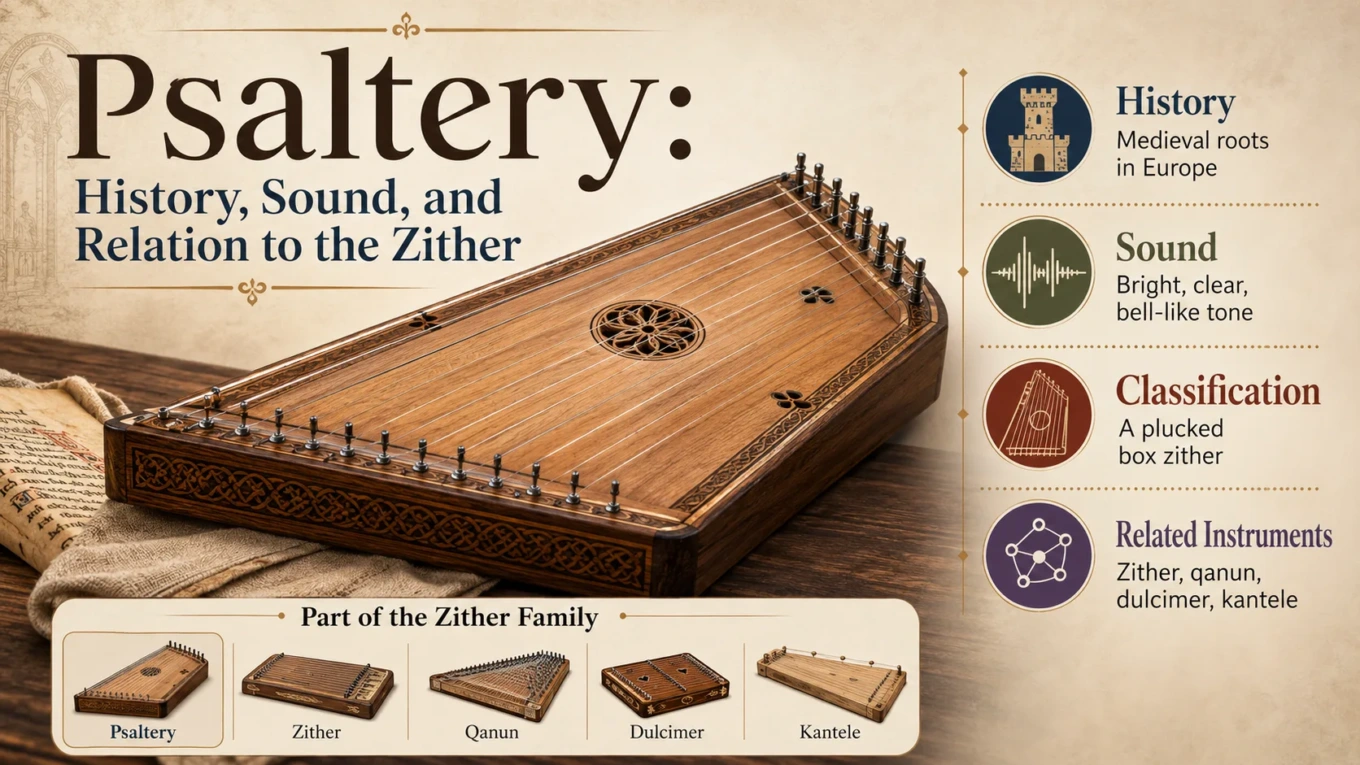
Psaltery: History, Sound, and Relation to the Zither
The psaltery is best understood as a plucked box zither: a stringed instrument whose strings run across a shallow wooden body rather than along a separate neck. In medieval Europe it was played with fingers or small picks, often with each string left open for a fixed pitch. That simple idea gives the psaltery its clear, bell-like voice and also explains why it sits close to the zither family, the qanun, the dulcimer, and several other flat-bodied chordophones.
What Is a Psaltery?
A psaltery is a chordophone[1] in which stretched strings produce the sound. Most historical psalteries are described as a type of box zither[2], because the strings lie over a shallow box-like body that supports and amplifies them.
The name is old, but it has not always meant one exact instrument. In medieval European sources, the psaltery could appear in rectangular, triangular, wing-shaped, or trapezoidal forms. Some examples were plain working instruments. Others were carefully decorated, especially in manuscript art and courtly images.
Unlike a lute, guitar, or harp, the psaltery has no long neck that changes the speaking length of a string during performance. Its notes usually come from open strings[3]. Each string, or sometimes each course[4] of paired strings, is tuned to a pitch before playing.
| Feature | Typical Form | Why It Matters |
|---|---|---|
| Instrument Family | Zither-type chordophone | The strings run across the body rather than along a separate neck. |
| Body Shape | Rectangular, triangular, trapezoidal, or wing-shaped | The outline can affect string length, layout, and visual style. |
| Sound Production | Plucked strings | The tone is clean, bright, and fast to speak. |
| Pitch System | Mostly fixed-pitch open strings | Players normally select notes by choosing different strings, not by stopping one string at many positions. |
| Related Instruments | Qanun, dulcimer, kantele, gusli, autoharp, zither | These instruments share family traits but differ in structure, tuning, and playing method. |
How the Psaltery Fits into the Zither Family
In broad organological use, a zither is a stringed instrument whose strings are stretched across a body that acts as the main support. The psaltery fits this broad meaning very well. It does not fit the narrower modern use of “zither” that often points to the Alpine or concert zither with a fretted fingerboard.
The psaltery is therefore a zither in the family sense, not a concert zither by another name.
Classification Note: The psaltery is usually placed among board or box zithers because its strings pass over a flat or shallow soundboard[5] and a resonating body[6]. This separates it from necked lutes and from harps, even when older names overlap in translation.
This distinction matters because many historical terms were flexible. A medieval image might show a musician holding a psaltery in a way that looks close to a small harp or lyre. Yet the construction tells the clearer story: strings across a board or box, fixed pitches, and no separate neck used for stopping the strings.
Names, Spellings, and Older Meanings
The word “psaltery” is linked to older Greek and Latin terms connected with plucking. Historical spellings and related names include psalterion, psalterium, saltere, sawtry, and salterio. These names can point to different regional forms, periods, or translation habits.
Older texts may not describe construction with the precision expected in a museum catalog. A term might refer to a plucked string instrument in a broad sense, while an image or surviving object may show a more specific box-zither design. For that reason, the safest reading combines name, image, construction, and musical setting rather than relying on the word alone.
Historical Development
The psaltery was known in Europe by the Middle Ages and appears in many manuscript illuminations, carvings, and written references. It was especially visible in medieval visual culture, where musicians are often shown holding a small flat-bodied instrument and plucking its strings.
Its exact routes of transmission are difficult to reduce to a single line. Many references connect medieval European psalteries with older plucked instruments from the eastern Mediterranean and with the trapezoidal qanun. The relationship is believable in broad structural terms, but regional instruments developed their own designs, tunings, and playing habits.
By the later medieval period, psalteries were shown in several body shapes. Rectangular examples could use strings of similar length, with pitch controlled mainly by string thickness and tension. Triangular and trapezoidal layouts allowed shorter and longer strings to sit in a more pitch-related order across the body.
The instrument did not disappear completely, but its role changed. In later European music, keyboard instruments and other plucked or struck string instruments took over many of the musical spaces where the psaltery had once been useful. Modern psalteries are often used in medieval music performance, early music education, instrument making, and folk revival settings.
Construction and Body Shape
A psaltery is usually built as a shallow wooden box. The upper surface works as the soundboard, while the enclosed air space helps the instrument project. The body may be trapezoidal, triangular, rectangular, or shaped with decorative curves.
The strings are fastened between two fixed points. At one side, they may attach to a hitch pin[7] or similar anchor. At the other, a tuning pin[8] allows the player or maker to adjust tension. A bridge[9] may define the speaking length of the strings and pass vibration into the soundboard.
Not every psaltery is built in the same way. Some are plain, with little more than a box, pins, and strings. Others show carved edges, painted decoration, rosettes, or shaped sound openings. Ornament can tell a museum visitor something about status and taste, but it should not be confused with a universal acoustic rule.
Soundholes and Air Movement
Many box-zither psalteries include one or more soundholes[10]. These openings are not just decoration. They allow the air inside the body to move more freely and can affect how the instrument speaks, especially in volume and resonance.
The placement and shape of soundholes vary. Some are round. Others are carved as rosettes or more complex patterns. A careful maker balances visual design with the strength of the soundboard, since too much cutting can weaken the top.
Strings and Materials
Historical psalteries may be associated with gut, horsehair, or metal strings, depending on period, region, and source. Medieval European box psalteries are often described with metal strings, which help explain their bright and ringing tone.
A gut string[11] can offer a softer attack and a warmer response. A metal string[12] usually gives a clearer edge, stronger sustain, and a more bell-like brightness. Modern makers may use steel, brass, bronze, or other suitable wire, but these choices vary by design.
Luthier’s Note: Wood choice can shape resonance, but it does not work alone. Soundboard thickness, bridge pressure, body depth, string tension, and the size of the instrument all matter. A small change in one part can alter the feel of the whole instrument.
How a Psaltery Is Tuned
A psaltery is usually tuned so each string gives one note. This makes it different from a fretted zither or guitar-like instrument, where one string can produce many notes when pressed at different positions.
Many modern psalteries are arranged in a diatonic tuning[13], which suits simple melodies and modal early music. Some instruments include extra notes for chromatic[14] playing, but the layout depends on the maker. Historical sources do not support one fixed psaltery tuning for every place and century.
On a trapezoidal or triangular psaltery, string length often changes across the body. Longer strings tend to serve lower notes, while shorter strings serve higher notes. The player reads the layout through practice, sight, or marked strings rather than through a keyboard-like pattern.
Playing Technique
The psaltery is usually plucked with the fingers or with a plectrum[15]. Some players use one pick, while others use two, allowing alternation between hands. The playing posture can vary: the instrument may rest on a table, lie across the lap, or be held against the body, depending on size and style.
Because the strings are open, the player must move from string to string to form a melody. This gives the instrument a direct, transparent sound. It also means that tuning accuracy matters. A slightly poor tuning will be heard quickly, especially when two strings ring together.
Plucked Psaltery and Bowed Psaltery
The historical psaltery was mainly a plucked instrument. The bowed psaltery[16] is a later form that uses a bow along the edges of a triangular body. It belongs to the same broad naming family, but it should not be treated as the standard medieval psaltery.
That difference is important for beginners. A bowed psaltery has a smooth, sustained tone and a very different playing motion. A plucked psaltery has a sharper attack and more immediate decay, even when the body gives a pleasant ring.
What the Psaltery Sounds Like
A plucked psaltery often has a clear, bright, and lightly ringing sound. The tone can feel close to a small harp in its attack, but the body and string layout give it a different profile. Metal strings can make the sound more brilliant, while gut or lower-tension strings can soften it.
The instrument speaks quickly. Notes do not need much force to emerge. On a well-made psaltery, the soundboard responds with a clean shimmer rather than a heavy bass. This is one reason the instrument suits melodic lines, drones, simple harmonies, and early music textures.
Listening Note: The psaltery’s tone is easiest to recognize in the space after the pluck. A good instrument lets the note bloom briefly, then fade without a muddy after-ring.
Musical Use and Cultural Setting
Medieval art often shows the psaltery in devotional, courtly, or learned musical scenes. This does not mean every psaltery was a formal court instrument. It does show that the instrument had a clear visual identity and enough cultural presence to be recognized by artists and viewers.
Modern performers use the psaltery in early music groups, storytelling, folk arrangements, and educational settings. Since little surviving music is written only for psaltery, players often adapt vocal melodies, dances, hymns, and modal tunes that fit the instrument’s range.
The psaltery works well when the arrangement respects its strengths. It is not built for loud projection against heavy modern ensembles. It is better suited to small rooms, clear textures, and music where ringing open strings add color without clutter.
Relation to the Zither, Qanun, and Dulcimer
The psaltery shares family traits with several flat-bodied string instruments, but each has its own playing logic.
| Instrument | Shared Trait | Main Difference |
|---|---|---|
| Psaltery | Strings across a shallow resonating body | Usually plucked open strings, often without frets or complex levers. |
| Qanun | Trapezoidal zither form with many strings | Often uses courses and small pitch-adjusting levers in many modern forms. |
| Hammered Dulcimer | Strings across a flat resonating body | Played by striking strings with small hammers rather than plucking them. |
| Concert Zither | Zither-family body support | Includes fretted strings[17] for melody and separate accompaniment strings. |
| Kantele or Gusli | Open-string zither layout | Regional construction, tuning, repertoire, and playing methods differ. |
The dulcimer comparison needs care. Some dulcimers are part of the broad zither family, but not every dulcimer is a psaltery. The main dividing line is method: the psaltery is normally plucked, while the hammered dulcimer is struck.
The qanun is closer in outline to some trapezoidal psalteries, yet it belongs to its own musical traditions and construction history. Many qanuns use multiple strings per note and pitch-changing devices, while a simple psaltery often keeps a more direct fixed-pitch layout.
Common Misunderstandings
The first misunderstanding is that “psaltery” means any old string instrument. It does not. The term is broad in old sources, but in instrument study it usually points to a plucked zither-like instrument with strings stretched over a flat board or shallow box.
The second misunderstanding is that the psaltery is simply a small harp. The visual similarity can be tempting, especially with triangular forms. A harp has strings rising from a resonating body and neck or pillar structure, while the psaltery’s strings lie across its body.
The third misunderstanding is that all psalteries had the same number of strings. They did not. String count depends on body shape, date, region, and modern maker. Any claim of one universal number should be treated carefully.
What Beginners Should Know
A beginner can learn a simple psaltery melody fairly quickly because each string gives a fixed note. The challenge is not finger pressure or fretting. The challenge is orientation: finding the right string, keeping the instrument in tune, and letting the strings ring cleanly.
- Choose a layout that matches the music you want to play.
- Learn the tuning pattern before learning many pieces.
- Use a light plucking motion; too much force can make the tone harsh.
- Mute unwanted ringing when the harmony becomes unclear.
- Keep a tuning tool and a reliable pitch reference nearby.
Players coming from guitar may need time to adjust. A psaltery does not reward chord shapes in the same way. It rewards accurate string choice, clean rhythm, and sensitivity to ringing resonance.
Care, Handling, and Collecting Notes
A psaltery should be protected from sudden changes in humidity and temperature. Its soundboard, pins, and string tension all depend on stable conditions. A dry room can make wood shrink or cause tuning instability, while excessive humidity can dull response and affect joints.
Collectors should look closely at the bridge area, pin block, soundboard cracks, and any repairs around soundholes. On a historical or replica instrument, decoration is only one part of value. Construction quality and structural health matter more for sound and long-term stability.
Collector’s Note: A decorative psaltery is not automatically a playable psaltery. Before bringing an older instrument up to pitch, the pin block, seams, and soundboard should be checked by someone familiar with string tension on small wooden instruments.
How Museums Describe the Psaltery
Museum descriptions often identify a psaltery by body type, string layout, material, date, and place of origin when known. A careful label may use terms such as “box zither,” “plucked chordophone,” or “medieval European psaltery.” These terms help separate construction from later romantic names.
When an object has uncertain origin, museum language may stay cautious. A catalog might describe the instrument by visible features rather than making a strong claim about use. This is good practice, because many old instruments have been repaired, restrung, altered, or copied.
FAQ
Is a psaltery a type of zither?
Yes, in the broad instrument-family sense. A psaltery is usually treated as a box zither because its strings run across a shallow resonating body. It is not the same as a modern concert zither.
Is a psaltery the same as a dulcimer?
No. They are related through the wider zither family, but a psaltery is normally plucked, while a hammered dulcimer is struck with small hammers. The playing method changes the sound and musical feel.
How many strings does a psaltery have?
There is no single standard number. Historical and modern psalteries vary by shape, range, maker, and tuning plan. It is safer to describe the specific instrument rather than give one fixed count.
Is the bowed psaltery medieval?
The bowed psaltery is a later instrument associated with the psaltery name, but it should not be treated as the usual medieval plucked psaltery. Its bowing method creates a different sound and technique.
Can beginners learn the psaltery?
Yes. The fixed-pitch strings make simple melodies approachable. Beginners still need patience with tuning, string navigation, and controlling unwanted ringing.
What does a psaltery sound like?
A plucked psaltery often sounds bright, clear, and lightly ringing. Metal-strung instruments can have a bell-like edge, while lower-tension or gut-strung examples may sound softer.
Glossary of Technical Terms
Chordophone
A chordophone is an instrument that produces sound through vibrating strings. In the zither family, the strings are usually stretched across a body that supports and amplifies them.
Box Zither
A box zither is a zither with a hollow box-like body under the strings. The psaltery is often described this way because its body works as both support and resonator.
Open String
An open string sounds without being pressed against a fret or fingerboard. Many psalteries rely on open strings, with each string tuned to one pitch.
Course
A course is a set of one or more strings treated as one musical note. Some zither-family instruments use paired or grouped strings to strengthen volume or color.
Soundboard
The soundboard is the top surface that receives vibration from the strings. On a psaltery, it helps turn small string vibrations into an audible musical tone.
Resonating Body
The resonating body is the part of the instrument that helps amplify and color the sound. In a psaltery, this is usually a shallow wooden box beneath the strings.
Hitch Pin
A hitch pin anchors one end of a string. On psalteries and related zithers, it helps hold string tension against the tuning system on the opposite side.
Tuning Pin
A tuning pin adjusts string tension and therefore pitch. Psalteries need stable tuning pins because each string normally supplies a fixed note.
Bridge
A bridge defines the vibrating length of a string and transfers vibration into the soundboard. Its position and fit can strongly affect response and clarity.
Soundhole
A soundhole is an opening in the body or soundboard. In psalteries, it can help air movement inside the box and may also serve as decoration.
Gut String
A gut string is made from prepared animal intestine. In zither-family instruments, gut can give a softer and less metallic response than wire.
Metal String
A metal string is made from wire such as steel, brass, or bronze. On psalteries, metal strings often create a bright tone with clear sustain.
Diatonic Tuning
Diatonic tuning uses the notes of a scale similar to the white keys of a piano in one key area. Many beginner-friendly psalteries use this layout for simple melodies.
Chromatic
Chromatic means including the half-step notes between the main notes of a scale. A chromatic psaltery layout allows more keys but can be harder to navigate.
Plectrum
A plectrum is a small pick used to pluck strings. Psaltery players may use one or two plectra depending on the music and instrument layout.
Bowed Psaltery
A bowed psaltery is a later psaltery-related instrument played with a bow. It shares the open-string idea but produces a sustained tone rather than a plucked attack.
Fretted String
A fretted string changes pitch when pressed against frets. This feature is common in concert zithers but not typical of the standard plucked psaltery.