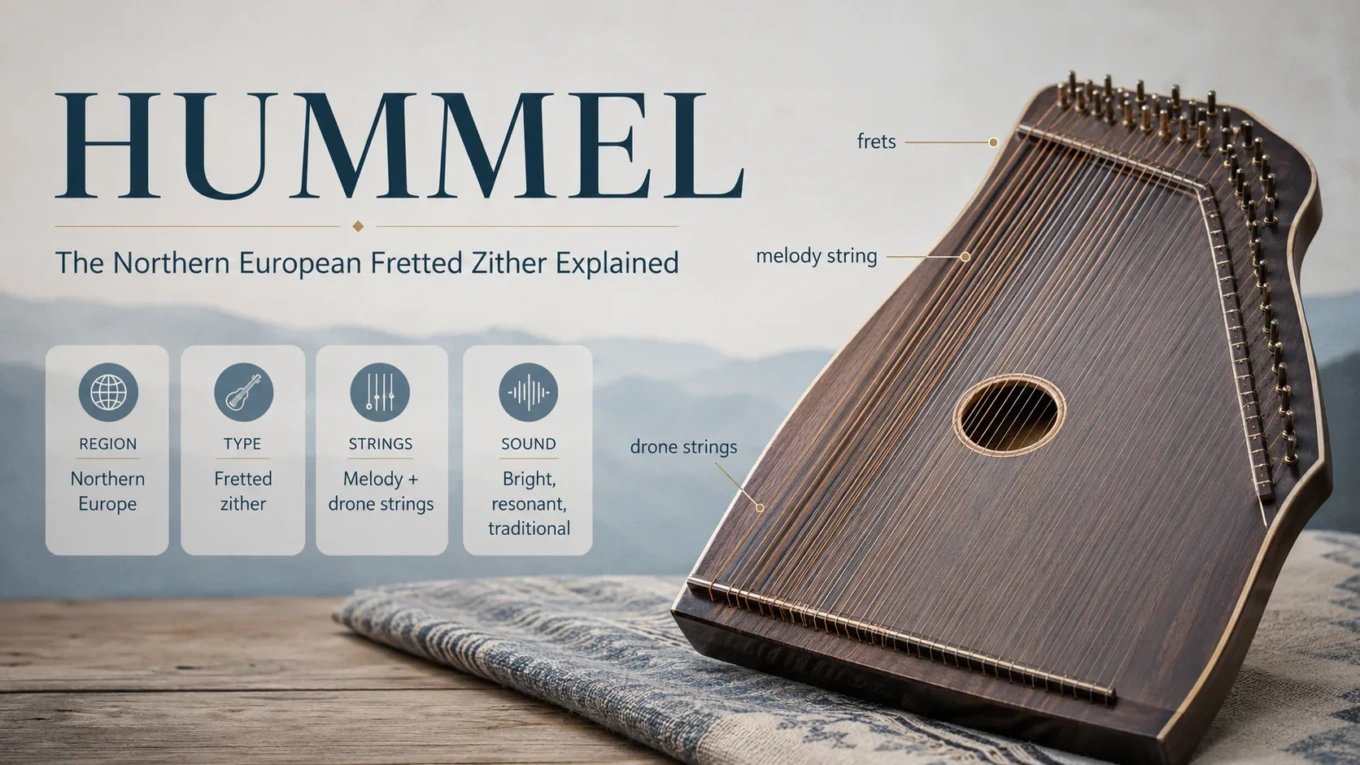
Hummel: The Northern European Fretted Zither Explained
A hummel is a Northern European fretted zither[1] built around a simple but useful idea: a small set of melody strings[2] is stopped over frets, while a larger set of drone strings[3] or accompaniment strings rings beside it. This gives the instrument its plain, ringing character. The hummel is not the same instrument as the Alpine concert zither, but it belongs to the same wider family of chordophones in which strings run across a resonating body rather than along a separate neck.
The name appears in several forms, including hummel, hommel, and humle. These spellings can point to different language settings, especially Swedish, Danish, German, Dutch, and Flemish contexts. In English writing, “hummel” is often used as a convenient umbrella name for the northern European form, but museum catalogues and older studies may prefer “hommel” or a local spelling.
Its appeal lies in the contrast between control and resonance. One hand chooses notes on the fretted melody side. The other hand plucks or strums across the strings, allowing the open accompaniment to keep a steady tonal ground. For that reason, the hummel is best understood as a drone-based fretted zither, not as a small guitar, harp, or modern chord zither.
Main Details Worth Knowing
| Feature | Usual Description |
|---|---|
| Instrument Family | Plucked string instrument; a zither-type chordophone[4] |
| General Form | Flat, shallow body; often treated as a type of box zither[5] in organological description |
| Region | Associated with Sweden, Denmark, northern Germany, the Netherlands, and Flanders, with local forms and names |
| String Layout | A few stopped melody strings plus several unstopped drone or accompaniment strings |
| Fret Placement | Frets are normally placed under the melody strings only, not across every string |
| Playing Position | Usually played flat on a table, bench, or lap so the body can project the sound |
| Closest Relatives | Norwegian langeleik, German scheitholt, Icelandic langspil, and several northern European drone zithers |
The table describes the center of the tradition rather than a rigid specification. Surviving hummels differ in outline, number of strings, fret count, tuning, decoration, and repair history. This variety is part of the instrument’s identity.
Names, Spellings, and Regional Use
Hummel is a useful modern spelling, but it should not hide the regional names around it. Hommel is common in Dutch and Flemish contexts. Humle appears in Scandinavian use. Some sources also treat the instrument as part of a larger family of northern European fretted drone zithers rather than as one fixed design.
The instrument is especially associated with Swedish folk culture, where examples are documented from the early modern period and later rural household use. It also appears in discussions of Danish, northern German, Dutch, and Flemish music making. In several of these regions, the hummel was a domestic instrument: small enough for home use, direct enough for dance tunes or simple melodies, and built in forms that local makers could adapt.
Because the word was used across languages, “hummel” can create confusion. In one catalogue it may mean a Swedish fretted zither. In another, “hommel” may describe a Low Countries form. In another setting, a related instrument may be described under a local name, even when its layout is very close to the hummel.
Classification Note: The spelling is less useful than the structure. A hummel-type instrument normally has stopped melody strings and open drone or accompaniment strings on a shallow resonating body.
How the Hummel Fits in the Zither Family
In broad instrument classification, a zither is a string instrument in which the strings run across a body without a separate neck doing the work of extending the strings. In that broad sense, the hummel is a zither. More specifically, it is a fretted drone zither: the player can shorten the sounding length of some strings with frets, while other strings remain unstopped.
The hummel’s resonating body[6] is not just a support for the strings. It helps the instrument speak. The thin top, the hollow or shallow box form, the bridge contact, and the air inside the body all help shape the sound. This is why the instrument is usually placed on a surface while playing; a table can add volume and help the small body carry better.
In museum language, many hummel-type instruments sit near the category of true board zithers or box zithers with a resonator box. The exact label may vary with the catalogue system. A Swedish hummel, a Dutch hommel, and a German scheitholt may be grouped close together because they share the same playing logic, even when their outlines and local names differ.
Body Shape and Sound-Producing Parts
Most hummels have a flat top and bottom. The body may be long and narrow, pear-shaped, half-pear-shaped, or closer to a shallow box. Some examples place the string band near the center. Others place it closer to one edge, leaving a wider decorated area or a broader resonating space on one side.
The top plate works as a soundboard[7]. It receives string vibration through the bridge area and turns that vibration into audible sound. Thin wood can respond quickly, but it also needs enough stability to hold tension. For that reason, old hummels often show repairs, replaced pegs, cracks, or altered bridges.
One or more soundholes[8] may be cut into the top. Their shapes can be plain or decorative. Heart-shaped openings, round holes, and simple cutouts are all found in related northern European zithers. A soundhole does not work by itself; it is part of the body’s air movement and visual design.
Materials and Craft Choices
Documented hummels are usually wooden instruments, but there is no single wood recipe for all forms. Local makers used available wood, practical joinery, and thin boards suited to a light domestic instrument. Some examples are plain. Others carry painted, carved, or shaped details.
Wood choice can shape resonance, but it should not be treated as a fixed sound formula. Body thickness, bridge pressure, string tension, age, repair work, and playing surface can change the result as much as species of wood. A museum example and a modern reconstruction may look related yet respond very differently under the hand.
Luthier’s Note: On a hummel, small changes matter. A low bridge, loose peg, heavy replacement string, or warped top can change the balance between melody and drone.
Strings, Frets, and Playing Logic
The hummel usually separates its strings into two working groups. The first group passes over a fretboard[9] or a fretted part of the body. These are the melody strings. The second group stays open and provides the drone or chordal background.
The frets[10] may be metal, brass, wooden, or made in another practical form depending on the instrument. They are placed under the melody strings rather than across the whole width of the instrument. This makes the hummel different from a guitar-like instrument, where most or all strings can be stopped across a full neck.
The accompaniment strings are usually open strings[11]. They sound at their full length and are not pressed against frets. A player may let them ring as a drone, brush them as part of a rhythm, or tune them to support a mode or home pitch. Their role is not decorative; they shape the whole musical surface.
Some hummels have one melody string. Others have two or three melody strings, sometimes tuned in unison or in an octave relationship. When two or more strings are meant to be sounded as one line, they can function as a course[12]. This can thicken the melody, add shimmer, or create a more forceful attack when plucked.
Why the Frets Do Not Always Match Modern Expectations
Many fretted hummels are linked to older local scales and practical ear-based tuning. The fret spacing may not behave like a modern guitar. Some examples suggest a diatonic[13] pattern. Others show layouts that reflect local pitch habits, repairs, or maker judgment.
For beginners, this means the hummel should not be judged only by chromatic keyboard logic. Its fret layout belongs to a drone-centered instrument. It favors certain modes, repeated tonal centers, and melody shapes that sit well above ringing open strings.
Tuning: Flexible Rather Than Standardized
There is no single universal hummel tuning. Tunings vary by region, instrument, string count, and musical use. A common principle is easier to name than a fixed chart: melody strings are tuned so they can carry the tune over frets, while the open strings are tuned to support the tonal center[14] and related tones.
Some documented descriptions mention melody strings tuned in unison, with another melody string tuned lower, often an octave or a supporting interval away. Drone strings may be tuned to the home pitch, fifth, octave, or a chordal spread that suits the tune. Such patterns make the hummel useful for music that stays near one tonal area.
This tuning logic explains both the charm and the limit of the instrument. It can make a small melody sound full, because the open strings fill the space beneath it. It can also make rapid modulation or chromatic harmony less natural than on a concert zither or keyboard.
How the Hummel Is Played
The hummel is usually placed flat, often on a table. The left hand stops the melody strings against the frets. The right hand plucks or brushes the strings with fingers or a plectrum[15]. In some styles, the player strikes across both melody and drone strings so the tune and accompaniment sound together.
The melody side gives the instrument direction. The drone side gives it weight. A tune may move step by step over the frets while the open strings keep sounding underneath. When the player brushes several strings together, the result is a compact blend of melody, rhythm, and drone.
Basic Playing Motions
- Stopping: Press the melody string down behind a fret to choose a pitch.
- Plucking: Sound one or more melody strings with the fingers or a pick.
- Brushing: Move across melody and drone strings to create a fuller sound.
- Damping: Lightly touch ringing strings when a cleaner ending or less resonance is needed.
Good hummel playing depends less on speed than on balance. If the drone strings overpower the melody, the tune can disappear. If the melody strings are too loud or too tight, the instrument loses its soft domestic character.
Sound and Listening Clues
The hummel has a clear, intimate sound. It can be bright, nasal, dry, warm, or buzzing depending on the build, strings, and playing surface. The strongest listening clue is the mix of stopped notes and continuing open-string resonance. The melody does not stand alone; it moves through a field of drone.
When several melody strings are tuned together, the line can sound thicker than expected. If one string is tuned lower, a single stopped position can create a wider interval. This gives the instrument more texture than its plain shape might suggest.
Listening Note: Listen for the moment when a fretted melody note rubs gently against an open drone. That tension is part of the hummel’s voice, not a flaw by default.
Historical Setting Without Over-Simplifying It
The hummel belongs to a wide northern and western European family of fretted drone zithers. Related forms are known in several regions, and their histories do not follow one clean line. The Swedish hummel is often discussed beside the Norwegian langeleik, German scheitholt, Icelandic langspil, Flemish hommel, and other local instruments built around fretted melody strings and drones.
Evidence for Swedish use reaches back to the early modern period, and many later examples point to rural or household music making. In other northern European areas, related hommel-type instruments were known in domestic, folk, and local music contexts. During the nineteenth and twentieth centuries, many of these instruments became rarer as musical taste, dance culture, and available instruments changed.
The instrument did not vanish completely. Modern players, builders, and folk music researchers have revived interest in it, often through museum examples, old descriptions, and reconstructed playing methods. Because the surviving record is uneven, careful language matters. A single modern hummel cannot stand for every historical form.
How It Differs from Related Instruments
The hummel can be confused with several other zithers and dulcimer-like instruments. The confusion is understandable because many of them share drones, frets, and a flat playing position. The differences lie in regional practice, string layout, body form, and playing technique.
| Instrument | Shared Feature | Main Difference |
|---|---|---|
| Langeleik | Norwegian fretted drone zither with melody and drone strings | Has its own Norwegian tradition, tuning habits, body forms, and repertoire |
| Scheitholt | German fretted drone zither with a long, simple body | Often described through German sources and may have a plainer board-like outline |
| Appalachian Dulcimer | Uses fretted melody strings and drones in many tunings | Developed in a different regional setting with its own shapes, repertoires, and modern playing styles |
| Concert Zither | Has fretted melody strings plus many open accompaniment strings | Usually has a more complex string system, chromatic resources, and a different playing method |
The hummel should not be reduced to “a Scandinavian dulcimer” or “an early concert zither.” Those phrases may help a beginner imagine the layout, but they flatten the instrument’s regional identity. A better description is Northern European fretted drone zither.
What Museums and Collectors Look For
Older hummels can be difficult to identify from a photograph alone. The outline may resemble a small zither, dulcimer, or folk-made box instrument. The best clues are structural: a fretted melody area, open drone strings, a shallow body, side or end tuning pins, and evidence that the instrument was meant to be played flat.
Collectors and curators often examine the following details:
- the number of melody strings and drone strings;
- whether the frets are original, replaced, or unevenly spaced;
- the location and shape of soundholes;
- the bridge arrangement and string anchoring points;
- wear marks near the fretted area;
- repairs to the top, sides, pegs, and string pins;
- regional labels, inscriptions, decoration, or provenance.
A repaired hummel can still be valuable as an object of musical history, even when it is no longer safe to tune to full tension. For playable reconstructions, makers often study old instruments but adjust details for stability, string availability, and modern performance needs.
Collector’s Note: Missing strings do not always reveal the original setup. Peg holes, bridge marks, fret wear, and older catalogue notes may tell more than the current string count.
What Beginners Should Know
The hummel is rare compared with guitar, violin, or piano, so a beginner should expect fewer standard books and fewer fixed tunings. Learning usually starts with the instrument’s layout: which strings carry melody, which strings drone, and how the frets map the available scale.
A practical first goal is to play a short tune over a steady drone without letting the accompaniment cover the melody. This teaches the basic feel of the instrument. The next step is learning how different drone tunings change the mood and range of usable notes.
Modern players may use historical reconstructions, folk revival instruments, or custom builds. Each one may need its own tuning plan. A careful setup matters because old-style drone zithers can become hard to play when string tension, fret height, or bridge height is poorly matched.
Common Misunderstandings
The Hummel Is Not One Fixed Design
There is no single factory model that defines every hummel. Surviving examples show regional and maker-level variation in body shape, string count, and fretting.
The Drone Strings Are Not Extra Decoration
The open strings are central to the sound. They create the tonal ground that makes the fretted melody feel complete.
It Is Not the Same as the Alpine Concert Zither
Both belong to the zither family, and both may use fretted melody strings, but the concert zither has a more elaborate string layout and a different performance tradition.
It Should Not Be Forced into Modern Guitar Logic
The hummel’s frets, drones, and tunings are built for a different musical habit. It often works best with modal tunes, repeated tonal centers, and open resonance.
Glossary of Technical Terms
Fretted Zither
A zither-type instrument with one or more strings that can be shortened against frets. In hummel playing, the fretted area normally serves the melody strings, while other strings remain open.
Melody Strings
The strings used to carry the tune. On a hummel, these strings pass over the fretted area and can be stopped to create different pitches.
Drone Strings
Strings that sound a continuing pitch or chordal background. In hummel-type zithers, they help support the melody without needing to be stopped by the player.
Chordophone
A musical instrument whose sound is produced by vibrating strings. The hummel is a chordophone because its strings provide the main sound source.
Box Zither
A zither with a resonator box beneath or around the strings. Many hummel-type instruments fit near this category because the body is a shallow box-like resonator.
Resonating Body
The part of the instrument that receives string vibration and helps project sound. In a hummel, the thin wooden body and the playing surface both affect how clearly the strings speak.
Soundboard
The top plate of the instrument that vibrates in response to string energy. On a hummel, the soundboard is part of the small body that gives the instrument its volume and color.
Soundholes
Openings in the top of the instrument. They help the air inside the body move and also serve as visible craft details on many historical hummels.
Fretboard
The part of the instrument where frets are placed under the melody strings. Some hummels have a raised fretboard, while others place the fretted area more directly on the body.
Frets
Raised markers or strips that allow a string to be stopped at planned pitch points. On the hummel, frets usually serve the melody strings rather than the drone strings.
Open Strings
Strings sounded without being pressed against a fret. Hummel drone strings are usually open strings, and their constant resonance is part of the instrument’s character.
Course
A group of strings treated as one musical unit. If two hummel melody strings are tuned together and played as one line, they may function as a course.
Diatonic
A scale pattern built mainly from the notes of a seven-note mode or major/minor system, without every chromatic pitch. Some hummel fret layouts are best understood through diatonic or modal thinking rather than modern guitar spacing.
Tonal Center
The pitch that feels like the home point of a tune. Hummel drone strings are often tuned to support this center or a closely related interval.
Plectrum
A small pick used to pluck or brush the strings. Hummel players may use a plectrum or fingers depending on the instrument and style.
FAQ
Is a hummel a type of zither?
Yes. A hummel is a zither-type chordophone because its strings run across a resonating body without a separate neck. More specifically, it is a fretted drone zither.
Is hummel the same as hommel or humle?
They are closely related spellings used in different language settings. “Hummel” is common in English descriptions, while “hommel” and “humle” may appear in Dutch, Flemish, Danish, Swedish, or catalogue contexts.
How many strings does a hummel have?
There is no single standard number. Many examples use a small group of melody strings and a larger group of drone or accompaniment strings, but the exact count varies by instrument and region.
Does every hummel have frets?
A hummel-type instrument is normally understood as fretted because the melody strings are stopped over frets. The drone strings, however, usually remain open and are not fretted.
How is the hummel different from a concert zither?
The concert zither has a more complex string system and a later art-music and salon tradition. The hummel is usually simpler, drone-based, and tied to northern European folk and household music settings.
Can beginners learn the hummel easily?
The basic idea is approachable: stop the melody strings and let drones support the tune. The harder part is finding a suitable instrument, choosing a tuning, and learning a style that fits its regional and historical character.