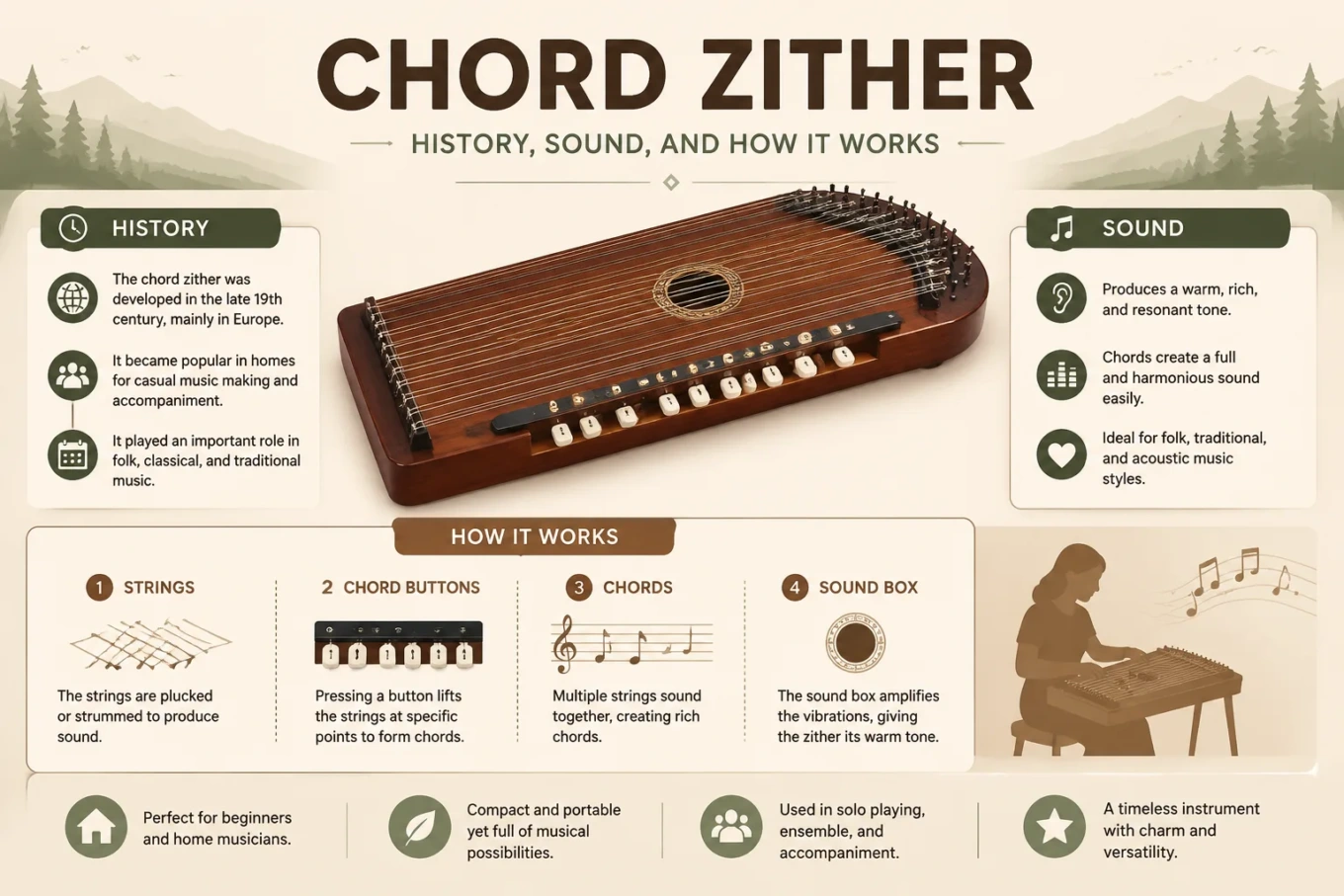
Chord Zither: History, Sound, and How It Works
A chord zither is a fretless zither built around a simple musical idea: individual melody strings[1] occupy one part of the instrument, while separate groups of strings are already tuned to usable chords. The player can therefore move between melody and accompaniment without forming guitar-style chord shapes or operating the chord bars found on an autoharp.
Historical instruments appear under names such as chord zither, guitar zither, Guitar-Zither, mandolin zither, and various maker-specific trade names. Those labels can overlap, so the most reliable way to understand an instrument is to examine its string layout and playing mechanism rather than its name alone.
What Makes a Chord Zither Different?
The defining feature is the division of the playing surface into two musical functions. One area carries strings used individually for melody. Another contains several chord groups[2], each tuned so that brushing or plucking the group produces a prepared harmony.
Most instruments associated with the classic guitar-zither design are fretless[3]. A melody pitch is therefore selected by choosing the appropriate string rather than pressing a string against a fingerboard to shorten its sounding length.
| Feature | Typical Chord-Zither Arrangement |
|---|---|
| Instrument family | Zither branch of the chordophone family |
| Melody system | Separate open strings, each assigned a pitch |
| Accompaniment system | Strings arranged in pre-tuned chord groups |
| Fingerboard | Usually absent on the familiar fretless guitar-zither form |
| Chord bars | Not required for the basic chord-group design |
| Playing action | Individual melody strings are plucked; chord groups are commonly brushed or plucked together |
| String count | Varies substantially by maker, model, range, and number of available chords |
Classification Note: The word “chord zither” is useful, but historical terminology is not perfectly standardized. Two instruments sold under similar names may have different numbers of melody strings, chord groups, doubled strings, decorative forms, or playing aids.
How the String Layout Works
A chord zither can look complicated because dozens of tuning pins and strings may cover much of its upper surface. The layout becomes easier to read once the two string systems are separated mentally.
The Melody String Field
The melody side consists of individually tuned open strings[4]. Each string normally supplies a fixed pitch when played without stopping it against a fret.
Historical designs may provide a diatonic, chromatic, or partly chromatic sequence depending on the model. Some instruments print note names, string numbers, or other visual markings close to the strings. This is especially useful because there is no conventional keyboard or fretted neck to show where one pitch ends and the next begins.
The principle differs sharply from a guitar. A guitarist can obtain several pitches from the same string by pressing it at different frets. On a fretless chord zither of this type, changing melody pitch normally means moving to another string.
The Chord String Field
The accompaniment side is divided into groups. Each group contains several strings tuned to notes that belong together harmonically. A group based on C major, for example, can contain different chord tones and may distribute them across more than one register. Exact voicing varies among instruments.
When the player sweeps across that group, several strings sound in one gesture. The instrument does not calculate or mechanically construct the chord at that moment. The harmony has already been built into the tuning plan.
This distinction explains much of the chord zither’s physical appearance. What initially looks like an unusually dense collection of strings is actually a visible map of melody pitches and prepared harmonies.
How a Chord Zither Produces Music
Plucking a string sets it into vibration. That energy passes through the bridge[5] to the soundboard[6] and resonating body. The larger wooden surfaces move more air than the string could efficiently move by itself, making the note more audible.
Melody and accompaniment then use the same acoustic system in different ways:
- A single melody string is selected and plucked.
- The bridge transfers its vibration into the body.
- A suitable chord group is selected for accompaniment.
- Several strings in that group are brushed or plucked.
- The melody can continue while different chord groups provide changing harmony.
Because many strings remain free to vibrate, the instrument can produce noticeable resonance[7] and sustain. The amount depends on construction, stringing, tuning, playing force, damping, and the condition of the individual instrument.
Why It Can Play Chords Without Frets or Buttons
The easiest way to understand the chord zither is to compare how different instruments create a chord.
On a guitar, the player changes the effective lengths of several strings with the fretting hand. Those altered pitches combine into a chord.
On a chord zither, the maker has already assigned strings to chord groups and tuned them accordingly. The player chooses a group rather than creating a fingering pattern.
| Guitar | Chord Zither |
|---|---|
| A small set of strings serves many notes | Many strings are individually assigned pitches |
| Fretting changes sounding length | Melody strings normally remain open |
| The player forms chord shapes | The player selects a pre-tuned chord group |
| One string can provide many fretted pitches | One melody string normally represents one open pitch |
The same principle makes simple chord changes physically direct. Instead of reshaping the hand for C, F, or G harmony, a player can move from one labeled or visually separated group to another.
What a Chord Zither Sounds Like
The characteristic sound comes from many freely vibrating strings mounted across a broad resonating surface. Individual melody notes often have a clear attack followed by an open, ringing decay. Chord sweeps create a denser sound because several strings begin vibrating almost together.
Listening Note: Listen for the contrast between a single, sharply defined melody pluck and the wider wash of sound produced by an accompaniment group. That alternation is one of the easiest ways to recognize the musical logic of the instrument.
There is no single chord-zither timbre[8]. A small instrument with relatively short strings will not respond exactly like a larger model carrying longer bass strings. String gauge, string material, body stiffness, bridge design, soundboard condition, pick material, and playing force can all affect the result.
Why the Chords Can Sound Broad
A chord group does not have to contain only three strings simply because a basic major triad has three different pitch classes. Historical makers could distribute chord tones across several strings and registers. Some designs also include a low bass string within or beside the group.
That arrangement gives a chord more physical sources of vibration. Several notes may continue ringing after the initial sweep, which creates a fuller texture than a single melody string.
The effect should not be described as identical across all chord zithers. String plans differ, and surviving antique instruments are often no longer strung exactly as they were when new.
How Melody and Accompaniment Are Played Together
The instrument was designed to make the relationship between melody and harmony visible. One hand can select melody strings while the other handles the grouped accompaniment, although exact hand use can vary with layout, technique, and player preference.
Plucking the Melody
Melody notes are sounded individually. A plectrum, fingerpick, or finger may be used depending on the instrument and playing approach. Because adjacent strings represent different pitches, accuracy depends on locating the correct string cleanly.
Brushing the Chords
Accompaniment groups can be swept so that several strings sound in quick succession. A lighter stroke gives the individual pitches more separation; a firmer, faster sweep makes them register more strongly as a single harmonic event.
A simple progression might move through C, F, G, and back to C while the melody continues above it. The player is not retuning or refingering the same strings for each harmony. Each selected chord has its own prepared group.
Controlling Unwanted Ringing
Open strings can continue sounding after they have been struck. Players may therefore use deliberate damping[9] or controlled hand contact when a cleaner separation between notes or chords is wanted.
This becomes more noticeable on instruments with long sustain. Too many overlapping strings can blur a chord change, particularly when moving between harmonies that contain different bass notes.
The 1894 Menzenhauer Guitar-Zither
The best-documented reference point for the familiar guitar-zither layout is the United States patent associated with Friedrich, or Fred, Menzenhauer. His application was filed on April 20, 1893, and U.S. Patent No. 520,651 was granted on May 29, 1894.
The patent calls the instrument a Guitar-Zither. Its described arrangement places an open scale of melody strings on one side of the sounding board and groups of accompaniment strings on the other. The strings within each accompaniment group are tuned to form a harmonic chord.
The design also included a visual system for relating numbered melody strings to suitable chord groups. This reveals an important part of the instrument’s purpose: the physical layout did more than generate sound. It helped make melody-and-chord playing easier to organize.
A Design Suited to Home Music Making
Fretless zither variants became established as manufactured parlour instruments during the late nineteenth century. The chord zither fitted that setting well because it could combine melody and accompaniment without requiring the player to learn a fretted fingerboard.
Menzenhauer-type guitar zithers were produced commercially in both Europe and the United States, including instruments associated with Menzenhauer & Schmidt and later Oscar Schmidt manufacturing. Numerous related models followed, with different dimensions, chord capacities, melody ranges, decoration, and trade names.
Industrial production also encouraged printed playing aids. Numbered strings, chord labels, and special music systems could turn a crowded soundboard into a practical visual interface for an amateur player.
Why Old Chord Zithers Have So Many Names
Historical naming is one of the hardest parts of identifying these instruments. Chord zither describes the musical arrangement reasonably well, but makers and retailers often preferred names intended to suggest other familiar instruments.
Labels encountered on surviving examples and related designs include:
- Chord zither
- Guitar zither or Guitar-Zither
- Mandolin zither
- Mandolin-guitar zither
- Harp zither
- Violin zither
- Maker-specific model and trade names
These terms should not automatically be treated as exact synonyms. A mandolin-type model may use doubled melody strings, while a violin-zither design can involve bowing and a different playing system. A harp-shaped body can describe appearance without turning the instrument into a true harp.
Collector’s Note: When a label and the physical construction seem to disagree, inspect the string systems first. Separate open melody strings beside visibly grouped accompaniment strings are more informative than a decorative name containing “guitar,” “harp,” or “mandolin.”
Chord Zither, Concert Zither, and Autoharp
These instruments are related through the broader zither tradition, but their playing systems should not be merged into one type.
| Feature | Chord Zither | Concert Zither | Autoharp |
|---|---|---|---|
| Melody fingerboard | Usually absent | Present | Absent |
| Melody method | Individual open strings | Fretted melody strings | Strings sound according to strumming and damping |
| Chord method | Prepared chord-string groups | Uses its own fretted and accompaniment-string system | Chord bars mute unwanted strings |
| Main visual clue | Separate melody and chord areas | Visible fingerboard | Chord-bar mechanism over the strings |
Why a Chord Zither Is Not Simply an Autoharp
An autoharp uses a mechanical selection system. Pressing a chord bar brings felt dampers into contact with strings that do not belong to the selected chord. The remaining strings are free to sound when strummed.
A basic chord zither uses a different logic. The desired accompaniment strings are already gathered into separate tuned groups, and the player directly plays the required group.
The practical distinction can be stated plainly: a chord zither selects the group to sound; an autoharp chord-bar system selects which strings should be muted.
Why It Is Not a Concert Zither
A concert zither normally has a fretted melody section where the player changes pitch by stopping strings against frets. It also carries open accompaniment strings, but its layout, technique, and repertoire developed around a different playing system.
The familiar guitar-style chord zither removes that fretted melodic fingerboard and instead assigns melody notes to separate open strings.
There Is No Standard Chord-Zither String Count
String totals vary too much for one number to define the instrument. The final count depends on melody range, chromatic coverage, number of chord groups, number of strings within each chord, bass arrangement, doubled strings, and maker-specific design.
Documented historical guitar-zither forms include instruments with melody sections spanning several octaves and accompaniment sections containing many additional strings divided among five or six chords. Other surviving models are smaller or organize their strings differently.
This is why an unidentified instrument should not be classified or tuned from string count alone.
Doubled Strings Change the Count
Some related mandolin-zither designs use strings in paired courses[10]. Two strings tuned together can be played as one musical unit, creating a different attack and increasing the apparent string count without necessarily increasing the number of distinct melody pitches.
Missing strings complicate identification further. An antique instrument that appears to contain 30 strings today may originally have carried more.
Chord-Zither Tuning Depends on the Model
There is no universal tuning chart that can safely be applied to every chord zither. Even instruments with similar body shapes can have different melody ranges, chord sets, string gauges, or bass arrangements.
When an original tuning plan is unknown, useful evidence includes:
- maker and model markings;
- printed pitch names beside the strings;
- chord labels;
- surviving string numbers;
- original instruction material;
- the number and position of chord groups;
- string length and gauge;
- documented examples of the same model.
The chord labels themselves often reveal more than the total number of strings. A clearly marked accompaniment area can show how the maker expected the instrument’s harmonic system to function.
Luthier’s Note: An old chord zither should not be brought to an assumed full tuning simply because a modern chart appears to fit its string count. Loose tuning pins, cracked wood, lifted bridges, unsuitable replacement strings, or an incorrect pitch plan can make added tension unsafe for the instrument.
Why Notes and Chords Were Printed on the Soundboard
Printed information is a functional part of many historical chord zithers. Note letters, numbers, chord names, lines, decorative labels, and playing guides help the player navigate a surface that may contain several dozen similar-looking strings.
The idea becomes especially useful on a fretless instrument. A concert zither fingerboard gives the hand a visible sequence of frets. A piano has a repeating pattern of black and white keys. A chord zither can instead use printed markings to tell the player where pitches and harmonies are located.
When the Soundboard Becomes a Music Map
Some historical systems went beyond permanent labels. Special numbered or under-string music aids could indicate which melody string to play and which accompaniment group matched it.
This allowed the instrument to function partly as its own notation surface. The player could follow locations on the instrument instead of translating every event from conventional staff notation.
Not every chord zither used the same system, and surviving paper guides are often missing. Their presence on some models nevertheless helps explain why string numbers and printed reference marks are common on instruments made for household music making.
Body Shape Does Not Identify the Instrument
Chord zithers appear in several outlines. Some are rectangular or broadly trapezoidal; others use curved sides or silhouettes intended to resemble a harp. Decoration can make the family resemblance even harder to judge.
Body shape therefore provides only supporting evidence. The stronger clues are mechanical:
- a shallow resonating wooden body;
- a large field of open strings;
- an identifiable melody-string area;
- separate accompaniment groups;
- many metal tuning pins;
- printed note or chord markings on many examples;
- no conventional guitar neck;
- no concert-zither melody fingerboard on the familiar fretless form;
- no autoharp chord-bar assembly on a basic chord-group model.
Sound holes are also poor identifiers by themselves. Round openings, decorative cutouts, and other shapes occur across many zither forms.
Materials, Bridge Layout, and Resonating Body
Most surviving commercial examples use a wooden soundbox with metal strings anchored between tuning pins and fixed attachment points. The strings pass over one or more bridge surfaces that define their vibrating lengths and transfer energy to the body.
Construction varies enough that a single wood species should not be presented as standard. Historical manufacturers also changed materials and decorative treatments across different models and price levels.
Wood choice can shape resonance, but the audible result comes from the instrument as a system. Soundboard thickness, bracing, bridge mass, body dimensions, string tension, and structural condition work together. An attractive species name alone does not predict how an antique instrument will sound.
Why the Bridge Layout Can Look Unusual
Melody strings and chord strings do not always share identical lengths. Bass notes generally require a different balance of vibrating length, string mass, and tension than higher pitches. Makers could therefore shape or position bridge sections to accommodate different string groups across the same body.
This is another reason a chord zither should be studied from the top as a complete layout rather than viewed as a box with interchangeable parallel strings.
Decoration Was Part of the Commercial Instrument
Many surviving guitar and chord zithers carry elaborate surface decoration. Dark finishes, floral transfers, painted borders, colored illustrations, ornamental labels, and decorative sound holes are common on various period examples.
The decoration does not determine the acoustic classification. A highly ornamented harp-shaped model and a simpler rectangular model can still rely on closely related melody-and-chord string principles.
For collectors, the decorative surface can nevertheless help document maker, model series, manufacturing period, and the commercial setting in which an instrument was sold. Original printed material should therefore be preserved whenever possible during cleaning or restoration.
How to Recognize an Antique Chord Zither
Identification works best as a sequence rather than a guess based on the label.
- Look for a fretted fingerboard. If a clear concert-zither fingerboard is present, the instrument belongs to a different playing system.
- Find the melody area. Look for a long sequence of individually tuned open strings, often with pitch or number markings.
- Find grouped accompaniment strings. Chord labels or physical spacing can reveal where one harmonic group ends and another begins.
- Check for chord bars. A large damper-bar mechanism suggests an autoharp-type system rather than a basic chord-group zither.
- Read every surviving label. Maker names, model numbers, patent dates, chord markings, and instruction text can narrow identification.
- Do not assume the present stringing is original. Strings may have been removed, replaced with incorrect gauges, or reorganized during earlier repairs.
Collector’s Note: A patent date printed on an instrument tells when the referenced invention was patented, not necessarily when that particular instrument was manufactured. The construction, maker mark, model, printed decoration, and surviving documentation still need to be considered together.
Can an Antique Chord Zither Still Be Played?
Many surviving instruments can produce music, but age alone does not show whether bringing one to playing tension is appropriate.
Before tuning, inspect for:
- cracks in the soundboard or back;
- open seams around the body;
- a bridge lifting away from the soundboard;
- warping around heavily loaded string areas;
- loose or leaning tuning pins;
- deep corrosion on old strings;
- missing strings or obvious gauge mismatches;
- unidentified repairs;
- uncertain tuning labels.
A chord zither carrying dozens of strings places cumulative tension on its wooden structure. Replacing every missing string and immediately tuning to an assumed chart can therefore create more stress than a weakened antique body should carry.
Replacement Strings Need More Than the Correct Pitch Name
A replacement string must work with the required pitch, vibrating length, material, diameter, and intended tension. Two metal strings tuned to the same note can load an instrument very differently if their gauges or construction differ.
This matters particularly on antique instruments whose original string specifications are missing. Matching another documented example of the same model is more reliable than fitting whatever modern music string happens to reach the note.
Why Chord Zithers Matter in Instrument History
The chord zither represents a particular solution to a recurring musical problem: how to place melody and ready-made harmony on one compact tabletop instrument.
Its solution was physical rather than electronic or keyboard-based. Each melody pitch received its own location, while accompaniment was organized into groups that could be selected directly. Printed markings then helped the player navigate the resulting string field.
That combination explains the instrument better than any one body shape or trade name. It also explains why museums may catalogue visually different specimens under related zither classifications while retaining the historical names used by their makers.
The surviving instruments are useful records of late nineteenth- and early twentieth-century instrument manufacture, domestic music making, decorative design, simplified notation systems, and experiments with alternative string layouts. Their construction can often be read directly from the soundboard: melody on one side, prepared harmony on the other.
Frequently Asked Questions
Is a Chord Zither the Same as a Guitar Zither?
The terms often overlap, especially for instruments derived from the late nineteenth-century fretless Guitar-Zither design. They are not perfect universal synonyms, however. Historical manufacturers used many trade names, so the physical string arrangement should be checked before assigning a precise type.
Does a Chord Zither Have Frets?
The familiar fretless chord- or guitar-zither form does not use a fretted melody fingerboard. Its melody notes are assigned to separate open strings. Other zither types, including the concert zither, can have fretted strings.
Is a Chord Zither an Autoharp?
Not in the usual mechanical sense. A basic chord zither provides separate pre-tuned accompaniment groups. An autoharp normally uses chord bars and dampers to silence strings that do not belong to the selected chord.
How Many Strings Does a Chord Zither Have?
There is no standard number. String count changes with melody range, number of chords, chord voicing, bass arrangement, doubled courses, maker, and model. The layout is more useful for identification than the total alone.
Why Are Chord Names Printed Beside the Strings?
The labels show which accompaniment group produces each harmony. Pitch letters, numbers, and other markings can also help the player find melody strings on an instrument that has no keyboard or fretted melody neck.
Can an Old Chord Zither Be Tuned and Played?
Possibly, if its structure and hardware remain sound and the correct tuning and string specifications can be established. A cracked body, lifting bridge, loose tuning pins, incorrect strings, or uncertain tuning plan should be assessed before full tension is applied.
Glossary of Technical Terms
[1] Melody String: A string used to produce an individual melodic pitch. On a fretless chord zither, a sequence of separate melody strings replaces the fretted melody fingerboard found on a concert zither.
[2] Chord Group: A set of strings tuned to notes belonging to a particular harmony and positioned so they can be played together. Chord zithers may contain several such groups.
[3] Fretless: Describes a string system without frets for stopping the string at fixed positions. On many chord zithers, pitch selection comes from choosing another open melody string rather than shortening one string against a fingerboard.
[4] Open String: A string sounded at its full available vibrating length without being stopped against a fret or fingerboard. Open strings form the basis of the melody and accompaniment systems on many chord zithers.
[5] Bridge: The structure over which the strings pass before their vibration is transmitted to the soundboard. Its placement and shape also help determine the vibrating length of the strings.
[6] Soundboard: The relatively broad resonating surface of the instrument’s body. String vibration reaches it through the bridge, allowing a much larger area to move air and produce audible sound.
[7] Resonance: The response of the instrument’s strings and wooden body to vibration. On a many-stringed zither, resonance contributes to sustain and to the interaction between notes that are allowed to continue ringing.
[8] Timbre: The tonal character that allows two instruments to sound different even when they play the same pitch. On a chord zither it is shaped by strings, body construction, bridge, soundboard, playing method, and other physical features.
[9] Damping: Reducing or stopping a string’s vibration by touching it or by using a mechanical damper. Players can use damping to prevent sustained open strings from blurring later notes or chord changes.
[10] Course: One musical string position made from two or more strings intended to be played together. Some related mandolin-zither designs use paired courses to change attack and tonal density.