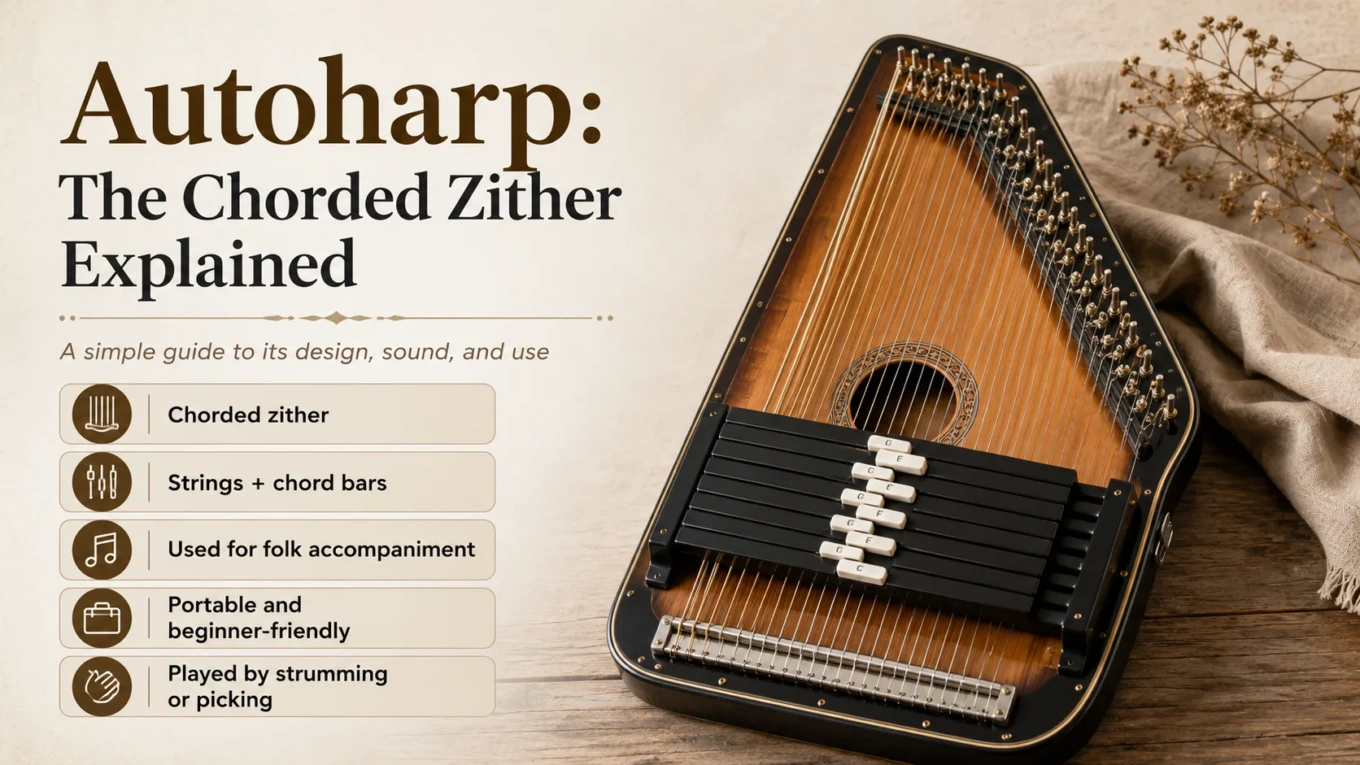
Autoharp: The Chorded Zither Explained
Pressing an Autoharp chord button does not tune the strings, move them to new pitches, or generate a chord electronically. The button operates a selective damping system: a chord bar allows the notes belonging to the chosen harmony to remain free while stopping the others. That simple mechanical idea is what makes the Autoharp one of the most recognizable forms of chorded zither[1].
The instrument belongs to the broad zither family even though its name contains “harp.” Its strings run across the body rather than extending along a separate neck, and its defining feature is a set of chord bars[2] fitted with dampers[3]. The player selects harmony with one hand and strums or picks the strings with the other.
What Makes an Autoharp a Chorded Zither?
In organological terms, the Autoharp is a chordophone[4]: vibrating strings produce the initial sound. More specifically, it fits within the broad zither concept because those strings are stretched across a resonating body[5] rather than running from a body onto a structurally distinct neck as they do on a guitar or lute.
The word chorded describes the instrument’s playing logic. An Autoharp does not need a separate bank of strings for every chord. Instead, many differently tuned strings share one playing surface, and each chord bar determines which of those strings may continue sounding.
Classification Note: “Zither” can refer narrowly to European instruments such as the concert zither or broadly to a much larger organological group. Calling an Autoharp a zither uses the broader structural meaning. It does not imply that the Autoharp, concert zither, koto, guzheng, qanun, or other zither-family instruments share the same playing system.
A typical Autoharp also lacks the fretted melody section associated with a concert zither. Harmony is controlled mechanically above the strings rather than formed by stopping strings against frets.
How a Chord Bar Turns Many Strings into One Chord
The easiest way to understand the mechanism is to follow one chord through the instrument.
Suppose the player selects C major. The essential pitch classes in that chord are C, E, and G. The Autoharp’s string bed[6] contains those notes along with pitches that do not belong to C major.
- The player presses the button marked C.
- The attached chord bar travels toward the strings.
- Felt or similar damping material contacts the strings that should not sound.
- Strings corresponding to C, E, and G remain free at the relevant openings in the damping pattern.
- The player strums across a broad area of the instrument.
- The muted strings contribute little or no sustained pitch, while the permitted notes form the C-major harmony.
The chord button acts as a filter, not a tuner. The strings must already be tuned to their intended pitches. Pressing a chord bar changes which strings can ring; it does not change their basic tuning.
What Happens When the Button Is Released?
Springs return the bar to its resting position. The damping material lifts away, leaving the strings available for the next chord selection.
This also explains why chord changes need clean timing. If one bar remains partly depressed while another is engaged, unwanted muting or brief pitch gaps can occur.
Main Construction Details
An Autoharp may look mechanically busy because the chord assembly covers part of the string field. Underneath that assembly, however, the instrument follows familiar zither principles: tensioned strings, a wooden body, bridges or anchoring hardware, and a vibrating soundboard[7].
| Part | Function |
|---|---|
| Strings | Provide the available pitches from which chords and melodies are produced. |
| Chord buttons | Give the player direct control over individual chord bars. |
| Chord bars | Carry the damping pattern across the string field. |
| Felt dampers | Silence pitches that do not belong to the selected chord. |
| Springs | Return chord bars to their raised position after the buttons are released. |
| Tuning pins | Adjust the pitch and tension of individual strings. |
| Pin block | Provides a stable structure in which the tuning pins are seated. |
| Bridge and anchors | Define string support and transfer string energy into the instrument structure. |
| Soundboard | Responds to string vibration and helps project the acoustic sound. |
Tuning Pins and the Pin Block
Each string is brought to pitch with a tuning pin[8]. Those pins must remain firmly seated under substantial combined string tension, which makes the pin block[9] an important structural part of the instrument.
Fine-tuning hardware is fitted to some modern instruments, but it is not a defining feature of the Autoharp. Traditional instruments can be tuned directly at the main pins with an appropriate tuning wrench.
Bridge, Anchors, and Body
The strings are secured at the opposite end by pins, an anchor assembly, or related hardware depending on the design. A bridge[10] or bearing surface helps establish the vibrating length and transmit energy to the body.
Construction materials differ among makers and periods. Maple, spruce, and other woods appear in production and custom instruments, while laminated construction is also used. Wood choice, thickness, bracing, stringing, and overall body construction can all shape response, but material alone does not determine an Autoharp’s tone.
Why 15-Chord and 21-Chord Autoharps Are Different
A “15-chord Autoharp” does not have fifteen strings. The number refers to the available chord buttons and bars.
Fifteen- and twenty-one-bar systems remain established configurations on modern factory Autoharps. Earlier instruments and specialized designs can use other counts, so 15 and 21 should not be treated as universal limits.
| Feature | 15-Chord | 21-Chord |
|---|---|---|
| Chord bars | 15 | 21 |
| Control area | Less crowded | Denser layout |
| Available harmony | Smaller chord selection | Broader chord selection |
| Mechanical principle | Selective damping | Selective damping |
| What the number describes | Chord controls, not string count | Chord controls, not string count |
More chord bars expand the harmonies immediately available to the player, but they do not change the basic operating principle. Every bar still contains its own pattern of damping and clearance points.
Why the Buttons Do Not Behave Like Piano Keys
An Autoharp button represents an entire chord rather than a single pitch. Depending on the layout, buttons may include major, minor, and dominant-seventh chords. Their arrangement is therefore based on harmonic use and the design of the chord-bar system, not on the continuous chromatic sequence found on a piano keyboard.
Layouts can also be customized. A player may rearrange bars for easier access to frequently used progressions or refelt bars to create a different chord set. For that reason, a particular button arrangement should not be assumed to represent every Autoharp.
Chromatic and Diatonic Autoharps Use the String Bed Differently
A major design distinction concerns how pitches are distributed across the strings.
Chromatic Autoharps
A chromatic[11] setup includes a broader range of pitch classes so that the instrument can support more keys, accidentals, and chord combinations. This makes chromatic Autoharps flexible for accompaniment and repertoire that moves between several tonal centers.
The tradeoff is that the available strings must accommodate more different pitches. The string field therefore has fewer opportunities to double the same note repeatedly.
Diatonic Autoharps
A diatonic[12] Autoharp concentrates its tuning around one key or a limited group of related keys. Strings that would otherwise supply less-needed chromatic pitches can instead be retuned to reinforce pitches useful in the chosen tonal system.
That repeated-note arrangement can produce a dense, responsive sound in its intended keys. The cost is reduced freedom outside them.
| Characteristic | Chromatic | Diatonic |
|---|---|---|
| Pitch selection | Broader | Focused on selected keys |
| Key flexibility | Greater | More limited |
| Repeated pitches | Generally less emphasis on doubling | Can use more doubled notes |
| Typical strength | Harmonic flexibility | Focused resonance and melody playing |
Diatonic Autoharps are not all tuned alike. One-key, two-key, and other custom systems exist, and players may develop arrangements suited to a particular repertoire.
Tuning and Chord Selection Are Separate Systems
This distinction explains many Autoharp problems that can otherwise seem mysterious.
Tuning determines pitch. The tuning pins establish what note each string produces.
Damping determines participation. The chord bars decide whether a particular string is permitted to sound during a selected chord.
An accurately felted C-major bar cannot produce a clean C chord if its C, E, and G strings are badly out of tune. Conversely, perfectly tuned strings cannot compensate for a damaged or misaligned damper that allows an unwanted F-sharp to ring through the chord.
When a Chord Sounds Wrong
| What Is Heard | What to Examine |
|---|---|
| Several chords sound out of tune | General string tuning |
| One unwanted note rings in one chord | Felt position or chord-bar alignment |
| A correct chord note sounds unusually dull | Damper touching a string that should remain free |
| Button action feels slow | Spring movement or chord-bar travel |
| Buzz appears when a bar is pressed | Uneven contact, loose hardware, or bar alignment |
Luthier’s Note: Chord-bar problems and tuning problems should be diagnosed separately. Altering tuning will not correct a misplaced damper, while refelting a bar will not correct strings that are at the wrong pitch.
How an Autoharp Is Actually Played
Simple accompaniment can be learned with a straightforward pattern: hold a chord button, strum, change bars, and repeat. The mechanism makes basic harmony accessible, but the instrument supports considerably finer control once the picking hand begins working with individual strings.
Chord Strumming
For accompaniment, the player depresses one chord bar and sweeps across multiple strings with the fingers or a plectrum[13]. The bar handles pitch filtering while the picking hand controls rhythm, direction, accent, and the part of the string field being struck.
The result is not mechanically identical every time. A short treble-side sweep can sound lighter than a broad stroke extending through the bass register.
Melody Picking
The Autoharp can also play individual melodic notes. A player may pick selected strings while operating chord bars rhythmically so that the intended melody notes remain available at the correct moment.
This technique changes the instrument’s musical role. Instead of functioning only as harmonic accompaniment, it can carry melody while adding chord tones between or around melody notes.
Fingerstyle Playing
Advanced players often use several fingerpicks[14] rather than relying on one flat pick. This permits separate bass notes, melody tones, chord strokes, repeated-note patterns, and other textures to occur within the same performance.
Players such as Kilby Snow and Bryan Bowers became closely associated with highly developed Autoharp picking approaches. Their playing demonstrates why the instrument should not be reduced to a device for strumming ready-made chords.
Tabletop and Upright Playing Change the Picking Area
Early Autoharp playing commonly placed the instrument horizontally on a table or lap. The chord-button hand worked above the string field while the picking hand used the accessible strings beyond the chord-bar assembly.
During the twentieth century, upright playing became prominent. The instrument is held against the torso, often with its long dimension angled upward. This gives the picking hand access to a different and generally broader portion of the strings.
Mid-century performers played an important role in establishing this approach. Historical accounts associate the transition with several musicians, while Maybelle Carter became especially influential in making upright Autoharp performance visible to a wide audience.
The position matters acoustically as well as ergonomically. Moving the picking hand to another section of a string changes the balance of upper partials and attack.
What Shapes the Autoharp’s Sound?
The selected chord is only one part of the result. Picking location, string gauge, body response, damping condition, tuning stability, and playing pressure all affect the audible character.
Picking Position
Plucking closer to a string’s termination point tends to produce a sharper attack with stronger upper-frequency content. Moving farther into the active length generally gives a rounder sound.
An upright player can exploit this difference by moving the picking hand across the exposed string field rather than striking every chord in exactly the same place.
Resonance and Sustain
When several correctly tuned strings remain free, their combined resonance[15] creates much of the Autoharp’s recognizable fullness. Repeated pitches in some diatonic setups can reinforce this effect.
The damping system works against that natural tendency to ring. Good chord-bar action needs to silence unwanted pitches cleanly without unnecessarily choking the notes that should remain audible.
Listening Note: A clean Autoharp chord should reveal the selected harmony without obvious stray pitches. Slight differences in attack and sustain are normal; a persistent non-chord tone points more directly toward tuning or damping alignment.
The Autoharp Origin Story Is More Complicated Than One Inventor
Charles F. Zimmermann is closely tied to the Autoharp name and its early American development. He filed a U.S. patent application for a “Harp” in December 1881, and U.S. Patent No. 257,808 was issued on May 9, 1882. The patent describes transverse mechanisms that silence selected strings so that the remaining strings form a chord, and the specification uses the term autoharp.
The instrument shown in that early patent, however, should not simply be treated as identical to every later Autoharp. The history also involves German instrument maker Karl August Gütter and Hermann Lindemann. They pursued a German patent in 1884 for a string-damping device that was issued in 1885, during a period when several related mechanical zither designs were developing.
Historical sources do not present an entirely uniform account of who should receive sole credit for the familiar Autoharp form. Older narratives often emphasize Zimmermann, while later research has examined Gütter’s contribution and the chronology of the different damping mechanisms in much greater detail.
The safest description separates several questions:
- Zimmermann is securely connected with the early documented use of the name autoharp and an 1882 U.S. patent for a selective string-damping system.
- Gütter and Lindemann are part of the documented German development of closely related chord-zither damping mechanisms.
- The familiar commercial instrument emerged from this wider period of experimentation rather than from one uncontested design event.
This distinction matters because the history of an instrument name, the history of a patent, and the history of the physical form sold to musicians are not necessarily the same history.
From Parlor Instrument to Old-Time Music
Autoharps became commercially visible in the United States during the late nineteenth century, when chord-operated zithers appealed to domestic music makers who wanted direct access to accompaniment. Early models appeared in several configurations, including instruments with far fewer chord bars than the familiar later 15- and 21-bar arrangements.
By the early twentieth century, the Autoharp had also entered Southern rural music-making. It was well suited to singing because one player could maintain full chords without forming each harmony note by note.
Ernest V. Stoneman used the instrument on commercial recordings in 1924. The Carter Family also helped establish the Autoharp within recorded country and old-time music, with Sara Carter using it for accompaniment.
When Melody Became More Visible
Accompaniment dominated much early recorded Autoharp playing, but musicians also developed melodic uses. Maybelle Carter brought wide attention to melodic Autoharp playing during the 1950s, while performers such as Kilby Snow developed distinctive approaches of their own.
Later fingerstyle players expanded the separation of bass, melody, chord, and rhythmic figures. This development did not change the underlying damping mechanism; it changed how much musical information the player drew from the available strings.
What Modern Autoharps May Add to the Basic Design
The fundamental arrangement remains acoustic strings plus mechanically selected damping, but present-day instruments can add equipment that earlier examples did not have.
- Fine tuners can allow small pitch corrections without making every adjustment at the main tuning pins.
- A magnetic or other suitable pickup[16] can provide an amplified signal for performance.
- Chord-bar assemblies may be rearranged or refelted for customized harmony layouts.
- Diatonic instruments may use specialized tunings developed around a player’s preferred keys.
- Custom-built instruments may differ in body construction, bar geometry, stringing, and hardware from standard factory models.
Fifteen- and twenty-one-chord hardware remains in current production, alongside fine-tuning and pickup systems. These additions expand convenience or stage use but do not alter the basic identity of the instrument.
Common Autoharp Misconceptions
“An Autoharp Tunes Itself”
It does not. Every string must be brought to the required pitch. Chord bars only mute or release strings.
“Pressing a Button Produces the Chord”
The button selects which strings are allowed to ring. Sound still begins when the player strums or picks the strings.
“It Is a Type of Harp”
The name is misleading in structural terms. The Autoharp is normally classified with zithers because its strings extend across its own resonating body rather than running between a neck-like element and a soundbox in the manner that defines harps.
“A 21-Chord Autoharp Has 21 Strings”
The number describes chord controls. String count is a separate construction specification and varies among instruments and historical models.
“Autoharps Can Only Strum Accompaniment”
Chordal accompaniment is one of their most accessible uses, but melody picking and developed fingerstyle techniques allow individual notes, bass lines, rhythmic figures, and chords to be combined.
Why the Damping Mechanism Defines the Instrument
The unusual feature of the Autoharp is not that it contains pre-tuned chords. It contains a field of independently tuned strings from which the mechanism continually subtracts unwanted pitches.
That creates a playing process built from three separate actions:
- Tuning establishes the available pitches.
- The chord bar decides which pitches remain active.
- The picking hand decides when, where, and how those strings sound.
This division of labor explains both the Autoharp’s accessibility and its depth. A beginner can produce usable harmony with one button and one strum, while an experienced player can manipulate individual strings, bar timing, rhythm, melody, register, and tone within the same mechanical system.
Glossary of Technical Terms
[1] Chorded Zither
A zither-family instrument designed to make chord selection directly accessible. On the Autoharp, this is achieved through chord bars that selectively damp strings rather than through a fretted chord section.
[2] Chord Bar
A bar positioned across the Autoharp strings and operated by a labeled button. Its damping pattern silences strings outside a selected chord while leaving the required pitches free.
[3] Damper
Material or a mechanism used to stop a vibrating string. Autoharp chord bars commonly use felt surfaces arranged so that only selected strings are damped.
[4] Chordophone
An instrument whose primary sound source is one or more vibrating strings. Zithers, harps, lutes, and many other string instruments belong to this broad category despite their different structures.
[5] Resonating Body
The physical body that receives energy from vibrating strings and helps make their sound acoustically useful. In a zither such as the Autoharp, the strings lie across this body rather than extending along a separate neck.
[6] String Bed
The complete field of strings arranged across an Autoharp. Different chord bars select different pitch combinations from the same string bed.
[7] Soundboard
The vibrating surface of the instrument body that responds to energy transmitted from the strings. Its material, thickness, bracing, and relationship with the rest of the body can influence acoustic response.
[8] Tuning Pin
A metal pin used to adjust the tension and therefore the pitch of an individual string. Autoharp strings require tuning independently of the chord-bar mechanism.
[9] Pin Block
The reinforced wooden structure that holds the tuning pins. It must resist the combined forces created by the instrument’s tensioned strings.
[10] Bridge
A supporting surface that helps establish the active string length and transmit vibration into the instrument structure. Autoharp bridge and anchoring details vary with design.
[11] Chromatic
In an Autoharp context, a chromatic setup provides a wider selection of pitch classes so that more keys and accidentals are available from the string bed.
[12] Diatonic
A tuning organized mainly around the notes needed for a particular key or limited group of keys. Diatonic Autoharps can use repeated pitches where a chromatic instrument would require additional accidentals.
[13] Plectrum
A pick used to set strings in motion. Autoharp players may use a flat plectrum for broad strumming or other picking equipment for more detailed articulation.
[14] Fingerpick
A small pick worn on a finger or thumb. Multiple fingerpicks allow an Autoharp player to separate melody, bass, and chord strokes more precisely than a single broad strum.
[15] Resonance
The response of strings and instrument structure to vibration. On an Autoharp, several permitted strings can ring together, while the damping system limits resonance from notes outside the selected harmony.
[16] Pickup
A device that converts instrument vibration into an electrical signal for amplification. It changes how an Autoharp can be amplified but does not replace its acoustic string-and-damper mechanism.
FAQ
Is an Autoharp actually a zither?
Yes. In broad organological classification, the Autoharp belongs to the zither family because its strings extend across its resonating body without a separate functional neck. Its chord-bar damping system distinguishes it from many other zithers.
Does an Autoharp automatically make chords?
No. Its mechanism automatically mutes strings that do not belong to the selected chord. The strings must already be tuned correctly, and the player must still strum or pick them to produce sound.
What does 21-chord Autoharp mean?
It means the instrument has 21 chord-bar controls. It does not refer to the number of strings. Fifteen-chord and twenty-one-chord systems use the same general selective-damping principle.
What is the difference between a chromatic and diatonic Autoharp?
A chromatic Autoharp distributes its strings across a broader set of pitches for greater key flexibility. A diatonic instrument concentrates its tuning around one or a few keys and may use more repeated pitches within those keys.
Can an Autoharp play melodies as well as chords?
Yes. Individual strings can be picked while the chord bars control which notes remain available. Advanced players combine melody, bass notes, chords, and rhythmic patterns in the same performance.
Who invented the Autoharp?
There is no completely uncontested one-name answer for the familiar instrument. Charles F. Zimmermann documented the term “autoharp” and a selective damping system in his 1882 U.S. patent, while Karl August Gütter and Hermann Lindemann were involved in closely related German chord-zither developments during the same period. The familiar commercial form emerged from this overlapping history.