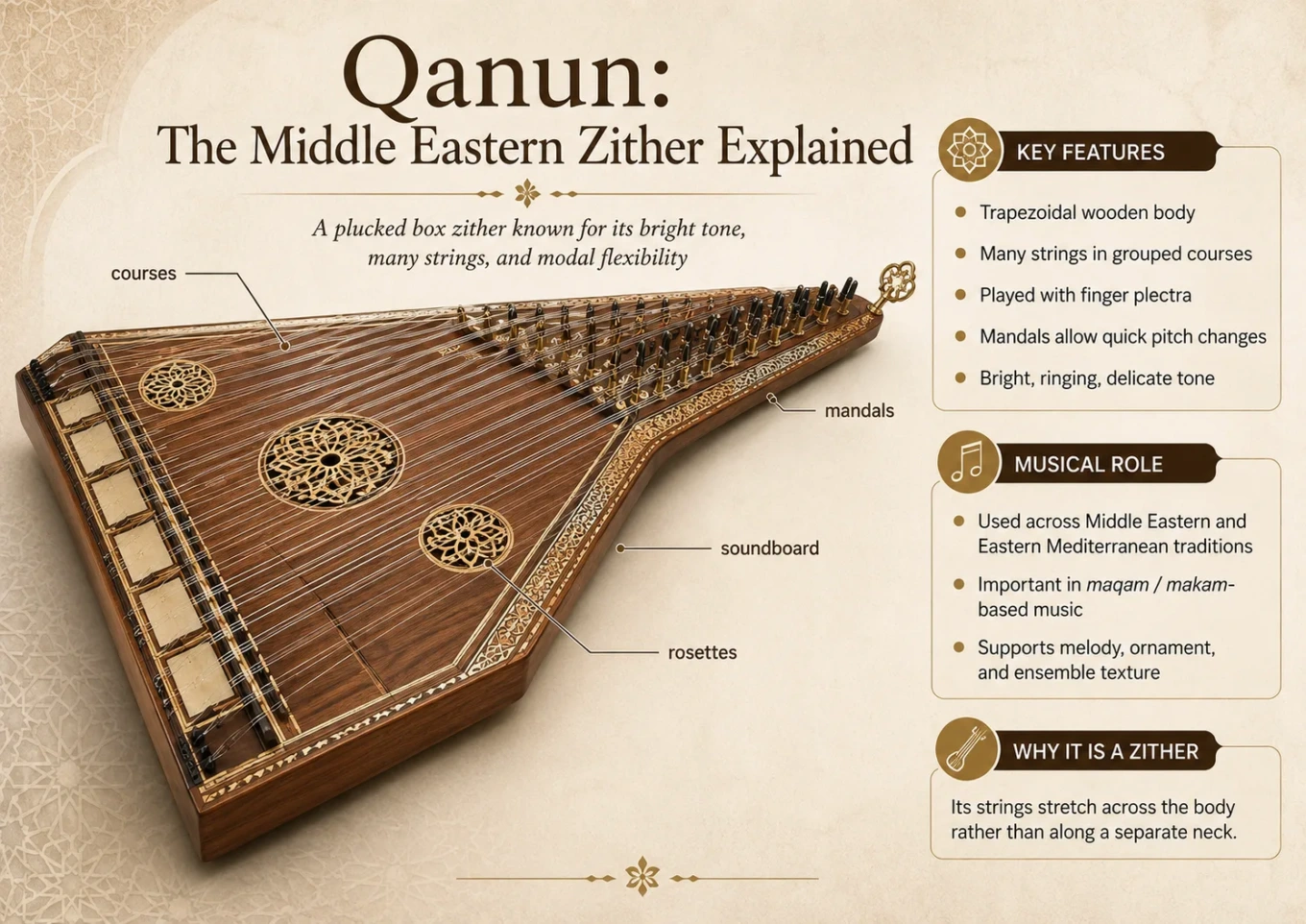
Qanun: The Middle Eastern Zither Explained
The qanun is a plucked box zither: a flat, usually trapezoidal instrument with many strings stretched across a shallow wooden body. It belongs to the wider zither family, but it is not simply a “Middle Eastern guitar,” a small harp, or a dulcimer. Its identity comes from three things working together: courses of strings, a resonant table, and small pitch-changing levers that let the player move through modal music with unusual speed and precision.
In Arabic, Turkish, Persian, Armenian, Greek, and neighboring musical settings, the name appears in several spellings, including qanun, qānūn, kanun, and kanonaki. The spelling changes with language and transliteration, but the instrument usually refers to the same broad family of flat, plucked zithers used across the Middle East, North Africa, parts of the Eastern Mediterranean, and nearby regions.
What Is a Qanun?
A qanun is a zither[1] because its strings run across the body rather than along a separate neck. In organological terms, it is a chordophone[2], meaning its sound comes from vibrating strings. More narrowly, it is often described as a plucked zither[3], because the player sounds the strings by plucking them rather than striking them with hammers or bowing them.
The qanun’s most recognizable feature is its low, flat, trapezoidal body[4]. One side is longer than the other, which helps organize different string lengths across the instrument. Longer strings serve lower pitches, while shorter strings serve higher pitches. This layout gives the qanun a wide range while keeping the instrument playable on the lap or on a table-like support.
Although the qanun is often grouped with Middle Eastern instruments, it should be described with care. It is used in many regional traditions, and its construction can vary by country, maker, school, and period. Turkish kanun, Arabic qanun, Armenian kanon, and Greek kanonaki traditions share family traits, but they do not always use identical dimensions, string counts, lever systems, or performance habits.
Main Details Worth Knowing
| Feature | Common Description | Why It Matters |
|---|---|---|
| Instrument family | Plucked box zither | The strings stretch across the body rather than along a neck. |
| Body shape | Flat and usually trapezoidal | The shape allows many string lengths to sit in one playable plane. |
| Sounding surface | Wooden soundboard, often with a membrane section in many examples | The surface helps transmit string vibration into audible sound. |
| Strings | Often arranged in multi-string courses | Several strings may sound together for one pitch, giving brightness and volume. |
| Pitch control | Movable levers or mandals on many modern instruments | They allow fast pitch adjustment for modal performance. |
| Playing method | Plucked with plectra, often attached to the index fingers | The technique gives clarity, speed, and strong rhythmic detail. |
Classification Note: The qanun is best understood as a zither by construction and as a regional art-music instrument by use. The family label explains its body-and-string layout; it does not erase the musical traditions that shaped the instrument.
Names, Spellings, and Regional Use
The word qanun is often connected with the idea of “law,” “rule,” or “canon,” but the musical instrument should not be reduced to a single neat origin story. Historical references to the name appear in learned musical writing, while the form of the instrument used today developed through craft practice, courtly and urban music, ensemble playing, and later conservatory traditions.
Spelling often signals language rather than a different instrument. Qanun and qānūn are common in Arabic-oriented transliteration. Kanun is widely used in Turkish. Kanon or related spellings may appear in Armenian or Greek contexts. A museum label may choose one spelling, while a performer may use another.
Regional terms also carry practical meaning. A Turkish kanun may be discussed with reference to Turkish makam theory and a dense lever system. An Arabic qanun may be described through Arabic maqam performance, regional tuning habits, and ensemble use. These labels help readers avoid treating the qanun as a single fixed object.
How the Qanun Is Built
A qanun body is shallow and box-like. The top surface includes a soundboard[5], usually made from wood, which receives vibration from the strings. Many documented examples also include a skin or parchment area near the bridge zone. This membrane-like section can affect attack and color, although makers and traditions differ in how they build and voice it.
The body acts as a resonating body[6]. It does not create pitch by itself; it helps the string vibration become louder and more present. The thin top, internal air space, bridge pressure, and overall stiffness of the box all shape the final sound.
Decoration may include mother-of-pearl, bone, wood inlay, shell, or patterned rosettes, especially on historical or finely made instruments. Ornament is not only visual. Rosettes and sound openings can also be part of how the soundboard is managed, though their exact acoustic effect depends on design and construction.
Strings and Courses
The qanun normally uses many strings arranged in courses[7]. A course is a group of strings tuned to the same pitch or near the same pitch and played as one note. Many modern qanuns use triple courses, meaning three strings sound together for one written or heard pitch. Some instruments, however, may differ in string count and layout.
This multi-string design gives the qanun much of its bright, ringing sound. When three strings are plucked together, the tone gains shimmer and body. Tiny tuning differences between strings in the same course can also affect the sound, though skilled players and makers usually aim for a clean, controlled result rather than uncontrolled beating.
Strings may be made from modern synthetic materials, metal-wound strings, or other materials depending on range, maker, and period. Historical instruments may show gut strings or other older materials. It is safer to speak of material families than to claim one universal qanun string type.
Bridges, Levers, and Pitch Changes
Near one side of the instrument, the strings pass over a bridge[8] that transfers vibration into the top. On many modern instruments, the player also finds rows of small metal levers. These are often called mandals[9] in Turkish usage and may be described more generally as pitch levers.
These levers create a practical form of microtonal[10] control. By raising or lowering a lever, the player changes the speaking length or tension relationship of a string course enough to adjust pitch by small intervals. This is one reason the qanun fits so well in modal traditions where pitches do not always match equal-tempered piano notes.
Some older or regional instruments may use fewer levers, different lever layouts, or other tuning practices. In performance, the lever system allows the player to prepare a mode before playing and also change selected pitches during the piece. The left hand may adjust levers while the right hand continues plucking, though exact technique depends on school and repertoire.
Luthier’s Note: A dense lever system is not just hardware added to a box. Lever height, placement, string angle, tuning stability, and ease of movement all affect whether the instrument feels responsive under the hands.
Playing Position and Technique
The qanun is usually played flat, either on the lap or placed on a table or stand. The player sits behind the long side of the instrument, with the lower-pitched strings generally closer to one side and higher-pitched strings arranged across the body according to length.
Players commonly use small plectra[11], often attached to the index fingers with rings or holders. These fingerpicks[12] give a clear attack and allow rapid passages. Bare-finger playing can occur in some settings or for special color, but the ring-and-plectrum method is closely associated with many qanun traditions.
The hands share the musical work. One hand may carry melody, the other may answer with ornaments, repeated notes, bass tones, or broken patterns. In skilled playing, both hands can move with great independence. The result is not only melody with accompaniment; it can be a woven texture of notes, tremolo, ornaments, and responsive pitch changes.
Open Strings and Prepared Pitch Layout
Unlike a fretted lute or guitar, the qanun does not shorten strings by pressing them against a fingerboard. The player normally plucks open strings[13]. This means each course is already tuned to a pitch before it is played, with levers used to alter pitch choices as needed.
This layout changes the way a player thinks. On a guitar, one string can produce many pitches under the left hand. On a qanun, the pitch field is spread across many pre-tuned courses. The player must know where each pitch lies and how lever settings prepare the mode.
Tuning and Modal Use
Qanun tuning[14] is not one single worldwide standard. It depends on instrument type, regional practice, repertoire, and the pitch system used by the musician. Many modern players tune courses across several octaves, then use levers to refine scale degrees for particular modes.
In Arabic, Turkish, and related art-music traditions, the qanun often works with maqam[15] or makam concepts. These modal systems include characteristic pitch relationships, melodic movement, emphasized notes, and phrase behavior. The lever system helps the qanun move among these pitch worlds without retuning every string from scratch.
It is tempting to describe the qanun as “microtonal” and stop there, but that word alone is too broad. The practical issue is not merely that the instrument can play small intervals. The deeper point is that players use those intervals inside living modal systems, where pitch, melodic direction, ornament, and phrase grammar all matter.
Sound, Resonance, and Playing Feel
The qanun has a bright, ringing attack followed by a quick but lively decay. Its resonance[16] depends on string material, body depth, soundboard response, bridge design, membrane area, and the player’s touch. A light pluck may sound delicate and glassy; a firmer stroke can bring a sharper edge.
The instrument’s timbre[17] is shaped by many small details. Triple courses add brilliance. The shallow box gives focus. The plectrum creates a clean start to the note. Lever adjustments may slightly change the feel of certain pitches under the fingers. No single part explains the whole sound.
One reason the qanun stands out in ensembles is its ability to articulate fast melodic figures without losing pitch clarity. It can also support singers or melodic instruments by outlining mode, giving rhythmic lift, and decorating important tones.
Listening Note: When hearing a qanun, listen for the short sparkle at the start of each note, then the way nearby strings and the body keep the sound alive. The beauty is often in the balance between crisp attack and ringing aftersound.
How the Qanun Differs from Related Zithers
The qanun shares the zither idea with many instruments, but its playing logic is distinct. It should not be treated as the same instrument as a guzheng, koto, santur, psaltery, or hammered dulcimer.
| Instrument | Shared Trait | Main Difference |
|---|---|---|
| Santur | Flat string instrument associated with regional art traditions | The santur is usually struck with light hammers, while the qanun is plucked. |
| Hammered dulcimer | Many strings stretched over a soundbox | The hammered dulcimer belongs to struck-zither practice, not plectrum-plucked qanun technique. |
| Psaltery | Flat plucked string layout in some forms | The qanun has a developed regional lever system and modal performance role. |
| Guzheng | Zither family relationship | The guzheng uses movable bridges under individual strings and left-hand pitch bending; the qanun uses courses and pitch levers. |
| Concert zither | Zither family relationship | The concert zither includes fretted melody strings and accompaniment strings, unlike the qanun’s open-course layout. |
Qanun and Santur
The qanun and santur can both appear in discussions of Middle Eastern and neighboring music cultures, but their sound production differs. The santur is a struck zither. The qanun is plucked. That one difference changes attack, technique, ornament, and phrasing.
A santur note begins with the impact of a hammer. A qanun note begins with the release of a plucked string. Both can sound bright and ringing, but the player’s body mechanics are not the same.
Qanun and Guzheng
The guzheng and qanun are both zithers, yet their pitch systems are organized differently. On the guzheng, individual strings run over movable bridges, and the left hand often bends pitch by pressing the string segment beyond the bridge. On the qanun, pitch adjustment is usually managed through prepared tuning and small levers near the string end.
This means the two instruments can look distantly related while feeling very different to play. The guzheng often shapes notes through bending after the pluck. The qanun often shapes pitch choice before or during the phrase by moving levers.
Materials and Craft Choices
Qanun makers may use woods such as walnut, spruce, maple, or other locally available and workshop-preferred materials, depending on region and design. It is better to speak in terms of maker choice than to claim that one wood defines the instrument. Wood choice can shape resonance, but body design, thicknessing, stringing, bridge work, and setup also matter.
The top must be responsive enough to speak clearly but stable enough to hold string tension. The bridge area needs careful support. The lever area must allow fine mechanical movement without rattling or slipping. A decorative instrument that cannot hold tuning is not a good musical tool.
Historical qanuns in museum collections may include wood, parchment, gut strings, metal fittings, bone, shell, ivory, mother-of-pearl, or other materials used in their period. Modern makers may avoid some older materials for legal, ethical, or practical reasons and use substitutes that are easier to maintain.
Collector’s Note: On older qanuns, labels, materials, repair marks, and lever design can tell as much as decoration. A museum-style description often records culture, date, material, dimensions, and classification because these details help separate visual beauty from organological evidence.
Museum and Heritage Context
Museums often classify the qanun as a plucked zither or as a chordophone-zither-plucked instrument. That wording may sound dry, but it is useful. It tells readers how the instrument makes sound and how it sits inside a larger family of string instruments.
Heritage descriptions often add cultural and regional labels: Turkish, Syrian, Egyptian, Armenian, Arab, Greek, or broader Middle Eastern and Mediterranean contexts. These labels should not be used as rigid ownership claims. They usually point to documented use, maker location, collection history, or musical setting.
The qanun also carries strong ensemble associations. It can appear with voice, oud, ney, violin, percussion, and other instruments depending on the tradition. In many settings, it helps define the modal surface of the music because its pitch layout makes scale degrees audible and flexible.
Common Misunderstandings
The Qanun Is Not a Harp
The qanun may sound harp-like to new listeners because of its many ringing strings, but it is not a harp. Harp strings run from a neck or frame to a resonator. Qanun strings stretch across a flat body, which places it in the zither family.
The Qanun Is Not the Same as Every Zither
The word zither describes a broad family, not one single design. A concert zither, guzheng, koto, kantele, santur, and qanun may all connect to zither classification in some way, but they differ in bridges, tuning, playing technique, repertory, and cultural use.
The Lever System Does Not Make the Instrument Automatic
Pitch levers help the qanun change notes quickly, but they do not replace training. The player still needs ear control, modal knowledge, tuning skill, and hand coordination. Lever movement has to fit the phrase, not interrupt it.
String Count Is Not One Universal Number
Many modern qanuns are described with a familiar range of courses and strings, often built around triple-string courses. Still, exact string count varies by maker, region, period, and model. A careful description should say what a particular instrument has rather than treating one model as the rule for all qanuns.
What Beginners Should Know
The qanun is approachable in one sense: the strings are visible, and each course gives a clear pitch when plucked. A beginner can learn simple melodies without first mastering fingerboard stopping. The challenge comes later, when tuning, levers, ornament, and modal phrasing become part of the same action.
For a new player, the first skills usually include:
- Learning the pitch layout across the courses.
- Using plectra cleanly without scraping or catching the strings.
- Keeping repeated notes even and controlled.
- Understanding how lever settings prepare a mode.
- Tuning patiently and checking courses by ear.
- Listening to regional style rather than treating the instrument as a generic zither.
A student coming from piano may understand pitch names quickly but still need time to learn modal intervals and lever use. A student coming from guitar may need to adjust to open-course playing. A student coming from another zither may adapt faster to the flat layout, but qanun technique remains its own discipline.
Care, Tuning Stability, and Handling
A qanun is sensitive to changes in humidity, temperature, and string tension. The shallow body, many strings, and fine lever mechanism all need stable conditions. Sudden environmental changes can affect tuning and may place stress on the soundboard or bridge area.
Routine care should stay simple and gentle. Keep the instrument covered when not in use, avoid damp or very dry storage, and do not place pressure on the levers or bridge. Tuning should be done gradually, especially if the instrument has been idle for a long time.
Repairs are best handled by someone familiar with qanun construction. General string-instrument repair knowledge helps, but the lever system, course layout, and soundboard structure require specific experience.
FAQ
Is the qanun a type of zither?
Yes. The qanun is usually classified as a plucked box zither because its strings run across a flat resonating body rather than along a neck. Its regional identity, however, is just as important as its family classification.
Is qanun the same as kanun?
In many contexts, yes. Qanun is common in Arabic-oriented spelling, while kanun is common in Turkish. The exact construction and playing style may still vary by regional tradition.
How many strings does a qanun have?
There is no single universal number. Many modern instruments use courses of multiple strings, often three strings per pitch, but the total count depends on maker, region, and model.
Is the qanun hard to learn?
Simple melodies can be learned early because the strings are laid out visibly. The harder parts are tuning, lever control, modal pitch awareness, ornament, and clean right-hand technique.
What makes the qanun different from a santur?
The qanun is plucked with plectra, while the santur is usually struck with light hammers. This changes the attack, hand movement, ornament style, and musical phrasing.
Does every qanun have pitch levers?
Many modern qanuns use levers or mandals, but historical and regional examples can differ. Lever number, layout, and pitch function should be described according to the specific instrument.
Glossary of Technical Terms
- Zither: A string instrument in which the strings run across the body rather than along a separate neck. In the qanun, the flat body holds the strings, supports resonance, and defines the playing surface.
- Chordophone: An instrument whose sound comes from vibrating strings. The qanun is a chordophone because plucked strings are the source of its pitches.
- Plucked Zither: A zither sounded by plucking the strings rather than striking or bowing them. The qanun belongs here because players commonly use plectra to set the strings in motion.
- Trapezoidal Body: A body shape with unequal parallel sides, common in qanun construction. This shape helps arrange different string lengths across a flat playing surface.
- Soundboard: The top surface that receives vibration from the strings and helps project sound. On a qanun, the soundboard may combine wood with a membrane area in many examples.
- Resonating Body: The hollow or semi-hollow structure that helps amplify string vibration. In the qanun, the shallow box gives the strings a louder and more focused voice.
- Course: A group of strings treated as one pitch. Many qanuns use multiple strings per course, which adds brightness and strength to each note.
- Bridge: The part that supports the strings and transfers their vibration into the soundboard. Bridge design affects response, volume, and tone color.
- Mandal: A small pitch lever used on many Turkish-style and related qanuns. By moving a mandal, the player can adjust pitch without fully retuning the string course.
- Microtonal: Refers to pitch intervals smaller or differently placed than the standard semitone divisions of equal-tempered piano tuning. In qanun playing, microtonal control supports modal pitch practice.
- Plectrum: A small pick used to pluck a string. Qanun players often use plectra to produce a clear, articulate attack.
- Fingerpick: A pick attached to the finger, often with a ring or holder. On the qanun, fingerpicks help the player pluck fast passages with control.
- Open String: A string sounded without being stopped against a fingerboard or fret. Qanun courses normally speak as open strings, with pitch prepared through tuning and levers.
- Tuning: The process of setting each course to the needed pitch. Qanun tuning is closely tied to regional practice, lever settings, and modal performance.
- Maqam: A modal system used in many Middle Eastern musical traditions. For qanun players, maqam knowledge shapes pitch choice, melodic movement, and lever use.
- Resonance: The way an instrument body responds after the string begins to vibrate. Qanun resonance comes from the interaction of strings, bridge, soundboard, body cavity, and playing touch.
- Timbre: The tone color of an instrument. The qanun’s timbre is often bright and ringing, shaped by courses, plectra, body design, and materials.