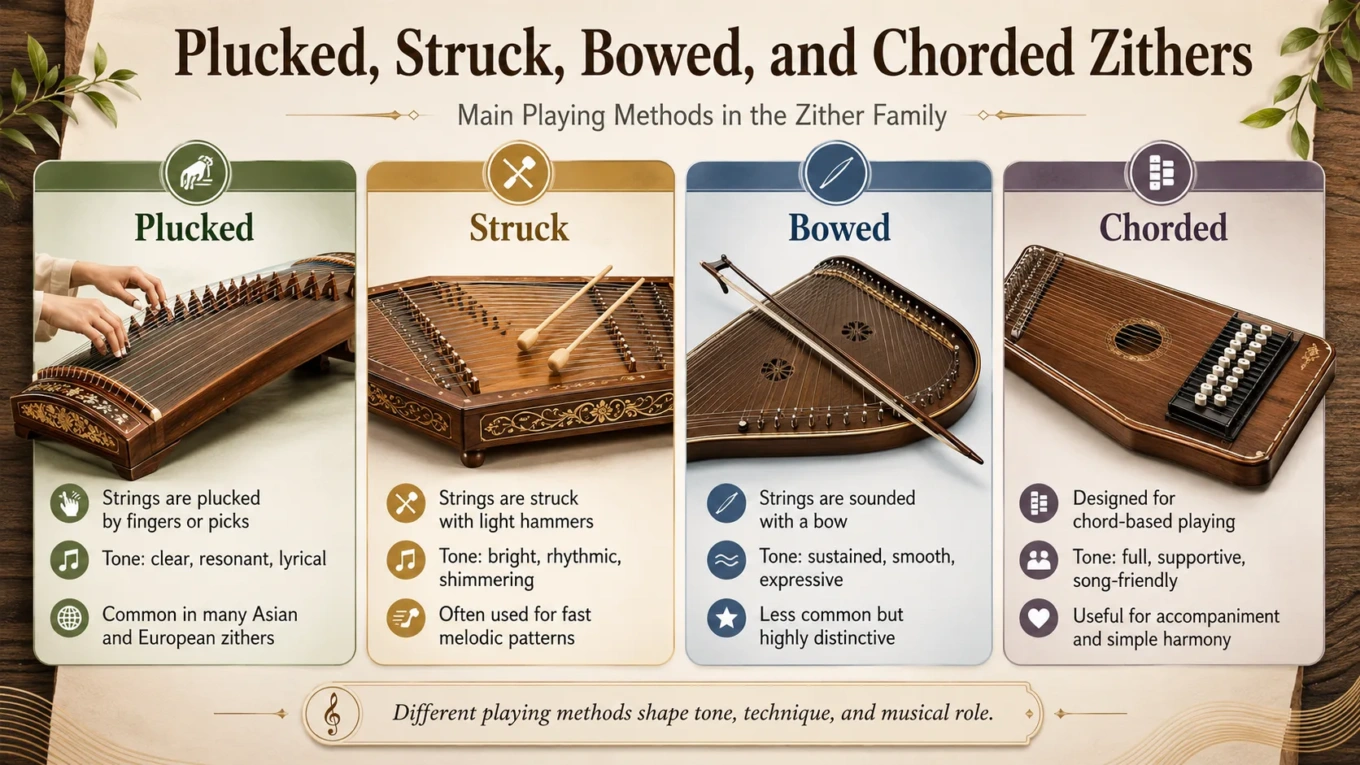
Plucked, Struck, Bowed, and Chorded Zithers Explained
A zither can be plucked, struck, bowed, or played through a chord mechanism, and each method changes how the same basic idea feels under the hands. The word zither[1] can describe a broad family of chordophones[2] whose strings run across or along a body without a separate neck. That body may be a flat board, a box, a tube, a trough, or a more complex resonating form. What separates one zither from another is not only shape, region, or tuning. The playing action matters just as much.
Why Playing Method Matters in Zither Classification
Plucking, striking, bowing, and chorded playing are not four neat instrument families. They are four ways of setting zither strings into motion. Some instruments fit one category clearly. Others overlap.
A guzheng is usually described as a plucked zither. A santur is usually described as a struck zither. A bowed psaltery uses a bow along its string ends. An autoharp belongs to the zither family in broad organological use, but its sound is organized through chord bars. These examples show why playing method is useful, but it should not replace careful attention to construction.
The same wooden body, soundboard[3], string material, bridge layout, and resonating body[4] all shape the result. Playing method explains how the sound begins. Construction explains how the sound grows, decays, and colors the tone.
| Playing Method | How the String Is Activated | Common Zither Examples | Typical Sound Character |
|---|---|---|---|
| Plucked | Finger, fingernail, plectrum, or fingerpick pulls and releases the string | Guzheng, koto, gayageum, guqin, kantele, qanun, psaltery | Clear attack, flexible ornament, strong control over timing |
| Struck | Small hammers, sticks, or beaters hit the string | Santur, hammered dulcimer, yangqin, some regional box zithers | Bright attack, ringing sustain, fast repeating patterns |
| Bowed | Bow hair or a bowed edge keeps the string vibrating | Bowed psaltery, bowed monochord-related forms, some experimental zithers | Sustained tone, narrow attack, vocal-like continuation |
| Chorded | A damping or chord-bar system selects grouped notes while strings are strummed or plucked | Autoharp, chord zither, some fretless chord-zither layouts | Harmonic blocks, accompaniment patterns, easy song support |
Classification Note: A playing method is not the same as a full instrument identity. A zither may be called plucked, struck, bowed, or chorded because of how musicians use it, but its body type, bridge system, string layout, and regional tradition still need separate attention.
Plucked Zithers
Plucked zithers form one of the widest groups in the zither family. The player sets each string in motion by pulling and releasing it with a bare finger, fingernail, plectrum[5], or fitted pick. The sound begins with a clear attack, then passes into the body through the bridge[6] or string support.
Many well-known East Asian board zithers are plucked. The guzheng, koto, gayageum, guqin, and đàn tranh all use plucking, but they do not work the same way. Some use movable bridges. Some do not. Some allow wide pitch bending by pressing the string behind the bridge. Others rely more on subtle touch, stopped tones, or surface articulation.
How Plucking Shapes the Sound
Plucking gives a zither player direct control over attack, spacing, emphasis, and ornament. A string can be released gently for a soft beginning, or sharply for a brighter tone. The player can also control the direction of the pluck, which changes how the string moves across the bridge and soundboard.
On many plucked board zithers, the plucking hand and the pitch-shaping hand have different roles. One hand may sound the string while the other presses, bends, damps, or colors the tone. This division is one reason two instruments with similar silhouettes can feel very different to play.
Examples of Plucked Zithers
- Guzheng: A Chinese plucked board zither with movable bridges in many modern forms. Players often use picks on several fingers.
- Koto: A Japanese long zither with movable bridges. It is often played with picks worn on the right hand, while the left hand shapes pitch and color.
- Gayageum: A Korean plucked zither with regional and modern variants. Silk, nylon, or other strings may be used depending on type and setting.
- Guqin: A Chinese fretless zither known for stopped tones, harmonics, and sliding gestures on its smooth upper surface.
- Kantele: A Finnish and Karelian zither tradition ranging from small diatonic instruments to larger concert forms.
- Qanun: A Middle Eastern plucked trapezoidal zither with many string courses and pitch-changing mechanisms in many modern examples.
Plucking and String Layout
Plucked zithers often use an open string[7] layout, meaning each string can sound at a preset pitch without being stopped by a finger against a fingerboard. Some instruments, such as the guqin, also use stopped tones, but they still differ from necked lutes because the strings run along the zither body rather than over a separate neck.
The number of strings varies widely. A small kantele may have only a handful of strings. A modern guzheng often has many more. A qanun uses grouped strings, often arranged in repeated courses[8]. These differences affect tuning logic, hand movement, and the kind of music the instrument supports.
Listening Note: In plucked zithers, listen to the first moment of each note. A hard pluck can sound bright and pointed. A softer release lets the body speak more gently. On some instruments, the pitch may continue to bend or shimmer after the pluck.
Struck Zithers
Struck zithers produce sound when a hammer, stick, or light beater hits the string. The player does not pull the string and release it. Instead, the string receives a quick impact. This gives many struck zithers a bright beginning and a ringing decay.
The santur, hammered dulcimer, cimbalom, and yangqin are often discussed in this area, though names and classifications vary by region and language. Some are strongly tied to local repertories and construction styles. Others have concert versions with extended range, dampers, or more complex tuning systems.
How Striking Changes the Feel
A struck zither rewards timing, rebound, and control of the hammer. The hand does not stay on the string after the note begins. The player shapes tone through hammer weight, striking point, speed, and damping.
Because the hammer can move quickly between strings, struck zithers can produce fast patterns and repeated notes with a different ease than many plucked zithers. The tradeoff is that pitch bending after the note is usually less central than it is on some movable-bridge plucked zithers.
Santur and Hammered Dulcimer as Struck Zithers
The santur and hammered dulcimer are often placed near each other because both use strings stretched over a resonating body and are sounded with small hammers. They are not identical instruments. Their shapes, tunings, bridge patterns, repertories, and regional histories differ.
In broad classification, a hammered dulcimer may be described as a type of box zither because the strings run over a box-like resonator. The name “dulcimer” can cause confusion because it also appears in other instrument names, including the Appalachian dulcimer, which belongs to a different playing and construction context.
Damping and Resonance in Struck Zithers
Struck zithers can have generous resonance. That resonance can be beautiful, but it needs control. Players may damp strings with the hands, with mechanical dampers on some instruments, or through careful pedaling in larger concert forms such as the cimbalom.
The bridge layout also matters. A single string path may pass over more than one bridge area, dividing string length into useful pitch zones in some instruments. This gives the player access to more notes without making the body impossibly large.
Luthier’s Note: Hammer hardness, string gauge, bridge height, and soundboard response all affect a struck zither. A small change in hammer material can shift the sound from rounded to glassy, even when the tuning stays the same.
Bowed Zithers
Bowed zithers are less common in everyday descriptions of the zither family, but they are useful for understanding how broad the family can be. A bowed zither uses a bow to keep a string vibrating after contact begins. The result is a sustained tone rather than a plucked or struck decay.
The bowed psaltery is the best-known modern example for many readers. It usually has strings arranged so the bow can touch one string edge at a time. This layout differs from a violin or other necked bowed instrument, where the player stops strings along a fingerboard.
Why Bowed Zithers Need a Different Layout
A bow needs access. On many plucked or struck zithers, strings sit close together across a flat plane. That makes clean bowing difficult because the bow may touch neighboring strings. Bowed psalteries solve this by arranging string ends along accessible edges, often in a triangular or wing-like shape.
Because each string is usually tuned to a fixed pitch, the player often moves from string to string for melody. Some bowed zithers may allow special techniques, but they should not be assumed to work like bowed lutes, viols, or violins.
Sound and Musical Use
Bowed zithers can produce a plain, sustained tone with a clear melodic line. The sound is often less percussive than a plucked psaltery and less bright than many hammered zithers. It can blend well in small acoustic settings, but projection depends on body design, stringing, and bowing technique.
The bow also changes phrasing. A player can connect notes more smoothly than on a plucked zither, but fast chordal textures may be less natural. This makes bowed zithers useful for melody, drone-supported textures, and slow song-like lines.
Chorded Zithers
Chorded zithers are best understood through playing logic rather than sound initiation alone. The strings may still be strummed or plucked, but a mechanism or printed layout helps the player produce chords. The autoharp is the clearest example.
On an autoharp, chord bars press dampers against unwanted strings. When the player strums, only the selected chord tones remain free to ring. This is why the instrument can support singing or simple harmonic accompaniment with less left-hand note selection than many other zithers require.
Chord Bars and Damping
A chord bar is not a fret. A fret[9] changes the sounding length of a string when the string is pressed against it. A chord bar on an autoharp usually works by damping strings that do not belong to the chosen chord. The player selects harmony by pressing a button or bar, then strums across the string field.
This makes chorded zithers especially clear for accompaniment. They are less focused on independent pitch bending or individual string ornament than many plucked board zithers. Their design favors harmonic grouping.
Chord Zither and Autoharp
The term “chord zither” can refer to several related fretless zithers designed for home music making, song support, or simple harmonic playing. Some have melody strings and grouped accompaniment strings. Some use printed note guides or chord diagrams. The autoharp adds a more direct chord-bar damping system.
These instruments should not be treated as simplified versions of guzheng, koto, or qanun. Their musical purpose is different. They organize harmony for strumming and song support rather than building long melodic ornament across movable bridges or complex modal tuning systems.
Collector’s Note: Older chord zithers may have printed tuning charts, paper labels, or string diagrams on the soundboard. These markings can help identify intended tuning, but they may not prove the instrument is still strung correctly.
Where the Categories Overlap
The four labels are practical, not absolute. A zither may be mainly plucked but also strummed. A chorded zither may use plucking or strumming to start the sound. A struck zither may include damping systems that affect harmony and texture. Some experimental instruments combine methods.
It is safer to ask two questions:
- How is the string first set into vibration?
- How does the instrument organize pitch, resonance, and harmony after that moment?
The first question separates plucked, struck, and bowed action. The second explains bridges, string courses, tuning, damping, frets, and chord systems.
Plucked vs. Struck
Plucked zithers usually give the player closer contact with each string. The note can begin with tiny differences in finger angle and pressure. Struck zithers place a hammer between hand and string, so rebound and impact become the main tools.
Neither method is more advanced by default. They serve different musical needs. Plucking suits pitch shading, ornaments, and direct string control. Striking suits bright rhythmic patterns, fast alternation, and ringing textures.
Bowed vs. Plucked
A bowed zither can sustain a note as long as the bow keeps the string moving. A plucked zither naturally fades after the release, though the body may sustain the note for some time. This single difference changes phrasing, breath, and melodic shape.
Bowed zithers also need physical access for the bow. That requirement affects string spacing and body outline. A zither made for plucking is not automatically suitable for bowing.
Chorded vs. Fretted
Chorded and fretted are often confused. A fretted zither, such as a concert zither with a fingerboard area, changes pitch by pressing strings against frets. A chorded zither uses grouped string selection, damping, or printed chord logic to help produce harmony.
Some instruments can contain both melody and accompaniment zones. The European concert zither, for example, combines fretted melody strings with open accompaniment strings. That does not make it the same as an autoharp, because the playing logic and mechanism differ.
Construction Details That Affect All Four Methods
Playing method can only explain part of the sound. A zither’s body and stringing decide how the vibration behaves after it begins.
Soundboard and Body
The soundboard receives energy from the strings and spreads it through the body. On a box zither, the enclosed air and wooden plates help amplify the tone. On a board zither, the body may be flatter and less enclosed, but still provides the surface that supports string vibration.
Wood choice can shape resonance, but it should not be reduced to a single rule. Thickness, bracing, bridge pressure, workmanship, humidity, string tension, and age also matter. In some traditions, materials are chosen as much for local craft practice and stability as for tone.
Bridges and Pitch
Bridges transfer string vibration into the body and can also divide or define string length. Movable bridges allow pitch layout to be adjusted across the instrument. Fixed bridges create a more permanent geometry.
On some plucked zithers, pressing the string behind a bridge bends pitch or adds expressive color. On many struck zithers, bridge placement helps organize a larger note range. On chorded zithers, bridges support string courses while damping or chord bars handle harmonic selection.
Frets, Open Strings, and Drones
Some zithers have no frets. Some have a fretted melody area. Some rely mostly on open strings. A few mix different systems in one instrument.
A drone string[10] may repeat a steady pitch or tonal center. A melody string[11] carries the tune. In chord zithers and concert zithers, these roles can be built into the layout. In other traditions, the musical role depends more on tuning and repertory than on a printed or fixed label.
How Museums and Musicians May Describe These Instruments
Museum catalogues often describe zithers through body type, string arrangement, materials, and playing method. A catalogue entry may say “box zither,” “plucked zither,” “struck zither,” or “board zither” depending on the classification system used. Musicians may use more familiar names: guzheng, koto, santur, autoharp, kantele, or psaltery.
Both approaches are useful. The instrument name carries cultural and musical identity. The classification label explains structure. Trouble begins when a broad label replaces the specific instrument name. A guzheng is not simply “an Asian zither,” and a santur is not just “a hammered zither.” Those phrases may help beginners start, but they leave out the craft tradition, repertory, tuning habits, and playing technique that make each instrument distinct.
What Beginners Should Know
A beginner choosing among zither types should start with playing method. The hand skill feels different in each group.
- Choose a plucked zither for direct string contact, melodic control, and ornament.
- Choose a struck zither for hammer technique, ringing patterns, and rhythmic clarity.
- Choose a bowed zither for sustained melody and a bow-based sound.
- Choose a chorded zither for song accompaniment and grouped harmony.
Tuning should also guide the choice. Some zithers have many strings and need patient tuning. Some use repeated courses. Some are diatonic, while others support chromatic playing through layout, mechanisms, retuning, or added strings. No single tuning rule fits the whole family.
Common Misunderstandings
“All Zithers Are Plucked”
Many zithers are plucked, but not all. Struck, bowed, and chorded zithers are well documented in broad instrument classification. The plucked examples are simply more familiar in many discussions.
“Dulcimer Always Means the Same Thing”
The word “dulcimer” can point to different instruments. A hammered dulcimer is often discussed as a struck box zither. An Appalachian dulcimer has a different structure and playing tradition. The name alone does not settle the classification.
“Chorded Zithers Are Not Real Zithers”
Chorded zithers can still belong to the zither family in broad organological use because their strings run across a resonating body without a separate neck. Their chord system changes the way the player selects harmony, not the basic string-body relationship.
“Bowed Zithers Work Like Violins”
Bowed zithers and violins both use a bow, but their construction is different. A violin has a neck and fingerboard. A bowed zither usually presents fixed-pitch strings on a zither body, often arranged for bow access at the edges.
FAQ
Is Every Zither Played the Same Way?
No. Zithers can be plucked, struck, bowed, strummed, or played with chord-bar systems. The playing method depends on the instrument’s design and tradition.
What Is the Difference between a Plucked Zither and a Struck Zither?
A plucked zither is sounded by pulling and releasing the string with a finger, nail, plectrum, or pick. A struck zither is sounded by hitting the string with a hammer or beater.
Is an Autoharp a Chorded Zither?
Yes, in broad classification an autoharp is commonly treated as a chorded zither. Its chord bars damp unwanted strings so selected chord tones can ring when the strings are strummed.
Can a Zither Be Bowed?
Yes. Bowed zithers exist, though they are less common than plucked or struck examples. The bowed psaltery is one familiar form.
Are Santur and Hammered Dulcimer the Same Instrument?
They are related as struck zithers, but they are not the same instrument. Their shapes, tunings, bridge layouts, repertories, and regional traditions can differ.
Does Playing Method Tell the Whole Story?
No. Playing method explains how the string begins to vibrate. Body shape, soundboard design, bridge layout, tuning, string material, and damping also shape the instrument’s sound and use.
Glossary of Technical Terms
Zither: A broad instrument term for chordophones whose strings run across or along a body without a separate neck. In some contexts it also refers more narrowly to European zither forms, so usage depends on setting.
Chordophone: An instrument whose sound comes from vibrating strings. Zithers are chordophones, but not all chordophones are zithers.
Soundboard: The vibrating surface that receives energy from the strings and helps project the sound. In zithers it may be part of a flat board, a box body, or another resonating structure.
Resonating Body: The part of the instrument that supports and amplifies string vibration. Its shape, material, and construction affect volume, sustain, and tone color.
Plectrum: A small pick used to pluck strings. In some zither traditions, players use separate fingerpicks rather than one handheld pick.
Bridge: A support that holds strings at a set height and transfers vibration into the body. Some zither bridges are fixed, while others can be moved to adjust pitch layout.
Open String: A string that sounds at its set pitch without being stopped against a fret or fingerboard. Many zithers rely heavily on open strings.
Course: A group of strings tuned and played together as one musical unit. Qanun and some other zithers use courses rather than only single strings.
Fret: A raised strip or ridge that helps define pitch when a string is pressed against it. Fretted zithers use frets for melody strings, while many board zithers remain fretless.
Drone String: A string used to provide a repeated pitch or tonal support. In zither layouts, drone strings may sit beside melody or accompaniment strings.
Melody String: A string or group of strings used mainly for the tune. Some zithers separate melody strings from accompaniment or drone strings in the layout.