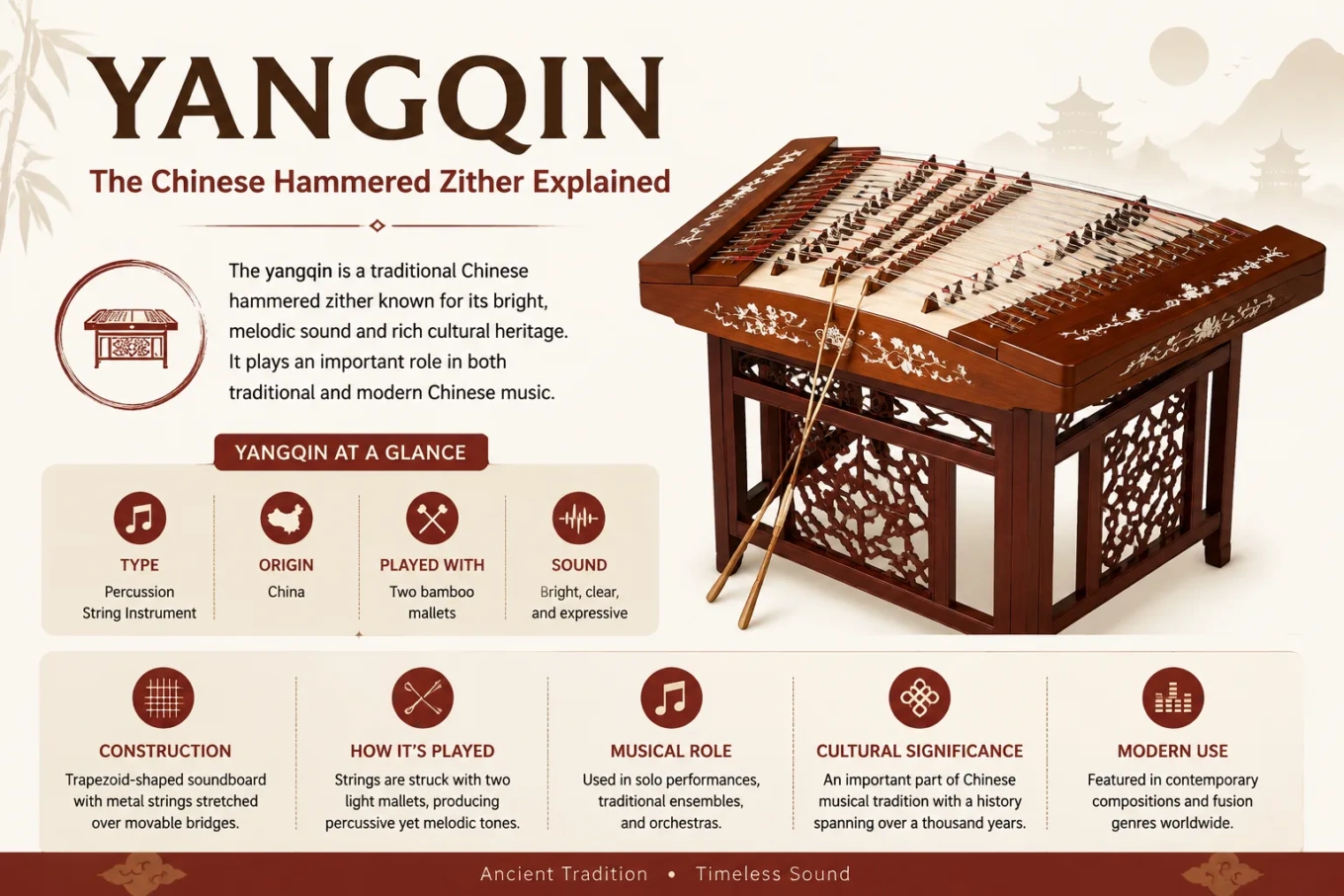
Yangqin: The Chinese Hammered Zither Explained
The yangqin is a Chinese hammered zither: a trapezoidal string instrument whose metal strings are struck with a pair of light beaters rather than plucked with the fingers. In organological terms it is a chordophone[1] and, more specifically, a struck zither[2]. English-language museums and performers also describe it as a hammered dulcimer[3]. Its dense field of strings, long bridge rows, bright attack, and two-handed beater technique give it a playing logic very different from plucked Chinese zithers such as the guzheng.
Modern yangqin are used for solo music, regional traditions, chamber ensembles, and Chinese orchestras. The instrument has also changed greatly since its earlier documented forms: concert models can offer a broad, nearly chromatic pitch field, while older examples are structurally simpler. There is no single string count, bridge layout, or tuning plan that describes every yangqin.
Why the Yangqin Is a Zither
The word zither describes a structural relationship between strings and body, not one fixed playing method. On a yangqin, the strings stretch across the resonating body and are supported by bridges; there is no separate lute-like neck carrying the playable string length. The player excites the strings directly with beaters.
Classification Note: “Zither” identifies the broad structural family. “Struck” describes how the strings are set into vibration. “Hammered dulcimer” is a familiar English label for this kind of struck string instrument. These terms can overlap without meaning that every regional hammered dulcimer is the same instrument.
This distinction matters because the yangqin is sometimes grouped with plucked strings in Chinese orchestra seating and notation practice even though its normal sound production is percussive. A player holds a beater in each hand and strikes selected string groups from above.
Main Construction Details
The basic shape is easy to recognize, but the working surface is more complex than the outline suggests. A wooden resonating body supports a broad soundboard[4]. Across it run many metal strings arranged in grouped courses[5]. Long bridges[6] divide and organize the vibrating lengths.
| Feature | What It Does |
|---|---|
| Trapezoidal body | Provides the broad surface needed for several string groups and bridge rows. |
| Soundboard | Receives vibration from the bridges and helps the body radiate sound. |
| Metal string courses | Produce the pitched sound; several strings may be tuned together as one course. |
| Long bridge rows | Set vibrating lengths and organize pitches across the playing surface. |
| Tuning hardware | Adjusts string tension; exact hardware and fine-tuning arrangements vary by model. |
| Paired beaters | Allow alternating strokes, rolls, chords, accents, and rapid patterns. |
Historical museum examples show wood, wire, and bamboo among the materials used. Modern instruments may add updated hardware, bridge caps, rollers, or other fittings. Such details should not be treated as universal because makers and model families differ.
How the Bridge and String Layout Works
The yangqin does not present notes in a single left-to-right row. Its playable surface is a network. Strings pass over multiple bridge lines, and the player learns where pitches sit in relation to those bridges and to neighboring courses.
Several physical ideas work together:
- A course can contain multiple strings tuned to the same pitch, increasing projection and changing the density of the sound.
- A bridge fixes a contact point that defines a usable vibrating length.
- Different sections of the same string system can produce different pitches.
- Pitch organization is spatial, so players memorize shapes and relative positions rather than reading the surface like a piano keyboard.
This is why photographs of a yangqin can look visually crowded even when the musical layout is familiar to an experienced player. The bridge rows act as a map.
Why One Universal String Count Does Not Work
String totals depend on the instrument’s design, the number of courses, and how many individual strings are used in each course. Older instruments, regional forms, student models, and modern orchestra models can differ. A fixed number presented as “the number of strings on a yangqin” is therefore misleading.
Tuning, Chromatic Notes, and the Pitch Map
Many modern concert yangqin are designed to provide a largely chromatic[7] playing field, meaning that the instrument can supply the semitone steps needed for music in many keys. The exact tuning of the outer registers[8] can vary between models, so a fingering or pitch chart must match the instrument in front of the player.
That model dependence explains why a diagram from one yangqin may not transfer perfectly to another. The broad logic can be similar while the lowest or highest notes differ.
Luthier’s Note: Pitch is controlled mainly by string length, tension, and mass. Turning a tuning pin[9] changes tension, but the bridge layout determines which string sections are available as playable lengths. Correct tuning therefore depends on both the hardware and the physical pitch map.
The Model 402 and Modern Orchestra Use
One model number that appears often in Chinese-orchestra practice is 402. It is not another name for the yangqin; it identifies a widely used modern design. Published orchestration guidance notes that model 402 instruments are common in Chinese orchestras and that model differences are especially noticeable at the extreme ends of the range.
Some 402 layouts also use a movable bridge at the right side to alter the lowest notes. This is a good example of why “standard yangqin tuning” should be treated as a model-specific subject rather than a single permanent chart.
The Bamboo Beaters Are Part of the Instrument’s Voice
The yangqin is normally played with two thin, flexible beaters, traditionally associated with bamboo. The beater is not merely a device for hitting a string. Its stiffness, contact surface, angle, speed, and rebound all affect the beginning of the note.
A clean stroke touches the course and leaves it quickly. If the beater stays against the string too long, it can interrupt vibration instead of allowing the note to bloom. Alternating right and left strokes also lets the performer build rapid passages without relying on one hand for repeated attacks.
Modern playing can use beaters with different contact treatments or faces, which changes the balance between a rounded sound and a brighter metallic edge. For that reason, two yangqin performances on similar instruments can differ noticeably in attack.
Playing Technique: More Than Repeated Strikes
The instrument’s technique starts with accurate striking, but it does not end there. Players use stroke patterns, rolls, chords, stopped strings, harmonics, and other color effects to shape phrases.
Alternating Strokes and Rolls
Fast right-left alternation is central to even articulation. A sustained impression can be created with tremolo[10], where repeated strokes arrive quickly enough to connect into a longer musical line. This is one reason the yangqin can carry lyrical melodies despite producing each normal note with a strike.
Chords and Broken Chords
Because the two beaters can reach separate pitch areas, players can articulate intervals, chords, and arpeggiated figures. In ensemble writing, these gestures can reinforce harmony or create a clear rhythmic layer without requiring the continuous sustain of a bowed instrument.
Damping and Stopped Strings
The many strings can continue vibrating after a strike, creating strong resonance[11]. Players therefore use forms of damping[12] or stopping to shorten selected sounds. Silence becomes part of articulation: ending one pitch cleanly can matter as much as starting the next one accurately.
Harmonics and Color Effects
Advanced playing can include harmonics[13], special stopping methods, different striking locations, and rapid sweeps across pitch areas. The exact vocabulary depends on the repertory and school of playing, so these techniques should not be reduced to one fixed list.
Why Resonance Needs to Be Controlled
Yangqin strings are not individually muted by a keyboard mechanism. After a strike, energy can remain in the course and neighboring strings may respond sympathetically. The result can be bright and spacious, but dense passages can lose definition if every sound is allowed to ring for the same length of time.
Damping helps separate harmonies, clarify rests, and keep rapid lines readable. It also changes the perceived character of the instrument. A freely ringing phrase can feel broad and blended; a tightly controlled passage can become dry, precise, and rhythmically sharp.
Listening Note: Listen to the decay after each strike, not only the attack. The difference between an open, ringing texture and a carefully stopped one reveals much of the player’s control.
What the Yangqin Sounds Like Across Its Range
The instrument is often described as clear and crisp, yet that description fits only part of its range. The lowest notes can carry more body and a darker metallic weight. The middle register tends to balance clarity with warmth. Higher notes produce a shorter, brighter attack that can cut through a busy ensemble.
Beater choice and stroke position can shift the timbre[14] further. A softer contact can round the edge of a note, while a harder contact emphasizes the metallic attack. The soundboard, bridge contact, string condition, room, and playing force also influence what the listener hears.
| Range Area | Common Listening Impression | Typical Musical Use |
|---|---|---|
| Lower | Fuller, darker, more resonant | Bass support, weight, lower melodic material |
| Middle | Clear, balanced, flexible | Melody, accompaniment, repeated patterns |
| Upper | Bright, pointed, metallic | Fast figures, accents, brilliance above an ensemble |
These are listening tendencies, not fixed acoustic rules. Instrument construction and performer technique can move the sound in either direction.
Where the Yangqin Came from
The yangqin belongs to a much wider Eurasian history of struck string instruments, but its exact route into China is not settled in a way that supports one simple origin story. Museum descriptions and organological accounts have linked it both to Middle Eastern hammered zithers and to dulcimer forms carried through maritime contact with Europe.
A safer historical point is that the instrument is documented in southern China by the late Ming-era context, with Guangdong repeatedly associated with its early Chinese use. The Metropolitan Museum of Art describes evidence for an appearance in southeastern China during the Ming dynasty and favors diffusion by sea from the Middle East. Other museum discussions of related East Asian instruments have emphasized dulcimers brought to China by European missionaries. These accounts describe different proposed routes, so the precise prototype should remain open rather than being presented as settled fact.
Historical Note: The useful distinction is between ancestry and identity. The yangqin may descend from a transregional hammered-dulcimer tradition, but its Chinese construction, repertory, terminology, technique, and ensemble roles developed locally over generations.
How the Chinese Yangqin Changed
Nineteenth-century museum instruments show a smaller and less elaborate form than many present-day concert instruments. Surviving examples can have relatively simple bridge arrangements and materials such as wood, wire, and bamboo. Modern orchestra instruments expanded the pitch system, added more elaborate bridge layouts, and supported music that moves more freely between keys.
Twentieth-century redesign did not merely make the instrument larger. It changed how pitches are organized under the hands. More bridge sections and a broader pitch field allowed modern players to handle chromatic writing, fast modulation, solo repertoire, and orchestral parts that would be awkward on earlier layouts.
Older regional forms did not disappear simply because modern concert models developed. The word yangqin can therefore refer to instruments that share the same basic identity while differing in bridge count, pitch range, stringing, and hardware.
The Name Yangqin
The modern Chinese name appears as 扬琴 in simplified characters and 揚琴 in traditional characters, normally romanized as yángqín. Older English-language sources may use spellings such as yang ch’in.
The final element qin should not cause confusion with the guqin. Chinese instrument names can share a character without describing the same construction. A yangqin is a struck, many-stringed instrument with a broad bridge field; a guqin is a very different plucked board zither with seven strings and no comparable hammered layout.
Regional Traditions and Musical Roles
The yangqin became established in several Chinese regional traditions as well as in larger instrumental ensembles. Guangdong is important to its historical record, and museum descriptions connect the instrument closely with Guangzhou regional opera and small-ensemble use.
Sichuan Yangqin
Sichuan Yangqin can name more than an instrument located in Sichuan. It also refers to a regional performance tradition in which the yangqin takes a leading role alongside instruments such as sanxian, huqin, and percussion. Singing and narrative delivery can be part of the performance practice.
This distinction is useful because regional labels often describe musical systems, repertories, and performance habits rather than a separate organological species. The instrument remains a yangqin, but its function changes with the tradition around it.
The Yangqin in a Chinese Orchestra
Modern Chinese orchestras commonly place the yangqin with the plucked-string section for practical ensemble organization, even though the player strikes the strings. The instrument can support several jobs within that section:
- Rhythmic articulation: short attacks can reinforce pulse and accents.
- Harmony: chords and broken-chord patterns can fill the middle of the texture.
- Melody: rapid alternating strokes can carry agile lines.
- Doubling: the clear attack can strengthen a line played by another instrument.
- Color: open resonance can add a bright, ringing layer.
Professional Chinese-orchestra repertory also treats the yangqin as a solo instrument. Concertos, duet writing, chamber works, and contemporary scores show that it is not limited to accompaniment. Current orchestra institutions continue to employ specialist yangqin players and teach the instrument at advanced levels.
How the Yangqin Differs from Related Hammered Zithers
The yangqin, Persian santur, concert cimbalom, and Western hammered dulcimer share a broad principle: the player strikes stretched strings on a zither-like body. That resemblance does not make their tuning systems, bridge layouts, repertories, or playing traditions interchangeable.
| Instrument | Main Association | Distinguishing Context |
|---|---|---|
| Yangqin | China | Chinese regional, chamber, solo, and orchestral traditions; modern multi-bridge chromatic designs are common. |
| Santur | Iran and neighboring traditions | Distinct tuning practice, repertory, bridge organization, and regional technique. |
| Concert cimbalom | Central and Eastern Europe | Large concert form with its own chromatic layout, technique, repertory, and often a damping system. |
| Hammered dulcimer | Several European and North American traditions | A broad English label covering regional forms with varied tunings, sizes, and bridge systems. |
The best comparison is therefore at the level of sound-production principle and instrument family. The musical identity of each instrument is carried by much more than the fact that strings are struck.
Yangqin and Guzheng Use Different Playing Logic
Both instruments can be placed within the broad zither family, but they ask the player to think about pitch in different ways.
| Feature | Yangqin | Guzheng |
|---|---|---|
| Normal sound production | Strings struck with two beaters | Strings plucked with fingers or finger picks |
| Body shape | Broad trapezoidal body | Long rectangular or gently curved body |
| Bridge system | Several long bridge rows organize a pitch network | Individual movable bridges support separate strings |
| Pitch interaction | Player navigates courses and bridge sections | Player plucks strings and can press string segments for pitch inflection |
The visual difference is immediate, but the deeper distinction is tactile. Yangqin technique is built around precise impact and rebound. Guzheng technique is built around plucking, finger control, and manipulation of the string on either side of the bridge.
Why “Chinese Piano” Can Be Misleading
The yangqin is occasionally compared with a piano because both can play melody, chords, and chromatic material through struck strings. The comparison helps only at a very broad level.
A piano hides its hammers inside a keyboard mechanism. A yangqin player holds the beaters directly and chooses the striking point by hand. The pitch map is arranged around strings and bridge rows rather than keys, and the player must manage open resonance without a piano-style damper mechanism. The physical experience is therefore much closer to navigating a struck string field than operating a keyboard.
What Beginners Usually Find Difficult
The first challenge is rarely making a sound. A single strike is easy; placing hundreds of accurate strikes into a controlled phrase is not.
- Finding notes: the pitch surface must be memorized as a spatial map.
- Course accuracy: nearby strings leave little room for careless strikes.
- Hand balance: right and left attacks need similar timing and weight.
- Rebound: the beater must leave the string cleanly instead of pressing into it.
- Resonance control: ringing notes can blur a new harmony if they are not stopped when needed.
- Tuning: a multi-course instrument requires patient, systematic work, especially when several strings must agree within one course.
Learning therefore combines ear training, map memory, fine motor control, and rhythmic coordination. Players also need to know the exact layout of their own instrument because model differences matter at the edges of the range.
How to Recognize a Yangqin
A photograph can usually be identified by a combination of features rather than one outline alone:
- a broad trapezoidal wooden body;
- a dense field of metal strings;
- several long bridge rows crossing the soundboard;
- tuning hardware along the sides;
- a pair of thin beaters held above the strings.
The trapezoidal shape by itself is not enough. Santur, cimbalom, and other hammered dulcimers can share a similar silhouette. Bridge layout, playing equipment, hardware, and cultural context help separate them.
What Changed and What Remained Distinctive
The modern yangqin reflects redesign as well as continuity. Concert instruments gained broader ranges, more elaborate pitch maps, and greater chromatic flexibility. Orchestra writing encouraged fast modulation, extended techniques, and more demanding solo parts.
Yet the recognizable playing principle remained: paired hand-held beaters striking grouped strings over a bridge-organized soundboard. Regional repertories, Chinese ensemble practice, specialist teaching, and modern composition have developed around that physical system. That combination is what makes the yangqin more than a generic hammered dulcimer with a Chinese name.
Glossary of Technical Terms
- Chordophone
- An instrument whose primary sound source is a vibrating string. Zithers, lutes, harps, and bowed string instruments are all chordophones, but their string-to-body structures differ.
- Struck Zither
- A zither whose strings are normally sounded by striking rather than plucking or bowing. The yangqin belongs to this broad playing category.
- Hammered Dulcimer
- A common English term for zithers whose strings are struck with small hand-held hammers or beaters. Regional hammered dulcimers can differ greatly in tuning, bridge plan, size, and repertory.
- Soundboard
- The vibrating upper surface that receives energy from strings through bridges or other contact points and helps the instrument project sound.
- String Course
- One playable string unit. On many zithers, a course can contain more than one physical string tuned to the same pitch.
- Bridge
- A support that transfers string vibration to the body and sets a boundary for the vibrating string length. Yangqin bridge rows also help organize its pitch map.
- Chromatic
- A pitch system that provides semitone steps rather than only the notes of one diatonic scale. Many modern yangqin layouts are largely chromatic, with model-dependent exceptions near the extremes.
- Register
- A section of an instrument’s range, such as low, middle, or high. Register affects both available pitches and perceived tone color.
- Tuning Pin
- A metal pin used to adjust string tension and therefore pitch. Multi-string zithers require careful tuning because several strings may belong to one course.
- Tremolo
- Rapid repetition used to create continuity or intensity. On yangqin, alternating beater strokes can make a struck pitch behave like a sustained melodic sound.
- Resonance
- The continued and reinforced vibration of strings and body after excitation. On a many-stringed zither, resonance contributes richness but may also need to be controlled for clarity.
- Damping
- The act of reducing or stopping vibration. Yangqin players use stopping techniques to shorten ringing notes and separate musical gestures.
- Harmonic
- A higher partial produced by encouraging a string to vibrate in sections rather than mainly along its full length. Harmonics can be used as a special color on several zither types.
- Timbre
- The tone quality that lets two instruments sound different even on the same pitch. On yangqin, beater contact, register, stringing, bridges, body response, and playing force all influence timbre.
Frequently Asked Questions
Is the Yangqin a Zither or a Dulcimer?
Both terms can be useful. Structurally, the yangqin is a struck zither. In English it is also commonly described as a Chinese hammered dulcimer. The labels describe related aspects of the same instrument rather than two different instruments.
Is the Yangqin Originally Chinese?
The present yangqin is a Chinese instrument with Chinese repertories, construction traditions, and performance practice, but its earlier ancestry appears connected to the wider Eurasian hammered-dulcimer family. The precise route and prototype behind its arrival in China remain debated.
How Many Strings Does a Yangqin Have?
There is no single number for every yangqin. String count changes with model, course layout, range, and the number of physical strings used for each course.
How Is a Yangqin Tuned?
Modern instruments use a bridge-based pitch layout that can provide a largely chromatic range. Exact note placement, especially at the lowest and highest ends, depends on the model, so players use a tuning chart appropriate to their instrument.
Is the Yangqin the Same as a Guzheng?
No. The yangqin is normally struck with two beaters and uses several long bridge rows. The guzheng is plucked and normally uses individual movable bridges for its strings. Their technique and pitch navigation are different.
What Are Yangqin Beaters Made From?
Bamboo is strongly associated with traditional yangqin beaters and is documented with historical instruments. Modern beaters can vary in construction and contact treatment to produce different attack and tone qualities.