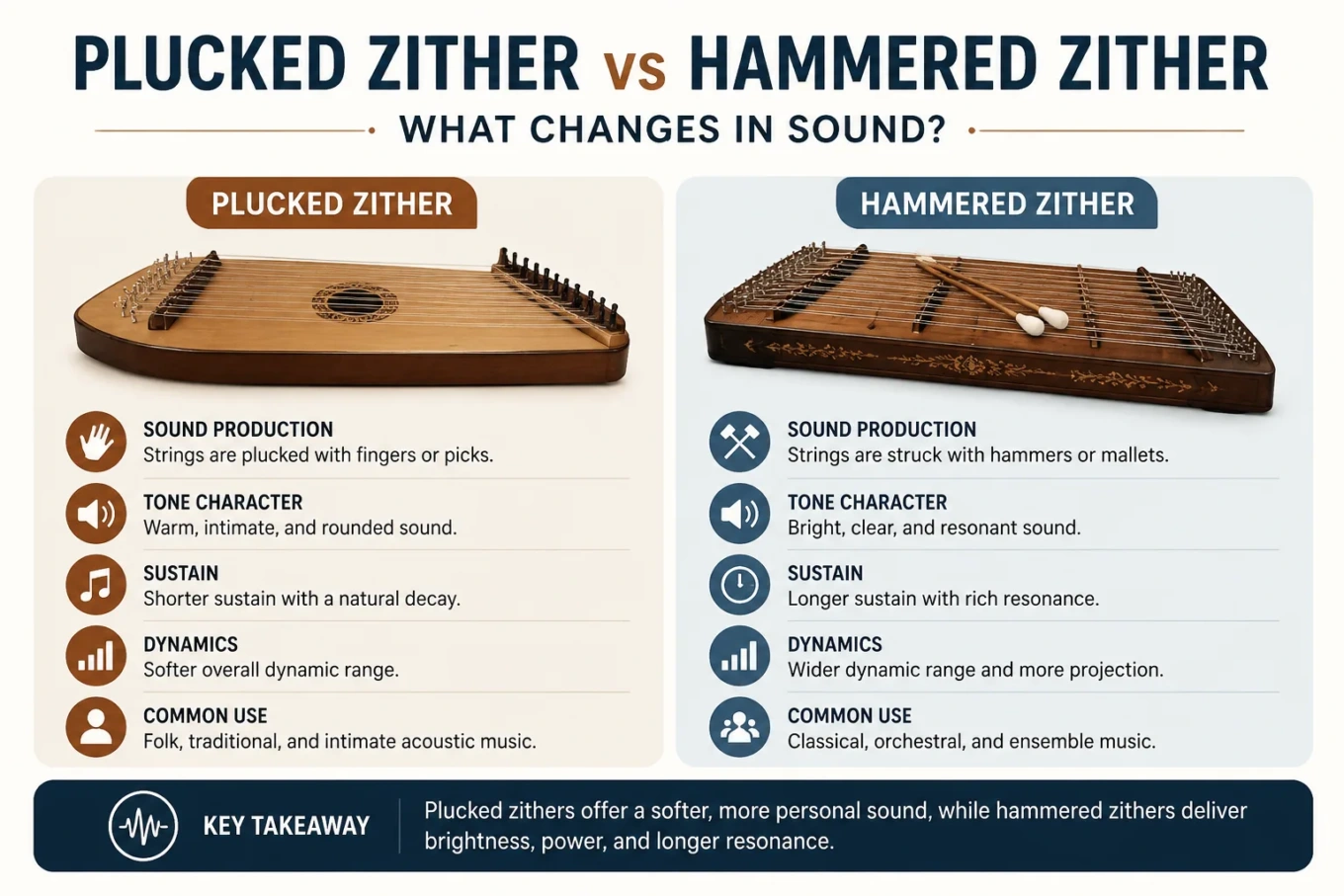
Plucked Zither vs Hammered Zither: What Changes in Sound?
A plucked zither and a hammered zither can use strings of similar pitch and still produce noticeably different note shapes. The main reason is not simply that one sounds “soft” and the other “bright.” It is how energy enters the string. A plucked string is displaced and released; a hammered string receives a short impact. That difference changes the attack[1], the first burst of vibration, the balance of upper frequencies, and the way individual notes separate from one another.
The distinction is easiest to hear during the first fraction of a second. After that initial event, string construction, bridge design, soundboard response, damping, playing position, and sympathetic resonance can become just as important as the original pluck or strike.
For that reason, plucked zither vs hammered zither is best understood as a comparison of excitation methods rather than a fixed contest between two kinds of tone.
The Difference Begins With How the String Is Set in Motion
A plucked zither begins with displacement. A finger, fingernail, fingerpick, or plectrum[2] pulls the string away from its resting position. When released, the string moves back through equilibrium and begins oscillating.
A hammered zither begins with impact. A small hammer or beater approaches the string, remains in contact for a short interval, transfers energy, and rebounds. The string then continues vibrating after the hammer has left it.
Classification Note: “Hammered zither” is useful everyday language, but struck zither[3] is the broader descriptive term. Santur, yangqin, cimbalom, and many hammered dulcimers belong to this general struck-string approach, although they remain distinct instruments with different constructions and musical traditions.
The physical distinction can be reduced to two short sequences:
- Plucked: pull → displace → release → vibrate
- Hammered: approach → impact → rebound → vibrate
Both methods ultimately produce a vibrating string. What changes is the string’s initial condition and the way energy is distributed across its modes of vibration.
Why the First Milliseconds Sound Different
The beginning of a musical note contains a short, information-rich event called the transient[4]. Human hearing uses this onset information heavily when distinguishing one sound source from another.
With plucking, the transient includes the release of the displaced string and may also contain a trace of contact noise from a nail, pick, or fingerpick. A hard plectrum can produce an especially clear initial edge.
With hammering, the transient includes the impact itself. A hard wooden beater can make this onset quite distinct. A softer or covered hammer can smooth it, but the note still begins through a collision rather than through string release.
This is why a hammered instrument can feel more percussive even when its strings continue ringing for a long time. The percussive character belongs mainly to the onset, not necessarily to the total duration of the note.
Listening Note: When comparing recordings, concentrate on the instant each note appears rather than on the full resonance. A pluck often exposes a release-like edge; a strike often reveals a compact impact before the tone opens into the resonating body.
Plucked and Hammered Sound Compared
The tendencies below are useful for listening, but none should be treated as an absolute rule. Construction can override many of them.
| Sound Feature | Plucked Zither | Hammered or Struck Zither |
|---|---|---|
| How the note starts | String is displaced and released | String receives a brief impact |
| Initial character | Release-based articulation | Impact-based articulation |
| Tone control | Finger or pick material, plucking force, plucking point | Hammer material, mass, flexibility, velocity, striking point |
| Percussive impression | Can be mild or pronounced | Often more obvious at note onset |
| Brightness | Highly variable | Highly variable |
| Sustain | Depends strongly on the instrument | Depends strongly on the instrument |
| Repeated articulation | Repeated finger or plectrum motion | Repeated or alternating hammer strokes |
Brightness Does Not Belong to One Playing Method
It is tempting to reduce the comparison to “hammered is bright, plucked is mellow.” Real instruments do not behave that neatly.
A plucked zither played with a hard plectrum close to a bridge may produce a sharp, upper-frequency-rich attack. Another plucked instrument played with bare fingertips farther from the bridge can sound much rounder.
A struck instrument can change just as much. Hard wooden hammers may emphasize a clean impact and strong upper-frequency content. Leather, felt, other coverings, or flexible beaters can alter the contact event and soften the perceived edge.
On a Plucked Zither, Brightness Can Change With
- bare fingertip versus fingernail;
- hard plectrum versus a more flexible one;
- metal fingerpick versus softer contact;
- distance from the bridge;
- plucking angle;
- force and speed of release;
- string material, gauge, and tension.
On a Hammered Zither, Brightness Can Change With
- hard or covered hammer surfaces;
- hammer mass;
- beater flexibility;
- impact velocity;
- where the hammer meets the speaking length of the string;
- string material and tension;
- bridge and resonator response.
The playing method therefore sets the type of excitation, but it does not lock the instrument into one timbre.
What Changes in the Harmonic Spectrum?
A vibrating string rarely produces only its lowest pitch. The sound normally contains a fundamental[5] together with a pattern of higher partials[6]. Their relative strengths help create the perceived timbre[7].
The excitation method changes how strongly these components begin.
When a string is plucked, its starting shape depends on where it is held before release. Plucking near the middle and plucking near a bridge do not excite the same frequency pattern. The position of the pluck can suppress some vibration modes while allowing others to emerge more strongly.
This is one reason bridge-near plucking often sounds thinner or more brilliant: stronger upper-frequency energy may remain audible in the attack. A more central plucking position tends to produce a different balance.
A hammer applies force over a short contact period rather than creating the same displaced starting shape. Hammer hardness, contact duration, impact speed, and striking position influence how broadly that energy is distributed through the string’s frequency components.
The resulting harmonic spectrum[8] is therefore shaped by more than the basic pitch. Two instruments tuned to similar notes may still have very different spectral profiles during their attacks.
Where the String Is Played Matters
Plucking or striking position can change tone enough that it deserves separate attention.
Plucking Near the Bridge
Plucking relatively close to the bridge changes the string’s initial vibration pattern. The result often has a more concentrated, wiry, or bright character because the excitation contains a stronger proportion of upper-frequency activity.
Plucking Farther From the Bridge
Moving the plucking point toward a more central part of the string usually changes the balance of modes. The sound may be perceived as fuller or less pointed, although the exact result depends on the instrument and string.
Changing the Hammer Strike Point
A struck string also responds differently when hit at different positions. The relationship between the strike point and the string’s vibration modes affects which partials receive energy.
On many hammered zithers, the physical layout restricts the practical strike area more than it does on a freely plucked string. Bridges, groups of strings, and the performer’s normal hammering technique all influence where contact can comfortably occur.
Attack and Sustain Are Different Questions
A strong impact does not automatically produce a short note.
Sustain[9] describes how long audible vibration continues after the initial excitation. Its duration depends on how quickly energy leaves the string and where that energy goes.
Several parts of a zither can affect this:
- string material and diameter;
- tension;
- vibrating string length;
- bridge construction;
- soundboard stiffness and mass;
- body geometry;
- damping from the player’s hands or instrument mechanisms;
- interaction between neighboring strings;
- sympathetic resonance.
Do Not Confuse Attack With Sustain: A hammered zither may begin with a clearly percussive impact and continue ringing well after the hammer rebounds. A plucked zither can also have a sharp attack yet lose energy quickly. The first moment of a note and its later decay are related, but they are not the same property.
The Bridge and Soundboard Reshape What the String Produces
A bare string moving through air is relatively inefficient at projecting sound. Much of the audible result comes from transferring vibration through the bridge[10] into a larger vibrating surface, often the soundboard[11].
This means that pluck-versus-strike differences do not reach the listener unchanged. They pass through the instrument’s mechanical structure.
A bridge can distribute string energy into the body while also interacting with neighboring strings. The soundboard then radiates that energy into the air according to its own resonant behavior.
Body shape, bracing, wood thickness, bridge placement, and other construction details can therefore make two plucked zithers differ from each other as much as a casual listener might expect a plucked and hammered instrument to differ.
Luthier’s Note: Wood choice can shape resonance, but species name alone does not predict the finished sound. Thickness, grain orientation, bracing, dimensions, bridge design, string loading, and workmanship interact with the material.
Why Hammered Zithers Often Feel More Percussive
The impression comes mainly from clearly separated note onsets.
Each hammer stroke introduces a new impact transient. Fast alternating strokes produce a sequence of closely spaced attacks, which makes rhythm especially visible to the ear.
This effect is easy to hear in instruments such as the santur, yangqin, cimbalom, and hammered dulcimer. They differ greatly in size, tuning systems, bridge arrangements, string grouping, repertory, and playing traditions, yet all use beaters to excite strings.
The hammer itself also becomes part of the player’s articulation system. Small changes in striking force can alter loudness and attack. Changes in hammer angle or contact can affect tone. Skilled players control these details continuously rather than producing identical impacts on every note.
Why Plucked Zithers Can Offer a Different Kind of Note Shaping
Plucking gives the player direct control over the instant of release. A finger or plectrum can alter force, angle, contact material, and location in one gesture.
Some plucked zithers also allow additional control after the string has already been set in motion.
On movable-bridge instruments such as the guzheng, koto, gayageum, and đàn tranh, the player may press or manipulate a string segment on one side of a movable bridge[12]. Depending on the instrument and technique, this can bend pitch, color a note, or create forms of vibrato.
That expressive option should not be mistaken for a universal property of plucked zithers. It comes from instrument construction. A qanun, guqin, concert zither, kantele, and guzheng all use plucking in important ways, but their methods of changing or sustaining a note after the attack are not identical.
Qanun and Santur: Two Clear Excitation Contrasts
The qanun and santur make the pluck-versus-strike distinction particularly easy to understand because both present many strings across a broad resonating body, yet the player’s contact with those strings is fundamentally different.
Qanun
Qanun strings are commonly arranged in multi-string courses[13], with strings in a course sounding together at the same or closely related pitch. The performer plucks using finger-mounted plectra in many traditions.
The resulting articulation begins with a distinct release. Fast passages are built from controlled finger movements rather than bouncing hammers. Pick material, picking direction, and the exact location of contact all contribute to the attack.
Pitch systems and mechanisms vary by regional form and instrument design. Many modern qanuns use small levers that allow performers to alter effective string length and pitch during performance.
Santur
A santur is played with lightweight hammers or beaters. Its strings pass across bridges in groups, and the performer creates notes through successive impacts.
The santur attack therefore carries the physical signature of the beater-string collision. Rapid alternation between the hands can produce flowing lines while retaining a clear sequence of individual onsets.
Its ringing quality comes not simply from being hammered but from the interaction of strings, courses, bridges, and the resonating body after each strike.
| Feature | Qanun | Santur |
|---|---|---|
| Primary excitation | Plucked | Struck |
| Player contact | Finger-mounted plectrum releases the string | Beater impacts and rebounds |
| Repeated notes | Repeated finger articulation | Repeated or alternating hammer strokes |
| Attack control | Pick contact, force, direction, location | Hammer material, force, angle, location |
| Resonance after attack | Depends on string and body system | Depends on string and body system |
These comparisons describe playing logic, not fixed tone rankings. A qanun is not automatically softer than a santur, and a santur does not automatically have shorter sustain.
Guzheng and Yangqin Show the Difference Another Way
The guzheng and yangqin offer another useful contrast because both can present broad horizontal string layouts while asking the player’s hands to interact with the strings in very different ways.
Guzheng
The guzheng is a plucked board zither with movable bridges. The right hand commonly initiates notes by plucking, often with fingerpicks, while the other hand can shape string tension on the opposite side of the bridges.
The attack may be crisp, delicate, forceful, or rounded according to technique. A note can then continue changing after the original pluck through pressure, pitch inflection, and vibrato-like movement.
Yangqin
The yangqin is a struck zither played with slender beaters, traditionally associated with bamboo in many playing traditions. Its strings are arranged across multiple bridge systems, giving the player access to many pitches within a compact striking field.
Because notes begin through beater contact, fast passages can form dense patterns of small transients. The soundboard and many strings then allow those attacks to blend into a broader resonant texture.
The contrast is therefore not simply “Chinese plucked instrument versus Chinese hammered instrument.” It is a difference in how the performer’s gesture becomes string motion and how the instrument allows that motion to develop afterward.
Pick Material and Hammer Material Change the Attack
Contact material belongs close to the beginning of the sound-production chain, so even a small material change can be audible.
Common Plucking Contacts
- Bare fingertip: can give a less sharply edged contact than many rigid picks.
- Fingernail: often produces a clearer release transient.
- Hard plectrum: can increase articulation and make upper-frequency content more apparent.
- Metal fingerpick: may produce a particularly defined initial contact on suitable instruments.
Common Hammer Contacts
- Bare wood: often creates a clearly defined impact.
- Leather-covered surfaces: can alter contact hardness and soften some of the initial edge.
- Felt or other soft covering: may reduce the prominence of high-frequency attack components.
- Flexible beaters: can behave differently from rigid ones because bending changes the contact and rebound.
These are tendencies rather than universal recipes. String tension, hammer geometry, instrument scale, player technique, and recording conditions can all change the audible result.
Multiple Strings Can Blur a Simple Pluck-or-Strike Comparison
Many zithers use more than one string for a single perceived pitch. When several strings are sounded together, tiny differences in tuning and vibration can create a richer, more animated decay.
A group of strings intended to act together is often called a course. Depending on the instrument, these strings may be tuned in unison or arranged according to another pitch relationship.
Once a course begins vibrating, the listener hears the combined behavior of several strings rather than one idealized string. Small tuning differences can create beating[14], while bridge coupling can transfer energy into other parts of the instrument.
This is especially relevant when comparing qanun, santur, hammered dulcimer, or related multi-string designs. The excitation method starts the sound, but the grouped strings influence what happens next.
Sympathetic Resonance Can Make the Decay More Complex
Strings do not always need to be directly plucked or struck to vibrate. Energy passing through the bridge and body can excite another string whose resonant frequency is close to a frequency already present.
This behavior is called sympathetic resonance[15].
It can make the decay of both plucked and struck zithers feel broader than the attack alone would suggest. A single note may trigger quiet responses elsewhere in the string system, especially on instruments with many open strings and limited damping.
For listening purposes, this matters because a sharp hammered onset can be followed by a diffuse resonant field. A clean pluck can do the same. The ear may therefore perceive a clear attack surrounded by a much softer halo of continuing vibration.
What the Ear Should Listen For
A good plucked-versus-hammered comparison becomes easier when the sound is separated into stages.
- Listen to the onset. Does the note begin with a release-like snap or with a compact impact?
- Notice the upper-frequency burst. Is there a brief bright edge that fades quickly?
- Listen for body resonance. Does the sound seem to expand after the initial contact?
- Follow the decay. Which parts of the sound remain after the first moment?
- Notice overlapping notes. Does the previous string continue ringing underneath the next attack?
- Listen for contact noise. A pick, fingernail, fingerpick, wooden hammer, or covered beater may leave a small mechanical signature.
Recordings with heavy reverberation, compression, equalization, or dense accompaniment can make these distinctions harder to hear. Close, relatively dry recordings reveal them more clearly.
What Plucking and Hammering Do Not Determine
The excitation method tells a great deal about the beginning of a note, but it cannot by itself predict the entire instrument.
- It does not determine which instrument is louder.
- It does not determine which instrument sustains longer.
- It does not determine how many strings are present.
- It does not determine total pitch range.
- It does not guarantee a bright or dark timbre.
- It does not determine whether rapid passages are possible.
- It does not tell whether bridges are fixed or movable.
- It does not reveal the tuning system.
- It does not indicate whether the instrument is intended mainly for solo or ensemble use.
These characteristics come from the complete instrument: strings, body, bridges, tuning, materials, damping behavior, and performance technique.
Why Two Plucked Zithers May Sound Less Alike Than Expected
“Plucked zither” describes a method of exciting strings, not a single construction.
A guqin, qanun, kantele, guzheng, koto, gayageum, psaltery, and concert zither can all involve plucking, yet they differ in scale, string arrangement, bridge systems, resonating bodies, playing posture, pitch control, and string materials.
The same caution applies to struck instruments. Santur, cimbalom, yangqin, and hammered dulcimer forms are not interchangeable names for one instrument. Their bridge layouts alone can produce very different playing geometries.
The most reliable acoustic comparison therefore begins with how the note starts, then moves outward to the string and resonating structure.
Can You Identify Plucked and Hammered Zithers by Sound Alone?
Often, but not with certainty.
A clear recording of isolated notes can expose the difference between string release and hammer impact. Repeated hammered notes may also reveal alternating strikes, while repeated plucks can expose finger or plectrum articulation.
Several conditions can make identification less reliable:
- a very soft hammer;
- a hard or metallic plectrum;
- strong room reverberation;
- close or unusually distant microphone placement;
- equalization that removes attack frequencies;
- heavy ensemble texture;
- digital effects;
- unusual damping or muting techniques.
Brightness alone is therefore a weak clue. The shape of the onset is usually more informative.
Frequently Asked Questions
Does a hammered zither always sound brighter than a plucked zither?
No. Hammer hardness can create a bright attack, but a hard plectrum or bridge-near pluck can also produce strong upper-frequency content. String construction, contact material, playing position, bridge design, and the resonating body all influence brightness.
Does a hammered zither have shorter sustain?
Not necessarily. Sustain depends heavily on string properties, damping, bridge coupling, body construction, and interaction with other strings. A hammered note may have a sharp attack while continuing to ring for a long time.
Why does hammering sound more percussive?
The hammer creates a short impact at the beginning of every note. Repeated strokes therefore produce a sequence of clearly defined transients, which the ear often interprets as a stronger rhythmic or percussive character.
Can changing where a string is plucked alter the tone?
Yes. The plucking point changes which vibration modes are strongly excited. Plucking near a bridge often produces a different harmonic balance from plucking farther along the string.
Are santur and hammered dulcimer the same instrument?
No. They share the broad principle of strings struck with small beaters, but their constructions, bridge arrangements, tuning practices, regional traditions, and playing techniques can differ. The names should not be treated as interchangeable labels.
Is “hammered zither” the same as “struck zither”?
They overlap, but “struck zither” is the broader descriptive term. Hammered zithers are struck with hammers or beaters, while organological descriptions may use “struck” when discussing the excitation method more generally.
Glossary of Technical Terms
[1] Attack: The opening phase of a note, when its amplitude rises from silence. On zithers, attack character is strongly affected by whether the string is released by a finger or plectrum or struck with a hammer.
[2] Plectrum: A small implement used to pluck a string. Zither-family instruments may use handheld picks, finger-mounted plectra, or other culturally specific forms.
[3] Struck Zither: A zither whose strings are set into vibration mainly through impact. Santur, yangqin, cimbalom, and hammered dulcimer forms provide familiar examples, though their designs and traditions differ.
[4] Transient: A short-lived acoustic event at the beginning of a sound. The release of a plucked string and the impact of a hammer produce different transient patterns.
[5] Fundamental: The lowest main frequency associated with the perceived pitch of a vibrating string. Higher vibration components combine with it to shape timbre.
[6] Partials: Frequency components present above or alongside the fundamental. Their strength and decay help distinguish the tone of different strings, playing techniques, and zither constructions.
[7] Timbre: The perceived tone quality that allows two instruments playing similar pitches to sound different. Attack, partials, materials, resonance, and playing technique all contribute to zither timbre.
[8] Harmonic Spectrum: The distribution and relative strength of frequency components produced by a vibrating string and resonating instrument. Plucking or striking method can alter this distribution, especially near the beginning of a note.
[9] Sustain: The period during which a note remains audibly resonant after its attack. On zithers, sustain depends on string behavior, damping, bridge coupling, soundboard response, and other construction details.
[10] Bridge: A structure that supports strings and transfers part of their vibration into the instrument body. Zithers may use fixed bridges, movable individual bridges, or more elaborate bridge systems depending on type.
[11] Soundboard: A vibrating surface that receives energy from the strings through the bridge and helps radiate sound into the air. Its dimensions, stiffness, thickness, and construction influence resonance.
[12] Movable Bridge: A bridge that is not permanently fixed to one position. Instruments such as guzheng, koto, and gayageum use movable bridges to establish vibrating string lengths and support their particular tuning and performance systems.
[13] Course: A group of strings treated as one musical unit. Courses may contain strings tuned in unison or in another intended relationship, depending on the instrument.
[14] Beating: A periodic rise and fall in perceived amplitude caused when two close frequencies interact. Slight differences between strings in a course can create audible beating.
[15] Sympathetic Resonance: Vibration that begins in a string without that string being directly plucked or struck. Energy transmitted through the bridge and body can excite another string when its resonant frequencies correspond closely to frequencies already present.