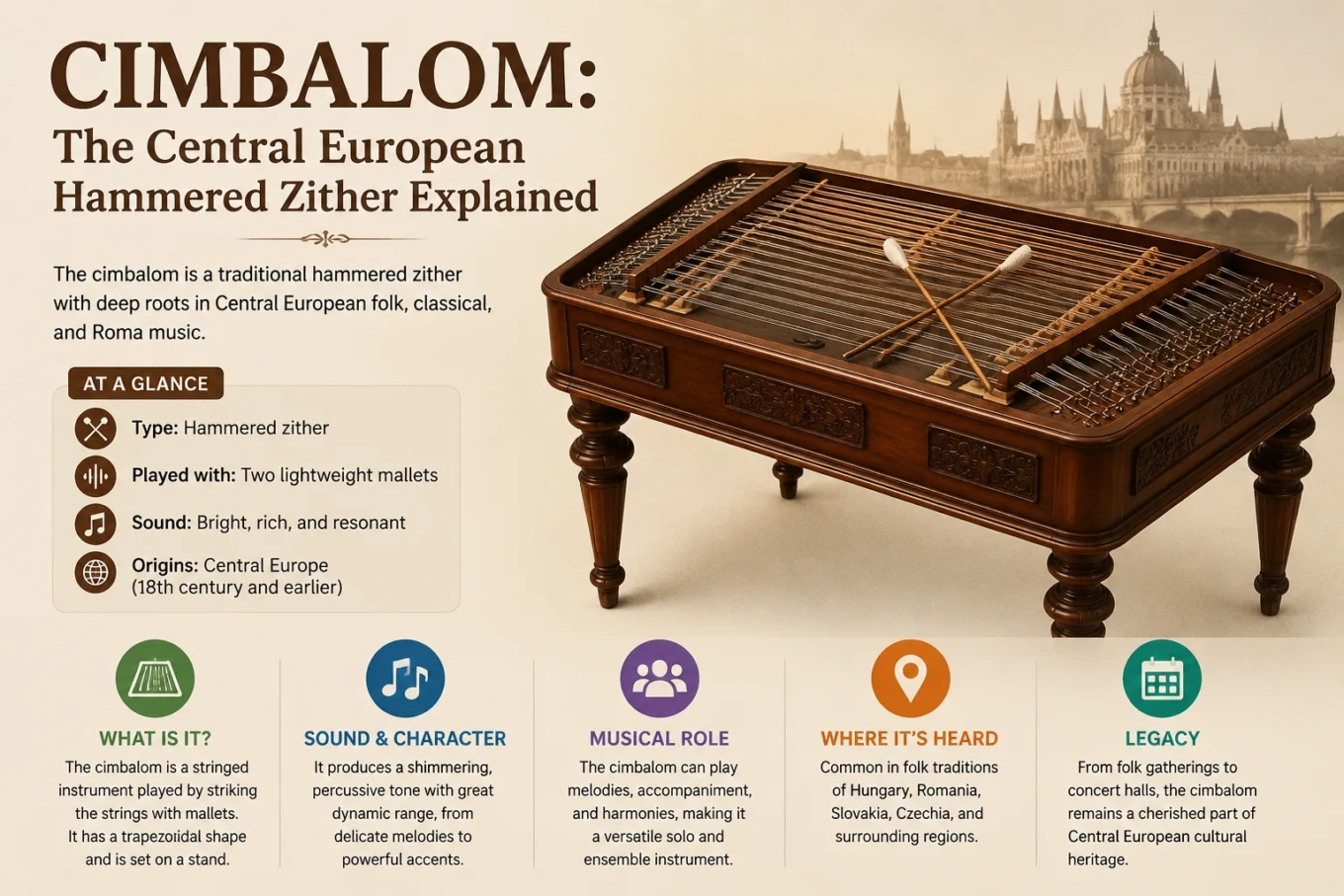
Cimbalom: The Central European Hammered Zither Explained
The cimbalom is a large Central European hammered zither[1] played by striking metal strings with a pair of handheld beaters. Its concert form is immediately recognizable: a broad trapezoidal body stands on legs, dense rows of strings cross several bridges, and a foot-operated damping system controls how freely those strings continue to ring.
That description only covers part of the instrument’s identity. Smaller folk cimbaloms can lack the pedal, use a narrower range, and follow regional layouts that differ from the modern concert instrument. The cimbalom is therefore better understood as a Central and Eastern European struck-string tradition with several forms, rather than as one fixed specification.
What Makes a Cimbalom a Cimbalom?
Organologically, the cimbalom is a chordophone[2]: its sound begins with vibrating strings. More specifically, it belongs among struck zithers because the player sets those strings in motion with beaters instead of plucking them with fingers or a plectrum.
The characteristic playing surface is built around groups of strings, often called a course[3] when several strings function together as one pitch. These courses pass across one or more bridges[4], creating a note layout that is much less linear than a piano keyboard.
- A trapezoidal resonating body supports a broad field of metal strings.
- Two lightweight beaters provide the normal attack.
- Multiple strings may sound together for a single pitch.
- Bridges organize both string length and playable pitch locations.
- The large concert instrument normally includes a foot-controlled damping mechanism.
- Bass and treble areas occupy different parts of the playing surface rather than forming one simple left-to-right scale.
Classification Note: Calling the cimbalom a struck zither and describing its playing action as percussive are compatible descriptions. “Zither” identifies the string-and-body relationship; “struck” describes how the player starts the vibration.
Folk Cimbalom and Concert Cimbalom
The word cimbalom can refer to instruments that differ greatly in size and mechanical complexity. This is one reason fixed statements about string count, range, weight, or tuning should be treated cautiously.
| Feature | Folk or Small Cimbalom | Concert Cimbalom |
|---|---|---|
| Support | May rest on a table, stand, barrel, or portable support | Usually built as a large instrument on its own legs |
| Damping | May have no pedal damping system | Normally uses pedal-operated dampers |
| Range | Often more limited and region-dependent | Broad and normally fully chromatic |
| Construction | Generally lighter and simpler | Heavy structure designed for high string tension |
| Typical Context | Local folk, dance, and ensemble traditions | Folk, solo, chamber, orchestral, and contemporary music |
Small cimbaloms should not be treated merely as reduced concert instruments. A folk instrument may preserve its own tuning logic, dimensions, bridge arrangement, repertoire, and performance practice. Likewise, the large pedal cimbalom developed for needs that a compact traditional instrument was not designed to meet.
The 1874 Transformation of the Concert Cimbalom
Cimbalom-like hammered zithers were present in European musical life before the modern concert instrument appeared. The major change came in Budapest in the 1870s, when instrument maker Vencel József Schunda developed the large pedal cimbalom associated with modern Hungarian concert practice.
Schunda did not invent the general idea of striking strings stretched across a zither body. His work reshaped an existing instrument type for greater range, stability, projection, and control.
The new concert form used a larger body, strengthened construction, reorganized bridges, a wider chromatic playing field, legs, and a damping mechanism. These changes allowed the cimbalom to move more easily between folk-derived professional ensembles and formal concert repertoire.
The physical enlargement was substantial. A surviving Schunda cimbalom made after 1874 in the Metropolitan Museum of Art measures roughly 142 cm along its long edge and about 97 cm along its shorter edge. It is a large piece of string engineering rather than a tabletop dulcimer.
Historical Note: The safest distinction is between the older cimbalom and hammered-zither tradition and Schunda’s development of the modern pedal cimbalom. Saying simply that “the cimbalom was invented in 1874” erases the earlier instruments from which the concert model developed.
Inside the Instrument
The concert cimbalom has to solve an unusual structural problem. A large number of metal strings must remain under controlled tension while the body stays stable enough to transfer vibration efficiently.
The Resonating Body and Soundboard
The upper vibrating surface is the soundboard[5]. String vibration reaches it through the bridge system, and the larger body helps turn the relatively small motion of the strings into an audible instrument sound.
Wood selection, thickness, bracing, bridge design, and internal construction can shape response, but no single recipe applies to every historical, folk, or modern cimbalom. The large concert form also needs reinforcement capable of handling much more accumulated string tension than a small portable instrument.
Strings and Courses
A player does not normally encounter one isolated string for every pitch. Multiple strings can be tuned together as a course, producing a fuller attack and a denser resonance.
String construction also changes across the range. Higher strings and lower strings have different physical requirements, so diameter and winding can vary. Makers balance pitch, tension, durability, response, and available vibrating length rather than using one string type across the entire instrument.
Bridges Shape the Pitch Map
The cimbalom bridge is more than a support. On many hammered-zither designs, a bridge can divide a string into usable vibrating sections. A player may therefore find playable pitches on different sides of a bridge and in different areas of the instrument.
This creates one of the cimbalom’s most distinctive learning problems: pitch rises and falls across a geometric field rather than along a single uninterrupted line.
Luthier’s Note: Bridge placement affects vibrating string length, note organization, and the transfer of energy into the body. Moving or altering a bridge casually can therefore affect more than one pitch relationship.
Why the Note Layout Looks So Complicated
A piano presents twelve chromatic notes in a repeating visual pattern. A cimbalom does not offer the same regular keyboard geography.
Instead, the player learns a network of string courses, bridge divisions, bass areas, treble areas, and repeated spatial relationships. Some nearby pitches may be physically close. Others require a larger movement of the beater than their musical interval would suggest.
The concert instrument is chromatic[6], so it can provide all twelve pitch classes needed for chromatic repertoire. That does not mean those notes appear in an obvious straight sequence.
Experienced players develop spatial memory. A written note becomes associated not only with a pitch name but with a location, bridge side, striking zone, and movement from the previous note.
How the Damper Pedal Changes the Instrument
Strike a metal string and remove the beater immediately: the string remains free to vibrate. Multiply that behavior across a large cimbalom and uncontrolled resonance can quickly blur rapid passages and harmonic changes.
The concert cimbalom addresses this with a damper[7] system operated by the player’s foot. Dampers contact the strings to shorten vibration; pedal movement releases or reapplies them according to the musical phrase.
This gives the performer control over sustain[8] in a way that many small traditional hammered zithers do not provide.
- Released dampers allow tones to ring and overlap.
- Applied dampers shorten notes and clear accumulated resonance.
- Rapid passages can be articulated more cleanly.
- Chords can be allowed to bloom and then stopped together.
- Short notes and broad resonant textures can exist within the same performance.
The pedal does not normally function like a pitch-changing pedal. Its main role is the management of resonance and note length.
The Beaters Are Part of the Sound
Cimbalom players normally hold one beater in each hand. The sticks are light enough for fast rebound and precise enough to target individual string courses inside a crowded playing field.
The audible result depends on more than hitting the correct note. Beater covering, hardness, mass, striking speed, angle, and contact point can all affect the initial attack.
A more yielding striking surface can soften the beginning of the note. A harder contact can emphasize brightness and definition. These are tendencies rather than fixed acoustic rules because string type, register, instrument construction, room acoustics, and playing force also affect the result.
Rebound matters as well. The beater should set the string into motion without remaining against it long enough to choke the vibration.
Why the Cimbalom Sounds Percussive and Resonant at Once
The cimbalom has a clear attack because the string is struck. What follows that attack is produced by a string instrument.
The initial impact starts several interacting processes. The struck course vibrates, the bridge transfers energy into the soundboard, the body radiates sound, and nearby strings may respond through sympathetic resonance[9]. Pedal position then determines how much of that activity is allowed to continue.
This helps explain the instrument’s wide tonal vocabulary. A cimbalom can sound dry and sharply articulated in one passage, then produce a dense field of overlapping metallic resonance in the next.
Listening Note: Listen separately for the impact of the beater and the sound that develops after it. The balance between attack, ringing courses, body resonance, and damping reveals much more about the cimbalom’s timbre[10] than labels such as “bright” or “metallic” alone.
Is the Cimbalom a Zither, Dulcimer, or Percussion Instrument?
The most precise short description is a struck zither in the hammered-dulcimer family.
Museum collections can classify the instrument as a chordophone, zither, struck instrument, and dulcimer without contradiction. Each term describes a different level of the instrument’s identity.
- Chordophone: vibrating strings are the primary sound source.
- Zither: the strings extend across a body without a separate projecting neck of the violin or guitar type.
- Struck zither: beaters set the strings into vibration.
- Hammered dulcimer family: places the cimbalom among related trapezoidal struck-string instruments.
It may also be grouped near percussion instruments in practical orchestral settings because the player’s motions resemble mallet percussion technique and some percussionists learn the instrument. That practical placement does not change its chordophone classification.
How It Differs from Related Hammered Zithers
Cimbalom, santur, yangqin, hammered dulcimer, hackbrett, and other struck zithers share broad construction ideas. Their similarities should not erase differences in tuning, bridge geometry, playing technique, repertoire, historical development, and regional terminology.
| Instrument | Main Musical Context | Useful Distinction |
|---|---|---|
| Cimbalom | Central and Eastern European traditions; concert repertoire | Large concert forms commonly use pedal-controlled damping |
| Hammered Dulcimer | Several European and North American traditions | A broad instrument name covering layouts that should not automatically be called cimbalom |
| Santur | Iranian and related regional musical traditions | Uses its own bridge organization, tuning practice, beaters, and modal context |
| Yangqin | Chinese musical traditions | Developed its own dense bridge system, tuning logic, technique, and ensemble role |
Shape is therefore a poor identification method by itself. Two trapezoidal instruments covered in strings may belong to related organological groups while demanding very different musical knowledge from the performer.
Regional Names and Musical Identities
The cimbalom belongs to a network of related Central and Eastern European traditions. Names such as cimbalom, cimbal, cimbál, țambal, and related forms appear in different languages and musical settings.
They should not be treated as proof that every instrument bearing a similar name follows the same construction standard.
Hungary
Hungary is closely associated with the development of the large concert cimbalom and with both folk and professional ensemble traditions. The pedal instrument developed by Schunda in Budapest became the reference point for concert cimbalom construction.
Slovakia and Moravia
Related instruments, commonly described with names such as cimbal or cimbál, remain closely connected with regional folk ensembles and dance music. Construction and performance practice can differ from the Hungarian concert model.
Romania and Moldova
The Romanian țambal belongs to a strong local performance tradition, including professional lăutari ensembles. Instruments may range from smaller forms to large versions suited to ensemble performance.
Other Central and Eastern European Traditions
Related hammered zithers are also documented under names such as tsymbaly and similar spellings in Ukrainian, Belarusian, and neighboring musical cultures. These instruments belong to the wider regional family but should not automatically be described as standardized Hungarian concert cimbaloms.
Regional Note: Name, country, and shape are useful clues, but construction and musical use provide a safer identification. Regional hammered zithers developed through connected histories without becoming one interchangeable instrument.
The Cimbalom in Hungarian and Romani Professional Music
The cimbalom has held several musical roles at the same time. It appears in Hungarian folk settings, urban professional ensembles, restaurant and café traditions, concert performance, and music played by Romani musicians.
Romani professional musicians have played an especially visible role in cimbalom performance in Hungary and Romania. Historical ensembles could place the instrument beside violin, viola or chordal strings, and double bass, allowing the cimbalom to move between accompaniment and highly virtuosic melodic work.
This relationship is better described through musicians and ensemble traditions than through ethnic labels applied to the instrument itself. The cimbalom is not owned by one performance community, and its regional history includes overlapping folk, urban, professional, and concert practices.
What the Cimbalom Does in an Ensemble
The instrument can change function within a few measures. Its large pitch field and fast attack allow it to behave as a melodic, harmonic, rhythmic, or coloristic voice.
Melody
The two beaters can alternate rapidly, producing scales, repeated notes, arpeggios, and decorated melodic lines. Fast alternation also supports a sustained-note effect through tremolo[11].
Harmony
Chords and broken chords can fill the space between melody and bass instruments. The ability to control ringing with the pedal helps prevent one harmony from bleeding excessively into the next.
Rhythm
A firm attack makes the cimbalom useful in dance-oriented music. Chordal patterns can reinforce pulse while the strings still provide more resonance than most membrane or bar percussion instruments.
Color
In orchestral writing, composers can use the cimbalom for a texture unavailable from piano, harp, celesta, or conventional percussion alone. The instrument combines exact pitch with a struck attack and an unusually active decay.
From Folk Ensemble to Concert Repertoire
The development of the large pedal instrument gave composers access to a cimbalom capable of wider chromatic writing, controlled resonance, and use in formal concert settings.
Béla Bartók incorporated cimbalom into orchestral scoring connected with Central European musical material. Igor Stravinsky became interested in the instrument and wrote for it directly, including in Ragtime for eleven instruments. Later composers continued to use cimbalom as an independent orchestral and chamber color rather than only as a reference to folk music.
Modern scores can place it beside strings, winds, percussion, harps, keyboards, plucked instruments, or small chamber ensembles. George Benjamin, John Adams, Louis Andriessen, and other contemporary composers have used the cimbalom where its precise attack and unusual resonance serve the orchestration.
A Living Performance Tradition
The cimbalom remains an active performance instrument rather than a museum-only survival. Contemporary players work in folk ensembles, classical music, jazz, improvisation, crossover projects, film-related performance, chamber groups, and orchestras.
Budapest’s House of Music Hungary has maintained a Cimbalom Salon series since 2022, pairing players from different backgrounds and presenting the instrument in settings that include folk music, improvisation, jazz, and other concert forms. Such programming reflects the same flexibility found in the instrument itself: a cimbalom can preserve regional playing practices while supporting music written far outside them.
Why Cimbalom Playing Is Technically Demanding
Producing one sound is straightforward: locate a string and strike it. Developing dependable technique is much harder.
The player must coordinate both hands while navigating a note layout that does not repeat like a keyboard. Accuracy is measured in small physical targets, and every strike must account for rebound, dynamics, neighboring strings, and the next movement across the instrument.
Advanced control combines several skills:
- Memorizing pitch locations across the bridge system.
- Striking the intended course without touching adjacent strings.
- Balancing alternating strokes between the hands.
- Controlling rebound at different dynamic levels.
- Using the pedal without disrupting rhythmic stability.
- Voicing chords so that individual pitches remain balanced.
- Managing resonance during rapid chromatic movement.
- Changing attack character through beater choice and striking technique.
Because the player looks down at a dense field of strings, visual memory is useful at first. Mature playing relies much more heavily on learned spatial relationships.
Tuning Is More Than Matching Pitch Names
A large cimbalom contains many strings and numerous unison courses. Tuning therefore requires both absolute pitch accuracy and agreement among the strings assigned to the same note.
Intonation[12] problems can become audible when strings within one course no longer match closely. Instead of one stable pitch, the listener may hear beating or an unfocused shimmer.
Temperature, transport, string condition, mechanical settling, and normal use can all affect tuning stability. The scale of the task is another reason a concert cimbalom should not be approached as though it were simply a larger guitar or small dulcimer.
Care Note: High string tension makes major adjustments a mechanical as well as musical matter. Instrument-specific tuning layouts and maker guidance are preferable to applying a generic hammered-dulcimer tuning pattern to an unfamiliar cimbalom.
Why Concert Cimbaloms Are Difficult to Move
The same construction that gives the concert cimbalom its range and stability also makes transportation demanding.
The instrument carries a large wooden body, internal reinforcement, bridges, many metal strings, damping hardware, pedal parts, and supporting legs. Historical and modern instruments vary, but a full concert cimbalom occupies much more space than a portable folk dulcimer.
Transport can also affect tuning. Moving a highly tensioned string instrument between rooms, vehicles, stages, and changing temperatures means setup involves more than placing it in position and unfolding a stand.
This practical reality helps explain why professional cimbalom performance often involves specialist players who know both the musical layout and the instrument’s physical behavior.
What to Listen for in a Cimbalom Performance
A cimbalom becomes easier to recognize once the listener separates several layers of its sound.
The Initial Strike
Listen to how hard or rounded the first instant of each note sounds. Beater material and technique strongly affect this part of the envelope.
The Course Shimmer
A pitch produced by several strings does not behave exactly like one isolated string. Closely matched strings can create a dense, lively tone while still being heard as one musical note.
The Resonance Between Notes
With the dampers released, previously struck strings continue sounding beneath later notes. The instrument can therefore create a layer of resonance that is not written as separate new attacks.
The Pedal Release
Listen for moments when a broad field of ringing sound suddenly becomes dry. That change often comes from the damping system rather than from a change in beater technique.
Common Cimbalom Misidentifications
“It Is Just a Large Hammered Dulcimer”
The cimbalom belongs to the hammered-dulcimer family, but the large pedal concert form has its own construction history, note layout, repertoire, and performance practice. The terms are related rather than universally interchangeable.
“Every Eastern European Hammered Zither Is a Cimbalom”
Regional instruments can carry related names and share ancestry without using the same dimensions, string arrangement, tuning, or damping system.
“The Pedal Changes the Notes”
The normal concert cimbalom pedal controls damping. It determines how freely the strings ring rather than functioning as a pitch-changing pedal system.
“Every Cimbalom Has the Same Number of Strings”
There is no safe universal number. Historical concert models, newer professional instruments, reduced-range instruments, and regional folk forms can differ.
“A Cimbalom Is a Percussion Instrument Because It Uses Beaters”
Its attack is produced by striking, but the vibrating strings are the primary sound source. In organological terms it remains a chordophone and zither.
Frequently Asked Questions
Is a cimbalom the same as a hammered dulcimer?
No. The cimbalom belongs to the wider hammered-dulcimer or struck-zither family, but the modern concert cimbalom has a particular Central European history, bridge layout, large body, and pedal damping system. “Hammered dulcimer” is the broader term.
Is the cimbalom a Hungarian instrument?
The modern pedal concert cimbalom is closely associated with Hungary and was developed by Vencel József Schunda in Budapest in the 1870s. Related cimbalom traditions also belong to Slovakia, Moravia, Romania, Moldova, Ukraine, Belarus, and other parts of Central and Eastern Europe.
Does every cimbalom have a pedal?
No. The large concert cimbalom normally has pedal-operated dampers, while smaller folk instruments may have no pedal system at all.
Is a concert cimbalom fully chromatic?
Modern concert cimbaloms are designed for chromatic playing. Folk and historical instruments should be considered individually because their ranges and tuning systems can differ.
Why does a cimbalom need so many strings?
The instrument covers a broad pitch range, and many pitches use courses made from several strings tuned together. The bridge system can also divide string lengths into different playable pitch areas.
Is cimbalom difficult to learn?
Producing a note is easy, but fluent playing requires accurate striking, two-hand coordination, memorization of a complex pitch map, pedal control, and careful management of resonance. The layout is one of the main challenges for players coming from keyboard instruments.
Glossary of Technical Terms
[1] Hammered Zither: A zither whose strings are sounded primarily by striking them with handheld hammers or beaters. Cimbalom, santur, yangqin, and several regional dulcimer traditions belong to related struck-zither groups while retaining different musical systems.
[2] Chordophone: An organological category for instruments in which vibrating strings provide the primary sound source. Zithers belong to this category alongside many other string instruments.
[3] Course: A group of two or more strings treated as one musical pitch. On zithers with multiple-string courses, the strings are normally tuned closely together and struck or plucked as a unit.
[4] Bridge: A structure supporting strings and transmitting vibration toward the resonating body. On many struck zithers, bridges also help divide strings into playable lengths and organize the pitch layout.
[5] Soundboard: A vibrating wooden surface that receives energy from the strings through the bridge system and helps radiate sound. Its construction forms part of the acoustic design of many box and board zithers.
[6] Chromatic: Capable of providing the twelve pitch classes used in the chromatic division of the octave in Western concert music. A chromatic cimbalom can therefore accommodate music containing semitone movement without retuning for each accidental.
[7] Damper: A component that contacts a string or group of strings to reduce or stop vibration. Concert cimbaloms use pedal-operated dampers to control the large amount of resonance produced by their metal strings.
[8] Sustain: The continuation of a musical sound after its initial attack. On a concert cimbalom, sustain depends on string behavior, body resonance, and whether the damping system allows the strings to keep vibrating.
[9] Sympathetic Resonance: Vibration produced in an unstruck string when acoustic or mechanical energy from another note excites it. Instruments with many exposed strings can produce noticeable sympathetic response when dampers are released.
[10] Timbre: The sound quality that allows two instruments playing the same pitch to remain distinguishable. On a cimbalom, attack, string courses, bridge behavior, resonance, beaters, and damping all contribute to timbre.
[11] Tremolo: Rapid repetition of a note or closely related notes to create the impression of a more continuous sound. Cimbalom players can alternate the two beaters rapidly because a struck string cannot be sustained with a bow.
[12] Intonation: The accuracy of musical pitch and pitch relationships. On a cimbalom, good intonation includes keeping the multiple strings within a course closely matched as well as maintaining the intended tuning of the full instrument.