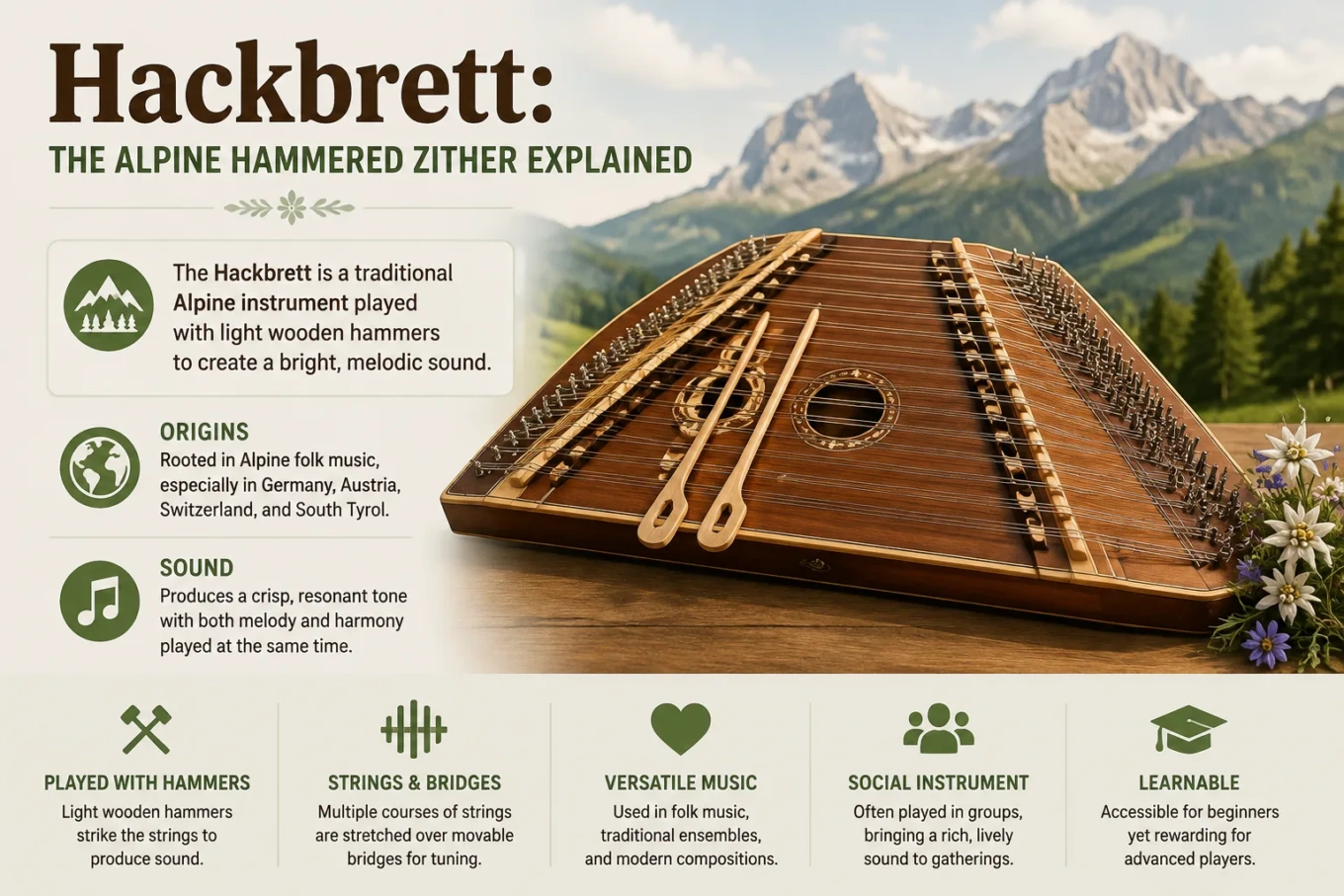
Hackbrett: The Alpine Hammered Zither Explained
The Hackbrett is an Alpine hammered zither whose strings are stretched across a shallow, usually trapezoidal body and struck with a pair of light beaters. In organological terms, it belongs to the struck-zither branch of chordophones[1], but the name does not describe one standardized instrument. Austrian, Bavarian, South Tyrolean, and Swiss traditions developed different string layouts, bridge systems, tuning methods, and playing roles. That regional variation is the most useful way to understand what a Hackbrett actually is.
What Makes a Hackbrett a Hammered Zither?
A Hackbrett produces sound from strings that run across the instrument’s own resonating body rather than from strings suspended along a separate neck. This construction places it within the zither family. The strings are normally struck rather than plucked, which separates its basic playing logic from the concert zither and many other European zithers.
The visible string field can look dense because the instrument usually carries string courses[2]: two or more strings may be tuned together and struck as one note. A course therefore behaves as one musical unit even though several physical strings are sounding.
| Feature | Typical Form | Musical Effect |
|---|---|---|
| Body | Shallow trapezoidal resonating box | Supports strings of different speaking lengths |
| Strings | Metal strings grouped in courses | Several strings can reinforce a single pitch |
| Bridges | Fixed bridges divide and support the string field | Organize pitch positions and, on some systems, create two playable segments on one course |
| Playing tools | Two small beaters | Allow melody, repeated notes, chords, and rhythmic accompaniment |
Classification Note: “Hammered dulcimer” is a useful English family label, but it does not erase regional identities. A Hackbrett is best understood as an Alpine member of the broader struck-zither and hammered-dulcimer tradition, with construction systems that developed locally.
Inside the Instrument: Strings, Soundboard, and Bridges
Why the Body Is Usually Trapezoidal
Pitch depends partly on the vibrating length of a string. Longer speaking lengths generally support lower pitches, while shorter lengths support higher ones when other variables are comparable. A trapezoidal body gives the builder room to arrange many useful string lengths across one compact surface.
The strings transfer vibration through the bridges to the soundboard[3], the thin wooden surface that helps set the surrounding air in motion. The soundboard sits over a hollow resonating box[4]. Wood selection, thickness, bracing, bridge placement, string tension, and overall geometry can all shape the response, but there is no single material recipe shared by every regional Hackbrett.
Why Several Strings Can Belong to One Note
Multiple strings tuned to the same pitch can give a course more acoustic weight than a single string. They also make tuning more exacting. If one string in a course drifts slightly away from the others, audible beating can appear as the close frequencies interfere.
Course size varies with the instrument. One well-documented Appenzell arrangement uses 25 courses with five strings in each course, producing 125 physical strings. That figure describes a regional construction pattern, not a universal Hackbrett specification.
The Bridge Can Create More Than One Playing Zone
A bridge[5] does more than hold the strings above the soundboard. On many hammered-zither layouts it also defines the playable speaking length[6] of a string. When a course passes over a dividing bridge, the musician may be able to strike different segments and obtain different pitches.
A notable Alpine example is the fifth bridge[7], or Quintensteg. In documented layouts, the bridge can divide a course in a proportion that allows pitches a perfect fifth apart to be taken from opposite sides. This is one reason a Hackbrett cannot be understood simply by counting strings: the bridge geometry determines how much musical information those strings can provide.
Luthier’s Note: Moving or replacing a bridge is not a cosmetic adjustment. Its position affects speaking length, pitch relationships, downbearing, and the way vibration reaches the soundboard. A regional bridge layout should not be treated as interchangeable with another Hackbrett system.
There Is No Single Alpine Hackbrett Layout
The name Hackbrett covers several local forms. Some are mainly diatonic[8], while others use a more fully chromatic[9] organization. Some gain altered pitches through extra strings; others use mechanical devices that change a course by a semitone[10].
| Form | Region | Distinctive Feature |
|---|---|---|
| Steirisches Hackbrett | Styria, Austria | Diatonic tradition with dividing bridge logic used for dance-music accompaniment |
| Salzburger Hackbrett | Salzburg and wider Austrian teaching traditions | Chromatic model developed in the 1930s |
| Osttiroler Hackbrett | East Tyrol, Austria | Pitch-changing devices known as Heber or Schneller |
| Appenzeller Hackbrett | Appenzell, Switzerland | Dense multi-string courses and a strong role in Appenzell string music |
| Walliser Hackbrett | Valais, Switzerland | Regional models can use stops or bars to raise selected courses by a semitone |
Steirisches Hackbrett
The Styrian form belongs to a living Austrian dance-music tradition. Its layout is associated with diatonic playing and bridge divisions that place useful chord and melody tones under the beaters. In traditional ensembles it has often worked beside violins, bass, accordion, harp, or other regional instruments rather than acting only as a solo voice.
This matters when comparing it with a chromatic Hackbrett. A diatonic layout can make certain home-key patterns physically direct, but it does not arrange every semitone in the same way as an instrument designed for chromatic access.
Salzburger Hackbrett
The Salzburger Hackbrett is tied to a redesign developed in the 1930s by musician Tobi Reiser with instrument maker Heinrich Bandzauner. Their model organized the instrument chromatically and became closely associated with revived Alpine ensemble practice, including Stubenmusik[11].
The change was more than a new name. A chromatic pitch layout gives the player direct access to all twelve pitch classes within the octave, which supports music that moves through more keys without relying on the same alteration devices found on some diatonic regional forms.
Osttiroler and Tiroler Forms
The East Tyrolean tradition is notable for Heber or Schneller, mechanical retuning devices mounted on the instrument. They alter selected pitches without requiring the entire string field to be rebuilt as a fully chromatic system.
A later Tyrolean development around the turn of the 21st century combined additional chromatic strings with fewer of these pitch-changing devices. It illustrates an important point about Hackbrett making: regional systems have continued to change in response to repertoire and playing needs.
Appenzeller Hackbrett
The Appenzell form is one of the best documented Swiss Hackbrett traditions. A commonly described modern arrangement uses 25 courses of five strings each, with the strings within each course tuned to the same pitch. The instrument is strongly associated with Appenzell string ensembles as well as solo playing.
Its dense courses help produce the bright, blended attack many listeners associate with the instrument. The exact result still depends on tuning, beater material, touch, instrument construction, and room acoustics.
Walliser Hackbrett
Hackbretter from Valais follow another regional path. Documented instruments can use stops or bars that shorten the active string length and raise the fundamental pitch of a selected course by a semitone. Valais instruments may also be smaller and carry fewer strings than the well-known Appenzell pattern.
The mechanism is a useful reminder that “chromatic capability” does not always mean “fully chromatic string layout.” Builders can reach altered notes through different mechanical and acoustic solutions.
How the Beaters Shape Attack and Articulation
The strings are usually struck with two small beaters[12], one held in each hand. Their mass, shape, flexibility, striking surface, and contact point influence the initial attack. Some regional beaters are bare wood; others may have leather or softer coverings on part of the striking surface.
The player controls more than volume. Alternating strokes can create flowing melody lines, rapid repeated notes, chord patterns, or a steady rhythmic layer beneath other instruments. The exact hand technique varies with regional school and repertoire.
Where the Beater Lands Matters
A strike near a bridge generally emphasizes a different balance of overtones than a strike farther into the open string segment. Players use this difference to shape articulation and color. Harder contact can give a more immediate edge, while softer coverings can reduce the sharpness of the attack.
Because several strings may sound together and nearby strings can respond through shared vibration, notes often overlap rather than stopping instantly. This contributes to the instrument’s clear but resonant character.
Listening Note: Listen separately for the short impact of the beater and the longer decay that follows. The first reveals the striking material and touch; the second reveals how the courses, bridges, soundboard, and body interact.
Why Hackbrett Tuning Cannot Be Reduced to One Chart
A universal “Hackbrett tuning” would be misleading. Regional forms differ in pitch organization, number of courses, bridge arrangement, alteration mechanisms, and range. Even instruments within one tradition can vary with maker, size, repertoire, and period.
Tuning is also more laborious than a diagram may suggest. Every string within a unison course must agree closely with its partners. The player or technician then has to preserve the pitch relationships created by the bridges and any mechanical alteration system.
Temperature and humidity can affect the wooden structure and the tension relationship of a large string field. For that reason, an instrument that was stable in one room may need correction after transport or a change in environment.
Tuning Note: A tuning chart is only useful when the regional type and individual instrument are known. Applying a Salzburger pattern to a Styrian, Appenzell, or Valais instrument can create confusion because the physical pitch maps are not the same.
From Early Records to Modern Alpine Practice
The Hackbrett is documented in the German-speaking Alpine area by the late Middle Ages. A 1447 record from Zurich is frequently cited as an early written mention, and Sebastian Virdung included a related struck string instrument in his 1511 music treatise. Later visual and written records show the instrument in Central European musical life under several names and forms.
By the 19th century, sources from Alpine regions describe the Hackbrett as an accompaniment instrument in rural dance music, including ensembles with two violins and bass. The Styrian and East Tyrolean traditions continued through changing ensemble formats, while the 20th century brought deliberate redesigns such as the chromatic Salzburger model.
- 1447: an early Swiss written record names the Hackbrett in Zurich.
- 1511: Sebastian Virdung publishes an early printed depiction of the instrument type.
- 19th century: written and visual sources document Hackbrett use in Alpine dance ensembles.
- 1930s: Tobi Reiser and Heinrich Bandzauner develop the chromatic Salzburger Hackbrett.
- Around 2000: a newer Tiroler form combines additional chromatic strings with a reduced number of pitch-changing devices.
Claims about a single ancient birthplace should be handled with care. Hammered zithers have long histories across Europe and Asia, and older sources sometimes propose routes from Persia or Arabia into Europe. The documented Alpine record is firmer than any simple one-line origin story for the modern Hackbrett.
Its Role in Alpine Ensembles Is Not Limited to Melody
The Hackbrett can carry a tune, but regional ensemble practice often asks it to do several jobs at once. Its layout lets a player move between short melodic figures, repeated rhythmic cells, chordal support, and doubling of other instruments.
- Rhythmic support: repeated strokes can reinforce dance pulse without copying a drum part.
- Chordal support: suitable regional layouts place chord tones within efficient striking patterns.
- Melody: the player can lead or double a violin, accordion, or another melodic instrument.
- Textural color: sustained string decay fills space between the attacks of bowed and plucked instruments.
- Solo playing: some traditions and modern repertoire treat the Hackbrett as a complete melodic and harmonic voice.
Appenzell string music offers a clear Swiss example of the Hackbrett working inside an ensemble rather than as a novelty effect. Austrian dance formations and Stubenmusik show different combinations, reinforcing the fact that function changes with region and repertory.
Hackbrett, Hammered Dulcimer, Cimbalom, and Santur
These instruments share aspects of struck-string construction, but their names should not be treated as interchangeable. Geography, bridge design, pitch layout, repertoire, playing technique, and later instrument development separate the traditions.
| Instrument | Association | Main Distinction |
|---|---|---|
| Hackbrett | Alpine Central Europe | Several Austrian, Bavarian, South Tyrolean, and Swiss regional systems |
| Hammered dulcimer | Broad English-language term and several local traditions | Useful family label, but not a single Alpine construction standard |
| Cimbalom | Hungary and Central/Eastern Europe | Concert forms developed larger chromatic layouts and may include dampers and pedals |
| Santur | Iran and neighboring musical traditions | Uses its own bridge, tuning, mallet, modal, and repertory practices |
| Concert zither | Central Europe | Normally plucked and built around a different fretted-and-open-string playing system |
The closest English description for a Hackbrett is often “hammered dulcimer,” but that translation loses useful regional information. Calling an Appenzeller or Salzburger instrument simply a hammered dulcimer tells the reader how it is broadly classified; it does not explain how its pitch system is built.
How to Recognize the Layout of a Hackbrett
A photograph can reveal useful clues, although it may not be enough for an exact identification. The most informative details are structural rather than decorative.
- Count the main bridges. Their number and position show how the string field is divided.
- Follow one course across the bridges. Check whether both sides appear to be playable pitch zones.
- Look for pitch-changing hardware. Levers, stops, bars, Heber, or Schneller can indicate a regional alteration system.
- Examine course density. A dense group of several parallel strings per note may point toward particular regional construction practices.
- Study the beaters with the instrument. Their shape and covering can support identification, though replacement beaters are common.
- Do not rely on body decoration alone. Rosettes, edging, finish, and painted details can reflect a maker or period without proving the tuning system.
For an older or handmade instrument, bridge placement, missing strings, replacement hardware, cracks, loose tuning pins, and a warped frame matter more than surface patina when trying to understand whether it can still function as designed.
The Hackbrett as a Living Instrument
Hackbrett practice continues in music schools, regional ensembles, workshops, new compositions, and instrument making. It is not restricted to museum collections or reconstructed repertory.
A recent example came on 11 April 2026, when the ninth Upper Austrian Hackbrett Day was held in Linz through cooperation between the Upper Austrian music-school organization and Anton Bruckner Private University. The program brought together players, teachers, instrument makers, beater makers, publishers, workshops, exhibitions, and youth ensembles. Such events show how traditional regional knowledge now sits beside formal teaching and newer repertory.
Modern use has not made the regional distinctions irrelevant. Players still need to know which physical system they are learning, because fingering maps on a plucked zither are replaced here by striking maps: where a note sits depends on the course, bridge, and local pitch design.
Glossary of Technical Terms
[1] Chordophone: An instrument whose primary sound source is a vibrating string. Zithers, lutes, harps, and bowed string instruments all belong to this broad organological category, even though their structures differ.
[2] String course: A group of strings treated as one musical unit. On a Hackbrett, several strings in one course may be tuned to the same pitch and struck together.
[3] Soundboard: The relatively thin wooden surface that receives vibration from the strings through the bridges and helps radiate sound from the instrument.
[4] Resonating box: The hollow body beneath the soundboard. Its dimensions and construction help determine how string energy is projected and sustained.
[5] Bridge: A support over which strings pass. On hammered zithers it can transmit vibration to the soundboard and also divide strings into separately playable lengths.
[6] Speaking length: The part of a string that is free to vibrate for a particular note. Changing that length changes pitch when the other main string conditions remain comparable.
[7] Fifth bridge: A dividing bridge, known in German as a Quintensteg, arranged so that opposite playable sections of a course can produce notes a perfect fifth apart in suitable layouts.
[8] Diatonic: A pitch organization centered on the notes of a seven-note scale pattern rather than giving every semitone an equal physical position. Some regional Hackbretter use diatonic layouts with added alteration methods.
[9] Chromatic: A pitch organization that provides all twelve semitones within the octave. On a Hackbrett, chromatic access may come from the string layout itself or from regional mechanical solutions.
[10] Semitone: The smallest interval in the common twelve-tone equal-tempered system. Regional Hackbrett mechanisms can raise selected courses by this interval.
[11] Stubenmusik: A Central Alpine chamber-like folk ensemble tradition associated with informal indoor music making. Instrumentation varies and can include Hackbrett, zither, guitar, harp, bass, and other instruments.
[12] Beater: A small hand-held striker used to set the strings in motion. Hackbrett beaters vary in form and may use bare wood, leather, or other contact treatments depending on tradition and maker.
FAQ
Is a Hackbrett the Same as a Hammered Dulcimer?
A Hackbrett belongs to the broader hammered-dulcimer or struck-zither family, so “hammered dulcimer” is a useful English description. The word Hackbrett, however, carries more regional information and covers distinct Alpine construction traditions.
Is the Hackbrett Austrian or Swiss?
Both countries have established Hackbrett traditions, and the instrument is also associated with Bavaria and South Tyrol. Styrian, Salzburg, East Tyrolean, Appenzell, and Valais forms show why it should not be assigned to one standardized national model.
Is Every Hackbrett Chromatic?
No. Some Hackbretter are built around diatonic layouts, some use mechanical devices for altered pitches, and others use chromatic string systems. The Salzburger Hackbrett is a well-known chromatic form.
How Many Strings Does a Hackbrett Have?
There is no universal number. String count depends on regional type, maker, size, range, and course design. A documented Appenzell pattern uses 25 courses of five strings, or 125 strings, but that should not be applied to every Hackbrett.
Why Does a Hackbrett Have So Many Bridges?
Bridges support the strings, transfer vibration to the soundboard, and organize playable string lengths. On some systems a dividing bridge lets opposite sections of one course produce different pitches.
Can a Hackbrett Play Chords as Well as Melodies?
Yes. Depending on the regional layout and repertoire, a player can use the instrument for melody, repeated rhythmic figures, chordal accompaniment, doubling, or solo textures.