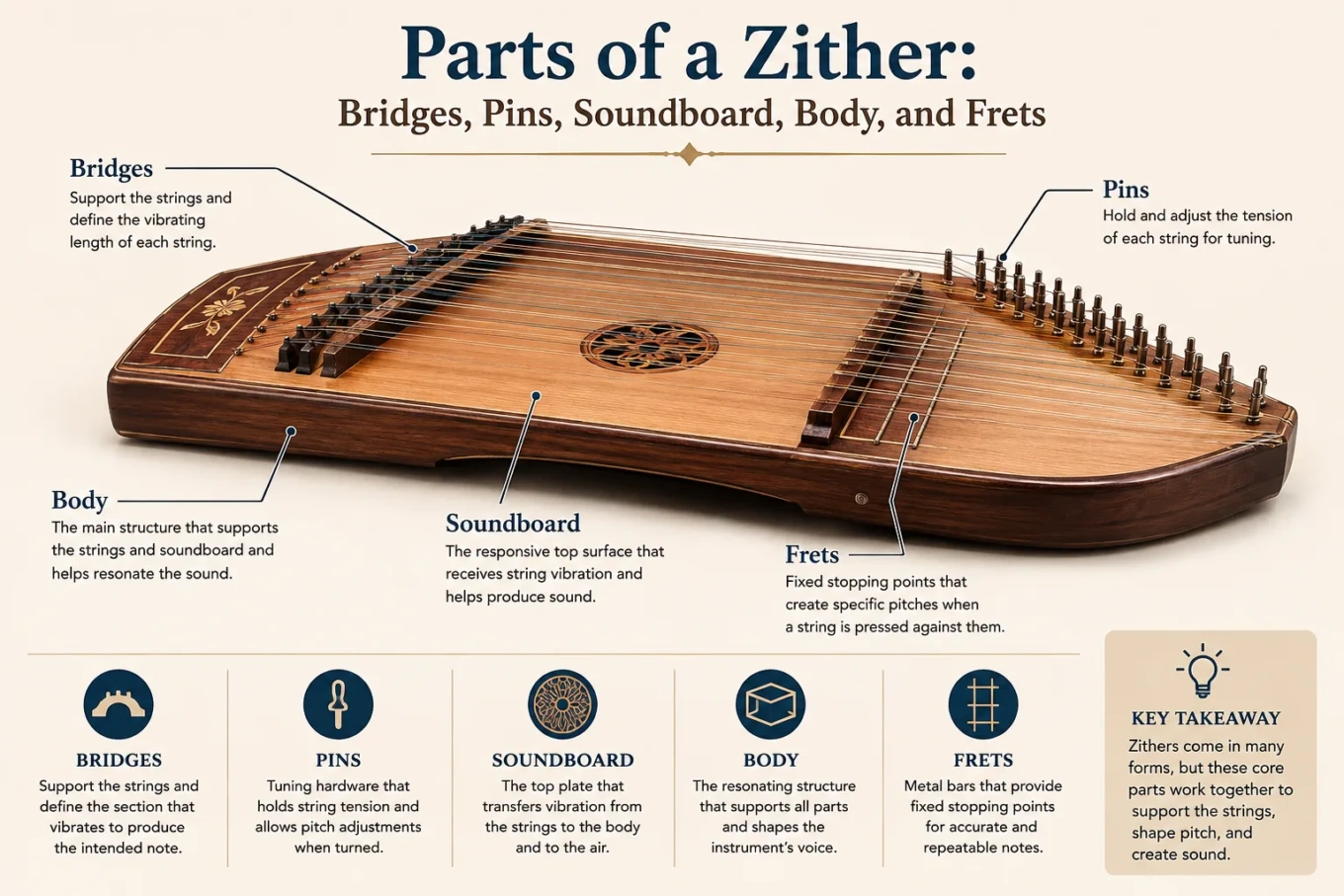
Parts of a Zither: Bridges, Pins, Soundboard, Body, and Frets
A zither does not have one universal anatomy. In the narrow European sense, the word often points to the concert zither; in broader organology[1], it covers a much wider branch of chordophones[2] whose strings are carried by the instrument body rather than by a separate neck in the manner of a guitar or violin. That difference matters when naming parts. A bridge, tuning pin, soundboard, resonating body, or fret may be central to one zither and absent, replaced, or arranged very differently on another.
The safest way to read zither anatomy is by function: what supports the strings, what holds tension, what defines the vibrating section, what responds to string vibration, and what lets the player change pitch. The physical answer changes between a concert zither, guzheng, koto, gayageum, guqin, santur, kantele, qanun, autoharp, and other members of the wider family.
The Main Parts and What They Actually Do
| Part | Main Job | Common Variation |
|---|---|---|
| Bridge[3] | Supports the string and usually defines one boundary of a vibrating string section. | Fixed, shared, separate, or individually movable. |
| Tuning pin[4] | Changes and holds string tension when turned. | Metal wrest-style pins, pegs, or other tensioning systems may be used. |
| Soundboard[5] | Provides a responsive surface that receives vibration from the strings and bridge system. | May be a distinct top plate or part of a board-like body. |
| Resonating body[6] | Supports the string system and provides the larger physical structure through which vibration can develop. | Box, long board, trapezoidal body, carved body, and other forms occur. |
| Fret[7] | Creates a fixed stopping position when a playable string is pressed against it. | Present on some zithers, especially the melody section of the concert zither; absent on many others. |
No single row in the table should be treated as a checklist for every instrument called a zither. The family is too varied for that. The useful question is whether another part performs the same structural job.
Bridges Define More Than String Height
A bridge raises a string above the surface of the instrument, but its role is not limited to clearance. It commonly marks one end of the string’s speaking length[8], the section that vibrates as the intended note. It also provides a mechanical path between the string and the structure beneath it.
On a European concert zither, the bridge system is fixed. The player does not slide the bridge to set each note. Tension is adjusted through the tuning hardware, while the fretted melody strings gain additional pitches by being stopped against frets.
Fixed and Shared Bridges
A fixed bridge stays in a set position under normal playing. One bridge may support several strings, or an instrument may use separate bridge sections for different string groups. The exact shape varies with the maker and instrument type, so the number of visible bridge pieces is not a reliable way to define the zither family.
Struck zithers such as santur and hammered dulcimer also use fixed bridge systems, but their string fields and playing geometry differ sharply from those of a concert zither. The bridge is still easy to recognize by function: strings cross an elevated support that helps define their usable vibrating lengths.
Individual Movable Bridges
Guzheng, koto, gayageum, and đàn tranh commonly use an individual movable bridge[9] for each string in many established forms. Bridge placement helps determine the usable length of the string, so moving a bridge changes the geometry that the tuning system must accommodate.
This arrangement also changes how the instrument looks. Instead of one long bridge supporting a bank of strings, a row of separate bridges stands across the body. Their position is part of setup, not decoration.
Bridge position should not be confused with tuning pin position. A bridge sets support and string geometry. A tuning pin or another tensioning device controls tension. Some zithers use both; others solve those jobs differently.
Pins Are a Family of Hardware, Not a Single Part
Old zithers often show rows of metal pins, and it is easy to label every one of them a tuning pin. That can be wrong. The first task is to trace where the string begins, where it crosses its supports, and where it ends.
Tuning Pins
A tuning pin changes string tension. Many European concert, chord, and box zithers use metal pins that are turned with a tuning key. Square-headed forms are common in documented historical instruments, though head shape and construction vary.
Turning the pin winds or unwinds a small amount of string and changes tension. The pin must also resist the pull of the string once the desired pitch is reached. For that reason, its supporting wood is a structural area rather than a purely decorative part of the top.
Hitch Pins and Other Anchors
A hitch pin[10] usually anchors the string at the end opposite the tuning pin. It is not normally turned to tune the note. Depending on the instrument, the same anchoring job may be handled by a post, peg, loop, knot, rail, or other fixture.
The distinction is practical:
- Tuning pin: intended to adjust and hold tension.
- Hitch or anchor point: intended mainly to secure the other end of the string.
A row of similar-looking pins can therefore contain hardware with different jobs. Naming the part by function is more reliable than naming it by appearance alone.
The Wood Behind the Pins
On many pin-tuned zithers, the tuning pins enter a dense supporting member often described as a pin block[11] or, in some instrument traditions, a wrest plank. This area must hold the pins firmly enough to resist string tension without allowing them to rotate freely.
The pin block may be partly hidden by the top structure, which is why an old zither can appear to have pins inserted directly into a thin surface even when stronger support lies beneath. Museum descriptions of historical box zithers often separate the soundboard, pin blocks, tuning pins, and bridge or saddle as distinct construction features.
Soundboard and Body Are Related, but They Are Not Synonyms
The soundboard is the responsive surface most directly associated with the strings and bridge system. The body is the larger structure that carries the instrument. On a hollow-bodied zither, the body can include the soundboard, sides, back, internal supports, and air space. Calling the whole instrument top a “body” may be understandable in casual speech, but it hides a useful construction distinction.
What the Soundboard Does
A plucked or struck string by itself moves little air. The bridge and adjoining structure pass some of that motion into a broader surface. The soundboard responds over a much larger area than the string, while its thickness, bracing, arching, wood properties, and connection to the rest of the body influence how the instrument behaves.
That does not mean wood species alone determines tone. Two zithers made from the same named wood can differ because of plate thickness, bridge design, stringing, body shape, internal support, setup, and workmanship.
What the Body Does
The body has to support the string layout as a complete mechanical system. It carries the top structure, holds or supports anchor points, provides the platform for bridges, and resists the accumulated pull of the strings. In hollow instruments, it also encloses an air volume that interacts with the vibrating surfaces.
Not every zither presents this as an obvious “box.” Long board zithers, carved forms, trapezoidal struck zithers, and other regional designs can make the boundary between soundboard and body look quite different. A museum catalogue may also choose terminology suited to the construction of the specific object rather than force every zither into the same vocabulary.
What May Be Hidden Inside
The visible top does not reveal the entire structure. Depending on the design, a zither may contain braces, rails, blocks, liners, joints, or reinforced areas beneath the soundboard. These parts support string tension and help keep the body stable.
This is one reason a tuning pin, bridge, or anchor should never be understood as an isolated fitting. Each depends on the wood and joints around it.
Frets Belong to Some Zithers, Not to the Whole Family
The European concert zither is especially useful for understanding why the word “zither” can mislead beginners. Its melody strings run over a fingerboard[12] fitted with raised frets, while many of its other strings are played as open strings[13]. The same instrument therefore combines a fretted melody area with a larger unfretted string field.
When a melody string is pressed against a fret, the contact point shortens the section free to vibrate. The fret does not tune the string in the same way as a tuning pin. Instead, it gives the player a repeatable stopping position for a particular pitch relationship.
Fret and Fingerboard Are Different Parts
The fingerboard is the playing surface beneath the stopped strings. The frets are the raised strips set into or onto that surface. A worn or damaged fret is therefore not the same thing as damage to the fingerboard itself.
Some historical zither-related instruments place frets directly into the main wooden surface rather than on a strongly raised, guitar-like fingerboard. Construction vocabulary should follow what is physically present.
Position Markers Are Not Frets
A visible line, dot, inlay, or marker does not automatically count as a fret. A fret must provide a raised contact point that physically stops the string when the player presses it down.
The guqin is a useful example of the distinction. It has marked playing positions but no raised frets. The player uses open strings, stopped notes, slides, and harmonics on a smooth surface. The markers guide position; they do not form hard fret edges under the strings.
Autoharp chord bars are also not frets. They mute selected strings to produce chord combinations rather than shortening one string at a series of fixed stopping points.
The Same Structural Job Can Use Different Hardware
| Layout | Typical Part Pattern | What to Notice |
|---|---|---|
| Concert zither | Fixed bridge, tuning pins, fretted melody fingerboard, separate open-string field. | Fretted and unfretted string systems coexist on one body. |
| Long movable-bridge zithers | Individual bridges under strings; no conventional fretted fingerboard. | Bridge placement is part of string setup, while tensioning hardware varies by instrument and model. |
| Fretless board zither | Smooth playing surface, fixed end supports, no raised frets. | Pitch can depend on open strings, stopping positions, slides, harmonics, or other instrument-specific methods. |
| Struck zither | Fixed bridges under a dense string field; no fretted melody fingerboard. | Several strings may be organized into a course[14] and treated as one pitch group. |
The table shows why a universal “zither parts diagram” can be misleading if it presents one instrument as the anatomy of the entire family. A concert zither diagram is useful for a concert zither. A guzheng, koto, guqin, santur, or qanun needs its own labels where construction differs.
Following One String Across the Instrument
Tracing a single string is one of the fastest ways to understand an unfamiliar zither. On a fretted concert-zither melody string, the path can be read schematically as:
- tuning pin,
- nut[15] or other fixed end support,
- fretted fingerboard,
- bridge,
- anchor or hitch point.
The exact orientation can be reversed depending on how the instrument is held or illustrated, but the functional sequence remains useful. One end allows tension adjustment, two support points define the principal vibrating section, and the frets create shorter stopped lengths within that section.
On a movable-bridge zither, the path is different. The individual bridge stands between the two string ends and creates a usable segment on one side. On instruments that allow pressing or bending on the other side of the bridge, that second segment also becomes part of the playing technique. The bridge is therefore both a structural support and part of the player’s pitch-control geometry.
Parts That Are Easy to Misidentify
Bridge vs Nut
Both can define an endpoint of a vibrating string section, but they are not interchangeable names. A nut is normally the smaller fixed support at one end of a stopped-string area. A bridge is usually the more direct connection between the string field and the main vibrating structure.
Tuning Pin vs Hitch Pin
If the string winds around the fitting and the fitting is designed to turn for pitch adjustment, it is probably part of the tuning system. If the string simply loops around or attaches to it and the fitting remains stationary, it is functioning as an anchor.
Soundboard vs Body
The soundboard is a responsive plate or surface. The body is the larger supporting structure. On some instruments the two are visually easy to separate; on others the construction makes the boundary less obvious.
Fret vs Position Marker
A fret rises above the playing surface and stops the string physically. A marker gives the player a visual or tactile location without acting as the stopping edge.
Fingerboard vs Fret
The fingerboard is the surface. Frets are individual raised pitch divisions placed on that surface. A zither may have a fingerboard-like playing area without using raised frets, and many zithers have neither.
Reading an Old or Unfamiliar Zither
Historical instruments are often incomplete, restrung, repaired, or photographed without all removable parts in place. Identification is more reliable when the visible hardware is read as a system rather than as isolated objects.
- Trace the strings first. Follow each string from one end to the other before naming pins, bridges, or anchors.
- Check whether the bridge is shared or individual. A continuous bridge under many strings suggests a different layout from a row of separate movable bridges.
- Look for evidence of adjustment. A tuning pin usually has a head shaped to accept a tuning tool or a peg form intended to turn.
- Separate raised frets from decoration. Inlay lines, painted marks, and position dots do not shorten a string unless they form a raised contact point.
- Do not assume a missing movable bridge was never present. Some instruments are stored or photographed with removable bridges taken off.
- Treat mixed hardware cautiously. Replaced pins, later strings, altered bridges, and repairs can make an old instrument look unlike its original setup.
When the instrument type is unknown, the most dependable description is functional and literal: “row of square-headed tuning pins,” “individual movable bridges,” “fretted melody fingerboard,” or “strings crossing a fixed bridge.” That is more precise than forcing an uncertain object into the anatomy of a familiar zither.
Glossary of Technical Terms
[1] Organology: The study and classification of musical instruments, including their construction, playing method, materials, and relationships. In zither research, organology helps explain why the same family name can include instruments with very different bodies and pitch systems.
[2] Chordophone: A musical instrument whose primary sound source is a vibrating string. Zithers are one branch of the wider chordophone category.
[3] Bridge: A support over which one or more strings pass. On zithers it can be fixed or movable and often helps define string length while coupling the strings to the body structure.
[4] Tuning Pin: A pin or similar adjustable fitting used to change and hold string tension. Many European zithers use metal pins turned with a tuning key.
[5] Soundboard: The responsive plate or surface that receives vibration from the strings through the bridge or adjoining structure. Its form varies widely across the zither family.
[6] Resonating Body: The larger body structure that supports the strings and participates in the instrument’s acoustic response. It may be hollow, board-like, carved, box-shaped, or built in another form.
[7] Fret: A raised strip that provides a fixed stopping point for a string. On a concert zither, frets are used under the melody strings rather than across the entire open-string field.
[8] Speaking Length: The part of a string that is free to vibrate as the intended note between its effective support points. Fretting or moving a bridge can alter this length on instruments designed for those actions.
[9] Movable Bridge: A bridge that can be repositioned rather than permanently fixed. Guzheng, koto, gayageum, and đàn tranh commonly use separate movable bridges in many established forms.
[10] Hitch Pin: A stationary pin used mainly to anchor a string end. It differs from a tuning pin because it is not normally the fitting used to adjust pitch.
[11] Pin Block: A dense structural member that holds tuning pins firmly under string tension. Related terminology such as wrest plank appears in some instrument traditions and catalogues.
[12] Fingerboard: The surface beneath strings that are stopped by the player’s fingers. On a concert zither, the melody-string fingerboard carries frets.
[13] Open String: A string sounded without being pressed against a fret or otherwise stopped by the finger. Many zithers use open strings for melody, accompaniment, bass, drone, or resonance.
[14] Course: A group of two or more strings treated as one musical unit or pitch group. Courses are common in several multi-string zither traditions, especially where paired or grouped strings are struck or plucked together.
[15] Nut: A fixed string support that forms one boundary of a playable string section. On fretted zither layouts it can mark the end of the fingerboard opposite the bridge.