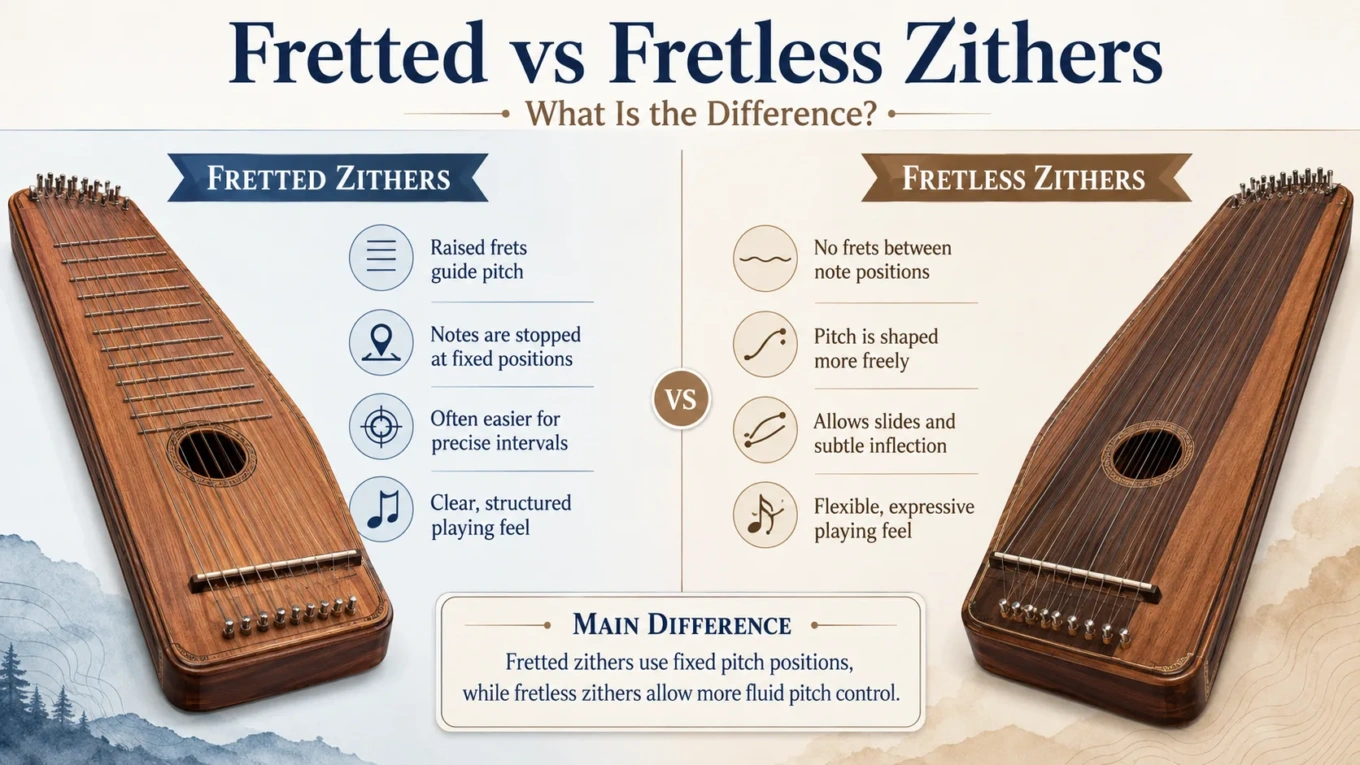
Fretted vs Fretless Zithers: What Is the Difference?
Fretted vs fretless zithers are separated by one practical question: does the player change pitch by pressing a string against fixed frets, or does the instrument rely on open strings, movable bridges, slides, bends, and hand control instead? The difference affects tuning, left-hand work, repertoire, tone, maintenance, and the way the instrument is classified. A European concert zither may place fretted melody strings beside many open accompaniment strings, while a guzheng, koto, gayageum, guqin, qanun, santur, psaltery, or autoharp may use a different pitch system without a guitar-like fretboard.
Fretted vs Fretless Zithers: The Basic Difference
A fretted zither[1] has one or more strings that can be pressed against frets[2]. The frets mark fixed pitch positions. This lets one string produce many notes, much like a guitar string does, although the body shape and playing position may be very different.
A fretless zither[3] does not use frets as the main way to stop notes. Its pitch system may come from pre-tuned open strings[4], movable bridges, hand pressure, slides, bending, or separate strings assigned to different notes.
The word zither[5] can be used narrowly or broadly. In a narrow European sense, it often points to the concert zither or Alpine zither. In organology, it refers more broadly to a type of chordophone[6] where the strings run across, along, or over the body rather than extending along a separate neck.
Classification Note: Fretted and fretless are playing-structure terms, not separate cultural families. A zither can be European, East Asian, Middle Eastern, Nordic, Slavic, or American and still be described by whether its pitch system uses frets, open strings, bridges, or another method.
Main Differences in Playing Structure
| Feature | Fretted Zithers | Fretless Zithers |
|---|---|---|
| Pitch Selection | Pitch changes when a string is pressed against a fret. | Pitch often comes from open strings, bridge placement, tuning, bending, sliding, or separate strings. |
| Left-Hand Role | The left hand may stop melody strings on a fingerboard. | The left hand may bend, damp, slide, press, retune, or shape tone rather than fret notes. |
| Common Examples | Concert zither, Alpine zither, some scheitholt and hummel forms, mountain dulcimer in broad zither classification. | Guzheng, koto, gayageum, đàn tranh, guqin, qanun, santur, hammered dulcimer, many psalteries. |
| Tuning Logic | Some strings may work like a small fretted fingerboard, while others remain open. | Each string or string group may be tuned to a pitch, scale degree, drone, or modal layout. |
| Sound Character | Stopped notes can sound direct and clearly placed, with fret contact shaping attack. | Open resonance, pitch bending, and subtle aftertouch often play a larger role. |
The table also shows why a simple “fretted means easy, fretless means hard” answer does not work. Frets help with pitch placement, but they add left-hand fingering. Fretless instruments may look visually simpler, yet they often demand fine control of tuning, pressure, damping, and touch.
How Frets Change a Zither
Frets divide a sounding string into predictable note positions. When the player presses the string down, the vibrating length changes and produces a stopped pitch[7]. On a concert zither, the fretted section usually sits on a fingerboard[8] near the player, while many other strings remain open for harmony, bass, and accompaniment.
This hybrid layout is one reason concert zither technique feels unlike guitar technique. The fretted strings carry much of the melody, but the right hand also manages unfretted accompaniment and bass strings. The instrument is not just a small guitar laid flat. Its logic depends on a mixed string field.
What Frets Give the Player
- Repeatable pitch positions: A note can be found again by returning to the same fret.
- Chromatic movement: Many fretted zithers can move through semitone steps on a melody string.
- Melodic flexibility: Fewer melody strings can cover a wider range than a purely open-string layout.
- Clear left-hand mapping: The player can see the pitch path across the fingerboard.
Frets can make certain passages easier to organize, especially for Western staff notation and chromatic melody. They also create a firm contact point, which can give stopped notes a focused attack. That clarity depends on fret condition, string height, and player pressure.
What Frets Limit
Frets also set boundaries. They favor fixed pitch positions. Smooth slides, gentle pitch shades, and flexible tuning colors are possible on some fretted instruments, but they do not behave the same way as on a fretless surface or a movable-bridge zither.
Frets must be placed accurately. Worn, uneven, or poorly seated frets can cause buzzing, poor intonation[9], or notes that feel stiff under the hand. On older zithers, fret condition can matter as much as string condition.
Luthier’s Note: A fretted zither should not be judged only by the number of strings. The angle of the fingerboard, fret height, string spacing, and action[10] affect how playable the instrument feels.
How Fretless Zithers Select Pitch
Fretless zithers do not all work the same way. Some assign one pitch to each string. Some use movable bridges[11] to set scale positions. Some allow the player to press or slide on the string surface. Others use a set of courses tuned to a mode, chord pattern, or repertory need.
The bridge[12] is often central to this design. On instruments such as guzheng, koto, gayageum, and đàn tranh, movable bridges divide the string and set the main speaking length. The player usually plucks on one side of the bridge while the other side can be used for pitch bending, vibrato-like motion, and expressive pressure.
On the guqin, the situation is different. It is a fretless seven-string zither with no movable bridges under each string. Instead, the player uses open notes, stopped notes, harmonics, and slides along the surface. Pearl or shell markers may guide finger positions, but they are not frets; they do not stop the string by themselves.
Common Fretless Pitch Systems
- Open-string layouts: Each string is tuned to a usable pitch, chord tone, bass note, or scale degree.
- Movable-bridge layouts: Bridges set string length and pitch before or during setup.
- Stopped fretless layouts: The player presses the string against or toward the surface without a fret.
- Struck-string layouts: Instruments such as santur and hammered dulcimer use hammers; pitch comes from tuned strings and bridge divisions.
- Chord-bar layouts: Autoharp-style instruments use bars that damp selected strings, not frets under the player’s fingers.
Fretless does not mean featureless. Many fretless zithers have complex bridge fields, string gauges, tuning pins, damping demands, and regional playing habits.
Construction Details That Shape the Difference
The fretted or fretless choice affects the whole instrument. It changes the soundboard[13], the resonating body[14], the stress pattern of the strings, the player’s hand position, and the way the instrument is repaired.
Fingerboard and Fret Placement
A fretted zither needs a stable fingerboard. The frets must align with the intended scale length and tuning system. The fingerboard may hold four or five melody strings on a concert zither, though older and regional examples vary. Some historical instruments have unusual half-fret patterns or localized fret layouts, so a modern guitar-based expectation can mislead the eye.
The scale length[15] matters. A longer string length needs different tension and spacing than a shorter one. If the frets are not placed for that scale, tuning problems cannot be fixed by ordinary tuning alone.
Open-String Fields and Courses
Many fretless zithers use sets of strings tuned across a surface. Some strings may appear singly, while others are arranged in courses[16]. A course can give more volume, a fuller attack, or a paired pitch effect, depending on the instrument.
On santur and hammered dulcimer types, the player strikes strings with small hammers. On psalteries, the player may pluck or bow depending on the form. On qanun, each course may work with small levers on modern instruments, allowing pitch changes that do not resemble fretting.
Drone, Melody, Bass, and Accompaniment Roles
Some zither layouts separate the strings by function. A concert zither may have melody strings[17] over the fretted fingerboard and open accompaniment, bass, or contrabass strings elsewhere. A drone zither may use one or more drone strings[18] to maintain a repeated pitch foundation.
This is one reason fretted vs fretless should not be reduced to the presence of metal strips. The musical job of each string also matters. A fretted string may carry melody; an open string may provide harmony, rhythmic pulse, resonance, or a tonal center.
Examples from the Zither Family
Instrument names can hide structure. A visitor may see the word “zither” applied to several instruments that do not share the same playing method. The examples here focus on fret use, not on ranking one form above another.
Concert Zither and Alpine Zither
The concert zither is the best-known fretted zither in the narrow European sense. It usually combines a small fretted melody section with many open strings for accompaniment and bass. The Alpine zither extends this idea in some forms with a larger body or added string range, depending on the maker and period.
The fretted section allows stopped melody notes. The open strings give harmony and resonance. This mixed layout can look crowded, but it follows a practical division of labor between the hands.
Scheitholt, Hummel, and Related Drone Zithers
Several European folk zithers use fretted melody strings together with drone or accompaniment strings. Names such as scheitholt and hummel can refer to related but regionally varied instruments. Some examples have simple diatonic frets rather than a fully chromatic layout.
These instruments show how frets can serve song accompaniment and drone-based music without turning the instrument into a guitar-like object.
Guzheng, Koto, Gayageum, and Đàn Tranh
These long board zithers use movable bridges in many common forms. They are fretless, but not pitch-poor. The bridges set the main scale. The player can also press or bend the string segment on the opposite side of the bridge to shape pitch and color.
This design supports a different kind of left-hand expression. Instead of choosing a fret number, the player works with pressure, timing, release, and after-sound.
Guqin
The guqin is fretless and bridge-free in the usual sense. Its seven strings pass over a smooth surface, with markers that help locate harmonics and stopped positions. The player creates open tones, stopped tones, slides, and harmonics through touch rather than fret contact.
Because of this, the guqin is a strong reminder that a fretless zither can have a highly ordered pitch system even without frets or movable bridges.
Qanun, Santur, Hammered Dulcimer, and Psaltery
The qanun is commonly treated as a zither-family instrument in broad classification. It uses many courses and, in modern forms, may include small levers for rapid pitch alteration. Those levers are not frets.
Santur and hammered dulcimer instruments are struck zithers. Their pitch comes from tuned strings running over bridge systems. A psaltery may be plucked or bowed depending on the type. These instruments can be fretless while still having fixed pitches set by string length and tuning.
Autoharp
The autoharp is often described as a chord zither. Its chord bars damp strings that are not part of the selected chord. The bars do not work like frets because they do not shorten a string to make a new pitch. They mute selected strings and let others ring.
Collector’s Note: On old zithers, the label “fretless” may point to several different designs: a chord zither, a psaltery, a dulcimer-like instrument, or a simple open-string board zither. The safest inspection starts with the string path, bridge layout, tuning pins, and any fingerboard or chord-bar mechanism.
Sound and Touch: What Changes for the Ear
Fretted and fretless zithers can both sound clear, warm, bright, dry, or resonant depending on material, stringing, body shape, and playing method. Still, the pitch system changes how the sound begins and moves.
Fretted Sound
A fretted note often has a defined attack because the string contacts a hard fret. This can help melody lines speak with clarity. On a concert zither, that fretted melody may sit over ringing open strings, giving the music a layered texture.
Frets can also reduce some pitch flexibility. The note is guided by the fret position. A player can use ornaments and finger movement, but the fret sets the main pitch point.
Fretless Sound
Fretless zithers often draw attention to resonance, aftertouch, and pitch shading. On movable-bridge instruments, a player may press the string beyond the bridge to raise pitch or create a wave-like motion. On guqin, sliding motion across the surface can be part of the musical vocabulary.
This does not mean all fretless zithers sound soft or fluid. Santur and hammered dulcimer types can have a bright, percussive attack. Qanun can sound crisp and highly articulate. Fretless design simply means the pitch system is not governed by frets.
Microtonal and Modal Flexibility
Some fretless zithers can support microtonal inflection[19] more directly than fixed-fret layouts. This is especially relevant in traditions where pitch bends, modal color, or small pitch adjustments are part of the style.
Not every fretless zither is automatically microtonal in use. A koto set for a common tuning, a hammered dulcimer tuned to a fixed pattern, and a simple psaltery may all behave as fixed-pitch instruments during performance. The difference is structural possibility, not a universal rule.
Tuning Differences
Fretted zithers and fretless zithers approach tuning from different angles. A fretted melody string needs a correct open pitch and accurate fret placement. If either part is wrong, the note pattern suffers.
Fretless zithers place more responsibility on string tuning, bridge position, and playing touch. On movable-bridge instruments, bridge placement can set the scale before playing. Small changes in bridge position may change intonation, string response, and hand spacing.
Fretted Zither Tuning
On concert zithers, fretted strings and open strings may follow established tuning systems, but details vary by instrument type, maker, number of strings, and regional practice. The fretted strings are usually treated as melody strings. Open accompaniment and bass strings are tuned to support harmonic movement.
A beginner should avoid assuming that every concert zither uses one exact string count or one universal tuning. Published tunings exist, yet older instruments and regional variants may differ.
Fretless Zither Tuning
Fretless instruments often tune each string or course to the notes needed for a mode, piece, or tradition. Guzheng, koto, gayageum, and đàn tranh players may set movable bridges for a selected tuning. Santur and hammered dulcimer players tune many strings to a layout that supports scales and repeated patterns.
Fretless tuning can be slower because each string has its own role. It can also be flexible, because a new bridge position or retuning can reshape the instrument for a different musical setting.
Playing Technique and Hand Logic
The player’s hands think differently on fretted and fretless zithers. Frets create a map. Fretless designs often create a field of tuned strings and touch-sensitive pitch areas.
Left Hand on Fretted Zithers
On a fretted zither, the left hand often stops melody strings. Finger pressure must be firm enough for clean contact but not so heavy that pitch bends sharp or the hand tires. Clean movement across frets helps avoid unwanted noise.
The right hand may pluck with a thumb ring, fingerpicks, bare fingers, or another method depending on the instrument and tradition. On concert zither, the right hand also manages open strings that are not fretted at all.
Left Hand on Fretless Zithers
On many fretless movable-bridge zithers, the left hand does not stop notes in the same way. It may press strings to raise pitch, create vibrato-like motion, prepare ornaments, or control release after the right hand plucks.
On guqin, left-hand slides and stopped tones are part of the main technique. On santur or hammered dulcimer, the hands focus on hammer control, strike placement, rhythmic clarity, and damping[20] rather than finger stopping.
Where the Confusion Starts
Confusion often starts when “zither” is treated as one instrument instead of a family term. Another source of confusion is the word “fretless.” In some sales or museum descriptions, “fretless zither” may refer to a chord zither, a psaltery-like board instrument, or any zither without a fingerboard.
A fretless zither is not automatically a guzheng. A fretted zither is not automatically a concert zither. A dulcimer may be part of the zither discussion in broad classification, but the mountain dulcimer and hammered dulcimer differ sharply in playing method.
Autoharp Bars Are Not Frets
The autoharp can confuse beginners because it has a mechanical system across the strings. Those bars select chords by muting strings. They do not create new pitches by shortening string length. For that reason, the autoharp is not fretted in the same sense as a concert zither fingerboard.
Markers Are Not Frets
Some fretless zithers have position markers. The guqin’s markers guide harmonics and finger placement, but they do not rise under the strings to stop them. A visual guide is not the same as a fret.
Movable Bridges Are Not Frets
Movable bridges set a string’s speaking length, but the player does not press the string onto each bridge to produce a scale. The bridge is part of tuning and setup. Frets are player-contact pitch points.
How Museums and Instrument Catalogs Describe Them
Museum and catalog language often uses classification terms before familiar player terms. An object may be listed as a board zither, box zither, trough zither, half-tube zither, plucked zither, struck zither, chord zither, or fretted zither. These labels describe structure and sound production.
A museum record may also mention material, string number, tuning devices, bridge design, soundholes, decoration, and region. A player may care first about feel and repertoire. Both views are useful, but they answer different questions.
For fretted vs fretless zithers, the most useful catalog clues are:
- whether a fingerboard is present;
- whether raised frets sit under any strings;
- whether the strings pass over individual movable bridges;
- whether the instrument has chord bars, tuning levers, hammers, or bows;
- whether strings are grouped into melody, drone, bass, or accompaniment roles.
Which Type Is Easier for Beginners?
No single answer fits every zither. A small fretted zither may feel easier because pitch positions are visible. A simple fretless psaltery may feel easier because each string gives one note. A concert zither may be demanding because it asks the player to coordinate fretted melody with many open strings. A guqin may appear spare but needs refined touch and listening.
The best beginner choice depends on the desired sound and learning path. A player interested in Alpine or Central European repertoire may need a fretted concert zither. A player drawn to guzheng, koto, gayageum, or đàn tranh should expect movable bridges and fretless bending. A player seeking chord accompaniment may prefer an autoharp-style chord zither.
Practical Learning Differences
- Fretted zither: Learn left-hand fingering, fret positions, right-hand plucking, and tuning of open strings.
- Movable-bridge fretless zither: Learn bridge setup, string tuning, right-hand tone, left-hand bends, and damping.
- Open-string fretless zither: Learn string layout, scale pattern, plucking or striking order, and resonance control.
- Chord zither or autoharp: Learn chord bars, strumming direction, damping, and chord changes.
Care, Setup, and Inspection
Fretted and fretless zithers need different checks. A fretted instrument should be inspected for fret wear, fingerboard straightness, string height, buzzing, and tuning stability. The nut[21] and bridge area must guide the strings cleanly.
A fretless movable-bridge instrument should be checked for bridge fit, bridge angle, soundboard pressure, string spacing, and tuning pin condition. A bridge that leans, slips, or cuts into the soundboard can affect tone and tuning.
Wood choice can shape resonance, but it should not be treated as a magic guarantee of sound. Construction quality, string condition, bridge fit, surface thickness, and setup all matter. On older instruments, cracks, loose braces, lifting bridges, and unstable tuning pins deserve careful attention.
Material Note: Many zithers use wood as both structure and resonator, but regional forms differ. Some have box bodies, some are board-like, some use tube or half-tube shapes, and some combine wood with metal, gut, silk, nylon, steel, or composite strings.
Choosing the Right Description
When describing an instrument, “fretted” or “fretless” should be paired with a second detail. A clearer description might say “fretted concert zither,” “fretless movable-bridge board zither,” “struck fretless zither,” or “chord zither with damping bars.”
This avoids false grouping. A guqin and an autoharp can both be fretless in the simple sense, but they do not share the same playing logic. A concert zither and a mountain dulcimer can both have frets, but their body form, repertoire, and hand technique differ.
Useful Description Pattern
- Name the instrument when known.
- State whether it is fretted or fretless.
- Describe how pitch is selected.
- Describe how sound is produced: plucked, struck, bowed, or strummed.
- Mention bridge, fingerboard, chord-bar, or open-string layout if it affects playing.
A precise description helps readers, players, collectors, and curators speak about the instrument without forcing it into the wrong category.
FAQ
What is the main difference between fretted and fretless zithers?
Fretted zithers use fixed frets to help create different pitches on at least some strings. Fretless zithers do not use frets for pitch selection; they may rely on open strings, movable bridges, tuning, bends, slides, or other pitch-control methods.
Is a concert zither fretted or fretless?
A concert zither is usually partly fretted. Its melody strings run over a fretted fingerboard, while many accompaniment and bass strings remain open and unfretted.
Is a guzheng a fretless zither?
Yes. A guzheng is a fretless movable-bridge zither. Its bridges set the main string pitches, and the player can press or bend strings on one side of the bridge for pitch shaping.
Does fretless mean harder to tune?
Not always, but fretless zithers often place more work on tuning and setup. Movable-bridge instruments need careful bridge placement, while open-string instruments may require many strings or courses to be tuned before playing.
Are autoharps fretted zithers?
No in the usual playing sense. Autoharps are chord zithers with bars that damp selected strings. Those bars do not act like frets because they do not shorten a string to create new pitches.
Can a zither have both fretted and fretless parts?
Yes. The concert zither is the clearest example. It uses fretted melody strings together with open unfretted strings for accompaniment, bass, and resonance.
Glossary of Technical Terms
- Fretted Zither: A zither with one or more strings that are pressed against frets to create different pitches. In the concert zither, this usually applies to the melody strings on the fingerboard.
- Fret: A raised strip or ridge that marks a fixed pitch position. When a string is pressed against it, the vibrating string length changes.
- Fretless Zither: A zither that does not use frets as its main pitch system. Pitch may come from open strings, bridge placement, slides, bends, or other methods.
- Open String: A string sounded without being stopped by a finger. Many zithers depend heavily on open strings for melody, drone, harmony, or bass.
- Zither: A string instrument type where the strings run across or over the body rather than along a separate neck. The term can refer narrowly to European concert zithers or broadly to many related chordophones.
- Chordophone: An instrument that produces sound mainly through vibrating strings. Zithers are one branch of chordophones.
- Stopped Pitch: A note made by shortening a string with the hand. On a fretted zither, the fret gives the stopped note its fixed contact point.
- Fingerboard: The surface under the player’s fingers on fretted melody strings. On concert zithers, it is the part of the instrument most closely related to guitar-like pitch selection.
- Intonation: The accuracy of pitch across the instrument. On fretted zithers it depends on fret placement and setup; on fretless zithers it may depend on tuning, bridge position, and touch.
- Action: The height and feel of the strings above the playing surface. If action is too high or too low, a zither may become tiring, buzzy, or hard to tune cleanly.
- Movable Bridge: A bridge that can be repositioned to change string length and tuning. Guzheng, koto, gayageum, and đàn tranh commonly use movable bridges.
- Bridge: A support that transfers string vibration to the body or soundboard and helps define the vibrating length of the string. Bridges may be fixed, movable, individual, or grouped depending on the instrument.
- Soundboard: The vibrating top surface that helps project sound. On many zithers, the soundboard carries string tension and strongly affects response.
- Resonating Body: The body or chamber that helps amplify and color string vibration. It may be a box, board, tube, half-tube, trough, or other form depending on the zither type.
- Scale Length: The vibrating length of a string between its contact points. It affects pitch, tension, spacing, and fret placement.
- Course: A string group treated as one musical unit. Qanun, santur, dulcimer, and some other zithers may use courses rather than single isolated strings.
- Melody String: A string mainly used to carry the tune. On concert zithers, melody strings usually run over the fretted fingerboard.
- Drone String: A string used to sound a repeated or sustained pitch foundation. Drone strings are common in several folk zither traditions.
- Microtonal Inflection: A pitch shade smaller than the usual semitone division in many Western tuning systems. Some fretless zithers allow these small changes through pressure, bending, or fine tuning.
- Damping: Stopping or controlling string vibration after a note sounds. Zithers with many open strings often need careful damping to prevent unwanted ringing.
- Nut: A fixed support near the end of a string path that helps guide string spacing and height. On fretted zithers, the nut works with the bridge and frets to shape playable string length.