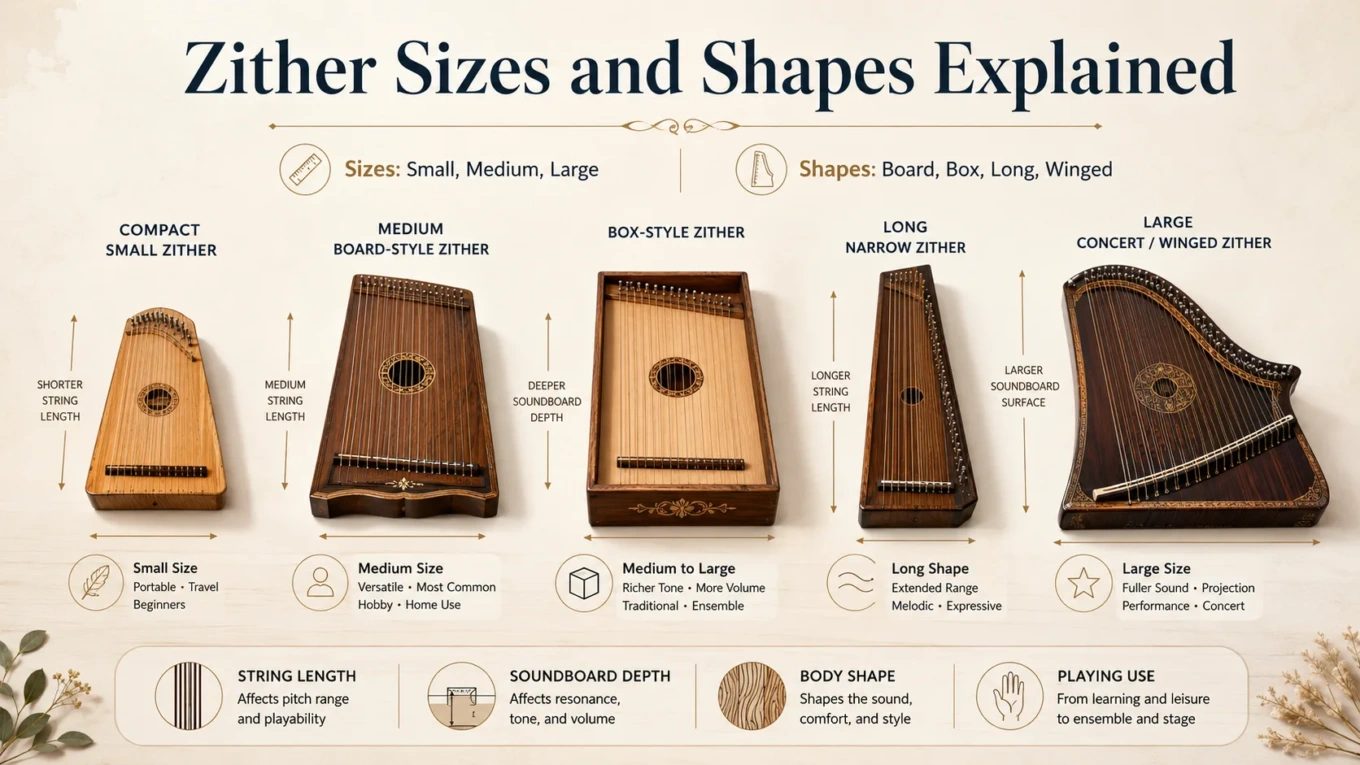
Zither Sizes and Shapes Explained
Zither sizes and shapes are not random decoration. They show how the strings are supported, how the body carries vibration, how the player reaches the instrument, and how much space the maker has for pitch, resonance, bridges, and hand movement. A small five-string kantele, a long guqin, a trapezoidal qanun, and an Alpine concert zither all belong near the zither family in organological language, yet their bodies solve very different musical problems.
The word zither can be used narrowly for certain European instruments, especially the concert zither, or broadly for a large group of chordophones[1] whose strings run across a body rather than along a separate neck. For size and shape, the broad meaning is more useful. It lets a reader compare flat boards, hollow boxes, curved half-tubes, trough-like forms, and frame-based designs without treating them as the same instrument.
What Size Means in the Zither Family
Size in a zither is usually a mix of three measurements: the length of the body, the width across the strings, and the depth of the resonating structure. A museum record may describe a German zither by length, greatest width, soundbox depth, and the sounding length of its strings. A long East Asian zither may be described by overall length and width. A small folk zither may be measured mainly by its wooden body.
These numbers matter, but they do not tell the whole story. The same overall length can feel very different if one instrument is narrow and low, while another has a deep soundbox and wide string fan. The size of a zither is best read together with its string bearer[2], its resonating body[3], and the way the strings are arranged.
Classification Note: In many museum and organology settings, zither shape is not treated as a matter of outline alone. The body is described by how it supports the strings: board, box, tube, trough, frame, or another related form. This is why two instruments that look very different may still be called zithers in a broad classification.
Main Zither Shape Families
A practical way to understand zither shapes is to start with the body type, not the country of origin. Regional names are essential for culture and repertoire, but body shape explains why a qanun feels unlike a guqin, and why a concert zither sits differently from a koto.
| Shape Family | Typical Body Form | Size Tendency | What the Shape Affects |
|---|---|---|---|
| Board zither | Flat or slightly shaped board carrying the strings | Small table instruments to long floor or table zithers | String spacing, hand reach, bridge placement, and surface resonance |
| Box zither | Board combined with a hollow box-like sound chamber | Often wider or deeper than a simple board | Projection, lower-frequency support, and body volume |
| Half-tube zither | Curved or vaulted surface, often long and narrow | Usually elongated | Contact between strings, bridges, and an arched body |
| Trough zither | Strings stretched across an open or hollowed trough | Varies by regional form | Air space below the strings and body response |
| Frame zither | Strings carried by an open frame rather than a closed board | Can be compact or wide | Open resonance, string layout, and structural tension |
| Trapezoidal zither | Angled body with unequal sides | Often broad enough for many courses | String-length grading, courses, and right-left hand layout |
A board zither[4] places the strings across a board-like body. Some are plain and compact; others carry many strings and bridges. In broad classification, board zithers may include instruments with added resonators, but the basic idea remains a string-carrying surface rather than a necked body.
The shape family does not replace the instrument’s real name. A kantele should not be reduced to “a board zither,” and a guqin should not be treated as a generic long zither. Shape language helps compare structure; cultural names preserve musical identity.
Long Zithers: Length, Reach, and String Layout
Long zithers place much of their musical logic along a horizontal line. The player sees pitch, hand position, and string order spread across the length of the body. This is common in several East Asian instruments, including the guqin, guzheng, koto, gayageum, and đàn tranh, though each has its own construction, repertoire, and playing method.
Length gives the maker more room for lower pitches, wider string spacing, and bridge movement. It can also allow the player to use gestures that need space: pressing a string to bend pitch, sliding along a marked surface, or shaping notes to the left of a bridge. The soundboard[5] may be flat, slightly arched, or part of a more curved body, depending on the instrument.
In documented museum examples, long zithers can differ greatly in measurement. A Japanese koto may be close to 180 cm long, while a guqin example may be around 120 cm. Smaller historical or regional examples also exist, so length should be read as a design range, not a fixed rule.
Why Longer Bodies Are Often Useful
A longer body can support longer vibrating strings. This may help lower notes speak more clearly, although the result also depends on string material, tension, bridge design, and the body’s response. The string length[6] is often more useful than overall body length when judging how the instrument will feel under the hand.
- Longer instruments can give more room for separated pitch areas.
- Long bodies can support wider bridge spacing on instruments such as guzheng or koto.
- Flat or gently curved surfaces can allow pitch bending, slides, and left-hand pressure techniques.
- Transport and storage become harder as length increases.
Small Zithers: Compact Bodies and Direct Sound
Small zithers often have fewer strings, shorter bodies, and a more direct playing feel. Small kanteles, small psalteries, children’s zithers, and some regional board zithers may fit easily on a lap or table. Their compact size does not make them lesser instruments; it changes their range, response, and musical use.
Shorter strings often mean a brighter or tighter response, depending on tuning and material. With fewer strings, the player may work within a small set of notes rather than a broad chromatic range. This can make the instrument accessible, but it can also require careful tuning and clean damping.
Small bodies may have less air volume, so their lower notes may not carry like those of a deep box or long body. Makers may compensate through wood choice, board thickness, string gauge, and bridge placement. These adjustments shape the result, but they do not erase the basic limits of size.
Luthier’s Note: A smaller zither is not automatically quieter, and a larger zither is not automatically better. The relation between size and sound depends on string tension, bridge pressure, soundboard stiffness, body depth, and the way the player sets the strings in motion.
Box Shapes and Soundbox Depth
A box zither[7] uses a hollow chamber below the string surface. That chamber may be shallow, deep, rectangular, wing-shaped, trapezoidal, or gently curved. Depth can help the body support resonance, but too much depth can also change weight, balance, and touch response.
European concert zithers often show the value of a shaped soundbox. They may have a curved or asymmetrical outline, with fretted melody strings near one side and open accompaniment strings spread across the body. This shape is not merely visual. It helps organize the hands: one area for stopped melody work, another for open chordal and bass strings.
Autoharps also use a box-like body, but their chord bars create a different playing logic. A player presses a bar to mute unwanted strings while strumming across the remaining notes. The body shape gives room for many strings, but the mechanical chord system is what makes the instrument feel unlike a concert zither.
What Soundbox Depth Can Change
Soundbox depth affects air space, weight, and body stiffness. In many zithers, a shallow soundbox gives a fast and clear response, while a deeper body may add warmth or support lower pitches. These are tendencies, not laws. Two instruments of similar depth can sound unlike each other if their woods, internal support, stringing, and bridge pressure differ.
Depth also affects comfort. A deep tabletop zither may lift the strings too high for relaxed wrist movement. A shallow lap zither may feel easier to hold but offer less body volume. Builders balance sound, posture, durability, and local tradition.
Curved and Half-Tube Shapes
A half-tube zither[8] carries strings over a curved or vaulted surface. The term is useful in classification because the body is not a flat board in the usual sense. The curvature can shape how the strings sit, how bridges touch the body, and how the instrument rests during performance.
The koto is often described as a long zither with a half-tube or vaulted body form. Its movable bridges and long body give it a clear visual logic: strings travel along the length, each bridge sets a speaking length, and the player works with the right and left hands on different parts of the string.
Curved shapes also appear in other regional zither traditions. The exact construction may vary, so the safest wording is to describe the observed body rather than force every instrument into a single global pattern.
Trough, Frame, and Raft-Like Forms
Some zithers do not look like the familiar flat board or box. A trough zither[9] stretches strings across the mouth of a trough-like body. A frame zither[10] uses an open frame to hold the strings. Raft-like forms may use bundled canes or similar structures as the string-bearing base.
These shapes are easy to overlook because they do not match the common image of a European zither or East Asian long zither. Yet they show how broad the zither idea can be. The shared feature is not a fixed outline. It is the relation between strings and the body that carries them.
For collectors and researchers, these forms need careful description. A single label such as “zither” may be too broad unless it is paired with body shape, region, playing method, and material. Museum catalogues often use layered wording for this reason.
Trapezoidal Zithers and Angled Layouts
Trapezoidal zithers use unequal sides to organize strings of different lengths. The qanun is a well-known example: its broad, angled body gives room for many strings arranged in courses[11], with shorter and longer string lengths set across the instrument. Santur and hammered dulcimer family instruments also often use trapezoidal or near-trapezoidal layouts, though they are struck rather than plucked in many traditions.
The angled form is practical. It lets the maker grade string length across the body without making the instrument excessively long. The player can reach many pitches from a seated position, with the instrument resting on a stand, table, or lap depending on regional practice and size.
Trapezoidal shape can also make tuning hardware, bridges, and string groups easier to organize. On some qanun forms, small levers may adjust pitch by fine intervals. That system belongs to qanun technique and regional tuning practice; it should not be assumed for every trapezoidal zither.
Width and the Number of Strings
Width often increases when an instrument needs more strings, more courses, or separate playing zones. A narrow long zither may carry a modest number of strings in a single row. A wider box or trapezoidal zither can support several groups of strings, chord areas, or accompaniment sections.
The relationship is not simple. A guqin has a long body but only seven strings in its classic form. A concert zither may be shorter than some East Asian long zithers but carry many more strings. A qanun can hold many courses across a broad trapezoid. A small kantele may have only a few strings, while concert kanteles can use many more.
Width also changes hand movement. A narrow instrument allows quick reach across the strings. A wide zither may require the player to divide tasks between the hands, use a set posture, or develop precise movement patterns. The body shape teaches the hand where music is placed.
Bridge Systems and Shape
Bridges are one of the clearest links between shape and sound. A long zither with a movable bridge[12] system, such as guzheng or koto, uses bridge position to set pitch and string length. Moving a bridge changes the speaking length of the string and affects tension behavior during tuning.
Other zithers use fixed bridges. A concert zither uses a different logic: some strings are stopped over a fingerboard, while others remain open for accompaniment. In that setting, body shape must allow the fretted area and the open-string field to coexist.
A qanun may use bridges together with grouped courses and pitch-adjusting hardware in some regional forms. A hammered dulcimer or santur may place strings over bridges that divide the string into playable sections. These instruments can be classified near zithers in broad organology, but their playing action changes the way shape is used.
Fixed, Movable, and Mixed Layouts
- Movable-bridge zithers often need long, open surfaces so each bridge can stand under its own string.
- Fretted zithers need a stable area for stopped notes and a comfortable left-hand path.
- Open-string zithers may devote more body space to tuned strings that are not shortened by the fingers.
- Course-based zithers need enough width for grouped strings and clean separation between courses.
Frets, Open Strings, and Body Plan
A fretted string[13] needs a fingerboard or stopping surface. This affects body shape because the player must press the string cleanly against a marked or raised pitch system. The European concert zither places this logic on one side of the instrument.
An open string[14] speaks at its tuned pitch without being shortened by a finger. Many zithers rely heavily on open strings. Some use them for melody, some for accompaniment, and some for repeated tonal centers. The body must give these strings enough length, spacing, and stable anchoring.
Drone strings[15] may appear in some zither traditions, especially where a repeated tonal foundation is part of the musical style. Sympathetic strings[16] are less universal in the zither family, but related string instruments sometimes use them to add resonance. These features require extra space and careful layout when present.
How Shape Changes Playing Position
A zither’s body shape decides where the instrument can sit. Small zithers may rest on the lap. Long zithers usually need a table, stand, or floor-level setup. Trapezoidal instruments often sit in front of the player, with the widest side placed for hand access. Concert zithers are commonly played on a table or lap with a set orientation toward the fretted and open string areas.
Playing position also affects size. An instrument built for lap use must remain manageable in weight and width. A stage or ensemble instrument can be larger if it has a stand and if the player’s posture supports long sessions. The same musical range might feel easy on one body and awkward on another because the shape changes reach.
Common Playing Positions
- On a table: common for concert zithers, qanun, hammered dulcimer types, and many study instruments.
- Across the lap: common for compact folk zithers and some smaller regional forms.
- On a stand: useful for wide or heavy instruments, especially in ensemble settings.
- Floor or low support: used in some traditions where seated posture and instrument height are part of the playing method.
Materials, Thickness, and Body Response
Wood choice can shape resonance, but material alone does not predict the sound. A thin, responsive soundboard may speak quickly; a thicker body may feel steadier but less flexible. Local woods, maker preference, climate, repair history, and string tension all affect the result.
Some zithers use softwood soundboards, hardwood frames, lacquered surfaces, metal strings, gut strings, silk strings, nylon-wrapped strings, or other materials depending on the instrument and period. A guqin may be associated with lacquered wood construction; a koto is often associated with paulownia in many modern examples; a qanun may combine wood with skin or parchment areas in some forms. These are not universal rules for all zithers.
The body must withstand string tension. Wider and longer instruments often need careful internal support. In some box zithers, bracing[17] helps manage the pull of strings and the movement of the soundboard. Poor balance between tension and body strength can lead to warping, buzzing, or a weak response.
Material Note: It is safer to describe what a material may help do than to claim it always creates one fixed sound. Body thickness, bridge pressure, string tension, and construction details can change the result as much as the named wood.
Shape and Timbre
Timbre is the audible color of the instrument. In zithers, it is shaped by string material, plucking or striking method, bridge design, body size, soundboard response, and the air space within or below the body. Shape plays a role because it controls how vibration travels through the body.
A long, narrow zither may give clear separation between strings and a focused attack. A broader box zither may support a fuller body response. A trapezoidal instrument may give a varied feel across registers because the string lengths and bridge positions change across the body. A small zither may sound direct and intimate, with less low-end support.
Playing method matters just as much. Fingers, nails, fingerpicks, plectra, hammers, or a bow can make the same body type behave differently. A plucked long zither and a bowed zither may share classification language but differ greatly in sound and touch.
Names That Can Mislead
Instrument names often mix shape, region, playing method, and translation. The word zither may appear in museum records for instruments that musicians normally call by regional names: koto, guqin, kantele, gusli, qanun, santur, psaltery, dulcimer, or autoharp. This does not mean all of those instruments are interchangeable.
Some terms describe shape more than identity. “Long zither” is useful for a museum label, but it is not a substitute for “guqin” or “koto.” “Box zither” can describe a construction type, but it does not tell a player how the instrument is tuned or played. “Dulcimer” may refer to different instruments in different English-speaking contexts, including hammered and fretted forms.
The safest reading is layered:
- Start with the regional or instrument name.
- Check the body shape: board, box, half-tube, trough, frame, or trapezoid.
- Check the playing method: plucked, struck, bowed, strummed, or stopped.
- Check the string layout: single strings, courses, fretted strings, open strings, or mixed groups.
- Check the tuning system only after identifying the instrument type.
Size Ranges in Familiar Zither-Related Instruments
Some size patterns are useful for orientation, as long as they are not treated as strict standards. Historical, regional, student, concert, and decorative examples can differ from the forms most players know today.
| Instrument or Type | Common Shape Impression | Size Pattern | Caution When Comparing |
|---|---|---|---|
| Concert zither | Shaped box body with fretted and open-string areas | Medium tabletop or lap-sized instrument | String count, body outline, and fret layout vary by maker and period |
| Kantele | Box or board-like plucked zither | Small few-string forms to large concert instruments | A five-string kantele and a concert kantele should not be judged as the same size class |
| Guqin | Long, narrow, low body | Usually long but not very wide | Classic form uses a limited number of strings compared with many other long zithers |
| Koto | Long vaulted or half-tube-like body with movable bridges | Often long and table-supported | Small and historical variants exist; modern student and performance forms differ |
| Qanun | Trapezoidal plucked zither | Broad enough for many courses | Course count and lever systems vary by region and maker |
| Psaltery | Flat board or box, often triangular or trapezoidal | Small to medium | The name can cover plucked and bowed forms in different contexts |
| Hammered dulcimer or santur | Trapezoidal struck zither type | Usually table or stand supported | Regional tuning, bridge plans, and hammer technique vary widely |
Why Shape Is Not the Same as Classification
Shape helps identify a zither, but it is not the only test. A rectangular box with strings is not automatically the same kind of instrument as every other rectangular box with strings. Organology also looks at whether the strings run along the body, whether the instrument has a separate neck, whether the body functions as the string support, and how the strings are sounded.
A guitar and a zither may both have wooden bodies and strings, but the guitar has a neck that extends the string path away from the body. A zither, in the broad sense, carries its strings across the body itself. This is why a flat instrument with many strings may be closer to the zither family even if it does not resemble a European concert zither.
Shape words are best used as descriptive tools. They help readers see structure before learning regional technique.
What to Notice When Looking at a Zither
A careful visual inspection can reveal much about size and shape before the instrument is played. The outline, string direction, bridge plan, and body depth show how the maker expected the instrument to work.
- Body outline: Is it rectangular, wing-shaped, trapezoidal, curved, narrow, or open?
- String path: Do the strings run straight along the body, fan outward, or cross bridge fields?
- Bridge type: Are the bridges fixed, movable, notched, individual, or grouped?
- Playing zones: Is there one string field, or separate areas for melody, chords, bass, or drone support?
- Body depth: Is the instrument a thin board, a shallow box, a deeper resonator, or a trough-like form?
- Surface marks: Are there frets, pitch markers, inlays, or bridge guides?
- Sound openings: Are there visible sound holes[18], underside openings, or skin-covered sections?
These details are often more useful than a broad label. They show how the instrument invites the player’s hands to move.
Common Misunderstandings About Zither Size and Shape
Large Does Not Always Mean Lower or Louder
A larger body can support lower pitches and wider string layouts, but it does not guarantee a louder instrument. Sound depends on many parts working together: string tension, bridge pressure, soundboard stiffness, body depth, and the way the player attacks the string.
Long Does Not Always Mean Many Strings
The guqin is long but has relatively few strings in its classic form. A concert zither may be shorter than some long East Asian zithers but carry many more strings. Length and string count answer different design needs.
Trapezoidal Does Not Mean One Instrument
A qanun, santur, hammered dulcimer, and some psaltery forms may share angled outlines, but their playing methods and musical systems differ. Shape can group them visually, not musically.
Small Does Not Mean Simple
A small zither can be demanding if its tuning, damping, ornamentation, or hand technique is refined. Compact size may reduce range, but it does not remove musical depth.
What Beginners Should Know About Size
Beginners often choose by appearance first, then discover that size controls daily use. A very long zither may be beautiful but hard to store, tune, or position. A very small zither may be easy to handle but limited in range. A wide instrument may offer more notes, while also asking for more careful posture.
The best size depends on the instrument type. A beginner interested in kantele will not need the same body size as someone learning guzheng, qanun, or concert zither. It is better to choose within the correct tradition than to search for a universal “medium zither.”
- For lap use, check weight and width before string count.
- For table use, check height, stand stability, and arm reach.
- For movable-bridge instruments, make sure there is room to adjust bridges without crowding.
- For fretted zithers, check whether the left hand can reach the fingerboard comfortably.
- For many-string instruments, allow space for tuning tools and careful string access.
Collector’s Note on Shape, Repair, and Display
Older zithers should be judged by structure as much as appearance. A warped soundboard, collapsed bridge area, cracked soundbox, loose tuning pins, or uneven body twist can change both sound and safety under tension. Decorative inlay may be attractive, but it should not hide structural problems.
Shape also affects display. A long zither needs full-length support. A trapezoidal instrument may need even support under its widest and narrowest ends. A shallow box zither should not rest on a fragile bridge area. Instruments with skin, parchment, or thin soundboards need stable humidity and careful handling.
For museum-style description, the most useful record includes body length, greatest width, depth, string count if known, string material if known, bridge type, playing method, and regional name. If any detail is uncertain, it should be described as uncertain rather than filled in by guesswork.
How Zither Shape Connects to Sound and Use
Zither shape is a map of musical use. Long bodies give room for string length and gesture. Box bodies add a chamber below the strings. Trapezoids organize many pitches across changing string lengths. Curved bodies change the way bridges and strings meet the surface. Small boards give direct access and portable handling.
None of these shapes is the standard form of all zithers. The zither family is too broad for one silhouette. The better question is not “What size is a zither?” but “What type of zither is it, and what does its body need to do?”
FAQ About Zither Sizes and Shapes
What is the most common zither shape?
There is no single common shape for all zithers. Board and box forms are widely seen, but long half-tube bodies, trapezoidal bodies, trough forms, and frame forms also appear in different traditions.
Are bigger zithers louder?
Not always. A larger body can help resonance, but loudness also depends on string tension, bridge pressure, soundboard response, playing method, and construction quality.
Why are some zithers trapezoidal?
A trapezoidal body gives space for strings of different lengths across the instrument. This is useful in instruments such as the qanun, santur, and hammered dulcimer family forms, where many pitches must fit within reach of the player.
Is a long zither the same as a guzheng or koto?
No. “Long zither” describes a body type, not one instrument. Guzheng and koto are related as long plucked zithers with movable bridges, but they belong to different musical traditions and have different construction details.
Do all zithers have soundboxes?
No. Some have hollow boxes, some have board-like bodies, some use curved or trough-like bodies, and some may rely on added or open resonating structures. The body design depends on the instrument type.
What size zither is best for a beginner?
The best size depends on the specific instrument. A small kantele may suit a beginner who wants a compact plucked zither, while a student guzheng, qanun, or concert zither must be chosen within that tradition’s normal body size and playing posture.
Glossary of Technical Terms
Chordophone
A chordophone is an instrument that produces sound mainly through vibrating strings. In the zither family, the strings are carried by the body itself rather than by a separate neck in the guitar or violin sense.
String Bearer
The string bearer is the part of the instrument that physically supports the strings between fixed points. In zithers, this may be a board, box, curved tube-like surface, trough, frame, or related body form.
Resonating Body
The resonating body is the part that receives vibration from the strings and helps turn it into audible sound. In zithers, it may be a flat board, a hollow box, a curved body, or another structure tied to the string support.
Board Zither
A board zither uses a board-like surface as the main support for the strings. Some board zithers are simple and flat, while others include resonating structures, bridges, or added hardware.
Soundboard
The soundboard is the vibrating surface that helps project the sound of the strings. Its thickness, stiffness, grain, and bridge contact can affect how quickly and clearly a zither responds.
String Length
String length is the vibrating distance between the points that define a string’s speaking pitch. On many zithers, it matters more than overall body length because it affects pitch, tension, and playing feel.
Box Zither
A box zither has a hollow box-like chamber beneath or around the string surface. This chamber can help support resonance and projection, although its effect depends on construction and setup.
Half-Tube Zither
A half-tube zither carries its strings over a curved or vaulted surface rather than a flat board. The term is often used in organological classification for long curved-body instruments.
Trough Zither
A trough zither has strings stretched across the mouth or opening of a trough-like body. The hollowed form shapes how air space and body vibration support the strings.
Frame Zither
A frame zither uses an open frame to carry the strings. Unlike a solid board or box, the structure may leave more open space around or below the string field.
Course
A course is a group of one or more strings treated as a single pitch unit. Qanun and some dulcimer-family instruments may use courses, which affects body width and tuning layout.
Movable Bridge
A movable bridge can be shifted to change a string’s speaking length and pitch. Instruments such as guzheng and koto use movable bridges as part of their tuning and playing setup.
Fretted String
A fretted string is stopped against a fret or fingerboard area to create different pitches. Concert zithers use this idea for melody strings while other strings remain open.
Open String
An open string sounds at its tuned pitch without being shortened by the player’s finger. Many zithers use open strings for melody, accompaniment, drones, or chordal support.
Drone String
A drone string is tuned to provide a repeated or sustained tonal foundation. It may appear in some zither traditions, but it is not a feature of every zither.
Sympathetic String
A sympathetic string vibrates in response to other sounding strings rather than being played directly all the time. Such strings are not universal in zithers, but they can add resonance where the design includes them.
Bracing
Bracing refers to internal support pieces that help a soundboard or body handle string tension. In box zithers, bracing can affect strength, stability, and soundboard movement.
Sound Hole
A sound hole is an opening in the body that allows air movement and can affect projection. Some zithers have visible sound holes, underside openings, or other openings tied to their resonating design.