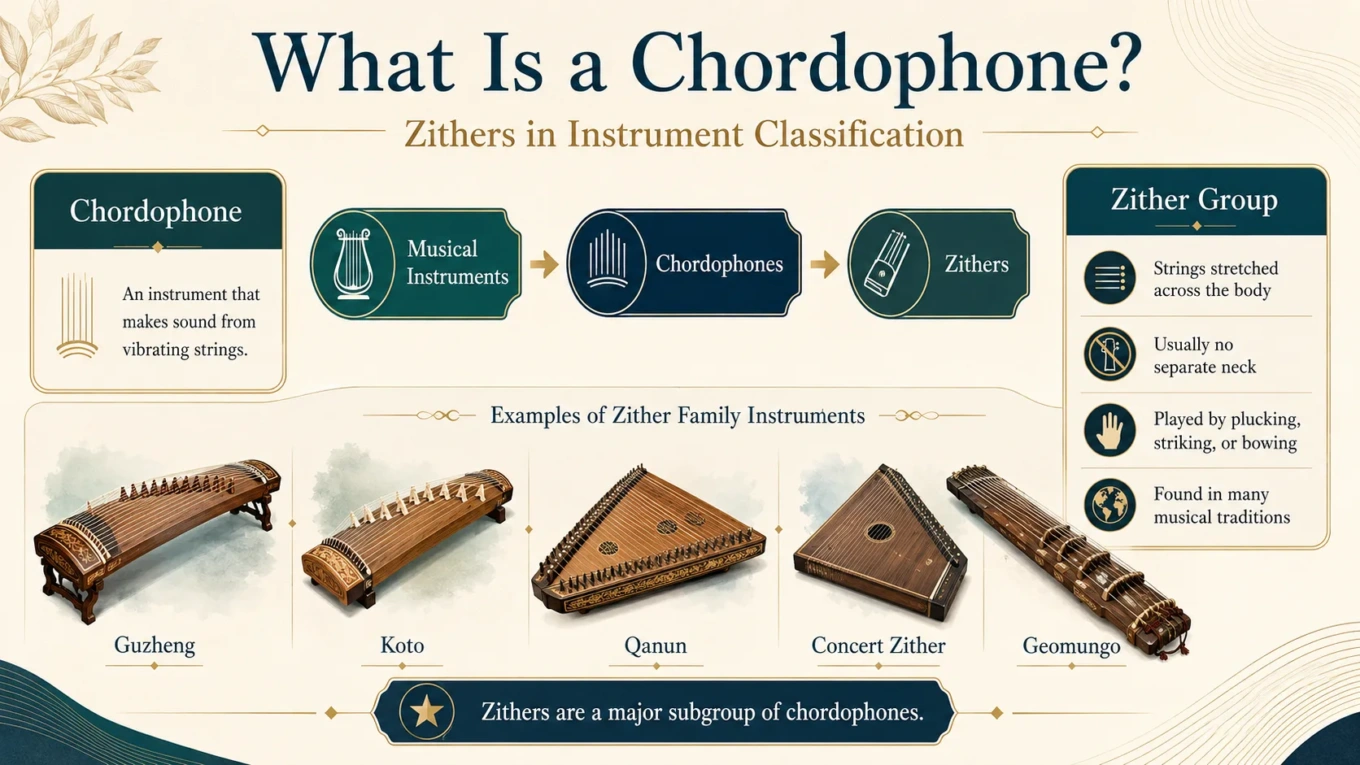
What Is a Chordophone? Zithers in Instrument Classification
A chordophone[1] is any musical instrument whose sound begins with a stretched string. A zither[2] belongs inside that family, but it occupies a special place: its strings are carried by a body, board, tube, box, trough, or frame rather than by a separate neck like a lute or guitar. That one detail explains why organologists classify many very different-looking instruments as zithers.
The word chordophone does not describe a musical style, a region, or a playing method. It describes how the instrument makes sound. If a string is stretched between fixed points and the vibrating string supplies the primary sound, the instrument can be described as a chordophone.
The word zither is narrower in everyday use and wider in classification. In casual English, it often means a European concert zither or Alpine zither. In organology[3], it can also describe a broad family of string instruments in which the strings lie across, along, or over the instrument’s own string bearer[4].
What a Chordophone Means in Instrument Classification
A chordophone is defined by sound production. The string is placed under tension, then set into motion by plucking, striking, bowing, rubbing, or another action. The vibrating string produces the tone; the body of the instrument shapes and carries that sound.
This is why chordophone classification can group together instruments that do not look similar on stage. A violin, harp, qanun, koto, santur, guzheng, autoharp, and concert zither can all be chordophones, even though their shape, playing position, and musical use differ widely.
| Classification Term | Meaning | How It Relates to Zithers |
|---|---|---|
| Chordophone | An instrument whose main sound comes from stretched vibrating strings. | Zithers are chordophones because their strings supply the primary tone. |
| Simple Chordophone | A string instrument built around a string bearer, with any resonator not treated as the defining structural part. | Many zithers fit here because the strings run on or over a board, box, tube, trough, or frame. |
| Composite Chordophone | A string instrument in which the resonating body and string support form a more integrated structure. | Lutes, guitars, violins, and harps are usually discussed here rather than as zithers. |
| Zither | A chordophone in which the strings are stretched over, across, or along the instrument body or support. | This category includes several forms, from board zithers to box zithers and movable-bridge East Asian zithers. |
Classification Note: A zither is not defined by one sound, one country, one tuning, or one number of strings. It is defined mainly by the relationship between the strings and the body that carries them.
Why Zithers Are Chordophones
Zithers are chordophones because their tone comes from strings under tension. The resonator[5], soundboard[6], bridges, and materials may color the sound, but the string remains the starting point.
The zither family is especially useful for understanding classification because it breaks the habit of seeing “string instrument” as only a guitar-like or violin-like object. A zither may have no neck. It may have no fingerboard. It may rest on a table, sit across the player’s lap, lie flat on a stand, or be built as a long board with movable bridges.
That broad structure explains why instruments such as guzheng, koto, gayageum, đàn tranh, kantele, gusli, qanun, psaltery, santur, hammered dulcimer, autoharp, and concert zither can be discussed near one another in classification. They are not the same instrument. They are related by string placement and body logic.
The Zither Idea: Strings Carried by the Body
The central zither idea is simple: the strings are carried by the instrument itself. In a guitar or violin, the strings run from a body to a neck. In many zithers, the playing length sits directly over the body, board, tube, box, trough, or frame.
This does not mean all zithers look flat. Some are long and slightly curved. Some are box-shaped. Some are narrow boards. Some have raised bridges. Some use frets. Some have chord bars or dampers. The shared feature is not outline; it is string layout.
Simple Chordophones and Zithers
In the Hornbostel-Sachs classification system, many zithers are placed under simple chordophones[7]. The word simple here can be misleading. It does not mean the music is easy, the construction is plain, or the tradition is less developed. It means the classification focuses on a string-bearing structure rather than a neck-and-body arrangement.
A simple chordophone can still be refined, decorated, difficult to tune, and musically demanding. A concert zither, guqin, qanun, or santur may require long study, careful setup, and sensitive touch.
Composite Chordophones and Why They Differ
Composite chordophones[8] include many instruments in which the string support and resonating body form a more unified neck, body, yoke, or frame design. Lutes and guitars are familiar examples. Their strings pass over a neck and body in a way that differs from the usual zither layout.
This distinction helps explain why a guitar is not normally called a zither, even though it is a chordophone. It also explains why a zither can be a chordophone without looking like the bowed and plucked string instruments most people first imagine.
Main Zither Forms Inside the Chordophone Family
Zither classification becomes clearer when the body form is named. The terms below describe construction, not musical quality. They also overlap with regional naming, museum cataloging, and craft traditions.
Board Zithers
A board zither[9] uses a board-like support for the strings. Some forms are plain and narrow; others are wide, long, and carefully shaped. The board may act as part of the resonating structure, or it may need a separate resonating space to project strongly.
Many East Asian long zithers are often discussed through the board-zither idea, although their individual traditions have their own names, tunings, playing techniques, and histories. Guzheng, koto, gayageum, and đàn tranh should not be treated as interchangeable labels.
Box Zithers
A box zither[10] has a hollow body that helps amplify the strings. Concert zithers, psalteries, autoharps, and many regional European zithers are often described through this shape. The box may be shallow or deep, plain or ornate, and its internal bracing can affect sustain and response.
In a box zither, the upper surface often serves as a soundboard. Wood choice, thickness, bracing, and bridge pressure can shape resonance, though exact sound depends on the whole build rather than one material alone.
Tube, Trough, and Frame Zithers
A tube zither[11] carries strings along a tube-like body. Some examples use plant materials such as bamboo or cane in documented traditions. A trough zither[12] places the strings across or over a hollowed trough form. A frame zither[13] stretches strings across a frame rather than over a closed box.
These categories show why the zither family cannot be reduced to one modern tabletop instrument. Museum cataloging often pays close attention to body shape because it helps separate similar string layouts from different regional forms.
How Bridges, Frets, and Strings Shape the Classification
Many zithers use a bridge[14] to transfer string vibration into the body. Some have one or more fixed bridges. Others use movable bridges[15] that define string length, pitch area, and playing response.
Movable bridges are a familiar feature in several East Asian long zithers, but each tradition handles setup, tuning, ornamentation, and right-hand or left-hand technique in its own way. A movable bridge is a structural clue, not a complete identity.
Some zithers include fretted strings[16], while others rely on open strings[17]. A concert zither may combine melody strings over a fretted fingerboard area with open accompaniment strings. Other zithers may use open strings almost entirely, with pitch changed by tuning, bridge placement, pressure, or selective damping.
Luthier’s Note: On many zithers, the bridge does more than hold the string up. It helps set speaking length, transfers vibration, and affects touch. Small changes in bridge position or pressure can alter tuning stability and response.
Chordophones Are Classified by Sound Source, Not by Playing Method
A zither may be plucked, struck, bowed, strummed, or played with mechanical assistance. That does not remove it from the chordophone family. The playing method describes how the string is set into motion; chordophone classification describes what vibrates to make the sound.
This is why the santur and hammered dulcimer can be discussed as struck zithers, while the qanun is usually described as a plucked zither. A concert zither may use fingers and fingerpicks. An autoharp uses chord bars that damp selected strings. These playing methods are different, but the sound source is still the string.
Plucked Zithers
Plucked zithers are played with bare fingers, nails, fingerpicks, or a plectrum[18]. Qanun, guzheng, koto, gayageum, đàn tranh, kantele, gusli, and many psalteries may be discussed in this area, depending on the regional form and playing tradition.
Struck Zithers
Struck zithers are sounded by hammers[19] or beaters. Santur and hammered dulcimer are common examples. Their classification can cause confusion because the player’s motion looks percussive, yet the vibrating source remains the string.
Fretted and Unfretted Zithers
Some zithers allow the player to shorten a string against frets or a fingerboard area. Others use fixed open strings, movable bridges, or pressure techniques. A fretted zither and an unfretted zither may belong to the same broad family while requiring very different hand skills.
Why “Zither” Can Mean Two Different Things
The word zither has two common uses. The first is a narrow everyday use: a European zither, often the concert or Alpine type, with melody strings and open accompaniment strings. The second is the broader organological use: a class of chordophones where strings are carried by the body or support.
Both uses are valid in the right setting. Confusion starts when one meaning is used as if it were the only one. A person asking about “the zither” may mean a concert zither. A museum label using “zither” may mean a structural family that includes many regional instruments.
| Use | Meaning | Example Context |
|---|---|---|
| Narrow musical use | A specific European zither type, often with fretted melody strings and open accompaniment strings. | Concert zither, Alpine zither, teaching books, regional performance. |
| Broad classification use | A chordophone type where strings are stretched across, along, or over the instrument body or support. | Museum catalogs, organology, instrument family descriptions. |
| Loose popular use | A flat or tabletop string instrument whose exact type may not be named. | General music writing, casual descriptions, older travel accounts. |
Where Zithers Differ from Lutes, Harps, and Dulcimers
Zithers are not simply “any string instrument.” Their classification depends on how the strings relate to the body.
- Zither and lute: A lute-type instrument usually has a neck or handle connected to a resonating body. A zither normally carries its strings across, along, or over its body or string support.
- Zither and harp: A harp has strings that run in a different geometric relationship to its neck, resonator, and frame. A zither usually presents the strings over the body or support surface.
- Zither and dulcimer: Some dulcimers are classed as zithers, especially hammered dulcimers. The word dulcimer can also point to regional names and playing styles, so it should not be treated as a perfect synonym for zither.
- Zither and autoharp: An autoharp is commonly understood as a chorded zither. Its chord bars damp unwanted strings, which gives it a playing logic different from many open-string zithers.
These distinctions help protect the individuality of each instrument. A guqin is not a koto. A qanun is not a santur. A concert zither is not an autoharp. Classification shows family relation, not sameness.
String Layout: Melody, Drone, and Courses
Many zithers use more than one type of string function. A melody string[20] may carry the main tune. A drone string[21] may sustain a repeated pitch or tonal center. Other strings may provide accompaniment, resonance, or harmonic support.
Some zithers use courses[22], where two or more strings are tuned together or treated as one musical unit. This can add volume, shimmer, and density to the tone, though the exact effect depends on tuning and construction.
Not every zither has drones, courses, or a separate melody area. The family is too broad for a single rule. A better approach is to ask how the strings are arranged, how they are tuned, and how the player selects or changes pitch.
Materials, Resonance, and the Body’s Role
The chordophone label starts with the string, but the body matters. A vibrating string by itself is quiet. The instrument body helps carry that vibration into the surrounding air.
In many wooden zithers, the soundboard receives energy from the bridge and spreads the vibration across a wider surface. The lower body, internal air space, braces, or frame can affect projection and sustain. Wood choice can shape resonance, but it works with thickness, age, bracing, finish, bridge design, and string tension.
Some zithers use metal strings, others use gut, silk, nylon, fluorocarbon, or other materials depending on tradition and modern setup. String material affects feel, tuning behavior, brightness, sustain, and touch. No single material defines the whole family.
Listening Note: Zither timbre[23] often reveals the instrument’s structure. A box zither may sound compact and focused, a long movable-bridge zither may offer bending and ornamented sustain, and a struck zither may produce a clear attack followed by ringing decay.
How Museums and Researchers Describe Zithers
Museum records often describe a zither by structure first: board, box, tube, trough, frame, fretted, plucked, struck, or with movable bridges. They may also include region, maker, date, materials, string count, decoration, and playing method.
This method helps avoid vague labels. A catalog entry that says “zither” alone may be useful, but a fuller description tells more: whether the instrument has a hollow box, whether the strings pass over individual bridges, whether frets are present, whether the soundboard is wood, and whether the instrument was made for solo, ensemble, teaching, ritual, court, domestic, or folk use.
Classification does not replace cultural names. It supports them. The local name gives identity and context; the chordophone and zither labels help compare structure across instrument families.
Common Classification Mistakes
Several misunderstandings appear often when chordophones and zithers are discussed.
- Calling every string instrument a zither: All zithers are chordophones, but not all chordophones are zithers.
- Treating zither as one instrument only: The word can mean a specific European instrument or a wider classification group.
- Using playing method as the family label: Plucked, struck, and bowed describe action, not the whole classification.
- Assuming one string count: Zithers vary widely in number of strings, depending on type, region, and maker.
- Merging related instruments: Guzheng, koto, gayageum, qanun, santur, psaltery, and autoharp have different structures and musical languages.
Why This Classification Matters for Zithers
Chordophone classification gives a clean way to understand the zither family without flattening its variety. It explains why a flat European concert zither, a long East Asian movable-bridge zither, a plucked Middle Eastern qanun, and a struck santur can all sit near one another in instrument classification while remaining separate instruments.
For learners, the classification helps with vocabulary. For makers, it points to structure. For collectors, it supports careful identification. For listeners, it explains why related instruments can share a string-based sound source yet differ in attack, sustain, pitch control, and resonance.
Glossary of Technical Terms
- Chordophone
- A musical instrument whose main sound comes from stretched vibrating strings. Zithers, lutes, harps, bowed strings, and many other string instruments belong to this broad sound-producing family.
- Zither
- A chordophone in which the strings are stretched across, along, or over the body or string support. In everyday use, the word may also refer more narrowly to the European concert zither.
- Organology
- The study and classification of musical instruments. In zither studies, organology helps describe structure, sound source, materials, and playing method without reducing every instrument to one regional name.
- String Bearer
- The part of an instrument that supports the strings under tension. In many zithers, the body, board, tube, box, trough, or frame acts as the string bearer.
- Resonator
- A body or chamber that helps strengthen and carry the sound made by the strings. In zithers, the resonator may be a box, hollow tube, trough, or another attached or built-in structure.
- Soundboard
- A vibrating surface that helps project string sound. On many box zithers, the upper wooden surface acts as the soundboard and receives vibration through the bridge.
- Simple Chordophone
- A classification term for instruments built around a string bearer. Many zithers are placed here, though the term does not mean the instrument is musically or technically easy.
- Composite Chordophone
- A chordophone in which the string support and resonating body form a more integrated structure, such as in many lutes, guitars, violins, and harps. This contrasts with many zither layouts.
- Board Zither
- A zither whose strings are carried by a board-like support. The board may be plain, shaped, hollowed, or paired with other resonating features depending on the instrument type.
- Box Zither
- A zither with a hollow box body that helps amplify the strings. Concert zithers, psalteries, and autoharps are often discussed through this structural idea.
- Tube Zither
- A zither whose string bearer has a tube-like form. Some documented forms use natural tube materials, though construction varies by region and maker.
- Trough Zither
- A zither in which the body has a hollowed trough-like shape. The strings are stretched across or along this structure, and the hollow form can help shape resonance.
- Frame Zither
- A zither with strings stretched across a frame. The frame supports string tension, and a resonator may or may not be present depending on the type.
- Bridge
- A part that supports the string and transfers vibration into the body or soundboard. On zithers, bridge shape and placement can affect pitch, response, and tone.
- Movable Bridge
- A bridge that can be repositioned to adjust string length, pitch area, or setup. Movable bridges are found in several long zither traditions, but each instrument uses them differently.
- Fretted String
- A string whose pitch can be changed by pressing it against frets or a fingerboard area. Some concert zithers use fretted melody strings alongside open accompaniment strings.
- Open String
- A string played without being stopped against a fret or fingerboard. Many zithers rely heavily on open strings, with pitch organized through tuning, bridge placement, or string selection.
- Plectrum
- A small pick used to pluck strings. Some zithers are played with a plectrum, while others use bare fingers, nails, fingerpicks, or mixed techniques.
- Hammers
- Small beaters used to strike strings. In struck zithers such as santur and hammered dulcimer, hammers set the strings into vibration rather than plucking them.
- Melody String
- A string used mainly to carry the tune or lead line. In some zithers, melody strings are separated from accompaniment or drone strings by layout and playing technique.
- Drone String
- A string tuned to provide a repeated or sustained pitch foundation. Not all zithers use drone strings, but they appear in several string traditions.
- Course
- A group of two or more strings treated as one musical unit. Courses can add volume and texture when the strings are tuned together or near one another.
- Timbre
- The tone color or sound character of an instrument. In zithers, timbre is shaped by strings, bridges, body form, materials, tuning, and playing method.
FAQ
Is a zither a chordophone?
Yes. A zither is a chordophone because its sound begins with vibrating strings stretched under tension. The zither label adds more detail by describing how those strings are carried by the instrument body or support.
Are all chordophones zithers?
No. All zithers are chordophones, but many chordophones are not zithers. Guitars, violins, harps, and lutes are chordophones, but their structure differs from the usual zither layout.
Why is a zither called a simple chordophone?
In classification, simple chordophone refers to the way the strings are supported by a string bearer. It does not mean the instrument is plain, easy to play, or musically limited.
Is a guzheng a type of zither?
Yes, guzheng is commonly described as a Chinese zither, more specifically a long plucked zither with movable bridges. It should still be understood as its own instrument, not as a generic version of every zither.
Is a dulcimer a zither?
Some dulcimers, especially hammered dulcimers, are often classified as zithers because their strings are stretched over a body and struck with hammers. The word dulcimer also carries regional and historical meanings, so context matters.
Does every zither have frets?
No. Some zithers have fretted strings, but many do not. Others use open strings, movable bridges, tuning systems, or pressure techniques to shape pitch and musical expression.