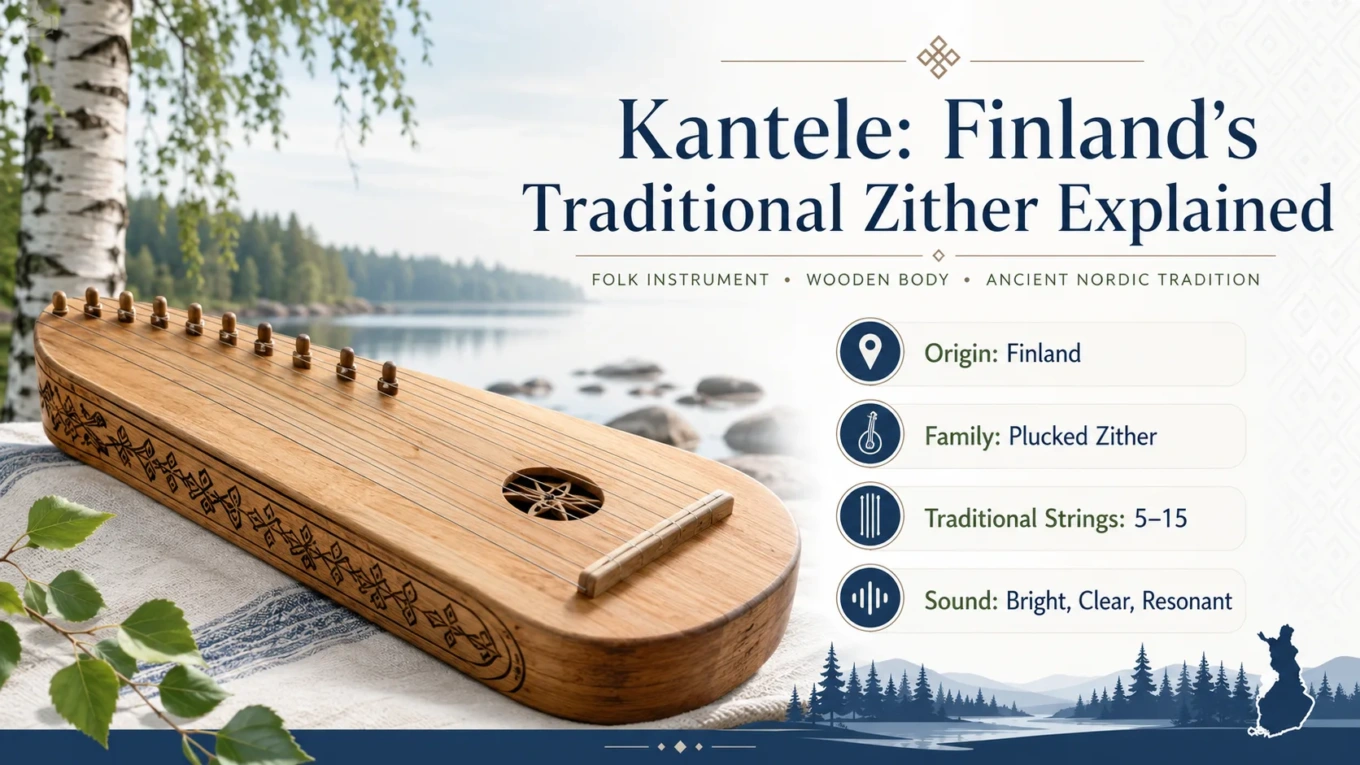
Kantele: Finland’s Traditional Zither Explained
The kantele is a Finnish and Karelian plucked zither[1] with a clear identity of its own: strings run across a wooden body, each string gives a set pitch, and the player shapes melody, chord, and ringing sustain directly with the fingers. It belongs to the wider chordophone[2] family and, more narrowly, to the Baltic psaltery[3] group. That makes it a relative of instruments such as the Estonian kannel, Latvian kokles, Lithuanian kanklės, and some forms of gusli, but not a copy of any of them.
The word kantele can name a small five-string folk instrument, a larger village or ensemble instrument, a modern concert instrument, or an electric version used in composed and experimental music. The family is broad, so a careful explanation starts with one simple point: the kantele is not only one fixed object. It is a group of related Finnish and Karelian zithers that share a playing logic but differ in size, string count, shape, tuning, and musical use.
Small kanteles are often held in the lap or placed on a table. Concert kanteles are larger, built for a wide pitch range, and may include levers or dampers. Older documented forms may have only five or six strings and a body hollowed from a single piece of wood; many later instruments use metal strings and bodies assembled from several pieces. The change is not merely cosmetic. It affects volume, sustain, tuning range, and the kind of music the instrument can support.
Classification Note: In a broad organological sense, the kantele is a zither because its strings are stretched over the same body that helps the sound resonate. In a cultural sense, it is one of Finland’s best-known traditional instruments and a close member of the Baltic psaltery family, not a harp, guitar, or dulcimer in everyday playing logic.
Main Details Worth Knowing
| Feature | What It Means for the Kantele |
|---|---|
| Instrument family | Plucked zither within the broader chordophone group. |
| Regional identity | Strongly associated with Finland and Karelia, with close relatives around the Baltic region. |
| Common string counts | Small models may have 5, 10, 11, or 15 strings; larger concert models often reach about 39 or 40 strings, depending on maker and design. |
| Body type | A shallow wooden soundbox[4], either carved from one piece in some older and small forms or assembled from separate wooden parts in many later instruments. |
| Pitch layout | Often diatonic in small and many folk models; concert models use mechanisms to reach more chromatic notes. |
| Playing method | Usually plucked, strummed, or muted with the fingers; some contemporary techniques use other tools or extended sounds. |
| Common confusion | The kantele is sometimes called a lap harp in English, but its construction and string-to-body relationship make it a zither. |
What Makes a Kantele a Zither?
A kantele is a zither because the strings lie across a resonating body rather than rising from a neck or separate frame. On a guitar or lute, a player changes pitch by stopping a string against a neck. On a kantele, each string normally gives one pitch, and the pitch is set by tuning, string length, and string tension.
The kantele body acts as both structure and resonator. Its soundboard[5] receives vibration from the strings and helps spread the sound into the surrounding air. This is one reason even a small five-string kantele can sound clear and bell-like when played with a light touch.
Unlike a fretted zither, the kantele does not rely on frets for melody. Unlike a hammered dulcimer or santur, it is not normally struck with hammers in its traditional playing. Unlike a harp, its strings do not rise from a tall frame. The family resemblance to those instruments is real, but the playing layout is different.
Names, Region, and Cultural Setting
The Finnish word is kantele. In English, the plural is often written as kanteles, while Finnish grammar uses its own forms. Related Baltic instruments carry different names: kannel in Estonia, kokles in Latvia, kanklės in Lithuania, and several related regional names in nearby traditions. These names should not be treated as interchangeable labels for the same instrument.
In Finland, the kantele is widely recognized as a national instrument and appears in education, folk practice, art music, and cultural memory. It is also associated with Karelian song tradition and with the poetic material later collected into the Kalevala. Mythic stories about the instrument carry symbolic weight, but the practical instrument belongs to living musical practice, craft, and teaching.
Because English speakers sometimes see “lap harp” as a friendly shorthand, the phrase can help beginners picture the playing position. It should not replace the more accurate classification. A kantele is not built like a harp; it is a zither with strings running across a body.
Construction: Body, Strings, and Sound Path
The kantele’s form looks simple at first: a shallow wooden body, a row of strings, tuning pins[6], and a playing surface. Closer inspection shows why small changes matter. Body depth, wood thickness, string length, anchoring angle, and surface stiffness all help shape the response.
Many small kanteles use open strings[7], meaning the strings are not stopped against a fingerboard while sounding. A five-string kantele may look easy because it has few strings, but its clarity depends on touch, muting, and the balance between resonance and silence.
Carved and Built Bodies
Older small forms are often described as hollowed from a single block of wood. In that type, the maker removes material to create the resonating chamber while leaving enough strength for the string tension. Later and larger kanteles are commonly built from separate pieces, allowing greater control over size, shape, and soundboard behavior.
Wood choice varies by maker and region. Maple and alder are often mentioned for small Finnish instruments, while other resonant woods may appear in modern workshop practice. Wood can shape attack, decay, and resonance, but no single species guarantees one fixed sound. Craft, dimensions, stringing, and setup matter as much as the name of the wood.
String Materials
Historical descriptions often mention horsehair strings on early small kanteles. Modern small and concert kanteles more commonly use steel or other metal strings. The change from organic to metal stringing affects brightness, tension, durability, and projection.
Metal strings usually offer a clearer attack and longer sustain. Horsehair-style reconstruction or experimental stringing may offer a softer response, but it belongs to specialist practice rather than the most common beginner setup.
The Traditional Varras and Ponsi System
One construction detail often missed in casual descriptions is that traditional small kanteles may have no separate bridge and no nut. Instead, the strings can run from tuning pins to a metal bar called the varras[8], supported by wooden brackets called ponsi[9]. This direct string path is part of the instrument’s particular feel and sound.
Modern instruments may use different hardware, especially larger concert models. For that reason, “the kantele has a bridge” or “the kantele has no bridge” is too broad as a blanket statement. The answer depends on the type being discussed.
Luthier’s Note: A shallow kantele body leaves little room for acoustic correction after construction. The maker must balance string tension, top stiffness, hollowing, and anchoring layout before the instrument ever receives its final tuning.
Small Kantele and Concert Kantele
The kantele family is often easier to understand through two broad groups: small kanteles and concert kanteles. They share a name and family identity, but their musical roles can be quite different.
Small Kantele
A small kantele may have five strings, but 10-, 11-, and 15-string models are also common in teaching and folk settings. These instruments are usually diatonic[10] or close to diatonic, with strings chosen to suit songs, drones, simple harmonies, and accessible ensemble playing.
The five-string model has a special place in Finnish education and beginner learning because it allows a player to make usable musical patterns quickly. That does not make it a toy. A skilled player can use touch, damping, rhythm, and ornament to create a refined sound on a very small instrument.
Concert Kantele
The concert kantele[11] is a much larger instrument designed for wider repertoire, including art music and contemporary composition. Many concert models are built around a broad diatonic layout and use mechanical solutions to reach chromatic[12] notes.
These instruments may have around 39 or 40 strings, depending on design. They often include semitone levers[13] that raise selected pitches, giving access to sharps, flats, and enharmonic choices without fully retuning the instrument. Some models also use a damper board[14] to control sustain across many ringing strings.
The playing position can differ as well. On many small kanteles, the longest and lowest strings sit farther from the body of the player. On concert kanteles, the orientation is often reversed, placing the longer bass strings nearer to the player. This affects hand layout, technique, and reading habits.
Tuning and String Layout
Kantele tuning is not one universal formula. The instrument’s tuning depends on size, repertoire, regional habit, teacher, and maker. Small five-string kanteles are often taught in major or minor pentachord patterns, and many players retune them to fit song material.
A drone string[15] may support a tonal center while the other strings carry melody or chord tones. On larger small kanteles, melody strings[16] give more stepwise movement and a wider song range. Some instruments include levers on selected strings so the player can shift between common modes without changing every tuning pin.
The common beginner error is to think of the kantele as a tiny piano laid flat. It is better understood as a ringing field of selected pitches. The player chooses which strings to let speak, which strings to mute, and how long each tone should live.
Why String Count Changes the Music
Five strings invite pattern, drone, and direct touch. Ten to fifteen strings open more melodic range and chord color while staying manageable for beginners. Concert instruments offer a much wider range, but they also require more advanced damping, tuning control, and hand independence.
More strings do not automatically mean a better kantele. They mean a different instrument with different demands.
How the Kantele Is Played
The kantele is usually played by plucking or strumming the strings with the fingers. Small kanteles can be played in the lap, on a table, or on another stable surface. Larger instruments need a table, stand, or dedicated playing position.
One common small-kantele approach is to strum across several strings while muting the ones that should not ring. Another approach plucks individual strings for melody and simple accompaniment. The instrument rewards clean release as much as clean attack; silence is part of the technique.
Finger Movement and Damping
Because open strings continue to ring, the player must manage sustain. Damping can stop a string, clarify rhythm, or prevent overlapping harmonies from becoming muddy. On small kanteles, the hands may alternate between sounding and silencing. On concert kanteles, damping becomes a larger part of the player’s technique because many strings can resonate at once.
Some contemporary performers also use harmonics[17], mallets, e-bow effects, scraping, prepared-string textures, or other extended techniques. These sounds belong to modern performance practice and should not be confused with the basic folk technique taught to beginners.
Sound, Resonance, and Listening Cues
The kantele is often described as clear, bell-like, and ringing. Those words are useful, but they do not tell the whole story. A small five-string kantele can sound intimate and dry when lightly touched, while a larger concert kantele can produce a long wash of resonance[18] that needs careful damping.
Timbre[19] changes with string material, body size, playing position, nail or fingertip contact, room acoustics, and muting. A metal-strung kantele may have a bright attack. A deeper body may support a fuller decay. A very shallow body may give a leaner, quicker response.
Listening Note: When hearing a kantele, listen for the space after the pluck. The tone does not simply start and stop; it blooms, overlaps, or is cut short by the player’s hand. That control of ringing sound is central to the instrument’s character.
How It Differs from Related Instruments
The kantele sits near several familiar instrument names, but careful comparison prevents confusion.
- Kantele and harp: A harp has strings rising from a frame. A kantele has strings stretched across a body, so “lap harp” is a loose English description rather than a precise classification.
- Kantele and dulcimer: Some dulcimers are also zithers, but hammered dulcimers are struck with hammers, while the kantele is normally plucked or strummed.
- Kantele and psaltery: The kantele belongs to the Baltic psaltery group, but the general word “psaltery” covers many historic and regional instruments.
- Kantele and gusli: Some gusli types share a Baltic or eastern European zither family resemblance, but regional construction, naming, repertoire, and technique differ.
- Kantele and autoharp: Both can be classed as zithers in a broad sense, but the autoharp uses chord bars and a different accompaniment logic.
Musical Role in Finland and Karelia
The kantele has served many musical settings: home music, song accompaniment, folk ensemble playing, children’s music education, solo performance, chamber music, and modern composition. Its role has changed with instrument design. A five-string kantele suits modal songs, drones, and improvisatory textures; a concert kantele can handle larger arrangements, chromatic movement, and notated concert repertoire.
Older poetic and song traditions often place the kantele near voice, story, and memory. Later national art and education helped make the instrument a public symbol. Today, the same family can appear in folk groups, music schools, classical training, experimental performance, and electric amplified settings.
What Beginners Should Know
A five-string kantele is one of the most approachable traditional zithers for a new player. It has few strings, clear tuning, and a direct physical layout. A beginner can learn simple melodies, drones, and strummed patterns quickly.
The ease of starting should not hide the depth of the instrument. Advanced playing depends on touch, timing, damping, tuning awareness, and control of sustain. Moving from a five-string kantele to a 10-, 15-, or concert model is not just a matter of adding notes. It changes the way the player organizes the hands.
Choosing a First Kantele
For a first instrument, the most practical choice is usually a stable small kantele with reliable tuning pins, clean string spacing, and a comfortable body edge. A five-string model is suited to first lessons and folk-style exploration. A 10- or 15-string model gives more range but asks for more tuning and hand control.
Large concert kanteles are specialized instruments. They belong to serious study, performance, or advanced repertoire rather than casual first contact.
Care, Tuning, and Handling
A kantele should be kept away from harsh humidity swings, direct heat, and rough handling. The shallow wooden body can respond to dry air, and metal strings can lose tuning as the environment changes. Gentle, regular tuning is safer than large sudden turns.
When tuning, the player should always confirm the sounding string before turning a pin. Small movements matter. Over-tightening can break a string or stress the instrument.
Collector’s Note: Older kanteles should be inspected as musical objects, not only as decorative folk items. Check the body for cracks, loose hardware, replaced strings, warped surfaces, and signs that modern string tension may not suit the original construction.
Common Misunderstandings About the Kantele
It Is Not One Standard Instrument
A five-string kantele and a concert kantele can both be correct examples of the family, even though they look and behave differently. The name covers a range of forms.
It Is Not Simply a Small Harp
The lap position can make the kantele look harp-like to newcomers, but the structure is different. The zither layout is the more accurate way to understand it.
It Does Not Always Have the Same Number of Strings
String count varies by type and maker. Five strings are iconic for small kanteles, but 10-, 11-, 15-, 36-, 39-, and 40-string instruments also appear in modern and historic discussions.
It Is Not Limited to Folk Music
The kantele has a strong folk identity, but it is also used in classical study, chamber music, contemporary composition, improvisation, and electric performance.
FAQ
Is the kantele a type of zither?
Yes. The kantele is a plucked zither because its strings run across a resonating body rather than from a separate neck or harp frame. It is also part of the Baltic psaltery group.
Is the kantele Finnish or Karelian?
The kantele is strongly associated with Finland and Karelia. It is widely recognized as Finland’s national instrument, while Karelian traditions are also central to its history and musical identity.
How many strings does a kantele have?
There is no single number. Small kanteles may have 5, 10, 11, or 15 strings, while modern concert kanteles often have about 39 or 40 strings depending on the maker and model.
Is a kantele the same as a harp?
No. English speakers sometimes call it a lap harp, but the kantele is structurally a zither. Its strings lie across the resonating body instead of rising from a harp frame.
Is the kantele easy to learn?
A five-string kantele is approachable for beginners because the layout is simple and the tuning can support immediate musical patterns. More advanced playing still requires careful damping, timing, and tuning control.
Does every kantele have levers?
No. Many small kanteles have no levers, while some modern small instruments and many concert kanteles use levers to change selected pitches without full retuning.
Glossary of Technical Terms
[1] Plucked Zither
A zither whose strings are sounded by the fingers, nails, or a small plectrum rather than by a bow or hammer. In the kantele family, plucking and strumming are the usual sound-making actions.
[2] Chordophone
A musical instrument that produces sound mainly through vibrating strings. The kantele is a chordophone because the strings, not a reed, membrane, or air column, create the primary sound.
[3] Baltic Psaltery
A regional group of plucked zithers found around the Baltic area. The Finnish and Karelian kantele belongs to this group alongside related instruments with local names and traditions.
[4] Soundbox
The hollow body that helps amplify and color the vibration of the strings. On a kantele, the soundbox is usually shallow, so its size and stiffness have a direct effect on response.
[5] Soundboard
The vibrating surface that receives energy from the strings and helps radiate sound. In a kantele, the soundboard is part of the same body over which the strings are stretched.
[6] Tuning Pins
Metal pins used to adjust string tension and pitch. On a kantele, small turns can make clear pitch changes, so tuning needs careful movement and listening.
[7] Open Strings
Strings that sound without being stopped against a fingerboard or fret. Most kantele playing relies on open strings, with the player choosing which strings to sound or mute.
[8] Varras
A metal bar used in some traditional kantele construction as the string anchor at one end. It helps define the direct string path found on older small forms.
[9] Ponsi
Wooden supports or brackets associated with the varras in traditional kantele construction. They help hold the anchoring bar in place within the body design.
[10] Diatonic
A pitch layout based mainly on the notes of a scale rather than all twelve chromatic notes. Many small kanteles use diatonic layouts suited to songs, drones, and simple harmonies.
[11] Concert Kantele
A larger kantele designed for extended range and advanced repertoire. It often uses many strings, levers, and damping systems to support concert performance.
[12] Chromatic
A pitch system that can include the semitone steps between diatonic notes. Concert kanteles may use levers to reach chromatic notes without rebuilding the basic string layout.
[13] Semitone Levers
Hand-operated mechanisms that raise a string’s pitch, usually by a half step. On modern kanteles, these levers help the player change scale material without retuning every string.
[14] Damper Board
A device on some larger kanteles that helps stop many strings from ringing. It gives the player more control over sustain, especially on concert instruments with many strings.
[15] Drone String
A string used to sustain or repeat a tonal center while melody or rhythm moves around it. In small-kantele playing, a drone can support modal or song-based patterns.
[16] Melody Strings
Strings used mainly to carry tune notes rather than only drone or chord support. Larger small kanteles give players more melody strings and therefore more pitch range.
[17] Harmonics
High, clear tones made by lightly touching a vibrating string at certain points. Contemporary kantele players may use harmonics for color beyond basic plucked notes.
[18] Resonance
The way the body and strings continue and shape vibration after a note is sounded. Kantele resonance can be short and intimate on a small instrument or long and layered on a concert model.
[19] Timbre
The tone color of a sound: bright, soft, glassy, dry, warm, or ringing. On the kantele, timbre depends on string material, body design, touch, damping, and room acoustics.