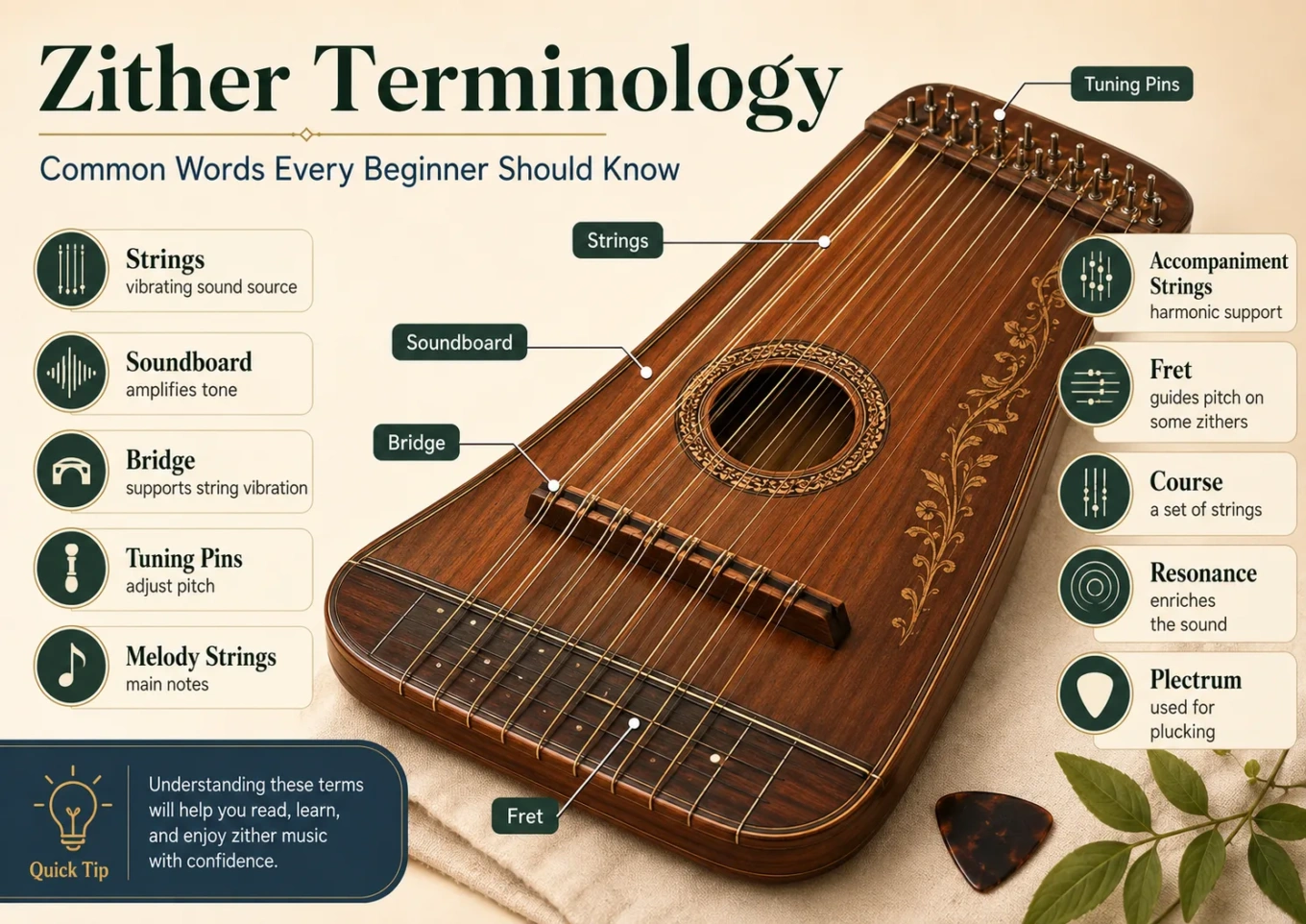
Zither Terminology: Common Words Every Beginner Should Know
Zither terminology can feel confusing because the word zither is used in two ways: narrowly for some European instruments such as the concert zither, and broadly for a large family of string instruments whose strings run across, along, or over a body without a separate neck. Beginner-friendly words like string, bridge, and tuning become more useful when they are understood in the wider zither family, where a guzheng, koto, kantele, qanun, santur, psaltery, autoharp, and concert zither may share family traits but differ sharply in construction and playing logic.
Zither Terminology and Why It Matters
Zither terminology helps beginners describe what they are seeing, hearing, tuning, or comparing. It also prevents one common mistake: treating every zither-like instrument as if it works the same way.
A zither is usually discussed as a chordophone[1], meaning a musical instrument that produces sound through vibrating strings. In organology[2], many zithers are described as instruments where the strings are supported by a body, board, tube, box, frame, or trough rather than by a neck like a guitar or violin. This broad definition is useful, but it needs care. A concert zither, guzheng, koto, guqin, gayageum, qanun, santur, and autoharp do not share one single playing method.
The terms below focus on words that beginners meet early: classification words, parts of the instrument, string layout, tuning language, playing technique, and sound description. They are practical words, not decorative labels.
Classification Note: The word zither may name a single instrument in everyday speech, especially the European concert zither. In museum, organology, and instrument-family writing, it can also name a broader group of instruments in which strings are stretched over a string-bearing body.
Main Terms Beginners Meet First
The table gives a plain starting point. Later sections explain how these words behave differently across zither types.
| Term | Plain Meaning | Why It Matters |
|---|---|---|
| Chordophone | A string instrument that makes sound from vibrating strings. | Places zithers within a larger instrument family. |
| String Bearer | The part that holds or supports the strings. | Helps separate zithers from necked lutes such as guitars. |
| Soundboard | The vibrating top or surface that helps project sound. | Shapes volume, response, and playing feel. |
| Bridge | A support that transfers string vibration to the body. | May be fixed, movable, individual, or shared across strings. |
| Open String | A string sounded without being stopped by a finger or fret. | Many zithers rely heavily on open-string tuning. |
| Course | One string or a group of strings treated as one musical unit. | Useful for instruments with paired or grouped strings. |
| Drone | A sustained or repeated pitch that supports the music. | Common in many traditional string settings, though not in every zither. |
| Movable Bridge | A bridge that can be repositioned to adjust pitch or playing layout. | Important for instruments such as guzheng, koto, and related board zithers. |
Words for Instrument Classification
Zither
A zither is a string instrument in which the strings are stretched over, across, or along a body that supports them. In broad classification, the body acts as a string bearer[3]. This is why many different instruments can be discussed as part of the zither family even when their music, shape, and playing method differ.
In everyday English, zither often points to a European instrument with melody strings over a fretted area and accompaniment strings over the body. In wider musical-instrument study, the same word can also include board zithers, box zithers, tube zithers, trough zithers, raft zithers, and frame zithers. Context decides the meaning.
Simple Zither
A simple zither is a classification term for an instrument where the strings and their bearer form the main sound-producing structure. Some simple zithers have a separate resonator, but the classification depends on the way the strings are carried, not on one fixed outer shape.
This term is useful when comparing a zither with a lute. A lute-type instrument, such as a guitar, has a neck that extends from a resonating body. A zither does not depend on that neck-and-body layout.
Board, Box, Tube, Trough, and Frame Zithers
These words describe the shape of the string-bearing structure.
- Board zither: strings run over a board-like body. Guzheng, koto, gayageum, and đàn tranh are often discussed in this area, though each has its own tradition and construction.
- Box zither: the body is box-shaped and acts as a resonating chamber. Many European zithers and psalteries are described this way.
- Tube zither: the string bearer is tube-like or made from a tube-shaped material in documented regional forms.
- Trough zither: strings stretch over a hollowed or trough-like body.
- Frame zither: strings stretch across a frame rather than a closed box or long board.
These terms are not style labels. They describe structure. Two instruments may both be zithers, yet one may use movable bridges, another may use chord bars, and another may be struck with light hammers.
Words for the Body and Sound-Producing Parts
Soundboard
The soundboard[4] is the surface that receives string vibration through the bridge and helps the instrument speak. On many box and board zithers, the top surface is more than a lid; it is part of the acoustic behavior of the instrument.
Wood choice, thickness, arching, bracing, and age can shape resonance[5], but not in a simple one-wood-equals-one-sound way. Craft, design, string tension, bridge placement, and playing technique also matter.
Resonating Body
The resonating body[6] is the part that helps amplify and color the string sound. In a box zither, it may be the hollow box. In a long board zither, the whole body may support and project the tone. In some forms, an added resonator changes the sound without changing the basic string-bearing idea.
Beginners often think the strings alone make the instrument loud. The strings begin the vibration, but the body helps make that vibration audible and musically shaped.
Bridge
A bridge[7] supports the string and passes vibration into the body. Some zithers use one or more fixed bridges. Others use individual movable bridges, one per string or per string group.
Bridge shape affects more than height. It can affect speaking speed, sustain, brightness, and the way pitch bends respond under the hand. On movable-bridge zithers, the bridge also helps define the playable tuning layout.
Fixed Bridge
A fixed bridge[8] stays in a set position as part of the instrument’s design. It may still be adjusted by a maker or repairer, but the player does not normally move it during regular tuning or playing.
Concert zithers, psalteries, autoharps, and many box zithers use fixed bridge arrangements. The player changes pitch through tuning pins, frets, chord bars, or string choice rather than moving the bridge for every scale layout.
Movable Bridge
A movable bridge[9] can be repositioned to set pitch relationships. Instruments such as guzheng, koto, gayageum, and đàn tranh commonly use movable bridges, though their bridge shapes and playing techniques are not identical.
On these instruments, the bridge divides the string into a speaking section and a non-speaking section. The player may pluck one side and press the other side to bend, shade, or ornament the pitch.
Luthier’s Note: A bridge is not only a support. Its height, mass, contact area, and fit can change how quickly a note speaks and how long it rings. These effects vary by instrument type and construction.
Words for Strings and String Layout
Open String
An open string[10] sounds at its tuned pitch without being shortened by the player’s finger. Many zithers are built around open-string playing. This is why tuning matters so much: the chosen tuning often defines what notes are ready under the hands.
On a guzheng or koto, many melodies use open strings plus bends and ornaments. On a concert zither, the player may combine open accompaniment strings with fretted melody strings. On an autoharp, chord bars mute unwanted strings so the remaining open strings form a chord.
Melody String
A melody string[11] is used mainly to carry the tune. On some instruments, all strings can act as melody strings. On others, the layout separates melody strings from accompaniment strings.
The European concert zither is a clear example: it normally has a fretted melody area and a larger group of open accompaniment strings. Exact string counts and tunings vary by model, period, and maker.
Drone String
A drone string[12] gives a sustained, repeated, or background pitch. It may support a mode, tonal center, or rhythmic pattern. Not every zither uses drones, and the word should not be forced onto every low or open string.
In some traditional settings, drone-like tones help hold the tonal ground while the melody moves. In other zither traditions, accompaniment is built from chords, arpeggios, bass notes, or struck patterns instead.
Course
A course[13] is one string or several strings treated as one musical unit. Some instruments use single-string courses. Others use paired, tripled, or grouped strings tuned in unison or octaves.
This word is useful when reading about psalteries, dulcimers, qanun-family layouts, or historical instruments. A description may say an instrument has a certain number of courses, which may not equal the total number of physical strings.
Unison and Octave
Unison[14] means two or more strings are tuned to the same pitch. An octave[15] means the pitches share the same letter name but one is higher or lower by an octave.
Grouped strings tuned in unison can make a tone feel fuller. Octave pairings can add width and brightness. These choices depend on instrument design and regional practice.
Sympathetic String
A sympathetic string[16] vibrates in response to other played notes rather than being the main plucked or struck string. Sympathetic strings are not present on every zither, but the idea matters in string-instrument study because it explains certain shimmering or halo-like effects.
When present, these strings usually need careful tuning. If they are poorly tuned or damped by dirt, wear, or poor setup, their effect can become weak or uneven.
Words for Frets, Stops, and Pitch Control
Fret
A fret[17] marks or creates a stopping point for the string. When a player presses a string against or behind a fret, the sounding length changes and the pitch rises.
Not every zither has frets. The concert zither has fretted melody strings. The guqin has position markers but no raised frets. Guzheng, koto, gayageum, and đàn tranh usually use bridges and hand pressure rather than a fretted fingerboard.
Fretted String
A fretted string[18] can produce several pitches because the player shortens it at marked positions. This makes it different from an open string that is mainly used at its tuned pitch.
On a concert zither, the fretted melody strings let the right hand play tune material while the other strings provide bass and accompaniment. That layout is one reason the concert zither should not be described as simply a small harp or a generic plucked board.
Stopped String
A stopped string[19] is shortened by the player’s finger or by a mechanical action. The stopped part does not vibrate as the speaking length of the string.
The term appears often in string-instrument writing. It helps explain why a fretted zither can play chromatic melodies with fewer strings than a fretless open-string zither would need for the same pitch range.
Pitch Bend
A pitch bend[20] changes the pitch after the note begins. On several East Asian board zithers, the player plucks one side of the bridge and presses the other side to raise or shape the pitch.
This is not the same as moving a fret or retuning the instrument. It is a playing gesture. The result can be a small expressive lift, a larger bend, or an ornament tied to a specific musical tradition.
Words for Tuning and Pitch Layout
Tuning
Tuning[21] means setting the strings to chosen pitches. On many zithers, tuning is not only maintenance; it is part of the instrument’s musical design.
A fretless open-string zither may need a tuning layout that already contains the notes of a piece, scale, or mode. A fretted zither can use fewer tuned strings for melody because frets create extra pitches. A chord-zither or autoharp-type layout uses tuning together with muting mechanics to form chords.
Scale
A scale[22] is an ordered set of pitches. Beginners often meet this word when learning why a guzheng, koto, or similar instrument may be tuned to a pentatonic pattern for many pieces, while other instruments use diatonic or chromatic layouts.
Scale language should be used with care. A scale name does not describe an entire musical tradition. It only describes one pitch set or a useful teaching layout.
Mode
A mode[23] is a pitch organization with its own tonal center and melodic behavior. In many traditions, mode is not just a row of notes; it also relates to phrase shape, emphasis, ornament, and musical setting.
For beginners, the safest starting point is simple: a mode tells a player which pitch feels like home and which notes carry weight. The deeper details depend on the instrument and the tradition being studied.
Diatonic and Chromatic
Diatonic[24] usually refers to a seven-note scale layout similar to major or minor scale organization. Chromatic[25] means including all twelve semitones in the Western equal-tempered system.
Some zithers are arranged for diatonic playing and require retuning, levers, extra strings, or special technique for chromatic notes. Others have frets, extra courses, or layouts that make chromatic playing more direct. The design matters.
Tuning Pin
A tuning pin[26] anchors a string and lets the player or technician adjust tension. Turning the pin changes the pitch.
Many zithers need a tuning key or wrench. Small movements can make audible changes, especially on short or high-tension strings. Beginners should turn pins slowly and listen often.
Words for Playing Technique
Plucked Zither
A plucked zither[27] is played by pulling and releasing the string with fingers, nails, picks, or plectra. Guzheng, koto, gayageum, đàn tranh, guqin, kantele, qanun, psaltery, autoharp, and concert zither can all involve plucking, though not in the same way.
Plucking angle, nail or pick material, string tension, and hand position affect the sound. A hard attack can make a note brighter. A softer release can make it rounder.
Plectrum
A plectrum[28] is a pick used to pluck a string. It may be held in the hand or worn on the finger, depending on the instrument.
On some instruments, plectrum type is closely tied to the tradition. On others, players choose among different materials for comfort, tone, or learning level.
Fingerpick
A fingerpick[29] is a pick worn on a finger. Concert zither players often use a thumb ring or pick for melody work. Guzheng players may use taped picks on several fingers. These are not interchangeable systems; the instrument’s repertoire and technique guide the choice.
Beginners should not assume that a pick used for one zither type will suit another. Fit, string spacing, attack, and hand angle all matter.
Struck Zither
A struck zither[30] is sounded by striking strings, often with small hammers. The santur and hammered dulcimer are common examples of struck zithers in many classification contexts.
Struck zithers need a different listening vocabulary from plucked zithers. The attack is often sharper, and the sound may bloom quickly after impact. Hammer weight, string material, bridge layout, and damping all shape the result.
Hammer
A hammer[31] is a light beater used to strike strings. It may be bare, padded, curved, flexible, or rigid depending on the instrument.
Hammer technique affects articulation. The same string can sound clear, dry, ringing, or soft depending on the striking point and hammer design.
Bow
A bow[32] draws sound from a string through friction. Bowed zithers exist, but they should not be treated as the default zither type.
When a zither is bowed, sustain and tone production change. The player must control pressure, speed, and contact point, much as other bowed-string players do, but within a zither-like structure.
Words for Sound and Listening
Timbre
Timbre[33] means tone color. It is the reason two instruments can play the same pitch and still sound different.
In the zither family, timbre may be shaped by string material, body size, bridge design, plucking surface, hammer type, damping, and the way the instrument is held or placed. It is better to describe what is heard than to rely on vague labels.
Sustain
Sustain[34] is how long a note continues after it is played. Some zithers are valued for a clear ringing decay. Others use damping, hand pressure, or short attack patterns to keep notes controlled.
Long sustain is not automatically better. In fast music, too much ringing can blur the texture. In slower passages, a long resonance can support the line.
Attack
Attack[35] is the first moment of a sound. Plucked strings often have a clear attack. Struck strings can have a sharper start. Bowed strings can begin more gradually if the bow is handled gently.
Beginners can learn a lot by listening to attack before judging volume. The start of the note reveals the playing tool, hand motion, and string response.
Damping
Damping[36] means stopping or reducing string vibration. A player may damp with the hand, a mechanical bar, felt, cloth, or a built-in system.
Autoharps use chord bars that mute unwanted strings. Some hammered dulcimer and santur players use hand or technique-based damping depending on tradition and instrument design. Many plucked-zither players damp selectively to keep lines clean.
Listening Note: When comparing zithers, listen for four things before reading labels: how the note starts, how long it rings, whether the pitch can bend, and whether unused strings continue to resonate.
Names That Often Cause Confusion
Zither and Dulcimer
Dulcimer can refer to more than one instrument type. A hammered dulcimer is often discussed as a struck zither because its strings are stretched over a box-like body and sounded with hammers. A mountain dulcimer has a fretted fingerboard and its own playing tradition, so the word dulcimer alone is not precise enough.
The safest beginner habit is to name the specific instrument: hammered dulcimer, mountain dulcimer, santur, psaltery, concert zither, or another form. The family relationship may be real, but the technique can be very different.
Qanun, Santur, and Psaltery
Qanun, santur, and psaltery are often placed near the zither family in classification writing, but they should not be merged into one type. A qanun is plucked and may use small levers or other pitch-changing features depending on regional and modern design. A santur is struck with light hammers. A psaltery may be plucked or, in some modern forms, bowed.
All three involve strings over a resonating body, yet their playing gestures and musical roles differ. The right term protects those differences.
Autoharp and Concert Zither
The autoharp is often classed as a chorded zither because it uses bars that mute strings to form chords. The concert zither uses fretted melody strings together with open accompaniment strings. Both can sit under the broad zither umbrella, but they do not share the same layout or learning path.
Calling an autoharp a “zither” may be correct in classification language. Calling it the same as a concert zither is not.
Guzheng, Koto, Gayageum, and Đàn Tranh
These long board zithers are visually related in broad terms: strings run over a long body, and movable bridges are part of the pitch layout. Still, each instrument belongs to its own musical language, construction history, repertoire, and playing technique.
A beginner may notice similar parts first: bridges, long strings, plucked sound, and pitch bending. The deeper terms come from the specific tradition being studied.
How Museums and Instrument Descriptions Use These Words
Museum records often describe instruments by material, region, classification, string count, body shape, and playing method. A record might call an instrument a board zither, then add a local name, place of origin, maker if known, date if known, and physical details.
These descriptions are careful because names travel. A single instrument may have a local name, a translated name, a museum classification, and a common English label. None of these should erase the others.
For beginners, the most useful reading order is:
- Identify the local or instrument-specific name.
- Check whether the description uses zither narrowly or broadly.
- Look for body type: board, box, tube, trough, frame, or another form.
- Note the playing method: plucked, struck, bowed, fretted, or mechanically muted.
- Read string count and tuning details with caution, because instruments vary by maker and period.
Beginner Mistakes with Zither Terms
Mistake 1: Treating “Zither” as One Instrument Only
The word can name one instrument in a shop, a family in a museum, or a category in an organology text. Before comparing instruments, check which meaning is being used.
Mistake 2: Assuming Every Zither Has the Same Tuning
Zither tuning varies widely. Even within one instrument type, regional practice, repertoire, maker design, string number, and teaching method can change the layout.
Mistake 3: Confusing Bridges with Frets
A bridge supports and transmits vibration. A fret marks or creates a place to stop the string. Some instruments use both ideas in different areas. Others use one and not the other.
Mistake 4: Counting Strings Without Counting Courses
A physical string count does not always tell the full layout. If strings are grouped into courses, the musical count may differ from the number of strings a player can see.
Mistake 5: Using Sound Words Too Loosely
Words such as bright, warm, ringing, dry, and clear can be useful, but they should be tied to what causes the sound: string type, body design, bridge setup, damping, pick material, or playing motion.
Practical Vocabulary for Reading Instrument Pages
The following short phrases appear often in zither descriptions. They help beginners read museum notes, maker descriptions, and teaching material with less guesswork.
- “Strings run parallel to the body” means the strings follow the length or surface of the instrument rather than extending along a neck.
- “Open-string tuning” means many notes are set before playing through the tuning of individual strings.
- “Movable bridges set the scale” means bridge placement helps create the pitch layout.
- “Fretted melody strings” means a smaller group of strings can create several pitches through finger stopping.
- “Chord bars mute strings” means a mechanism silences some strings so the remaining strings produce a chord.
- “Struck with hammers” means the sound begins from impact rather than plucking.
- “Resonating box” means the hollow body helps project the sound.
Glossary of Technical Terms
Chordophone: A musical instrument that produces sound through vibrating strings. In zither study, this term places zithers within the wider string-instrument family.
Organology: The study and classification of musical instruments. It helps explain why very different instruments can share the zither label in museum and research contexts.
String Bearer: The part of an instrument that supports the strings. In many zithers, the body itself acts as the string bearer rather than a separate neck.
Soundboard: The vibrating top or surface that helps transfer string energy into audible sound. On many zithers, it strongly affects response and projection.
Resonance: The way an instrument body responds to and reinforces vibration. In zithers, resonance depends on body shape, material, bridge contact, string tension, and setup.
Resonating Body: The part of the instrument that helps amplify and color the sound. It may be a hollow box, long board, tube, frame, or added resonator, depending on the zither type.
Bridge: A support that holds a string at playing height and transfers vibration to the body. Zithers may use fixed bridges, movable bridges, or several bridge systems.
Fixed Bridge: A bridge that normally stays in one set position. Pitch changes are made through tuning, frets, or other mechanisms rather than regular bridge movement.
Movable Bridge: A bridge that can be repositioned to adjust pitch layout. It is common on several long board zithers, including guzheng, koto, gayageum, and đàn tranh.
Open String: A string sounded without being stopped by a finger or fret. Many zithers rely on open strings because the tuning layout supplies much of the available pitch material.
Melody String: A string used mainly to play the tune. Some zithers separate melody strings from accompaniment strings, while others allow most strings to serve melodic roles.
Drone String: A string used for a sustained or repeated supporting pitch. Drone use varies by tradition and should not be assumed for every zither.
Course: One string or a group of strings treated as a single musical unit. A course may contain one string, paired strings, or several strings tuned together.
Unison: Two or more strings tuned to the same pitch. In zither layouts, unison stringing can add fullness and volume.
Octave: The interval between pitches that share the same letter name at a higher or lower level. Octave stringing can add brightness and width to a course.
Sympathetic String: A string that vibrates in response to another played note. Some instruments use sympathetic strings to add extra resonance, but they are not a standard feature of all zithers.
Fret: A raised or marked stopping point that changes a string’s sounding length. Frets are present on some zithers, such as concert zithers, but absent from many board zithers.
Fretted String: A string that can produce several pitches when pressed at fret positions. This allows a smaller number of strings to cover more notes.
Stopped String: A string shortened by the player’s finger or by a mechanism. Stopping changes the vibrating length and raises the pitch.
Pitch Bend: A change in pitch after a note has started. On some board zithers, players bend pitch by pressing the string section beyond the bridge.
Tuning: The process of setting strings to chosen pitches. In zither playing, tuning often defines the notes, chords, or modes available before the piece begins.
Scale: An ordered set of pitches. Zither tunings may be built around pentatonic, diatonic, chromatic, or tradition-specific pitch layouts.
Mode: A pitch organization with a tonal center and characteristic melodic behavior. In many zither traditions, mode is connected to phrasing and ornament as well as pitch choice.
Diatonic: A seven-note pitch layout often related to major or minor scale organization. Some zithers are arranged mainly for diatonic playing.
Chromatic: A pitch layout that includes all twelve semitones of the Western equal-tempered system. Chromatic access depends on the instrument’s strings, frets, levers, or tuning design.
Tuning Pin: A metal or wooden pin that anchors a string and adjusts its tension. Turning the pin raises or lowers the pitch.
Plucked Zither: A zither sounded by pulling and releasing the strings with fingers, nails, picks, or plectra. Many well-known zithers are plucked, but their techniques differ.
Plectrum: A pick used to pluck a string. It may be held by hand or attached to the finger, depending on the instrument.
Fingerpick: A pick worn on a finger. It changes attack, volume, and hand technique on instruments such as concert zither and guzheng.
Struck Zither: A zither sounded by striking the strings, often with small hammers. Santur and hammered dulcimer are common examples in many classification systems.
Hammer: A small beater used to strike strings. Hammer shape, weight, and surface affect the attack and tone.
Bow: A tool that draws sound from a string through friction. Bowed zithers exist, but bowing is not the default playing method for the zither family.
Timbre: The tone color of a sound. In zithers, timbre is shaped by strings, body, bridges, damping, playing tool, and technique.
Sustain: The length of time a note continues after it is played. Zithers may have long ringing sustain or shorter controlled decay depending on design and technique.
Attack: The first moment of a note. Plucked, struck, and bowed zithers often have different attack shapes.
Damping: Stopping or reducing string vibration. It can be done by hand, by a mechanical mute, or through built-in chord-bar systems.
FAQ
What does zither mean in beginner terms?
A zither is a string instrument whose strings are supported by a body, board, box, tube, frame, or related structure rather than a separate neck. In everyday use, the word may also refer more narrowly to the European concert zither.
Is every zither played the same way?
No. Some zithers are plucked, some are struck with hammers, some have frets, some use movable bridges, and some use mechanical damping bars. The family link does not mean the technique is the same.
What is the most useful zither term for a beginner to learn first?
Open string is one of the most useful early terms because many zithers rely on strings that sound at their tuned pitch. After that, bridge, soundboard, tuning, and course are especially helpful.
Does every zither have frets?
No. Concert zithers have fretted melody strings, but many board zithers such as guzheng, koto, gayageum, and đàn tranh use movable bridges and hand pressure instead of frets. Some zithers are entirely fretless.
What is the difference between a bridge and a fret?
A bridge supports the string and transfers vibration to the body. A fret changes the sounding length of a string when the player presses the string at that point. A bridge helps the string speak; a fret helps change pitch.
Why do string counts vary so much between zithers?
Zither designs serve different musical needs. Some use many open strings, some use grouped courses, some use frets to create extra pitches, and some use chord or damping systems. String count depends on instrument type, maker, period, and tuning layout.