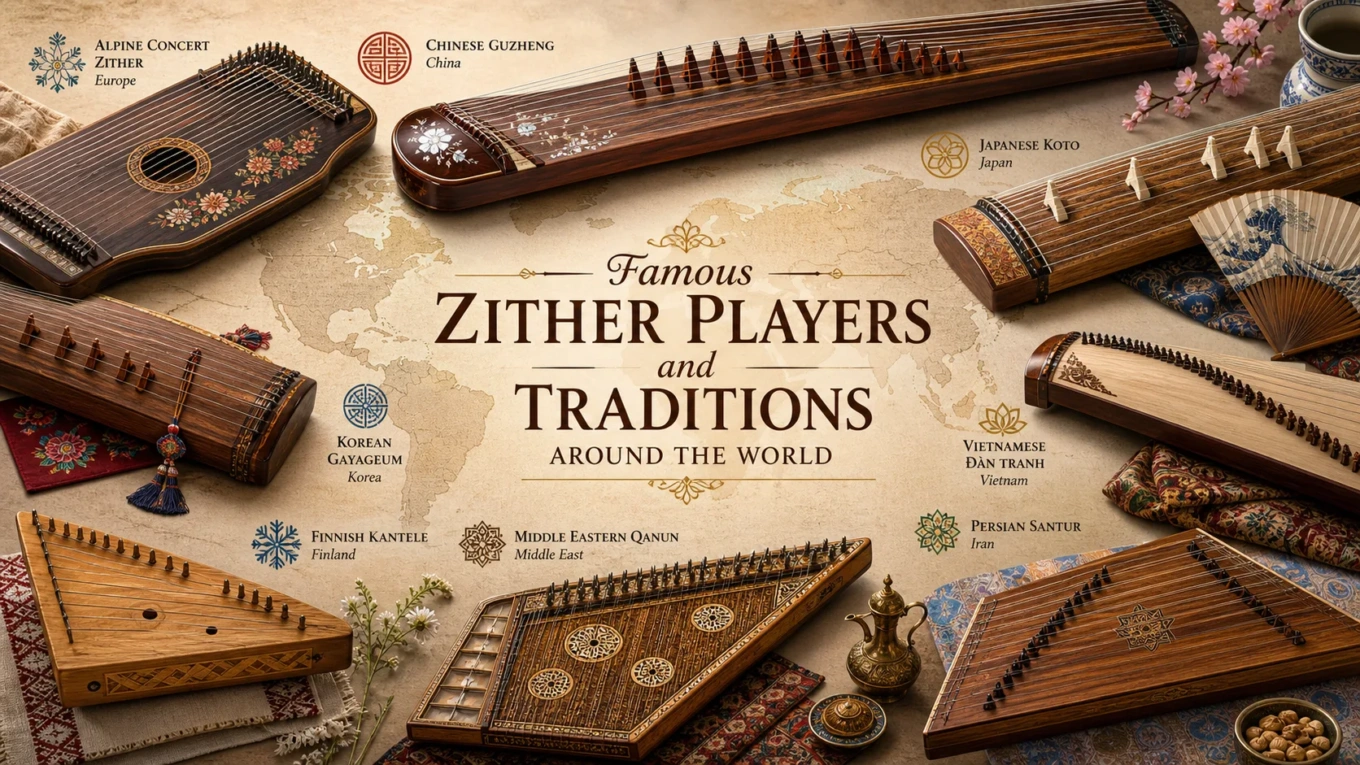
Famous Zither Players and Traditions Around the World
Famous zither players are best understood through the traditions they carry. A Viennese concert zither player, a Chinese guqin master, a Japanese koto composer, a Korean gayageum teacher, a Finnish kantele revivalist, and a North Indian santoor virtuoso may all belong to the wider zither family, yet their instruments ask for different hands, tunings, social settings, and ideas of musical beauty.
The word zither[g] can mean two things. In everyday European usage, it often points to the concert or Alpine zither. In organology[g], it can describe a much wider group of chordophones[g] whose strings run along a body, board, tube, frame, or box rather than along a separate neck. That broad use brings together instruments that should not be treated as one single type: guzheng, guqin, koto, gayageum, đàn tranh, qanun, santur, santoor, kantele, gusli, psaltery, dulcimer, autoharp, and several local forms.
This page keeps that distinction clear. It focuses on famous players as cultural and technical reference points, not as a ranked list. A player may be famous through recordings, a school of teaching, a museum-documented lineage, a concert repertory[g], or a change in how the instrument was used on stage.
Main Zither Traditions and Representative Players
The table below gives a practical map before the details. It does not include every major performer. It shows how different zither traditions became known through players, teachers, composers, and recorded sound.
| Tradition or Instrument | Region Commonly Associated With It | Main Playing Method | Representative Players | Why They Matter |
|---|---|---|---|---|
| Concert zither | Austria, Germany, Alpine regions, Central Europe | Plucked, with fretted melody strings and open accompaniment strings | Anton Karas, Ruth Welcome, Shirley Abicair | They brought the European zither into film music, recordings, radio, television, and light concert settings. |
| Guqin | China | Finger-plucked seven-string zither with stopped tones, harmonics, and slides | Guan Pinghu, Wu Jinglüe | They helped preserve, reconstruct, and transmit a solo tradition with a strong link to notation, touch, and scholarly listening. |
| Guzheng | China | Plucked board zither with movable bridges and fingerpicks | Wang Xunzhi, Cao Dongfu, Wang Changyuan, Xiang Sihua, Mindy Meng Wang | They represent regional schools, conservatory training, modern concert repertory, and contemporary cross-disciplinary performance for the zheng. |
| Koto | Japan | Plucked long zither, often with movable bridges and finger picks | Yatsuhashi Kengyō, Michio Miyagi, Tadao Sawai, Kazue Sawai | They mark turning points in classical repertory, modern composition, and contemporary koto performance. |
| Gayageum | Korea | Plucked zither with movable bridges, string bending, and solo or vocal traditions | Hwang Byungki and major sanjo lineages | The instrument links court, folk, solo, and composed repertories, with strong attention to pitch inflection. |
| Kantele | Finland and related Baltic-Finnic areas | Plucked small or concert zither, depending on type | Martti Pokela, Marjatta Pokela, Eva Alkula | They show the path from folk revival to conservatory and contemporary concert use. |
| Qanun | Arabic, Turkish, Armenian, Greek, and neighboring traditions | Plucked trapezoidal zither with courses and pitch levers on many modern forms | Göksel Baktagir, Halil Karaduman, Julien Jalâl Eddine Weiss | They show how the qanun works as both a solo instrument and a refined ensemble voice. |
| Santur and santoor | Iran, Kashmir, North India, and related regions | Struck zither played with light hammers | Farâmarz Pâyvar, Shivkumar Sharma | They helped shape the santur or santoor as a concert instrument in Persian and Hindustani classical settings. |
| Autoharp | United States and parts of Europe | Strummed or plucked chord zither with chord bars | Maybelle Carter, Sara Carter, Bryan Bowers | They show how a chord-zither design moved into country, folk, and singer-accompaniment styles. |
Why Famous Zither Players Are Hard to Compare
A violinist, guitarist, and pianist can often be compared through shared concert systems. Zither players are harder to place side by side because the word covers instruments with very different designs. Some use frets[g]. Some use movable bridges[g]. Some are struck with hammers. Some are plucked with bare fingers, plectra[g], or taped fingerpicks[g]. Some rely on open strings, while others depend on stopped tones and sliding pressure.
Fame also works differently from one tradition to another. In some zither cultures, the best-known figure is a composer. In another, it may be a lineage holder, a court musician, a recording artist, a folk revivalist, or a teacher who trained generations of performers. That is why a useful list should connect each name to an instrument, a repertory, and a playing culture.
Classification Note: In museum and organology language, “zither” is broader than most everyday music use. The term can cover plucked board zithers, box zithers, trough zithers, tube zithers, struck zithers, and chord zithers. This does not make a guqin, koto, qanun, santur, and autoharp the same instrument. It places them in a broad string-instrument category based on body-and-string layout.
European Concert Zither Players
The European concert zither is the form many readers picture when they hear the word “zither” in a narrow sense. It usually has a flat resonating body[g], a fretted melody area near the player, and a larger field of open strings for accompaniment and bass. Documented instruments vary, but many concert zithers have roughly several dozen strings rather than the small string counts found on some folk zithers.
Anton Karas and the Viennese Zither Sound
Anton Karas is probably the most widely recognized concert zither player outside specialist circles. His zither theme for The Third Man gave the instrument a sharp, memorable identity in film sound. The effect was not orchestral in size; it was intimate, pointed, and slightly dry, with plucked notes carrying melody, rhythm, and mood at once.
Karas came from a Viennese playing environment in which the zither could be heard in social settings as well as staged performance. That matters. His fame did not come from treating the instrument as a museum piece. It came from showing that a small plucked zither could carry a complete screen identity with very little added texture.
Ruth Welcome and the Recorded Zither Album
Ruth Welcome helped give the zither a place in mid-twentieth-century American recording culture. Her albums framed the instrument in polished arrangements, often with a warm, lyrical sound rather than the sharper tavern or film style associated with Karas. For many listeners in North America, her records were the first sustained exposure to the concert zither as a solo voice.
Her repertory leaned toward familiar melodies, standards, and light concert textures. That approach can be easy to underrate. It placed a demanding European instrument into the listening habits of people who might never attend a zither recital.
Shirley Abicair and the Zither as Song Accompaniment
Shirley Abicair made the zither visible in British and Australian entertainment settings, especially through song performance and television. Her use of the instrument shows another side of zither playing: accompaniment, stage presence, and the ability to support the voice without the weight of a full band.
This is a useful reminder that a famous zither player is not always famous for instrumental virtuosity alone. In some settings, the player’s skill lies in timing, balance, chord support, and clear delivery of melody.
Chinese Zither Traditions: Guqin and Guzheng
Chinese zither traditions show why the word “zither” needs careful handling. The guqin and the guzheng are both Chinese zithers, but their bodies, string counts, bridge systems, social roles, and playing techniques differ sharply. A listener should not treat one as a larger or smaller version of the other.
Guan Pinghu and the Guqin Tradition
The guqin is a seven-string plucked zither with no movable bridges. It uses open tones, stopped tones, harmonics[g], slides, and subtle changes in touch. The instrument is closely tied to solo listening, old notation, and a refined sense of silence between notes.
Guan Pinghu stands out as one of the best-known twentieth-century guqin players. His work is often associated with dapu[g], the practice of bringing old tablature[g] back into playable form. His recording of “Liu Shui” (“Flowing Water”) became one of the most widely known guqin recordings beyond China after its selection for the Voyager Golden Record. The fame of that recording should not reduce guqin music to one piece; it is better heard as a doorway into a much deeper solo tradition.
Wu Jinglüe is another central guqin name. His playing and teaching helped shape the professional concert and conservatory life of the instrument in the twentieth century. The guqin still keeps older ideas of personal cultivation and close listening, yet modern teachers and performers also present it in concert halls, archives, and recorded collections.
Listening Note: Guqin fame is not built on loud projection. Listen for the beginning and ending of each tone, the left-hand slide, the change from full tone to harmonic, and the space after a phrase. The quietness is part of the instrument’s design and musical language.
Wang Xunzhi, Cao Dongfu, Wang Changyuan, and the Guzheng
The guzheng is a plucked board zither with movable bridges and a large soundboard[g]. Modern concert instruments often use 21 strings, while other string counts also exist. Players commonly use fingerpicks, and the left hand shapes pitch through pressure, bends, vibrato, and ornaments on the section of string beyond the bridges.
Wang Xunzhi is associated with the Wulin zheng school, while Cao Dongfu is linked with the Henan tradition. Names like these matter because guzheng playing is not one uniform method. Regional schools differ in ornament, phrasing, tone color, and repertory. A piece from Henan does not ask the same touch as one from Chaozhou or Zhejiang.
Wang Changyuan is widely known as a modern guzheng performer and composer, especially through the solo piece often translated as “Fighting the Typhoon.” That work pushed the instrument toward a stronger concert identity, with more dramatic right-hand patterns and expanded left-hand activity. Xiang Sihua is another widely heard guzheng name in recorded traditional and classical repertory.
Modern guzheng players may study regional pieces, conservatory works, ensemble music, and cross-genre collaborations. The instrument’s public image has therefore become wide: it can sound delicate, bright, percussive, lyrical, or highly virtuosic depending on the piece and setup.
Mindy Meng Wang and Contemporary Guzheng Performance
Mindy Meng Wang is a guzheng performer and composer whose work places the instrument in experimental, electronic, improvisational, jazz, and Western classical settings as well as projects connected with Chinese musical traditions. Her career is a useful modern reference because it shows the guzheng working inside composition, sound design, multimedia performance, and collaboration rather than only inside inherited solo repertory.
At the 2026 Sydney Festival, Wang and composer and sound artist Monica Lim presented Opera for the Dead 祭歌. The production combined Wang’s guzheng with electronics, live vocals, percussion, cello, movement, and 3D animation, drawing on Chinese mourning rituals as part of the work’s musical and visual language. The performance gives a clear current example of the guzheng functioning inside an interdisciplinary stage work while remaining identifiable through its own sound and technique.
Japanese Koto Players and Schools
The koto is a Japanese plucked zither, most often known in its 13-string form, though other forms exist. It uses movable bridges and finger picks, with pitch inflection made by pressing the strings. Koto performance can sit in classical chamber music, solo repertory, new music, and cross-cultural projects.
Yatsuhashi Kengyō and Classical Koto Repertory
Yatsuhashi Kengyō is a major historical name in koto music. He is linked with the shaping of koto repertory beyond earlier courtly use and with the development of pieces and tunings that became central to later playing. Because his period is distant and documentation is not the same as for modern recording artists, claims around individual works should be treated with care. Still, his name remains a standard point of entry into classical koto history.
Michio Miyagi and the Modern Koto Voice
Michio Miyagi is one of the best-known modern koto figures. He composed, performed, taught, recorded, and helped expand the instrument’s repertory. His work with the 17-string bass koto added a lower range to ensemble and composed music, and his piece “Haru no Umi” became one of the most recognized koto-linked works internationally.
Miyagi’s importance lies in balance. He did not simply preserve older repertory, nor did he abandon the instrument’s older grammar. He used the koto as a concert instrument able to carry new forms, new ensemble colors, and modern recordings while still retaining its plucked-zither identity.
Tadao Sawai, Kazue Sawai, and Contemporary Koto Performance
Tadao Sawai and Kazue Sawai are closely tied to contemporary koto performance. Their work opened space for new compositions, ensemble projects, improvisation, and collaborations beyond older school boundaries. For listeners, their recordings can show the koto as a living concert instrument rather than a fixed historical sound.
This part of the koto tradition is useful for understanding how a zither can keep its physical design while changing its musical role. The bridge system, plucked attack, and bending technique remain central, but the repertory can move into newly composed and experimental settings.
Korean Gayageum Players and Sanjo Lineages
The gayageum is a Korean plucked zither with movable bridges. Older and regional forms are often associated with 12 strings, while modern concert forms may use more strings for wider pitch resources. The instrument is known for bright plucked tones and expressive left-hand bending.
Hwang Byungki is one of the most widely recognized gayageum figures in modern Korean music. He was a performer, composer, teacher, and scholar, and his work helped connect traditional technique with newly composed pieces. His music shows how the gayageum can move between older genres and modern concert language without losing its plucked-zither character.
Gayageum sanjo[g] is especially important for understanding famous players. Sanjo is not only a piece type; it is a solo tradition shaped by lineage, rhythmic cycles, improvisatory feeling, and close work with drum accompaniment. Different schools preserve different versions, ornaments, and phrase shapes.
Gayageum byeongchang combines singing and gayageum playing. This matters because some famous zither traditions are not purely instrumental. The player must balance voice, string attack, text delivery, and rhythmic movement.
Vietnamese Đàn Tranh and Related Plucked Zither Traditions
The Vietnamese đàn tranh is a plucked zither with movable bridges, related in broad family terms to East Asian board zithers such as the guzheng, koto, and gayageum. It has its own repertories, regional performance settings, and ornament systems. Treating it as a “Vietnamese guzheng” would erase too much of its musical identity.
In đàn tranh performance, the right hand plucks while the left hand shapes pitch, vibrato, slides, and ornaments. Depending on context, it may appear in chamber music, theatrical traditions, solo performance, and modern ensemble settings. Famous players are often known within Vietnamese music networks, teaching lineages, and diaspora concert life rather than through one single global name.
Regional Note: The đàn tranh, guzheng, koto, and gayageum share the broad idea of a plucked board zither with bridges, but the tuning habits, repertory, ornament, posture, and cultural setting are different. Similar shape does not mean identical tradition.
Qanun Players in Middle Eastern and Mediterranean Traditions
The qanun is a plucked trapezoidal zither used in Arabic, Turkish, Armenian, Greek, and neighboring musical cultures. Modern forms commonly use courses[g] of strings, with small levers or latches that help the player alter pitch during performance. In Turkish usage, these levers are often called mandals[g].
Göksel Baktagir is one of the best-known modern Turkish kanun players and composers. His playing is often admired for clean articulation, melodic flow, and control of pitch detail inside Turkish art music. Halil Karaduman is another widely recognized Turkish kanun figure, especially through recordings and collaborations that brought the instrument to large audiences.
Julien Jalâl Eddine Weiss became known for his work with the qanun and the Al-Kindi Ensemble, presenting classical Arab repertory in concert settings. His career shows how a zither player can become known not only as a soloist, but as an ensemble builder and cultural transmitter.
The qanun’s fame often comes from its role in modal music. A good player must make fast ornamental figures, clean repeated notes, and subtle pitch choices inside maqam[g] practice. The instrument can lead, answer a singer, support an ensemble, or create bright runs that cut through a texture.
Santur and Santoor: Famous Struck Zither Players
The santur and santoor belong to struck zither traditions. Instead of plucking the strings directly, the player uses light hammers. This changes the whole playing logic. A struck note has a clean attack and a ringing decay; fast patterns can shimmer across groups of strings, but sustaining a single singing line requires a different kind of control.
Farâmarz Pâyvar and Persian Santur
Farâmarz Pâyvar is one of the major santur names in Persian classical music. He is associated with performance, composition, teaching, and ensemble work. His role is often described through the santur’s move into a more visible solo and ensemble position within Persian art music.
Persian santur playing depends on finely controlled hammer strokes, modal knowledge, and clear phrase direction. The instrument can sound bright and percussive, but the best playing also gives shape to line, breath, and tension.
Shivkumar Sharma and the Indian Santoor
Shivkumar Sharma is the central modern name for the santoor in Hindustani classical music. He is widely credited with moving the instrument from regional and accompanying roles into a solo classical concert setting. That shift required more than fame; it needed adaptation of technique, repertory, and presentation for raga[g] performance.
The santoor’s struck-string design creates challenges for the slow unfolding of a raga, where slides and vocal-style curves are often central on other instruments. Sharma’s importance lies in how he found a musical path for the instrument inside that system without pretending it behaved like a sitar, sarod, or voice.
Finnish Kantele Players and Revival Traditions
The kantele is a Finnish and Baltic-Finnic plucked zither found in small folk forms and larger concert forms. A small kantele may have only a few strings, while concert kanteles can be far more complex. The instrument is often linked with Finnish folk poetry and song traditions, but modern kantele playing also includes classical, contemporary, and experimental music.
Martti Pokela and Marjatta Pokela are central names in the twentieth-century Finnish kantele revival. Their work helped bring the instrument into recordings, concerts, education, and a broader folk-music renewal. The Pokela family also shows how zither traditions often move through households as well as institutions.
Eva Alkula represents a later concert and contemporary path for the kantele. Her work with classical, electric, and cross-cultural projects shows that the kantele is not confined to a single folk image. It can be a quiet song instrument, a chamber instrument, an amplified stage instrument, or a partner to other plucked zithers such as the koto.
Gusli, Psaltery, and Other European Zither Paths
The gusli, psaltery, Baltic kanklės, kokle, and related instruments are often discussed near the kantele in broad zither classification. Some are strongly tied to local song, storytelling, and folk revival settings. Others appear mainly in museum collections, early music groups, or regional teaching.
Famous players in these traditions may not have the same global name recognition as Anton Karas or Shivkumar Sharma. That does not mean the traditions are minor. It means their fame often stays closer to local festivals, conservatories, archives, and craft communities.
For instrument research, these traditions are valuable because they show how simple-looking zithers can carry rich variation: carved bodies, hollowed soundboxes, wing-shaped forms, different string metals, varied tuning systems, and several right-hand patterns.
Autoharp Players and the Chord Zither Tradition
The autoharp is a chord zither[g] with bars that mute selected strings so the player can strum or pick chords. It is often linked with American folk and country music, though related chord-zither designs also appeared in Europe.
Maybelle Carter and Sara Carter brought the autoharp into a major recorded country and folk setting through the Carter Family sound. Maybelle is often remembered first for guitar, but her autoharp work also helped show the instrument as more than a simple chord pad. Sara Carter’s autoharp accompaniment gave many Carter Family recordings a direct, plain-spoken string texture.
Bryan Bowers later became a major autoharp figure in American folk performance. His playing helped make the instrument sound more soloistic, with clear melodic picking rather than only strummed chord support. This is a good example of how player technique can change the public identity of a zither type.
How Playing Technique Shapes Each Tradition
Zither traditions are often separated less by outline than by touch. A flat wooden body with strings can become many different instruments depending on bridge design, tuning, hand position, and the job each hand performs.
- Fretted melody with open accompaniment: The concert zither lets one hand stop melody notes on frets while the other plucks melody, accompaniment, and bass strings.
- Movable-bridge plucking: Guzheng, koto, gayageum, and đàn tranh players use bridges to set string lengths, then shape pitch with the left hand.
- Stopped, sliding, and harmonic touch: The guqin uses fine left-hand motion, marked pitch positions, and changes of contact to create tone variety.
- Lever-based modal control: Qanun players use pitch levers to move through modal pitch needs during performance.
- Hammered attack: Santur and santoor players shape rhythm, ring, and melody through the weight and rebound of small hammers.
- Chord-bar muting: Autoharp players use chord bars to simplify harmony while still allowing rhythmic strumming or melodic picking.
These technical differences explain why famous zither players rarely sound alike. They may share a broad family name, but the hands learn different habits.
What to Listen For in Famous Zither Recordings
A listener can learn a great deal by choosing one player from each tradition and focusing on touch rather than speed. Speed is easy to notice. Zither artistry often appears in smaller details.
- Attack: Is the note sharp, soft, brushed, struck, or rounded?
- Sustain: Does the sound ring freely, stop quickly, or fade under hand damping?
- Pitch shaping: Does the player bend, slide, retune with levers, or stop strings against frets?
- Texture: Is the music solo melody, melody with drone, chordal support, or dense patterning?
- Ornament: Are decorations fast and bright, slow and vocal, or nearly hidden inside the tone?
- Role: Is the instrument leading, accompanying, answering a singer, or working inside an ensemble?
For Anton Karas, listen to rhythmic bite and compact melody. For Guan Pinghu, listen to breath, silence, and sliding tone. For Wang Changyuan, listen to how a guzheng can become dramatic and orchestral in effect without ceasing to be a plucked board zither. For Mindy Meng Wang, listen to how the instrument keeps its plucked attack and pitch-shaping identity inside electronic and multimedia settings. For Michio Miyagi, listen to balance between traditional gesture and modern form. For Shivkumar Sharma, listen to how hammered notes are made to carry raga movement.
Common Misunderstandings About Famous Zither Players
Mistaking Every Zither for the European Concert Zither
When a reader searches for famous zither players, many results lean toward Anton Karas and the European zither. That is useful, but incomplete. A guqin or koto player is also a zither player in the broad organological sense, even if the local instrument name is more precise.
Treating Related Asian Zithers as One Instrument
The guzheng, koto, gayageum, and đàn tranh are related in broad classification and appearance, but they are not interchangeable. Each has its own repertory, posture, bridge habits, string feel, and performance history. A famous koto player does not automatically represent guzheng music, and a guqin master does not represent all Chinese zither playing.
Assuming More Strings Means a More Advanced Tradition
String count is not a ranking system. The seven-string guqin can carry highly detailed music. A small kantele can support old song traditions. A many-string qanun can move through modal pitch detail. A concert zither can combine fretted melody and open accompaniment. Design serves musical use.
Ignoring Teachers and Lineages
Some famous zither players are famous because they taught, reconstructed repertory, founded schools, or changed how the instrument was studied. Record sales are only one measure. In guqin, koto, gayageum, and guzheng traditions, transmission can be just as important as public fame.
Choosing a Starting Point for Listening
A practical listening path should start with one tradition at a time. Jumping from guqin to autoharp to santoor can be interesting, but it can also blur the ear. Better results come from hearing several players on one instrument before moving to another.
- Start with the instrument name, not only the word “zither.” Search for concert zither, guqin, guzheng, koto, gayageum, qanun, kantele, santur, santoor, or autoharp.
- Choose one older or lineage-based performer, then one modern concert performer.
- Listen for the role of the left hand. On many zithers, pitch color and expression come from the hand that is not plucking the main note.
- Notice the setting: solo, ensemble, song accompaniment, film music, radio, folk revival, or conservatory stage.
- Return to the table above after listening. The labels will make more sense once the ear has examples.
FAQ About Famous Zither Players
Who is the most famous zither player?
For the European concert zither, Anton Karas is often the most recognized name because of his music for The Third Man. In the wider zither family, fame depends on the instrument: Guan Pinghu for guqin, Michio Miyagi for koto, Hwang Byungki for gayageum, Shivkumar Sharma for santoor, and Maybelle Carter or Bryan Bowers for autoharp are common starting points.
Are guzheng and koto players also zither players?
Yes, in the broad organological sense, guzheng and koto players are zither players. In normal musical discussion, it is usually better to call them guzheng players or koto players, because each instrument has its own technique, tuning habits, and repertory.
Is Anton Karas the only famous concert zither player?
No. Anton Karas is the best-known name for many listeners, but Ruth Welcome and Shirley Abicair also helped bring the zither to wider audiences through recordings, broadcast work, song accompaniment, and stage performance.
Why do famous zither traditions sound so different?
They sound different because zither designs vary widely. Some have frets, some have movable bridges, some use hammers, some use fingerpicks, and some use chord bars. Tuning systems and musical roles also differ by region and tradition.
Is the santoor a zither?
Yes, the santoor is usually treated as a struck zither or hammered dulcimer-type instrument in broad classification. In Hindustani classical music, it is best discussed by its own name because its repertory and technique are specific.
Do famous zither players usually compose their own music?
Some do, and some mainly interpret inherited repertory. Michio Miyagi, Hwang Byungki, Wang Changyuan, Tadao Sawai, Farâmarz Pâyvar, and Shivkumar Sharma are strongly linked with composition or repertory expansion, while other players are known more for transmission, performance style, or recordings.
Technical Term Glossary
Zither: A broad string-instrument category in which strings run along a body, board, tube, frame, or box rather than along a separate neck. In narrow European usage, it often means the concert or Alpine zither.
Organology: The study of musical instruments, including their construction, classification, materials, playing method, and cultural use.
Chordophone: A musical instrument whose sound begins with vibrating strings. Zithers, lutes, harps, lyres, and bowed string instruments are all chordophones.
Fret: A raised strip or marker that helps define pitch when a string is pressed against it. Concert zithers use fretted melody strings; many other zithers do not.
Movable Bridge: A bridge that can be shifted to set the speaking length and pitch of a string. Guzheng, koto, gayageum, and đàn tranh commonly use movable bridges.
Plectrum: A pick used to pluck a string. It may be held in the hand, worn on a finger, or attached in a tradition-specific way.
Fingerpick: A small pick worn on a finger. Guzheng and koto players commonly use fingerpicks, though materials and wearing methods vary.
Resonator: The part of an instrument that helps amplify and color the vibration of the strings. On many zithers, the body itself works as the resonator.
Repertory: The body of pieces, styles, and performance materials used by a player, school, or tradition.
Harmonic: A clear, bell-like tone made by lightly touching a vibrating string at a special point rather than pressing it fully.
Dapu: A guqin practice in which old tablature is interpreted and worked into playable music. It requires knowledge of notation, style, and instrument technique.
Tablature: A notation system that tells the player where and how to play on the instrument, often showing finger actions rather than only abstract pitches.
Soundboard: The vibrating top or main resonant surface of an instrument. Wood choice, thickness, arching, and construction can shape resonance, though effects vary by instrument and maker.
Sanjo: A Korean solo instrumental tradition, often accompanied by janggu drum, moving through rhythmic cycles and phrase patterns associated with specific lineages.
Course: A group of two or more strings tuned to the same or related pitch and played as one unit. Qanuns often use courses rather than single strings for each pitch.
Mandal: In Turkish kanun usage, a small lever used to adjust pitch quickly during performance. Similar pitch-changing devices are used on many modern qanun forms.
Maqam: A modal system used in many Middle Eastern musical traditions. It shapes scale patterns, melodic movement, ornament, and expressive pitch choices.
Raga: A melodic system in Indian classical music. A raga is more than a scale; it includes characteristic phrases, important tones, mood, and rules of movement.
Chord Zither: A zither designed to help produce chords, often through grouped strings or muting bars. The autoharp is a well-known chord zither.