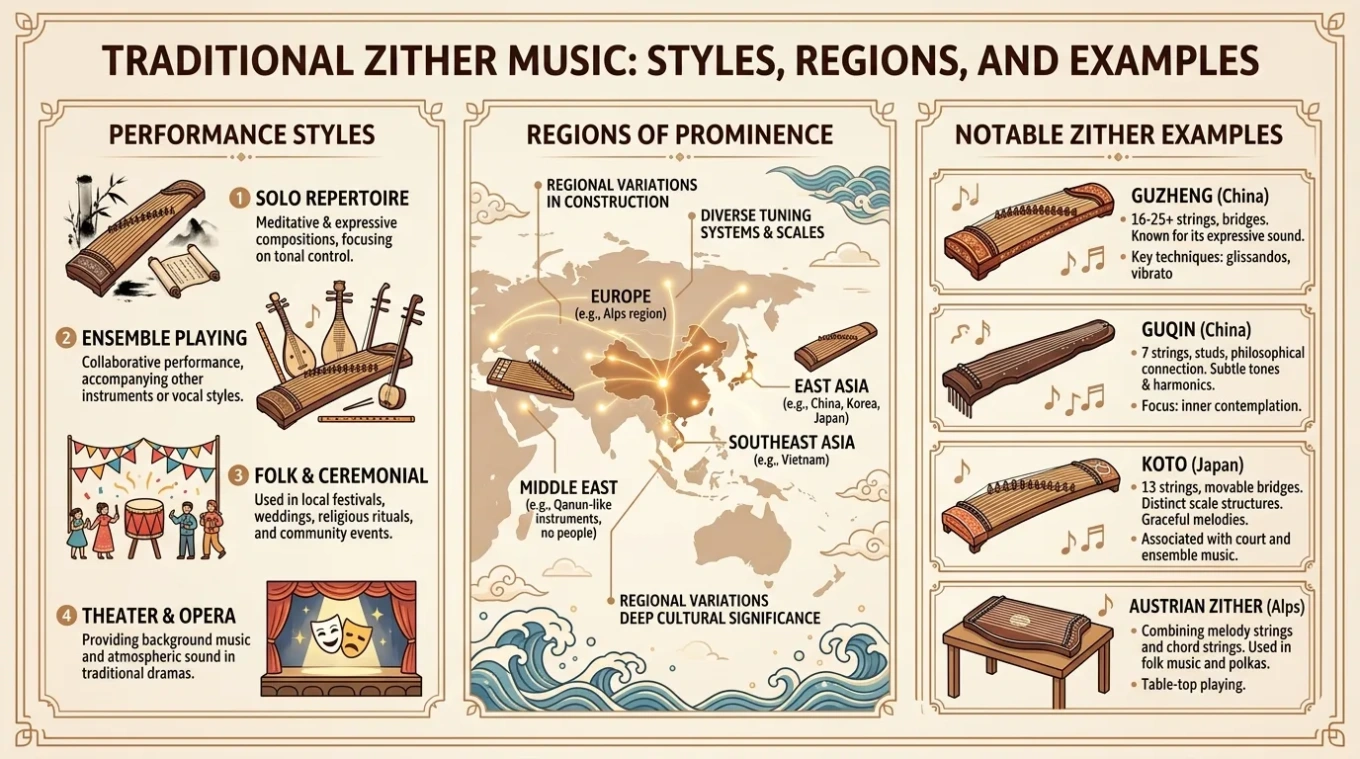
Traditional Zither Music: Styles, Regions, and Examples
Traditional zither music is not one sound, one region, or one playing method. It is a broad group of musical practices built around instruments whose strings run across a body, board, tube, box, frame, or resonating surface rather than along a separate neck. A Chinese guzheng, a Japanese koto, a Finnish kantele, a Turkish qanun, a Persian santur, an Appalachian dulcimer, and an Alpine concert zither can all sit near the zither family in organological discussion, yet their music works in very different ways.
The clearest way to understand traditional zither music is to listen for playing action, regional tuning habits, ornament, and musical role. Some traditions favor open strings and drones. Some use movable bridges for flexible pitch. Some strike the strings with light hammers. Some place melody, bass, and accompaniment on the same flat instrument.
Classification Note: In organology, a zither is usually treated as a type of chordophone†. In everyday use, the word can also mean the European concert zither specifically. Traditional zither music needs both meanings kept apart.
What Traditional Zither Music Means
Traditional zither music refers to musical styles linked to zither-family instruments in regional, social, ritual, courtly, household, folk, chamber, or teaching settings. The phrase does not describe a single genre.
It can include solo pieces, song accompaniment, dance tunes, ensemble parts, meditative repertory, salon music, village music, and formal chamber traditions. The instrument may carry the melody, supply a drone†, outline harmony, decorate a vocal line, or add rhythmic sparkle.
The family is wide because zither construction is wide. Some instruments have a shallow wooden box. Some have a long convex sound chamber. Some are trapezoidal. Some are tube-based. Some are fretted. Some are fretless. Some have courses† of two or three strings that sound together. These physical choices shape the music.
That is why a useful discussion of traditional zither music should avoid saying “zithers sound like this.” A guqin phrase, a qanun taqsim, a santur passage, and a kantele song setting do not share one fixed musical grammar.
Main Regional Styles and Musical Examples
| Region or Tradition | Common Zither Examples | Playing Logic | What to Listen For |
|---|---|---|---|
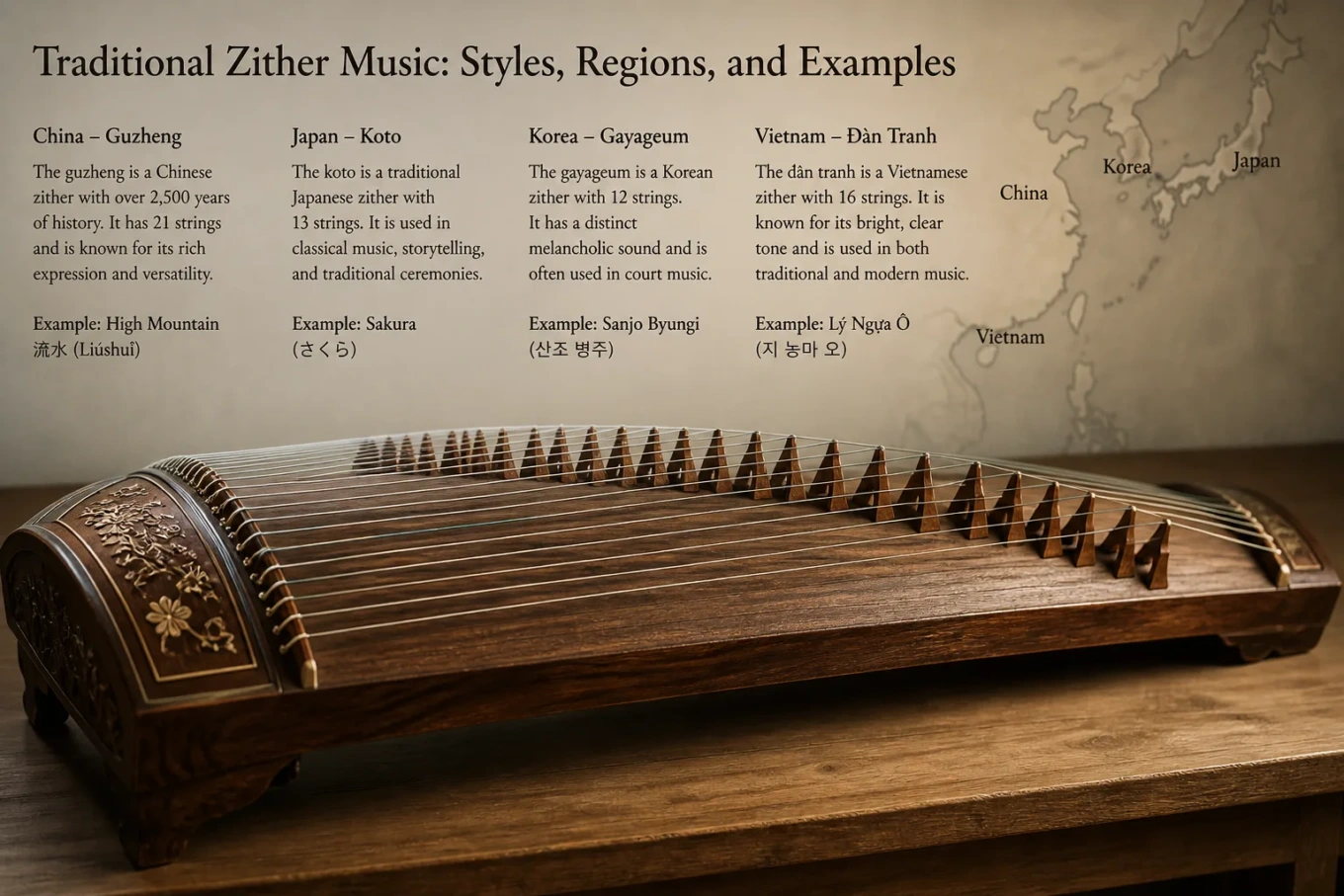
| East Asian long-zither traditions | Guzheng, koto, gayageum, đàn tranh, guqin | Mostly plucked strings, often with bridge-based pitch layout; guqin uses stopped and sliding tones on a fretless surface | Bent notes, tremolo, pentatonic† patterns, long decay, and ornament after the pluck |
| Northern and Baltic-Finnic traditions | Kantele, kannel, kokle, kanklės | Open-string plucking, strumming, and chordal patterns; older forms may use fewer strings | Clear drones, modal† melody, ringing open strings, and song support |
| Middle Eastern and Eastern Mediterranean art music | Qanun, kanun | Plucked courses with plectra; pitch adjusted by small levers on many modern instruments | Fast ornaments, bright attack, fluid modal movement, and fine pitch shading |
| Persian, South Asian, and related hammered traditions | Santur, santoor, hammered dulcimer types | Strings struck with light hammers or mallets across bridges | Shimmering repeated tones, fast rolls, bell-like resonance, and layered rhythmic patterns |
| Central European and Alpine traditions | Concert zither, Alpine zither, chord zither | Fretted melody strings plus open accompaniment and bass strings, depending on instrument type | Melody with self-accompaniment, bass support, chordal texture, and dance or salon phrasing |
| North American and European folk-related dulcimer traditions | Mountain dulcimer, hammered dulcimer | Lap-held fretted melody with drones, or struck string courses on a trapezoidal body | Drone-based tunes, simple modal melodies, rhythmic pulse, and strong connection to song repertory |
The table shows why “traditional zither music” is best treated as a family of musical approaches. The shared idea is not a single scale, tuning, or cultural setting. The shared idea is the relationship between strings and a resonating body†.
How the Instrument Shape Affects the Music
Zither music often begins with the physical layout of the strings. A long zither with movable bridges invites one kind of pitch shaping. A box zither with fixed open strings invites another. A hammered zither rewards repeated strikes, rolls, and rapid alternation.
The soundboard† matters because the strings need a surface that can receive vibration and project it into the room. Wood choice, chamber depth, bridge pressure, string material, and playing touch can all affect resonance. The exact result varies by instrument, maker, and regional form.
Open Strings and Drones
Many older zither practices make strong use of open strings. An open string sounds without being stopped by a finger. This allows a player to keep a drone or repeated reference tone under the melody.
Drone-based playing appears in several zither settings, but it does not mean all zither music is simple. A drone can create tension, support a mode, mark a tonal center, or give a singer a stable pitch field. On small kanteles and mountain dulcimers, for example, drone strings can become part of the instrument’s identity.
Movable Bridges and Pitch Bending
Many East Asian long zithers use movable bridges† to set string length and pitch. After plucking, the player may press the string on the far side of the bridge to bend the note upward or add vibrato.
This creates a musical effect that cannot be captured by pitch names alone. The note may begin as a clean attack, then curve, pulse, or lean into another pitch. In guzheng, koto, gayageum, and đàn tranh traditions, left-hand pressure often shapes the voice of the phrase as much as the right-hand pluck.
Fretted Melody and Self-Accompaniment
The European concert zither uses a different idea. Its melody strings pass over a fretted fingerboard†, while other open strings provide accompaniment and bass. The player can handle melody, harmony, and lower support on one flat instrument.
This gives Alpine and concert zither music a distinct texture. A melody may sound almost like a small plucked string solo, while open bass and accompaniment strings fill the space below it. The instrument can feel intimate, but the arrangement is technically demanding.
Hammered Sound and Repeated Attack
Struck zithers, including santur and hammered dulcimer types, use light hammers instead of direct plucking. The sound is bright at the start and can blur into a ringing cloud when many notes decay together.
The music often uses rolls, repeated notes, quick patterns, and cross-string movement. Bridge placement and string grouping affect how players move through the scale. Because notes decay while new notes are struck, the instrument can create a surface of sound that feels both percussive and melodic.
East Asian Long-Zither Music
East Asian long-zither traditions are among the most widely recognized zither styles, but they should not be treated as one musical system. Guzheng, koto, gayageum, đàn tranh, and guqin all sit near the long-zither discussion, yet each has its own construction, repertory, notation habits, and playing language.
Guzheng Music
The guzheng is a Chinese plucked long zither commonly associated with movable bridges and a bright, flexible tone. Modern instruments often use many strings, and common teaching setups frequently center on pentatonic layouts, though repertory and tuning practice can vary.
Guzheng music often uses right-hand plucking for clear melodic motion and left-hand pressure for bends, vibrato, slides, and grace notes. Fast tremolo can sustain a tone beyond the natural decay of a plucked string. Glissando† across open strings is another recognizable effect, but it is only one part of the instrument’s language.
Listening Note: In guzheng playing, the left hand often works after the right hand has already sounded the note. Listen for pitch movement after the attack, not only for the plucked note itself.
Koto Music
The koto is a Japanese long zither with movable bridges. It is often heard in solo repertory, vocal settings, and chamber combinations, including pairings with shamisen and shakuhachi in some traditional contexts.
Koto music may use spacious phrases, repeated patterns, vocal-linked melodic shapes, and carefully placed ornaments. The bridge layout allows retuning for different pieces or modes. As with other long zithers, the player can shape pitch after the pluck by pressing the string beyond the bridge.
The koto’s musical identity is not only its long body or string count. It is also the relation between tuning, gesture, notation, teaching lineages, and ensemble habit.
Gayageum Music
The gayageum is a Korean plucked zither with movable bridges. Different forms exist, and modern versions may differ from older forms in string number, materials, and repertory use.
Gayageum music often values ornament, bending, and rhythmic energy. In sanjo-related performance, the instrument may move through changing tempo sections with drum accompaniment. The player’s left hand gives notes a vocal quality through pressure, release, and subtle pitch movement.
Its tone can be warm and elastic. The exact sound depends on the instrument type, string material, tuning, and the player’s touch.
Đàn Tranh Music
The đàn tranh is a Vietnamese plucked zither related in broad construction logic to other East Asian long zithers, though its repertory and regional use are distinct. It appears in traditional ensemble settings, chamber music, and teaching contexts.
Its music may use plucked melody, ornaments, tremolo, and pitch inflection. As with guzheng and koto, the player can alter the pitch after sounding the string. This gives the melody a flexible contour rather than a fixed keyboard-like line.
Guqin Music
The guqin differs strongly from bridge-based long zithers. It is a Chinese seven-string zither without movable bridges. The player plucks, stops, slides, and uses harmonics† on a long lacquered surface.
Guqin music often values quiet attack, space between notes, sliding pitch, and subtle timbral change. Because the fingers stop the string directly on the surface, the instrument supports a wide range of tones: open, stopped, sliding, and harmonic.
This makes the guqin a useful reminder that “long zither” does not always mean “movable-bridge zither.” Its music is built around a different touch system.
Northern European and Baltic-Finnic Zither Music
Kantele, kannel, kokle, and kanklės traditions show another path for zither music: open strings, ringing resonance, and close ties to song, dance, and regional repertory. These instruments are often grouped as Baltic-Finnic or related psaltery-like zithers, though names, forms, and playing habits differ by place.
Older small instruments may have only a handful of strings. Modern concert forms can have many more and may include mechanisms for changing pitch. It is safer to speak of families and local forms rather than one fixed instrument.
Kantele Music
The kantele is strongly associated with Finnish and Karelian musical heritage. Small kanteles often support modal melodies and drones, while larger concert kanteles allow broader range and more complex repertory.
Traditional kantele playing can sound spare and transparent. The open strings ring into one another, so silence and decay become part of the music. Strumming, plucking, and damping techniques help shape the texture.
Kannel, Kokle, and Kanklės Traditions
Related regional zithers such as the Estonian kannel, Latvian kokle, and Lithuanian kanklės also use open-string resonance, though construction and repertory differ. Some forms are linked to song support, dance music, and domestic performance. Others have moved into staged folk and concert settings.
The music often favors clear melodic shapes, open-string ringing, and modal color. As instruments gain more strings or mechanical changes, the repertory can widen, but the older open-string logic remains central to many traditional sounds.
Gusli and Slavic Zither Traditions
The gusli is commonly associated with Russian and other East Slavic musical contexts, but it exists in several forms. Wing-shaped, helmet-shaped, and later keyboard-related forms are not the same object, and they do not all invite the same playing method.
In traditional settings, gusli music may support singing, storytelling, dance tunes, or instrumental pieces. Open strings can provide resonance beneath melody, and some playing styles use selective damping to control which strings continue to ring.
The gusli is sometimes compared with kantele-type instruments because both can use open-string plucked resonance. The comparison can be useful, but only to a point. Regional form, tuning, repertory, and playing position matter.
Qanun Music and the Plucked Trapezoidal Zither
The qanun, or kanun in Turkish spelling, is a trapezoidal plucked zither used in several Middle Eastern, Eastern Mediterranean, North African, and related art-music settings. It is usually played on the lap or a table, with plectra attached to the index fingers in many traditions.
Its sound is bright, quick, and detailed. Many modern qanuns use small levers, often called mandals in Turkish contexts, to adjust pitch. These levers allow the player to move through modal material with fine pitch changes during performance.
Qanun music often includes fast ornaments, tremolo, broken patterns, and melodic improvisation in some settings. Because several strings may form one course, a single plucked pitch can have a rich, doubled or tripled brightness.
Material Note: Qanun strings, bridges, skin or synthetic-covered areas, levers, and plectra all affect playing feel. Two instruments with similar outlines can respond differently under the hand.
Santur, Santoor, and Hammered Zither Music
Santur and santoor traditions belong to the struck side of the zither family. The player uses light hammers to sound strings stretched across a box, usually with bridges dividing or organizing the speaking string lengths.
Because the hammer strikes and leaves the string quickly, the attack is clear. The sound then blooms into resonance. Fast repeated strokes can create a sustained tone, while alternating patterns can make the instrument feel rhythmically alive.
Persian santur, Kashmiri santoor, Turkish santur references, and European hammered dulcimer traditions should not be collapsed into one repertory. They share a struck-zither principle, but their tunings, scales, hammers, stringing, and musical settings vary.
Hammered Dulcimer Music
The hammered dulcimer is a trapezoidal struck zither found in several European and North American folk-related traditions. Players use small hammers to strike string courses across bridges.
Its music often works well for dance tunes because the instrument gives clear attack and bright rhythmic lift. In slower airs, the long ring of the strings can create a soft haze around the melody. Damping, touch, and hammer weight help control that resonance.
Alpine and Concert Zither Music
The European concert zither is often the narrow meaning of the word “zither” in Central European contexts. It usually combines fretted melody strings with open accompaniment and bass strings. Alpine zither forms may include extra bass range and body extensions, depending on design.
Traditional Alpine and Central European zither music can include dance pieces, song arrangements, salon repertory, and solo works. The instrument can sound delicate, but it asks for careful coordination. One hand may stop melody notes on the fretted strings while the other plucks melody, accompaniment, and bass patterns.
Concert Zither Texture
The concert zither’s texture is one of its main musical traits. It can carry a melody and support itself with lower strings. That makes the instrument suitable for solo arrangements that would require several lines on another instrument.
Its tone is plucked and clear, with less of the wide pitch bending heard on many East Asian long zithers. The musical interest often sits in voice-leading, bass movement, accompaniment patterns, and clean articulation.
Chord Zither and Autoharp Connections
Chord zithers and autoharps sit near the zither family, but their playing logic differs from the concert zither. The autoharp uses chord bars that mute unwanted strings, allowing selected chords to ring when the player strums.
Traditional autoharp music is strongly tied to song accompaniment in many folk and popular settings. It is not simply a “small concert zither.” Its mechanism changes how harmony is chosen and how rhythm is shaped.
Mountain Dulcimer Music and Drone-Based Playing
The Appalachian mountain dulcimer is often treated as a fretted zither or box zither in broad classification. It is usually played on the lap, with melody on one string course and drones on others, though modern playing methods can be more varied.
Traditional mountain dulcimer music often favors modal tunes, song melodies, and clear rhythmic strumming. The drone strings create a stable tonal bed, while the fretted melody course moves above it.
This makes the mountain dulcimer a useful example of how zither music can be simple in layout but deep in regional feel. The music depends on mode, rhythm, text, and touch, not on a large number of strings.
How Traditional Zither Styles Use Tuning
Tuning is one of the main differences between zither traditions. Some instruments are retuned for each piece. Some keep a common layout for teaching. Some use modal systems. Some use chromatic bass strings. Some rely on drones. Some use levers or movable bridges to change pitch during performance.
There is no single “traditional zither tuning.” A safe description must name the instrument and regional practice.
Modal and Pentatonic Layouts
Many zither traditions use modal thinking, where a piece is organized around a tonal center, characteristic intervals, and expected melodic behavior. This differs from treating all music as major or minor harmony.
Pentatonic layouts are common in some East Asian zither teaching and repertory settings. They help create clear open-string patterns, but they do not remove complexity. Ornament, bending, rhythm, and phrase shape provide much of the musical detail.
Chromatic and Lever-Based Pitch Control
Qanun and concert zither traditions show other tuning solutions. The qanun can use levers for pitch adjustment, while concert zithers may include chromatic accompaniment and bass layouts depending on tuning system and instrument design.
These systems allow a player to move beyond a small fixed pitch set, but they also add technical demands. The player must know not only where pitches are, but how the instrument’s layout supports the style.
Ornament, Touch, and Expression
Traditional zither music often places great value on what happens around a pitch. A note may be bent, damped, repeated, slid into, struck again, brushed, or allowed to decay. The written pitch is only part of the sound.
On movable-bridge zithers, ornament may happen after the string is plucked. On hammered zithers, ornament may come through repeated attack and rhythmic grouping. On fretted zithers, it may come through clean stopping, chordal support, and controlled bass movement. On open-string zithers, damping can be as expressive as sounding.
Damping as a Musical Skill
Damping† means stopping a string from continuing to ring. It is easy to overlook because it is a quiet action. Yet on many zithers, too much uncontrolled resonance can blur the music.
Players may use fingers, palms, or hand position to control decay. In some styles, ringing overlap is wanted. In others, clarity matters more. The best touch depends on the instrument and repertory.
Tremolo and Sustained Tone
Tremolo† helps a plucked or struck zither sustain a tone. Since a string naturally decays after attack, rapid repetition can keep the sound alive.
Guzheng, koto, qanun, santur, and hammered dulcimer traditions all use repeated motion in different ways. The effect may be lyrical, rhythmic, decorative, or structural, depending on the piece.
Traditional Zither Music in Ensembles
Zithers often work well alone, but many traditions also place them in ensembles. Their role changes by setting.
- Melody carrier: A zither may state the main tune with ornament and variation.
- Accompaniment: Open strings, chords, or repeated patterns may support a singer or another instrument.
- Color instrument: Bright attack and long decay can add texture to a group.
- Rhythmic support: Strummed or hammered styles can mark pulse and movement.
- Improvisational voice: Some traditions allow the player to shape modal introductions or free passages.
The zither’s flat layout often makes it visually still, but the music can be active. Small hand motions can change pitch, rhythm, decay, and tone color.
Common Misunderstandings About Zither Music
Several misunderstandings appear often when zither-family instruments are discussed together. They usually come from using one regional instrument as the model for the whole family.
Misunderstanding 1: All Zithers Are Played the Same Way
They are not. Some are plucked with bare fingers. Some use fingerpicks or plectra. Some are struck with hammers. Some use chord bars. Some use frets. Some rely on sliding pressure. Playing method is one of the fastest ways to separate zither traditions.
Misunderstanding 2: Zither Music Is Always Folk Music
Many zither instruments have strong folk ties, but others appear in court, chamber, classical, devotional, theatrical, or formal teaching settings. A koto ensemble piece, a qanun performance in art music, a guqin solo, and a mountain dulcimer song setting belong to different cultural spaces.
Misunderstanding 3: The Number of Strings Defines the Tradition
String count matters, but it does not explain the music by itself. Bridge layout, tuning, ornament, repertory, and hand technique matter just as much. A smaller instrument can have a refined tradition, and a larger instrument can be used for simple accompaniment.
Misunderstanding 4: Dulcimer and Zither Always Mean the Same Thing
Some dulcimers can be discussed as zither-family instruments, especially hammered dulcimers and mountain dulcimers in broad classification. But the word “dulcimer” also carries regional meanings. It should not be used as a direct replacement for every zither.
How Museums and Researchers Describe Zither Music
Museums and organologists often describe zither-family instruments by construction and sound production. Terms such as board zither, box zither, trough zither, tube zither, plucked zither, struck zither, and fretted zither help place an object in a larger classification system.
Musicians often describe the same instrument through repertory, tuning, teacher lineage, local name, and playing technique. Both views matter. A museum label may call an instrument a struck zither, while a player may identify it through a regional name, a tuning habit, or a repertory style.
Collector’s Note: For older zithers, the name on a label may not be enough. Shape, bridge layout, stringing, tuning pins, wear marks, and regional context can all help identify how the instrument was probably used.
Examples of Traditional Zither Music by Listening Focus
Instead of treating examples as a simple playlist, it is more useful to group them by what the ear should notice.
Example Focus: Bending and After-Pluck Ornament
Listen to guzheng, koto, gayageum, or đàn tranh music for the way a note changes after it begins. The right hand may pluck a clear pitch, while the left hand bends or colors it. The expressive detail sits in the curve.
Example Focus: Quiet Sliding and Harmonics
Guqin music offers a different kind of attention. Listen for open tones, stopped tones, harmonics, and sliding gestures across the surface. The space between notes is part of the phrasing.
Example Focus: Open-String Ring and Drone
Kantele, kannel, kokle, kanklės, gusli, and mountain dulcimer music often reveal how open strings can support melody. Listen for how a drone or ringing set of strings shapes the mode.
Example Focus: Hammered Brilliance
Santur, santoor, and hammered dulcimer music show the struck side of the family. Listen for repeated attacks, fast rolls, and the way notes overlap after the hammer leaves the string.
Example Focus: Melody with Built-In Accompaniment
Concert zither music shows how one player can combine fretted melody with open accompaniment and bass. Listen for the separation between the singing line and the supporting strings.
What Beginners Should Know Before Learning a Zither Style
A beginner should choose a specific instrument and tradition before thinking about “zither” in general. The basic hand skills for guzheng, koto, qanun, mountain dulcimer, concert zither, and hammered dulcimer are not interchangeable.
The first learning question should be practical: Is the instrument plucked, struck, strummed, stopped, fretted, levered, or bridge-bent? The second question should be musical: Is the tradition built around drones, modes, fixed pieces, improvisation, accompaniment, solo repertory, or ensemble playing?
- Identify the exact instrument name and regional form.
- Check the usual playing position.
- Learn how the strings are tuned for beginner pieces.
- Study how the instrument controls ringing and silence.
- Listen for ornament before trying to copy speed.
- Avoid assuming that one zither method applies to another zither.
Traditional zither music rewards close listening. The visible motion may be small, but the musical choices are precise.
FAQ
Is traditional zither music the same in every region?
No. Traditional zither music changes by instrument, region, tuning, playing method, and repertory. A guzheng piece, a kantele song setting, a qanun performance, and a hammered dulcimer tune follow different musical habits.
Why do many zither styles use drones?
Drones work well on open-string instruments because they give the melody a stable tonal center. They can support singing, strengthen a mode, or add resonance under a simple tune.
What is a good example of plucked zither music?
Guzheng, koto, gayageum, đàn tranh, qanun, kantele, gusli, and concert zither repertories all include plucked zither music. The sound and technique differ widely between them.
What is a good example of struck zither music?
Santur, santoor, and hammered dulcimer traditions are strong examples of struck zither music. They use small hammers or mallets to sound the strings rather than direct plucking.
Does traditional zither music always use written notation?
No. Some traditions use notation, tablature, teaching pieces, or formal written systems. Others rely strongly on oral teaching, memory, demonstration, and regional performance practice.
Is the autoharp part of traditional zither music?
The autoharp is often discussed near chord zithers because its strings run across a body and chord bars mute selected strings. Its traditional use is especially linked to song accompaniment rather than concert zither technique.
Technical Term Glossary
Chordophone
A musical instrument whose sound is produced by vibrating strings. Zithers, lutes, harps, lyres, and bowed strings are all chordophones, though their construction differs.
Drone
A sustained or repeated pitch that supports a melody. In zither music, drones often come from open strings that continue to ring while another string carries the tune.
Course
A group of two or more strings treated as one musical unit. On some zithers, one plucked pitch may come from a pair or triple set of strings sounding together.
Resonating Body
The part of an instrument that helps amplify and color string vibration. On many zithers, this may be a box, board, tube, trough, or hollow chamber.
Soundboard
The vibrating surface that receives string energy through bridges or contact points and helps project sound. Its material and construction can shape resonance, but results vary by instrument.
Movable Bridge
A bridge that can be shifted to change the speaking length and pitch of a string. Movable bridges are central to many long-zither traditions.
Fingerboard
A surface where strings are stopped by the fingers to change pitch. In concert zither playing, fretted melody strings pass over a fingerboard.
Pentatonic
A five-note scale pattern. Some zither traditions use pentatonic layouts often, though the full musical style also depends on rhythm, ornament, tuning, and phrase shape.
Modal
Music organized around a mode rather than only modern major or minor harmony. A mode includes a tonal center, interval pattern, and typical melodic behavior.
Glissando
A rapid slide or sweep across pitches. On some zithers, a glissando is made by brushing across several open strings in sequence.
Harmonic
A clear, bell-like tone produced by lightly touching a vibrating string at a specific point. Guqin music uses harmonics as one of its main tone types.
Damping
The act of stopping a string from ringing. Damping helps control resonance, clarify rhythm, and prevent overlapping notes from blurring the music.
Tremolo
Rapid repetition of a note or string. On plucked and struck zithers, tremolo can help sustain a tone that would otherwise decay quickly.