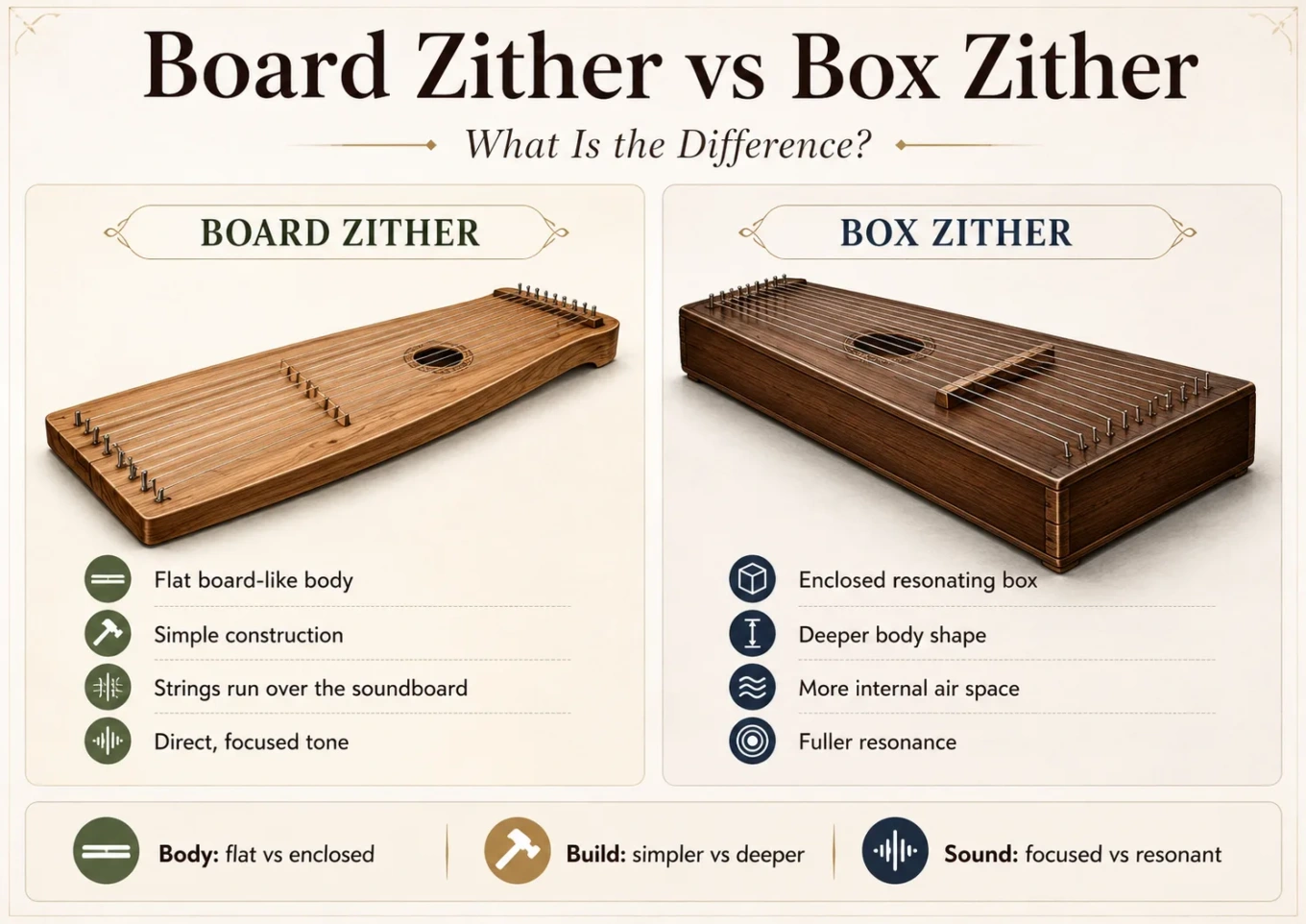
Board Zither vs Box Zither: What Is the Difference?
Board zither and box zither are closely related terms, but they do not mean exactly the same thing. A board zither is a zither[1] whose strings run over a board-like string bearer[2]. A box zither is usually a board zither with a box-shaped resonator[3] attached to or built beneath that board. The difference is mainly structural: one term names the string-carrying surface, while the other names the resonating body added to it.
This distinction can feel narrow because many familiar zithers combine both features. A concert zither, kantele, psaltery, qanun, koto, guzheng, and related instruments may all be described with zither-family language in some classification settings, yet their shapes, bridges, strings, tuning systems, and playing methods differ widely. “Board” and “box” describe construction, not one fixed musical tradition.
Board Zither vs Box Zither: The Main Difference
A board zither[4] is defined by its board-like string support. A box zither[5] is defined by the addition of a hollow box or chamber that helps strengthen the sound. In many museum and organology[6] descriptions, box zithers appear as a sub-type of board zither rather than a completely separate family.
| Feature | Board Zither | Box Zither |
|---|---|---|
| Basic idea | Strings are stretched over a flat or board-like support. | Strings are stretched over a board with a hollow box resonator. |
| Main construction focus | The string-carrying board. | The box-shaped resonating body. |
| Sound support | May have little extra resonance, or may use a separate resonator. | Uses a box chamber to add volume and body to the tone. |
| Classification relationship | A broad construction category. | Often treated as a resonated form of board zither. |
| Examples by structure | Simple board forms, some older or experimental flat zithers. | Many psalteries, chord zithers, concert zithers, and related box-bodied forms. |
| Common confusion | People may expect every board zither to have a full soundbox. | People may use “box zither” as if it names every zither with a flat body. |
Classification Note: In the Hornbostel-Sachs system[7], the broad zither idea depends on the way strings relate to the body. The strings do not run over a separate neck as they do on a lute or guitar. Board and box terms then narrow the description by naming the support and resonating structure.
What Is a Board Zither?
A board zither is a stringed instrument in which the main string support is a board. The strings pass across that board, and the board carries the tension, spacing, and layout of the instrument. This does not mean every board zither is plain or quiet. Some are simple, while others have carefully shaped soundboards[8], bridges, frets, decorative work, and added resonance systems.
The board is not just a visual base. It affects how the instrument is built, how the strings sit, and how the player reaches the strings. A board may be long and narrow, wing-shaped, rectangular, trapezoid, or gently curved, depending on the regional form and maker.
How the Board Works
The board gives the strings a stable path between fixed points. It may carry tuning pins, hitch pins, bridges, a fretted section, or a set of open strings[9]. In a simple form, the board may be almost the entire instrument. In a more developed form, the board works together with a hollow body or attached resonator.
Because of this, “board zither” can describe both plain and highly developed instruments. The term does not tell the reader how many strings the instrument has, whether it is fretted, whether it is plucked or struck, or whether it belongs to a specific country. It only gives a structural clue.
Typical Board Zither Traits
- The strings run over a board-like support.
- The instrument usually lacks a separate neck.
- The board may be flat, shallow, carved, or joined to another resonating part.
- Strings may be arranged as single strings, grouped courses[10], melody strings, accompaniment strings, or drones.
- The instrument may be plucked, strummed, struck, or played with another method, depending on the type.
What Is a Box Zither?
A box zither is a zither whose strings are supported by a board and whose body includes a box-like resonating chamber. The box may be shallow or deep, plain or carefully joined, rectangular or shaped. Its purpose is to give the vibrating strings a larger wooden or composite body through which the sound can develop.
The word “box” should not be read too literally. It does not always mean a square box. It refers to a hollow resonating body made from joined parts, often with a top surface that behaves like a soundboard. Many instruments that look elegant, curved, or wing-shaped may still function as box zithers in a structural sense.
The Role of the Soundbox
The soundbox[11] changes the playing feel and listening experience. A bare string stretched over a rigid support can vibrate, but it does not usually project much sound on its own. A box body gives the string energy a larger surface and air cavity to work with.
Wood choice, body depth, top thickness, internal bracing, and bridge placement can shape resonance. These details vary by tradition and maker, so it is safer to describe tendencies rather than one universal rule. A shallow box may produce a clear, direct tone; a deeper or wider body may give a fuller response, depending on the whole design.
Common Box Zither Features
- A hollow body beneath or around the string plane.
- A top plate that often functions as a soundboard.
- One or more bridges[12] that transfer string vibration into the body.
- Fixed tuning points, sometimes with separate sections for melody and accompaniment.
- A tone that usually carries better than a simple unresonated board form.
Why the Two Terms Overlap
The overlap comes from the way instrument classification works. “Board zither” identifies the string bearer. “Box zither” identifies the resonator type. A single instrument can therefore be both: it can have a board as its string support and a box as its resonating body.
This is why the phrase “board zither vs box zither” should not always be understood as two rival families. In many cases, it is a comparison between a wider category and one resonated form inside that category.
Luthier’s Note: A maker looking at these instruments would first ask how the string tension is carried, where the bridges sit, and how vibration enters the body. The label matters, but the construction tells the fuller story.
Construction Differences That Shape the Instrument
The most useful way to compare board zithers and box zithers is to look at the path of vibration. A player plucks, strikes, or strums a string. The string vibrates. That vibration passes through contact points, usually a bridge or bearing surface, and then into the board or box. The body then shapes the audible result.
String Support
On a board zither, the board is the defining support. It may be enough to identify the instrument even if the resonating part is small, separate, or absent. On a box zither, the board and the resonating body work together as a more complete acoustic structure.
This difference matters for classification, repair, and collecting. A damaged box zither may need attention to seams, top movement, or internal parts. A simpler board form may raise different questions: string path, pin stability, board flatness, and surface wear.
Resonating Body
A board zither may have no large hollow chamber, or it may rely on an attached resonator. A box zither has a hollow body made to support projection. This body is often part of the instrument’s identity, even when the player focuses mainly on the string layout.
The resonator does not “make” the pitch. The string length, tension, and mass shape pitch. The resonating body helps the sound become audible, colored, and sustained.
Bridge Systems
Bridge design separates many zither types more clearly than the broad labels do. Some instruments use fixed bridges. Others use movable bridges[13] that set speaking string length and can be adjusted for tuning, scale layout, or tone. Some have no raised bridge in the familiar sense and rely on other bearing points.
For example, East Asian long zithers such as the guzheng, koto, gayageum, and đàn tranh are often discussed with movable bridge systems in their own traditions. A European concert zither, by contrast, has a fretted melody area and additional open accompaniment strings. These instruments may share zither-family classification language, but their playing logic is different.
Frets and Fingerboards
Some zithers have frets[14]; many do not. A fretted section allows the player to stop strings at measured points, changing pitch along one or more melody strings. Concert zithers use this idea in a way that separates them from many open-string board or box forms.
A fretless box zither may instead give the player many pre-tuned strings. The musician selects pitches by choosing strings rather than shortening them against frets. That difference changes practice habits, notation, tuning work, and repertoire.
Sound and Playing Feel
A box zither often gives a stronger acoustic response than a simple board zither because the soundbox supports resonance[15]. The result is not automatically “better.” It is different. A light board form may sound direct and intimate. A box-bodied form may offer more body, sustain, and projection.
Timbre[16] depends on many details: string material, scale length, body shape, bridge pressure, top stiffness, playing tool, and tuning. Two box zithers can sound very different if one uses metal strings and the other uses gut, nylon, silk, or synthetic alternatives. Regional practice matters as much as the label.
Plucked, Strummed, or Struck
Many zithers are plucked with bare fingers, fingernails, fingerpicks, or a plectrum[17]. Some are struck with small hammers, as in hammered dulcimer and santur-related traditions. Some rare or regional forms may be bowed. The board-versus-box distinction does not decide the playing method by itself.
That is a common source of confusion. A person may see a flat stringed instrument and assume it is played like a guitar on a table. In practice, the technique can involve melody picking, drone strings[18], chord strumming, damping, ornamented bends, hammer strikes, or careful control of open strings.
Melody and Accompaniment Layouts
Some box zithers separate melody strings[19] from accompaniment strings. Concert zithers are a well-known example: fretted melody strings allow stopped notes, while additional open strings provide accompaniment. Other zithers use rows of open strings tuned to a scale, mode, or pitch set.
Some instruments also include sympathetic strings[20], though they are not a universal zither feature. When present, these strings are not always struck or plucked directly. They vibrate in response to related pitches and can add shimmer or sustain.
Examples That Help Clarify the Difference
Specific examples need careful wording because naming habits differ between museums, makers, and musicians. Still, several broad patterns help.
European Concert Zither
The European concert zither is commonly understood as a box-bodied zither. It has a resonating body, a fretted melody section, and additional open strings. In everyday speech, many people use “zither” narrowly for this instrument or its Alpine relatives. In wider classification language, it is one member of a much larger zither family.
Psaltery and Chord Zither Forms
Many psalteries and chord zithers use box-like bodies with open strings arranged for plucking or strumming. Their bodies may be rectangular, triangular, wing-shaped, or otherwise shaped. The box construction helps the instrument project without needing a separate neck or lute-like body.
Long East Asian Zithers
Instruments such as the guzheng, koto, gayageum, and đàn tranh are often discussed as long zithers in broad organological language. They usually deserve their own names first, because each belongs to a distinct musical tradition with its own tuning habits, bridges, string materials, ornaments, and repertoire. They should not be reduced to “box zither” as if the label explained the instrument fully.
Hammered Dulcimer and Santur-Related Instruments
Hammered dulcimers, santur, santoor, and related instruments are often classified within the larger zither area because their strings run over a body without a separate neck. Their playing method, however, is striking rather than ordinary plucking. The box body matters, but the hammer technique and bridge layout matter just as much.
Where the Confusion Starts
The confusion usually comes from three habits. First, “zither” is used both narrowly and broadly. Narrowly, it may refer to the European concert zither. Broadly, it can refer to a large group of chordophones[21] whose strings lie across a body or support without a separate neck.
Second, “board” sounds like a plain flat plank, while “box” sounds like a separate object. Real instruments are more varied. A board may be carved, braced, joined to a resonator, or integrated into a body. A box may be shallow, shaped, and finely built.
Third, players often name instruments by tradition rather than by classification. A musician is more likely to say koto, qanun, kantele, gusli, or concert zither than “box zither.” A curator may use both the local name and the structural label.
Collector’s Note: When identifying an old zither-family instrument, do not rely only on the outline. Look at string anchors, bridge marks, tuning pins, body seams, fret layout, and wear patterns. These details often reveal more than the broad label.
How Museums and Researchers Use the Terms
Museum records often need a shared vocabulary that works across cultures and periods. Terms such as board zither, box zither, trough zither, tube zither, and frame zither help describe structure without replacing local instrument names.
This is useful, but it has limits. A classification label can place an instrument in a family, yet it cannot fully describe style, repertoire, tuning, playing posture, or cultural use. For that reason, a good description usually combines three layers:
- The local or common name of the instrument.
- The structural label, such as board zither or box zither.
- The musical context, including region, playing method, tuning practice, and construction details.
A record that says “box zither” tells the reader something useful about the resonating body. It does not replace the need to know whether the instrument is a concert zither, psaltery, kantele, qanun, or another named form.
Which Term Should You Use?
Use board zither when the main point is the flat or board-like string support. Use box zither when the hollow box resonator is central to the description. Use the specific instrument name whenever it is known.
For a general comparison, the safest wording is:
- Board zither: a zither built around a board-like string bearer.
- Box zither: a board zither with a box-shaped resonating body.
- Specific instrument name: the best choice when discussing music, tuning, repertoire, or cultural setting.
This keeps the classification clear without flattening different traditions into one generic label.
What Beginners Should Know
For a beginner, the difference matters most when choosing, describing, or researching an instrument. A box zither may be easier to hear acoustically in a room because the body helps carry the sound. A simpler board zither may be quieter, lighter, or more direct in feel. Yet the learning path depends more on the specific instrument than on the category name.
A concert zither, kantele, psaltery, guzheng, koto, qanun, and hammered dulcimer do not share one beginner method. They ask for different hand positions, tuning routines, string maps, and musical habits. The label “zither” is a family clue, not a lesson plan.
Board Zither and Box Zither FAQ
Is a box zither a type of board zither?
In many classification contexts, yes. A box zither is often treated as a board zither with a box-shaped resonator. The board carries the strings, while the box helps strengthen and shape the sound.
Does every board zither have a soundbox?
No. Some board zithers may be simple board-based instruments, while others have attached or built-in resonators. The term “board zither” describes the string support first, not the amount of acoustic body.
Is a concert zither a board zither or a box zither?
A concert zither is generally understood as a box-bodied zither with a fretted melody section and additional open strings. In broader structural language, it belongs within the zither family and can be discussed as a resonated board-zither form.
Are guzheng and koto box zithers?
They are long zithers with resonating bodies, but their own names are more useful in musical discussion. Their movable bridges, tuning systems, playing techniques, and cultural settings are more specific than the broad label “box zither.”
Is a dulcimer the same as a box zither?
Some dulcimers are classified within the wider zither family, especially forms whose strings run across a box-like body without a separate neck. The word “dulcimer,” however, also points to particular playing traditions, including plucked and hammered types, so it should not be treated as an exact synonym.
Which term is better for describing an old instrument?
Use the specific instrument name when known. If the name is unknown, describe visible structure: board-like string bearer, box resonator, bridge layout, frets or no frets, string groups, and playing marks. That gives a more accurate description than choosing one broad label too quickly.
Glossary of Technical Terms
- Zither
- A stringed instrument type in which the strings run across a body or support without a separate neck in the guitar or lute sense. The word can refer narrowly to European concert zithers or broadly to a large family of related chordophones.
- String Bearer
- The part of the instrument that physically supports the strings between fixed points. In board zithers, the string bearer is a board-like surface.
- Resonator
- A body, chamber, bowl, tube, or other structure that helps the string sound become louder and more colored. In box zithers, the resonator is usually a hollow box-like body.
- Board Zither
- A zither whose strings are stretched over a board-like string bearer. It may be simple or may include added resonating parts.
- Box Zither
- A zither with a box-shaped resonating body. It is often understood as a resonated board zither, because the strings still relate to a board-like support.
- Organology
- The study of musical instruments, including their classification, construction, materials, playing methods, and cultural use. For zithers, organology helps separate structural labels from local instrument names.
- Hornbostel-Sachs System
- A widely used musical instrument classification system. It groups instruments by how they produce sound and by structural traits such as string support and resonator type.
- Soundboard
- The vibrating top surface that helps transmit string energy into the body of an instrument. In many box zithers, the upper plate acts as the soundboard.
- Open String
- A string played at its full length without being stopped by a finger or fret. Many zithers use open strings for melody, drones, chords, or accompaniment.
- Course
- A string or group of strings treated as one musical unit. Some zither-family instruments use single-string courses, while others may pair or group strings for a fuller sound.
- Soundbox
- A hollow body that helps amplify and shape the sound. In box zithers, the soundbox is central to the instrument’s acoustic behavior.
- Bridge
- A part that supports the strings and transfers their vibration into the instrument body. Bridge height, position, and material can affect playing feel and tone.
- Movable Bridge
- A bridge that can be shifted to adjust string length, tuning, or scale layout. Several long zither traditions use movable bridges as part of their normal setup.
- Fret
- A raised marker or bar that helps stop a string at a measured pitch point. Some zithers, such as concert zithers, use fretted melody strings; many other zithers are fretless.
- Resonance
- The way an instrument body responds to string vibration and helps sustain or strengthen sound. In zithers, resonance depends on body shape, material, bridge contact, and string setup.
- Timbre
- The color or character of a sound beyond pitch and volume. A box zither’s timbre may be shaped by its body depth, strings, bridges, and playing method.
- Plectrum
- A small tool used to pluck strings. Zither-family instruments may be played with a plectrum, fingerpicks, bare fingers, hammers, or other methods depending on tradition.
- Drone String
- A string tuned to provide a repeated or sustained pitch. Some zithers use drone strings to support melody or create a stable tonal center.
- Melody String
- A string used mainly for playing the tune. In some zithers, melody strings are separated from accompaniment or drone strings by layout and tuning.
- Sympathetic String
- A string that vibrates in response to other sounding strings rather than being played directly all the time. When used in zither-family instruments, it can add extra sustain or shimmer.
- Chordophone
- A musical instrument that produces sound through vibrating strings. Zithers, lutes, harps, bowed instruments, and many keyboard string instruments all fall within the chordophone category.