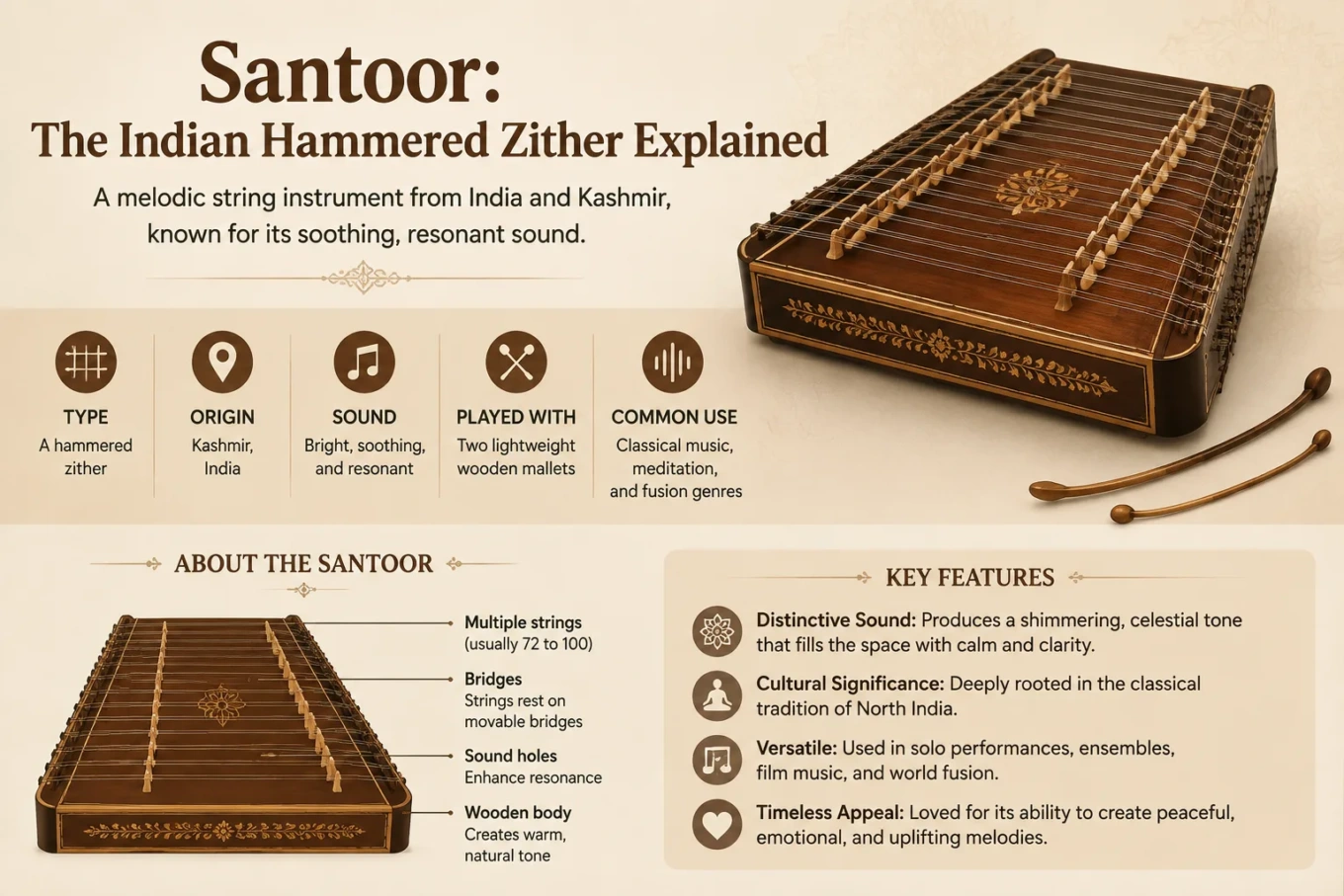
Santoor: The Indian Hammered Zither Explained
The santoor is a Kashmiri hammered string instrument built around a simple idea with demanding musical consequences: dozens of metal strings are stretched across a broad wooden body and struck with two light wooden mallets. In organological terms, it is a chordophone[1] and a struck zither[2]. The strings run across the instrument itself rather than along a separate neck, while the player produces notes by striking prepared pitches instead of stopping strings against frets.
The Indian santoor is especially associated with Kashmir and is now heard prominently in Hindustani classical music. Its concert form, however, should not be treated as a single fixed design. String counts, bridge layouts, materials, tuning arrangements, and playing methods can differ among instruments and performers. The often-repeated description of the santoor as a “100-string instrument” describes an important form of the instrument, not an engineering rule that applies to every santoor.
Why the Santoor Is a Hammered Zither
The word zither describes the relationship between the strings and the body more than it describes what the player does with the strings. On a santoor, the strings are stretched over the body and its soundboard[3]. There is no projecting guitar-like neck with a fingerboard on which pitches are stopped.
What distinguishes the santoor from many plucked zithers is its method of excitation. Its strings are struck. This places it among the broad family of hammered or struck zithers, and English-language descriptions often use the term hammered dulcimer for its general construction type.
Classification Note: “Zither” and “hammered” describe different aspects of the instrument. Zither refers to its structural organization; hammered describes how the strings are sounded. Calling the santoor a hammered zither therefore does not create a contradiction.
| Feature | Typical Santoor Form |
|---|---|
| Body | Low wooden resonating body with a broadly trapezoidal outline |
| Strings | Numerous metal strings arranged in grouped pitches or courses |
| Bridges | Multiple individual bridges arranged across the string field |
| Pitch Control | Strings are prepared by tuning rather than stopped against a fingerboard |
| Playing Tools | Two lightweight wooden mallets |
| Playing Position | Usually horizontal, with modern classical performers commonly supporting the instrument across the lap |
| Musical Setting | Kashmiri traditions and, in its developed concert form, Hindustani classical music |
A Santoor Is a Field of Prepared Pitches
A useful way to understand the instrument is to stop thinking of its many strings as dozens of separate melodic lines. Several physical strings may belong to one course[4], allowing multiple strings to reinforce the same pitch.
This distinction explains why a high string count does not mean that the performer has an equally large number of independent notes available. The musical layout is organized around grouped strings, bridges, and prepared pitches.
Body and Soundboard
The santoor uses a shallow wooden resonating body. Its upper surface supports a dense network of strings and bridges while also receiving their vibration. Kashmiri instruments are often associated with walnut construction, while other woods are also documented in santoor making. Wood choice, dimensions, thickness, internal construction, and setup can all affect response, so one material should not be presented as mandatory for every instrument.
The body also has to tolerate the combined tension of many metal strings. A well-made instrument therefore needs more than an attractive outer shape: the structure must remain stable while the top responds freely enough to transfer string vibration into audible sound.
Bridges Organize the String Field
The bridge[5] does more than hold a string above the soundboard. It transfers vibration into the body and helps define the usable vibrating length of the strings. Santoor bridges are distributed across the playing surface, making their placement part of both the acoustic design and the physical pitch map that the performer learns.
The result is visually distinctive. Instead of one long bridge near the edge of the body, the player faces rows of bridge-supported strings spread across a wide horizontal surface.
Why the Santoor Has So Many Strings
Multiple strings sounding the same prepared pitch can add volume, brightness, and density to the tone. They also allow a large set of usable pitches to be distributed across the instrument without relying on frets or finger-stopping.
Each string must still be brought to the required tension. Metal tuning pins[6] positioned around the instrument provide the mechanical adjustment needed to tune them.
String-Count Note: The familiar “100-string santoor” description should not be read as a universal specification. Traditional descriptions often associate the instrument with about one hundred strings, while modern classical designs may use different totals. The concert style associated with Shivkumar Sharma has been documented with 31 bridges and more than 90 strings. Makers and performers may use other arrangements.
How Two Small Mallets Shape the Santoor’s Sound
The strings are struck with lightweight wooden mallets commonly called mezrabs[7] in the Indian santoor tradition. Their low mass matters. A heavy hammer would produce a different response and make rapid, controlled articulation more difficult.
Each stroke starts a chain of vibration:
- The mallet contacts a string course.
- The strings begin vibrating.
- The bridge receives part of that vibration.
- The bridge transfers energy to the wooden top.
- The body radiates sound while the strings continue to ring.
This creates the santoor’s recognizable combination of a clear initial attack[8] followed by lingering resonance[9]. Fast alternation between the two hands can produce tightly articulated melodic runs while previously struck strings are still sounding.
Listening Note: A santoor note rarely consists only of the first impact. Listen past the strike. The lingering string vibration and overlapping decay of nearby notes create much of the instrument’s bright, shimmering character.
Stroke Placement Matters
Producing a note is easy; producing an even series of controlled notes is much harder. The player has to coordinate the two hands while controlling stroke strength, rebound, timing, and contact position.
A slight change in where or how a course is struck can change articulation. Stronger strokes can emphasize the percussive edge of the instrument, while controlled lighter strokes allow melodic lines to remain clearer. Advanced playing therefore depends on touch even though the player does not touch the strings directly with the fingers.
The Santoor’s Central Raga Challenge
Hindustani classical music is organized around raga[10], where musical identity depends not only on a collection of pitches but also on characteristic movement, emphasis, ornament, ascent, descent, and phrase shape.
This creates a particular challenge for a hammered instrument. A sitar or sarod player can physically alter a sounding string to shape pitch movement. A santoor player normally strikes a string that has already been tuned to a prepared pitch.
The instrument therefore has to produce fluid melodic language from a surface that behaves more like a field of predetermined notes.
The Instrument Is Prepared for the Raga
Santoor tuning should not be understood as one permanent universal chart. The player establishes a tonic, commonly discussed through the Indian solfège syllable Sa[11], and organizes the available pitches for the musical material being performed.
Which pitches are needed depends on the raga and the performer’s instrument. This is one reason a generic diagram claiming to show “the standard santoor tuning” can be misleading. Concert instruments do not all share one immutable combination of strings, bridges, and pitch positions.
Tuning also takes practical patience. Several strings assigned to one course need to agree closely enough to behave as a unified musical pitch. When one string drifts, the course can lose clarity even if its neighbors remain stable.
Why Meend Is Difficult on a Hammered Instrument
Meend[12] is a connected movement between pitches associated with melodic expression in Hindustani music. It exposes one of the main mechanical differences between the santoor and instruments whose strings can be bent or continuously altered after they are sounded.
A conventional santoor stroke begins on an already tuned string. The performer cannot normally pull that struck course across a long pitch interval in the same manner as a player bending a sitar string. Santoor musicians instead developed a vocabulary suited to the instrument: carefully connected attacks, rapid transitions, overlapping decay, ornament patterns, dynamic control, and performer-specific techniques that create greater melodic continuity.
This distinction matters. Rapidly striking two neighboring pitches is not mechanically identical to continuously bending one string from one pitch into another, even when the musical result suggests connected motion.
Modern Players Expanded What the Instrument Could Express
The modern classical santoor is strongly associated with Pandit Shivkumar Sharma, who worked to establish the Kashmiri instrument as a solo voice in Hindustani classical performance during the twentieth century. The task involved more than bringing a folk instrument onto a concert platform. Its construction, pitch range, playing position, stroke technique, and melodic vocabulary had to support extended raga performance.
The concert form associated with Sharma uses a larger pitch range than some earlier Kashmiri configurations and is documented with 31 bridges, more than 90 strings, and roughly three octaves. His approach also placed greater emphasis on sustaining musical continuity between the instrument’s naturally separated attacks.
His background in vocal music and tabla influenced an approach in which melodic development and rhythmic articulation could coexist naturally. That balance suits an instrument whose two mallets can behave as highly independent rhythmic tools even during melodic passages.
The Design Is Still Open to Refinement
Later musicians have continued to work on the santoor’s mechanical and expressive limits rather than treating one twentieth-century configuration as final.
Pandit Tarun Bhattacharya provides a recent example. He received the Padma Shri in 2026 and is credited by the Government of India with developing mankas, fine tuners intended to improve tuning accuracy on the santoor. He is also credited with introducing a meend technique to his approach to the instrument.
Such developments illustrate an important feature of santoor history: its concert design remains connected to individual performers who adjust both hardware and technique to meet musical needs.
From Kashmir to the Hindustani Concert Stage
The santoor has a strong historical association with Kashmir, where forms of the instrument have been used in regional music, including Sufi-linked performance traditions. The broader history of the instrument also intersects with the Persian santur.
Persian musical influence in North India included the santur, which became established in Kashmir. This makes the Persian connection an important part of the instrument’s history, but origin stories need careful wording.
Historical Note: The modern Indian santoor is sometimes identified with the shata-tantri veena, a “hundred-stringed” instrument mentioned in descriptions of earlier Indian music. Similar terminology and string counts do not, by themselves, prove an uninterrupted construction lineage between an ancient textual instrument and the modern Kashmiri santoor. The documented Persian santur connection to Kashmir should also be considered.
By the mid-twentieth century, the santoor was not yet established as one of the standard solo instruments of Hindustani concert music. Its short struck articulation and limited ability to produce continuous bends presented musical problems that performers had to address directly.
Its later classical identity is therefore best understood as an adaptation of a regional hammered zither to the demands of extended raga performance, rather than as a concert tradition whose present form remained unchanged for centuries.
Santoor and Persian Santur Are Related, Not Interchangeable
The spelling similarity can make the Indian santoor and Persian santur appear to be two names for exactly the same instrument. They belong to closely related hammered-zither traditions, but their present construction, tuning practices, repertoire, playing techniques, and musical systems developed in different settings.
| Feature | Indian Santoor | Persian Santur |
|---|---|---|
| Main Association | Kashmir and Hindustani classical performance | Iranian/Persian musical tradition |
| Instrument Family | Struck zither | Struck zither |
| Sound Production | Strings struck with light wooden mallets | Strings struck with light wooden mallets |
| Pitch Organization | Configured for Indian musical practice and performer-specific layouts | Configured for Persian musical practice |
| Modal Context | Raga-based Hindustani music | Persian modal practice, including the dastgah[13] tradition |
Even their string counts should not be used as absolute identification rules. Indian classical santoor designs often carry more strings than common Persian santur configurations, but both traditions contain construction variation.
How the Santoor Differs from Other Familiar Zithers
The most useful comparison starts with the performer’s hands.
- Santoor: two mallets strike groups of tuned strings.
- Persian santur: mallets also strike strings, but the instrument belongs to a different tuning and performance tradition.
- Qanun: the strings are plucked rather than hammered, and mechanical levers may be used to adjust pitch during performance.
- Guzheng: strings are plucked, while the hand can press the string on one side of a movable bridge to alter pitch and create ornaments.
- Koto: strings pass over movable bridges and are normally plucked with finger picks.
- Hammered dulcimer: shares the general struck-string principle, but layouts, tunings, repertoires, hammer designs, and regional playing methods vary widely.
The visible similarities among these instruments come from arranging strings across a resonating body. Their musical behavior becomes much clearer once bridge design, pitch control, and the method used to excite the strings are compared.
Why the Santoor Sounds Bright and Layered
The characteristic tone comes from several mechanisms working together. The mallet creates a sharp beginning to each note. Multiple strings in a course can reinforce the pitch. Previously struck strings may still be ringing when the next note arrives, creating overlapping layers of sound.
The instrument consequently produces both percussion-like clarity and sustained tonal activity. Its sustain[14] is not the continuous controlled sustain of a bowed string instrument; it comes primarily from strings continuing to vibrate after their brief contact with the mallet.
Fast passages can sound especially dense because one hand may begin the next articulation while tones struck fractions of a second earlier are still decaying.
Listening Note: The visual motion of a santoor performance can look strongly rhythmic because both hands repeatedly strike the instrument. The musical result can remain highly melodic. Much of advanced playing depends on making separate impacts form coherent phrases rather than isolated notes.
What Makes a Santoor Difficult to Build and Set Up
A large number of strings multiplies small construction and setup problems. Stable tuning depends on secure pins, suitable strings, well-positioned bridges, consistent courses, and a body capable of supporting substantial combined tension.
The bridge system is especially sensitive because each bridge participates in transferring vibration while also helping organize playable string lengths. Poor alignment can affect string position or playing accuracy. Uneven bridge contact can also affect response.
String replacement and setup require attention to gauge, pitch, tension, and course balance. Replacing a metal string with one that merely “fits” physically does not guarantee that it is suitable for the intended pitch or tension.
Luthier’s Note: On a many-stringed instrument, small inconsistencies accumulate. Bridge height, string seating, tuning stability, and course matching need to work together; correcting one isolated buzz or unstable string may require checking the setup around it rather than treating that string alone.
Learning Santoor Is More Than Memorizing String Positions
A beginner can produce a clear sound almost immediately by striking a correctly tuned course. Controlled playing demands several additional skills.
- Learning the physical pitch map across the bridges
- Developing accurate right- and left-hand strikes
- Controlling rebound instead of forcing the mallet into the strings
- Keeping repeated strokes even
- Moving cleanly between neighboring and distant courses
- Managing ringing notes so resonance supports rather than obscures a phrase
- Maintaining the tuning of many strings
- Learning raga phrasing rather than treating the instrument as a chromatic note grid
The gap between producing a note and producing a convincing phrase is therefore wide. Mechanical accuracy, listening, tuning, rhythmic control, and melodic knowledge develop together.
How to Recognize an Indian Santoor
A typical Indian santoor can usually be recognized by a combination of features rather than one measurement or string count.
- A low, broadly trapezoidal wooden body
- A dense field of metal strings across the upper surface
- Numerous small bridges rather than one continuous bridge
- Tuning pins distributed around the instrument
- No projecting fretted neck
- A horizontal playing position
- A pair of light wooden mallets used to strike the strings
These features separate it visually from necked Indian chordophones such as the sitar and sarod. They also help distinguish it from plucked zithers even when several instruments share a broadly rectangular or trapezoidal profile.
Glossary of Technical Terms
[1] Chordophone: A musical instrument in which vibrating strings are the primary sound-producing elements. Zithers, lutes, harps, and bowed string instruments all belong to the wider chordophone category, despite their very different structures.
[2] Struck Zither: A zither whose strings are sounded mainly by striking them with hammers or mallets rather than plucking or bowing them. The santoor and Persian santur are examples.
[3] Soundboard: The responsive upper surface that receives vibration from the strings, usually through bridges, and helps radiate that energy as sound. Its construction has a major role in the response of many wooden zithers.
[4] Course: A group of strings treated as one musical unit or pitch. A many-stringed zither can therefore have far fewer independently selected pitches than its total number of physical strings suggests.
[5] Bridge: A support over which strings pass. On the santoor, multiple bridges help establish string geometry and transfer vibration from the strings to the resonating body.
[6] Tuning Pin: A metal pin used to change and hold string tension. Turning the pin alters the pitch of the attached string.
[7] Mezrab: In the santoor context, a light wooden striking implement held by the player. The same word can describe different plectrum-related objects in other Indian instrumental traditions, so its meaning depends on the instrument.
[8] Attack: The beginning of a musical sound. A struck metal string has a clearly defined attack because energy is transferred during a brief mallet impact.
[9] Resonance: The continuation and reinforcement of vibration in strings and the instrument body. On a santoor, overlapping resonances contribute to the dense ringing quality heard around successive strokes.
[10] Raga: A melodic system used in Indian classical music that organizes selected pitches together with characteristic movements, emphasis, ornaments, and phrase behavior. It is more specific than simply choosing a scale.
[11] Sa: The tonic syllable in Indian solfège. Santoor players organize other required pitches in relation to this tonal center when preparing the instrument for performance.
[12] Meend: A connected glide or transition between pitches used as an expressive device in Hindustani music. It is mechanically difficult on a conventional hammered zither because the player normally strikes separate prepared pitches rather than bending a sounding string continuously.
[13] Dastgah: A principal modal system used in Persian classical music. It provides useful context when distinguishing the musical environment of the Persian santur from the raga-based environment of the Indian classical santoor.
[14] Sustain: The period during which a note continues sounding after it begins. On the santoor, sustain mainly comes from the free vibration of struck strings and the resonating body after mallet contact has ended.
Frequently Asked Questions About the Santoor
Is the Santoor the Same as the Persian Santur?
No. They are closely related struck zithers, but the Indian santoor and Persian santur belong to different present-day musical traditions and can differ in construction, string layout, tuning, repertoire, and technique.
Does Every Santoor Have 100 Strings?
No. One hundred strings is a widely repeated traditional description, but it is not a universal specification. Modern classical instruments may use other totals, including configurations with more than 90 strings and bridge layouts developed for individual performance approaches.
Why Is the Santoor Considered a Zither?
Its strings extend across the instrument’s resonating body rather than along a separate projecting neck. That structural relationship places it within the broad zither family, while the use of mallets makes it a struck or hammered form.
Is the Santoor Plucked?
No. Its normal playing method uses two lightweight wooden mallets to strike the strings. This separates its basic playing action from plucked zithers such as the qanun, guzheng, and koto.
Can a Santoor Play Meend?
The instrument does not naturally produce long continuous string bends in the same way as some necked Indian instruments. Santoor players have developed techniques for connected melodic expression, and individual performers have also introduced specialized approaches to meend.
Is There One Standard Santoor Tuning?
No. Tuning depends on the instrument, its bridge and string configuration, the performer, the tonic, and the musical material required for the raga. A single universal tuning chart would therefore misrepresent the variety found in actual instruments.