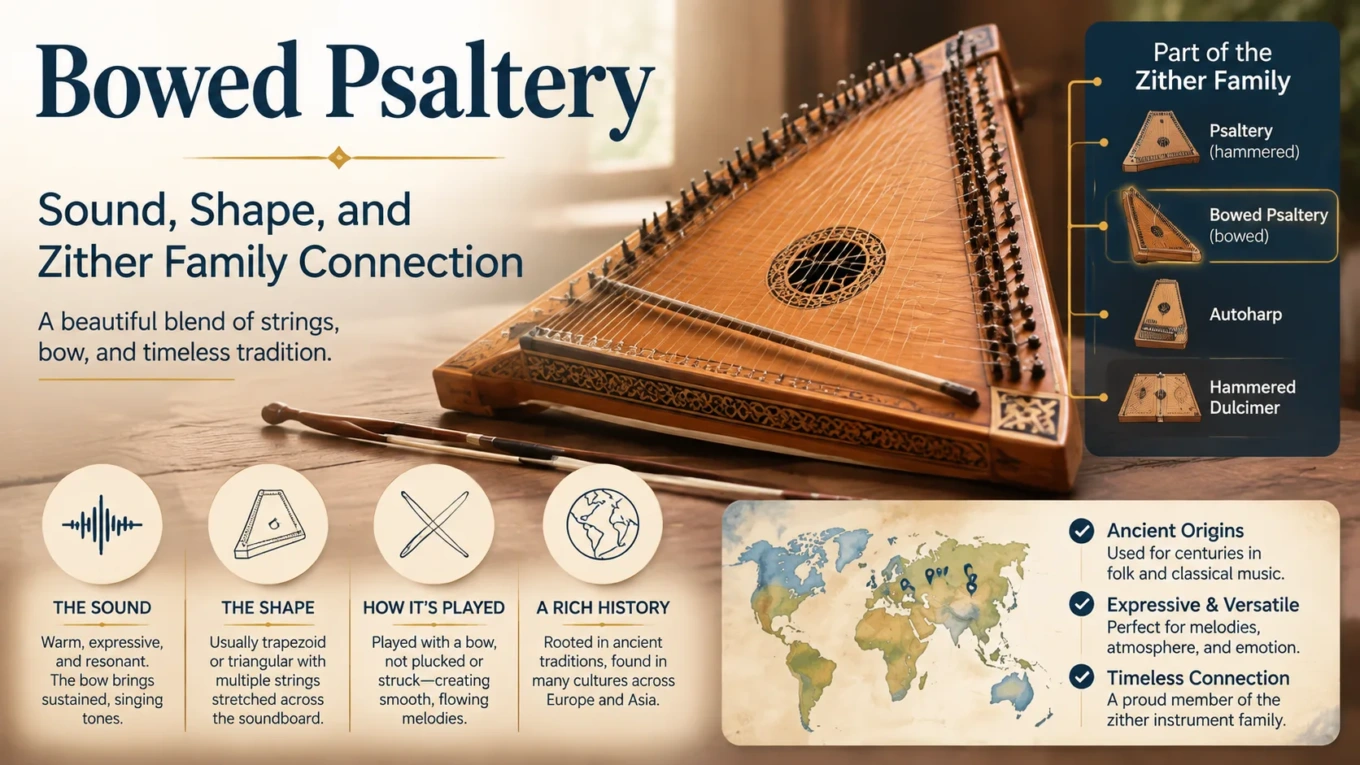
Bowed Psaltery: Sound, Shape, and Zither Family Connection
The bowed psaltery looks like a small triangular instrument from an older European tradition, yet the familiar modern form works according to a distinctly practical idea: many individually tuned strings are arranged so that a bow can reach them one by one. It is a bowed chordophone[1], but the presence of a bow does not place it in the violin family. Its strings lie directly across a resonating body rather than running along a neck and fingerboard, which is why the instrument remains closely connected with the zither family.
The most useful way to understand a bowed psaltery is to follow the relationship between its shape, string layout, bow access, and sound. The triangular outline is not simply decorative. It helps expose the ends of strings of different lengths, allowing the player to select fixed pitches with the bow.
Why the Bowed Psaltery Has Its Familiar Shape
Most modern bowed psalteries use a long triangular or sharply tapered wooden body. The strings run across the soundboard[2] and become progressively shorter toward the narrow end of the instrument.
This geometry solves an important playing problem. A bow needs a clear place to contact each string without immediately striking its neighbors. By arranging strings of different lengths along sloping sides, the maker leaves an exposed bowing point near the perimeter for each note.
Longer strings generally support lower pitches and shorter strings higher pitches, but length is only part of the tuning relationship. Tension, string mass, diameter, and material also affect pitch. For that reason, the triangular outline should be understood as a practical string-layout solution rather than a simple diagram in which length alone determines every note.
Main Construction Details
| Feature | Function |
|---|---|
| Tapered body | Provides a resonating chamber and exposes strings of different lengths along the edges. |
| Soundboard | Receives string vibration and helps transfer it to the surrounding air. |
| Strings | Usually provide individually tuned pitches rather than several fingered notes from one string. |
| Tuning pins | Adjust string tension and therefore pitch. |
| Bridge | Supports the strings and transfers vibration into the body. |
| Exposed string ends | Give the bow access to individual strings near the outer edges. |
The bridge[3] and soundboard work together as part of the acoustic system. Exact bridge shape, pin placement, soundhole design, body depth, and internal construction vary among makers, so there is no single universal bowed psaltery blueprint.
Luthier’s Note: The triangular outline is useful because it coordinates string length with bow access. Changing that geometry affects more than appearance; it can change the space available for bowing, string spacing, range, and overall playing feel.
One String, One Pitch
The playing logic differs sharply from that of a violin. On a typical bowed psaltery, each string is tuned to a particular open string[4] pitch. The player changes notes by moving the bow to another string.
There is normally no fingerboard on which the player shortens the vibrating portion of a string. Frets are also unnecessary for the usual fixed-pitch layout. A melody therefore moves physically across a group of separately tuned strings.
This arrangement makes pitch location visually straightforward once the player knows the layout, but clean playing still takes control. The bow must reach the intended string while avoiding its neighbors, and quick melodies may require repeated movement between different parts of the instrument.
Diatonic and Chromatic Layouts
Some bowed psalteries use a mainly diatonic[5] arrangement designed around the notes of a scale. Others are chromatic[6] and include the additional semitones needed for a wider range of keys and melodies.
On many chromatic instruments, natural notes occupy one side while sharps and flats are placed along the other. This creates an easily understood physical separation, but it is not a universal rule. Makers can use different pitch ranges, note sequences, string counts, and labeling systems.
The two-sided layout also affects movement. A passage using only natural notes may remain on one edge for several notes, while a chromatic passage can require the player to move the bow from one side of the instrument to the other.
Playing Note: A printed tuning diagram should match the specific instrument. A note map made for another bowed psaltery may use a different range or string order.
How the Bow Creates the Sound
A plucked string receives one short burst of energy and then gradually loses it. A bowed string can continue receiving energy while the bow remains in motion. This produces the sustained notes that give the bowed psaltery its characteristic melodic behavior.
Rosined bow hair grips and releases the string in a repeating motion. The vibrating string transfers energy through its supports into the wooden body. The result is usually a clear attack followed by a sustained tone rather than the rapid decay associated with many plucked psalteries.
The instrument’s timbre[7] is often described as bright, focused, silvery, or slightly glassy. Those descriptions are useful as listening language, but the actual tone varies with construction, strings, bow technique, room acoustics, and the individual instrument.
What Shapes the Tone
- Bow speed: affects how easily the string starts and how the note continues.
- Bow pressure: influences clarity, volume, and the amount of roughness in the attack.
- Contact point: changes the balance between the main pitch and upper partials.
- String properties: diameter, material, mass, and tension affect response and pitch.
- Soundboard and body: determine how string vibration is transferred and radiated.
- String layout: nearby undamped strings may react weakly to related frequencies.
That last effect can create a small amount of sympathetic resonance[8]. It should not be assumed to behave like a deliberately designed bank of sympathetic strings, however. The amount of secondary vibration depends on tuning, damping, construction, and the notes being played.
Listening Note: The clearest contrast with a plucked psaltery is usually the note envelope. A plucked note begins strongly and fades, while a bowed note can remain active for as long as the player maintains controlled bow contact.
Why the Bowed Psaltery Is Still a Zither
The word zither can be used narrowly for particular European instruments, especially the concert zither, or more broadly in organology for chordophones whose strings are stretched across a string-bearing body without the separate neck arrangement found on lutes and violins.
The familiar hollow-bodied bowed psaltery fits naturally within that broader structural idea and is commonly treated as a box zither[9]. Its strings are carried by the resonating body itself. The bow describes how the strings are set into motion; it does not redefine the basic string-bearing structure.
Classification Note: “Bowed” and “zither” describe different aspects of the instrument. Bowed identifies the main playing method. Zither identifies the structural relationship between strings and body.
Why a Bow Does Not Make It a Violin
Bowed psalteries and violins both use bows, but their pitch systems and physical construction are very different.
| Feature | Bowed Psaltery | Violin |
|---|---|---|
| String support | Strings extend across the zither body. | Strings extend from body across a neck and fingerboard. |
| Pitch selection | Player chooses separately tuned strings. | Player stops strings at different finger positions. |
| Fingerboard | Normally absent. | Essential to normal technique. |
| Number of available pitches | Closely tied to the installed and tuned strings. | Many pitches can be produced from each string. |
| Primary string activation | Bow. | Bow, with plucking also used in technique. |
| Broad structural family | Zither. | Lute-family chordophone. |
The difference becomes especially clear when a scale is played. A violinist changes the vibrating length of only a few strings with the fingers. A bowed psaltery player normally travels across many fixed-pitch strings instead.
This also changes the role of intonation[10]. On a violin, finger position directly determines whether a stopped note is accurately placed. On a normally tuned bowed psaltery, the pitch of each open string has already been set during tuning, so the player’s immediate task is selecting and bowing the correct string cleanly.
Bowed Psaltery and Plucked Psaltery
The shared name can create historical confusion. Psalteries have a much older history as string instruments played by plucking with fingers or a plectrum. The familiar modern bowed psaltery belongs to a different construction and performance context.
| Detail | Bowed Psaltery | Plucked Psaltery |
|---|---|---|
| Main string action | Bowing | Plucking |
| Note behavior | Sustained while bowing continues | Strong attack followed by decay |
| Body geometry | Often narrow and triangular so individual strings remain bow-accessible | Historical forms vary and do not need the same bow-access geometry |
| Historical identity | Familiar form is modern | Documented in much earlier musical traditions |
The distinction matters because an old depiction of a psaltery does not automatically document the modern bowed instrument. The name provides a connection, but names alone do not establish identical construction or technique.
Why the Instrument Can Look Older Than It Is
Triangular geometry, exposed strings, carved or pierced soundholes, and the word psaltery can make a modern bowed psaltery appear medieval. The historical relationship needs more care.
Plucked psalteries were known centuries before the modern bowed form. The bowed psaltery commonly encountered today developed within twentieth-century bowed-zither experimentation rather than as a continuously preserved medieval bowing tradition.
German bowed-zither designs from the early twentieth century form part of this background. Instruments associated with the violin-zither idea, including designs connected with Clemens Neuber in the 1920s, show that makers were experimenting with individually bowable zither strings before the modern triangular bowed psaltery became familiar in its later form.
It is therefore more accurate to describe the bowed psaltery as a modern member of the broader psaltery and zither landscape, shaped by older names and forms but not identical to the historical plucked psalteries shown in medieval art and collections.
Tuning Is Not Standardized Across All Bowed Psalteries
The neat visual order of the strings can suggest that every bowed psaltery follows the same tuning chart. It does not.
Range depends on body size, string count, intended repertoire, construction, and maker preference. A smaller instrument may cover fewer notes, while a larger chromatic model may extend across a broader range. Some instruments label every string; others rely on a printed chart or the player’s familiarity with the layout.
The vibrating scale length[11] of each string changes across the tapered body. Makers combine those different lengths with tension and string gauge[12] to establish the intended pitches.
Tuning Note: A bowed psaltery should be tuned to the layout intended for that particular instrument. Raising strings to pitches taken from an unrelated tuning chart can create unsuitable tension.
Materials and Resonance
Modern bowed psalteries are usually built around a wooden resonating box with metal strings. Exact woods, body thickness, bracing, bridge material, pin hardware, string specifications, and surface finish depend on the maker.
Wood choice can shape resonance, but species names alone do not predict the final sound. Soundboard thickness, stiffness, body volume, bridge coupling, string tension, and workmanship interact. Two instruments made from similar woods can therefore respond differently.
The metal strings contribute to the clear upper-frequency content often associated with the bowed psaltery. The body softens, reinforces, and radiates that vibration rather than simply acting as a decorative holder for the strings.
What Playing One Actually Requires
The absence of a fingerboard can make the bowed psaltery approachable for simple melodies. Once the instrument is accurately tuned, the correct pitch is already assigned to the correct string.
That does not make clean bowing automatic. Players still need to develop several forms of control:
- finding the intended string without hesitation;
- starting a note without scraping neighboring strings;
- maintaining even bow speed;
- changing direction smoothly;
- moving between the two sides of a chromatic layout;
- controlling dynamics without forcing the string;
- allowing unwanted strings to remain quiet when a passage demands clarity.
Expression comes mainly from bow speed, pressure, articulation, note length, phrasing, and dynamic control. Violin-style finger vibrato is not part of the normal fixed-string system because the player is not stopping the string against a fingerboard.
Some players support the instrument upright or at an angle, while others use a lap, stand, or table position. Technique varies with instrument size and player preference. One bow is sufficient for normal melody playing; two-bow approaches also exist as an alternative technique for players who want to sustain more than one string.
How Shape Limits and Enables the Music
The triangular structure gives the player direct access to many separate pitches, but it also establishes clear physical limits. A note that has no corresponding string cannot be produced in the ordinary fixed-pitch manner unless the instrument includes that pitch in its tuning.
This differs from a fingerboard instrument, where one string can provide many pitch positions. The bowed psaltery trades that flexibility for a direct note-selection system: locate the string, bow it, and the tuned pitch sounds.
That design works especially well for clear melodic lines, sustained folk melodies, hymns, modal material, slow ornamented phrases, and ensemble textures where a narrow sustained tone is useful. Repertoire is not restricted to those uses, but the physical layout naturally favors music that can be mapped comfortably across the available strings.
Where the Bowed Psaltery Fits in the Zither Family
Zithers can be set into vibration in several ways. Some are plucked with fingers or plectra. Others are struck with small hammers. Some are bowed. The method of activation changes the sound and technique, while the structural relationship between strings and body provides the stronger family connection.
The bowed psaltery is especially useful for showing why “zither” should not be treated as the name of one shape or one playing method. A concert zither, hammered dulcimer, plucked psaltery, and bowed psaltery organize their strings differently and produce sound in different ways, yet each can be discussed within broader zither classification when its string-bearing structure fits that category.
For the bowed psaltery, three features explain most of its identity: the body carries the strings, the triangular geometry gives the bow access to individual pitches, and each string normally supplies a fixed tuned note. Those features connect its shape, sound, and organological position without treating it as a violin simply because both instruments use bows.
Glossary of Technical Terms
[1] Chordophone. An instrument in which vibrating strings are the primary sound source. Zithers, lutes, harps, and bowed string instruments all belong to the chordophone category, although their strings are supported and played in different ways.
[2] Soundboard. The vibrating surface that receives energy from the strings and helps radiate it as audible sound. In many zithers, it forms part of the main string-bearing body.
[3] Bridge. A support that holds strings at the required height and helps transmit their vibration to the soundboard or resonating body. Bridge design varies widely across zither types.
[4] Open String. A string sounded without being shortened by a finger against a fingerboard or fret. On a bowed psaltery, each open string normally supplies its own tuned pitch.
[5] Diatonic. A pitch arrangement centered on the notes of a particular seven-note scale pattern rather than including every semitone. Some simpler bowed psalteries use mainly diatonic layouts.
[6] Chromatic. A pitch system that includes semitone steps, allowing sharps and flats beyond a basic diatonic set. Chromatic bowed psalteries usually require more strings and a more involved layout.
[7] Timbre. The tonal character that allows two instruments playing the same pitch to sound different. On zithers, string material, body construction, bridge behavior, and playing method all contribute to timbre.
[8] Sympathetic Resonance. The vibration of an unplayed string or body component in response to a related frequency produced elsewhere on the instrument. It can add a subtle layer of resonance when open strings remain free to vibrate.
[9] Box Zither. A zither whose strings are carried by a hollow, box-like resonating body. The common modern bowed psaltery is often described within this structural category.
[10] Intonation. The accuracy of musical pitch during performance. On fingerboard instruments it depends heavily on finger placement; on a normally tuned bowed psaltery, pitch accuracy depends more directly on the tuning of the separate open strings.
[11] Scale Length. The effective vibrating length of a string between its supporting points. Different string lengths are one reason the bowed psaltery can arrange lower and higher pitches along a tapered body.
[12] String Gauge. The thickness of a string. Gauge works together with length, material, and tension to determine pitch and playing response.
Frequently Asked Questions
Is a bowed psaltery really a zither?
Yes. The common modern form is structurally connected with the zither family because its strings are stretched across and supported by the resonating body rather than a separate neck and fingerboard. Bowing describes the playing method, not a different structural family.
Is the bowed psaltery a medieval instrument?
The familiar modern bowed psaltery should not be presented as a surviving medieval bowed instrument. Historical psalteries are much older, but they were primarily associated with plucked playing. The modern bowed form developed in the twentieth-century bowed-zither context.
Why is a bowed psaltery triangular?
The tapered shape helps expose the ends of strings of different lengths along the sides. This gives the bow access to individual strings while allowing a large number of fixed pitches to fit on a compact body.
Does every bowed psaltery use the same tuning?
No. String count, range, note order, diatonic or chromatic layout, and tuning can vary by maker and model. The correct tuning chart is the one intended for the specific instrument.
Does a bowed psaltery have frets?
Normally no. Most modern bowed psalteries use separately tuned open strings, so the player changes pitch by selecting another string rather than stopping a string against frets or a fingerboard.
Why does a bowed psaltery sound different from a violin?
The two instruments use different bodies, string layouts, pitch-selection systems, bowing positions, and resonating structures. A bowed psaltery usually produces notes from many fixed-pitch open strings, while a violin produces many pitches by stopping a small number of strings along a fingerboard.