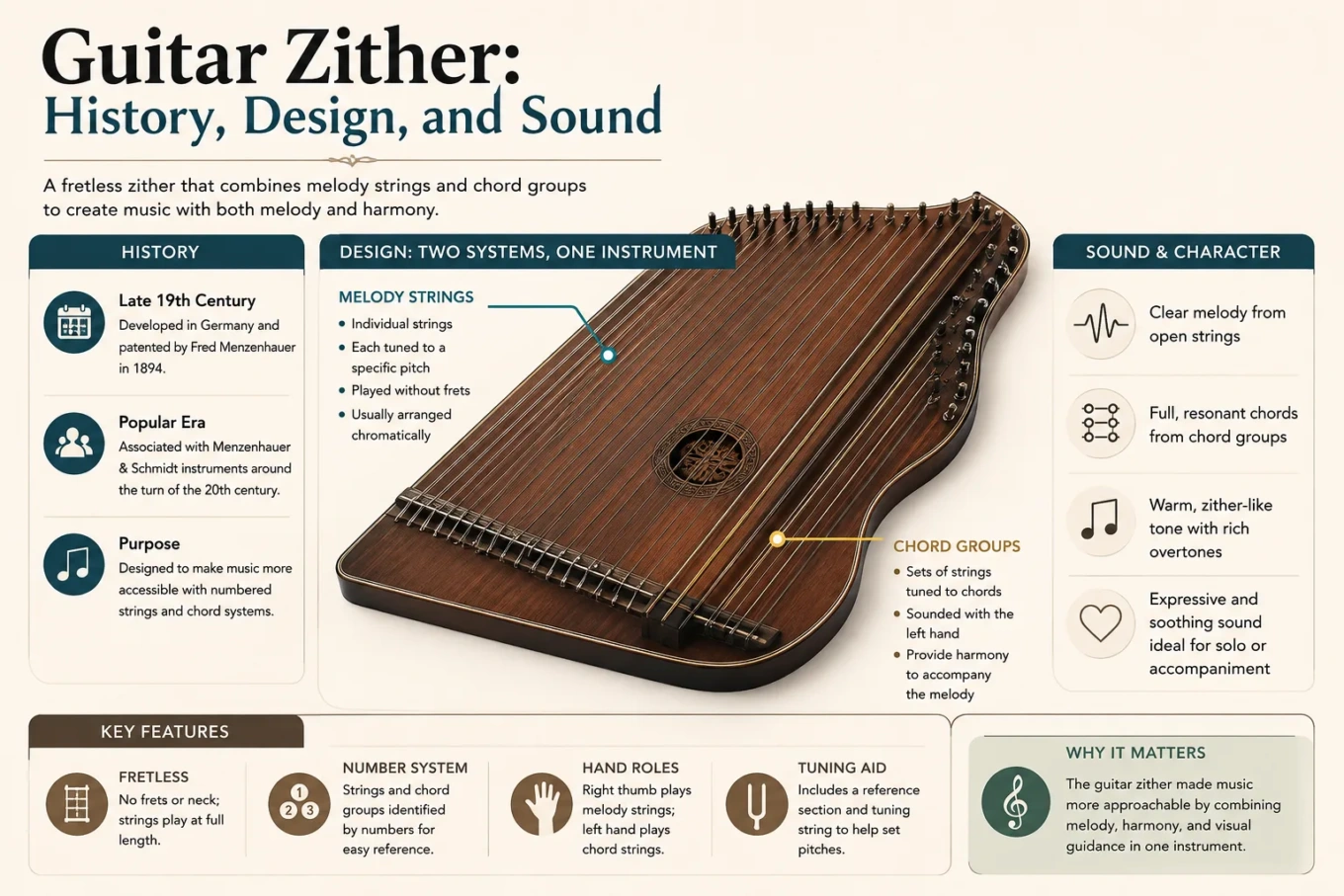
Guitar Zither: History, Design, and Sound
A guitar zither is a fretless zither built around two different kinds of string work: individual strings for melody and grouped strings for ready-made harmony. Despite the name, it normally has no projecting guitar neck and no guitar-style fingerboard. The label refers more closely to its chordal effect than to guitar construction. The form became especially associated with Friedrich “Fred” Menzenhauer and the Menzenhauer & Schmidt instruments produced around the turn of the twentieth century.
That layout made the instrument unusually direct. A player could pick a melody on an open string[1] field while sounding an accompanying chord from a separate group of strings. Historical systems also used printed numbers and underlay sheets to reduce dependence on conventional staff notation. The guitar zither was therefore not simply a differently shaped zither; its design reorganized melody, harmony, and visual guidance into one tabletop instrument.
Why the Name “Guitar Zither” Can Be Misleading
The word guitar suggests a neck, frets, and strings stopped by the fingers. Those features are not what define the historical guitar zither. Its strings lie across a broad body and sounding surface, with the full sounding length of each melody string available without fretting. In construction it belongs with fretless zithers rather than with necked guitars.
Historical German usage included Gitarrenzither and related spellings. Museum research on these instruments notes that the name had more to do with the impression of guitar-like chord accompaniment than with the physical structure of a guitar. This distinction matters because antique instruments are sometimes misidentified when the name is taken literally.
Name versus structure: a guitar zither may suggest a guitar by name, but its practical identity comes from a zither body, many unstopped strings, and a division between melody strings and chord strings.
The 1894 Menzenhauer Patent and Its Playing Logic
Fred Menzenhauer’s United States patent for a “Guitar-Zither,” published on May 29, 1894, gives a clear view of the instrument’s intended logic. The patent describes an open scale of melody strings on one side of the soundboard[2] and several sets of accompaniment strings on the other. Each accompaniment set is tuned as a separate chord.
The patent does more than describe string placement. It explains a system in which the melody strings and chord groups are identified by numbers. A detachable inclined bracket carries these markings and supports the music. Instead of relying only on ordinary notation, the music can indicate which numbered melody string and which numbered chord group should be sounded.
This was a practical design decision. It linked three things that a beginner had to coordinate: the printed instruction, the physical location of a string, and the harmony that belonged with the melody. Menzenhauer also included a hand rest and a separate tuning string over a small fretted reference section intended to help establish pitches during tuning.
What the Patent Says About the Hands
The patent specifies that the thumb of the right hand sounds the open scale strings while the fingers of the left hand vibrate the chord strings. That division is useful for understanding the layout: the two string fields were not merely decorative or organizational. They were assigned different musical jobs.
Later fretless zithers could be played with somewhat different techniques, including the use of a thumb plectrum[3]. Surviving instruments also differ in string count and arrangement, so the patent should be read as a documented early design rather than a specification that every later guitar zither followed exactly.
Melody Strings and Chord Groups Do Different Work
The clearest way to understand a guitar zither is to treat its string field as two neighboring systems.
The Melody Side
The melody section uses individual strings, each already tuned to a fixed pitch. Because the player does not shorten those strings against a fingerboard, changing pitch usually means moving to another string. In many documented German examples, the melody strings form a chromatic[4] sequence covering about three octaves, although smaller and differently arranged instruments also survive.
This one-note-per-string approach produces a wide fan of tuning pins and string lengths. It also explains why a guitar zither can carry far more strings than a conventional guitar: the instrument needs separate physical strings for pitches that a fretted neck could otherwise obtain by shortening a smaller number of strings.
The Harmony Side
The accompaniment strings are arranged in a chord group[5]. Instead of selecting the separate notes of a chord from across the whole instrument, the player finds a prepared cluster of strings tuned to work together. Menzenhauer’s patent describes groups built around a lower leading or bass string[6] with additional chord tones above it.
Surviving commercial guitar zithers commonly show five or six such groups, but this is not a universal rule. Makers altered the number of chords, the number of strings in each chord, the melody range, and the decorative layout. Some later catalogue models became much more elaborate than the early patent form.
| String Area | Main Job | How Pitch Is Selected |
|---|---|---|
| Melody strings | Single-note melody | The player plucks the individual string assigned to the required pitch. |
| Chord strings | Harmonic accompaniment | The player sounds a prepared group whose strings are already tuned as a chord. |
A 49-String Museum Example Shows the Design Clearly
A Menzenhauer & Schmidt Guitar-Zither No. 3½ in the Musical Instrument Museum of Leipzig University, dated to about 1910, offers a useful physical example. It has 49 strings: 25 melody strings and six chord groups containing four strings each.
| Feature | Documented Layout |
|---|---|
| Total strings | 49 |
| Melody strings | 25 |
| Chord groups | 6 |
| Strings per chord group | 4 |
Another Menzenhauer & Schmidt instrument in the Leipzig collection has 41 strings and a smaller melody-and-chord layout. The contrast is useful: “guitar zither” describes a design family, not one mandatory string count.
Other catalogue and museum examples expand the idea further. Some models doubled melody strings in a mandolin-like manner; others changed the outline or used names that referred to harp or lyre shapes. The basic attraction remained the same: a fretless melody field paired with organized accompaniment.
How the Body Supports So Many Open Strings
A guitar zither places many strings under tension across a relatively broad body. The bridge[7] and related string supports transfer string vibration into the soundboard, while the body provides the resonating structure and support needed for the string array.
The tuning end is crowded with tuning pins[8], because each independently tuned string needs its own adjustment point. The visual density of these pins is one of the easiest clues when identifying an old guitar zither.
Many surviving instruments also show printed or applied markings around the string field. These can include note names, numbers, chord labels, maker information, decorative transfers, or positions intended to work with an underlay sheet. The markings are functional evidence, not merely decoration: they reveal how makers tried to make a large string field easier to navigate.
Decoration Was Part of the Commercial Object
Historical examples often have dark-stained or black-lacquered bodies with colored transfer decoration, ornamental borders, floral motifs, or other printed designs. Such finishes gave mass-produced instruments a recognizable visual identity and allowed makers to distinguish models that could otherwise share much of the same playing principle.
Decoration should not be used to identify a maker by itself. Labels, stamped names, model numbers, patent wording, string layout, and construction details carry more weight than a floral or scenic transfer that may have been used across several products.
What a Guitar Zither Sounds Like
The sound follows directly from the construction. Melody notes come from strings that ring at their full open length. Their attack is clear, and the note can continue after the pluck as sustain[9] until the vibration fades or is stopped.
The chord side behaves differently. Several strings are set into motion together, so the ear receives a spread of separate attacks and overlapping decay rather than a single fretted string changing pitch. The soundboard couples these vibrations through the same body, and nearby undamped strings may also respond through sympathetic resonance[10].
This helps explain the historical guitar comparison without treating the instrument as a guitar substitute. The chord groups can suggest the function of strummed guitar harmony, yet the physical behavior is that of many open zither strings sharing one resonant body. There is no guitar neck shaping the melody through fretted stopping.
The Numbered System Turned the Soundboard Into a Map
The large number of strings created an obvious problem: finding the correct one quickly. Menzenhauer’s patent addressed this by giving the player a visual correspondence between printed numbers and physical strings. Related fretless zithers also used sheets placed beneath the strings so that a player could follow a diagram directly on the instrument.
This is one of the guitar zither’s most revealing design features. The printed system was not separate from the instrument; it interacted with the geometry of the strings. A melody could be represented as a path across the soundboard, while chord symbols or numbers directed the other hand to the matching accompaniment group.
Such aids reduced the amount of conventional notation knowledge required for simple pieces. They did not remove the need for timing, coordination, tuning, or accurate plucking. A large field of closely spaced strings still demanded physical control.
The practical idea: one visual system could tell the player where the melody note lived and which prepared chord group belonged with it. The instrument’s layout and its teaching method were designed to reinforce each other.
From Menzenhauer to Menzenhauer & Schmidt
Menzenhauer’s patent belongs to a wider late nineteenth-century market for fretless zithers intended for home music making. Oscar Schmidt’s business became closely associated with production of Menzenhauer guitar zithers. Historical instrument research records manufacture in Berlin and, with time, growing production in Jersey City, New Jersey.
By the early twentieth century, the guitar zither was no longer represented by one model. Makers and distributors offered different sizes, chord counts, string counts, decorative treatments, and hybrid commercial names. German trade catalogues continued to list guitar-zither forms into the late 1930s.
The history also explains why labels on surviving instruments may combine German and American place names. Menzenhauer & Schmidt examples can carry wording connected with Berlin, New York, or American manufacture. For identification, the exact inscription should be read together with the model number and string layout rather than interpreted from one place name alone.
Why the Mandolin-Guitar-Zither Appeared
One later modification doubled melody strings in a manner associated with mandolin stringing. The resulting Mandolin-Gitarr-Zither increased the number of vibrating strings assigned to the melody side. This did not turn the instrument into a necked mandolin; it adapted the paired-string idea to a fretless zither layout.
Other commercial variants used harp- or lyre-related names for their outlines. These names can make old catalogues confusing because marketing terminology does not always match strict structural classification.
Guitar Zither, Concert Zither, and Autoharp Are Not the Same Mechanism
The guitar zither becomes easier to classify when attention stays on how notes are selected rather than on names alone.
| Instrument | Melody or Note Selection | Harmony System |
|---|---|---|
| Guitar zither | Individual open melody strings | Separate pre-tuned chord groups |
| Concert zither | Melody strings are stopped on a fretboard[11] | Open accompaniment and bass strings |
| Autoharp | Strings form a common field | Chord bars use dampers[12] to silence strings outside the selected chord |
The guitar zither therefore should not be described simply as an autoharp without buttons. An autoharp selects harmony by damping unwanted strings. A guitar zither instead provides physically separate groups already tuned to its available chords. The two instruments can serve a similar accompaniment purpose while reaching it through different mechanisms.
The concert zither differs in another direction. Its fingerboard allows a player to stop melody strings at different fret positions, gaining many pitches from a smaller set of melody strings. The guitar zither generally assigns those melody pitches to separate open strings instead.
How to Recognize an Antique Guitar Zither
Identification works best by combining several physical clues. No single decorative feature or string count is enough.
- No projecting guitar neck: the strings extend across the body rather than along a separate neck.
- Two functional string zones: look for an individual melody field beside visibly grouped accompaniment strings.
- Many tuning pins: one-note-per-string melody layouts require a dense tuning system.
- Chord labels or group spacing: accompaniment strings may be separated or marked as distinct harmonic sets.
- Numbers or note guides: some instruments carry printed systems meant to help the player locate strings.
- Maker and model wording: inscriptions such as Menzenhauer, Menzenhauer & Schmidt, Guitar-Zither, or Gitarrenzither can support identification when they agree with the construction.
String count should be treated as supporting evidence only. Documented instruments range across different totals, and later commercial variants changed the melody and chord sections in several ways.
Why the Guitar Zither Occupies Its Own Place in Zither History
The guitar zither belongs to the broader history of the chordophone[13], but its identity is unusually tied to layout. Melody, harmony, printed guidance, and hand position were physically separated and organized on the same body.
That organization explains both its appeal and its limits. A player gained immediate access to prepared chords and individually tuned melody notes, while the fixed string layout restricted those choices to the pitches and chord groups built into the instrument. Adding more musical options generally meant adding more strings, more groups, or a more elaborate model.
For that reason, the guitar zither is best understood neither as a small guitar nor as a generic name for any chord zither. It is a historically documented family of fretless zithers in which open melody strings and grouped accompaniment strings form the central playing system. Menzenhauer’s 1894 patent captured that idea clearly, and surviving museum instruments show how manufacturers expanded it into multiple commercial forms.
Glossary of Technical Terms
[1] Open String
A string sounded without being shortened against a fret or fingerboard. On a guitar zither, melody pitches are commonly assigned to separate open strings.
[2] Soundboard
The resonant surface that receives vibration from the strings through the bridge or string supports and helps project the instrument’s sound.
[3] Thumb Plectrum
A pick worn on or attached to the thumb. It is associated with several zither playing traditions and can give the plucking hand a firm, repeatable attack.
[4] Chromatic
A pitch arrangement that includes the semitone steps within the octave rather than only the notes of one diatonic scale. Many documented guitar zithers use chromatically ordered melody strings.
[5] Chord Group
A set of neighboring strings tuned to sound together as a prepared harmony. On guitar zithers, these groups form the accompaniment side of the instrument.
[6] Bass String
A lower-pitched string that provides the bottom note or bass support of a chord group. Historical guitar-zither layouts may place one lower string with several higher chord tones.
[7] Bridge
A structural part that supports strings and transfers their vibration toward the resonant body. Its exact form varies among guitar-zither models.
[8] Tuning Pin
A metal pin used to adjust and hold a string at the required tension. Instruments with many individually tuned strings require correspondingly large groups of tuning pins.
[9] Sustain
The continuation of a note after the initial pluck. Open zither strings can keep vibrating until their energy fades or the vibration is deliberately stopped.
[10] Sympathetic Resonance
Vibration produced in an unplayed string when another sounding pitch excites it through the shared body or air. The effect depends on tuning, damping, and the physical response of the instrument.
[11] Fretboard
A surface fitted with fret positions against which strings can be stopped to change their sounding length. The lack of a conventional melody fretboard is one feature separating the guitar zither from the concert zither.
[12] Damper
A device or material that stops a string from vibrating. On an autoharp, chord-bar dampers silence strings that do not belong to the selected chord.
[13] Chordophone
An organological category for instruments in which stretched strings are the primary vibrating elements. Zithers are chordophones, although their body forms and playing mechanisms vary widely.