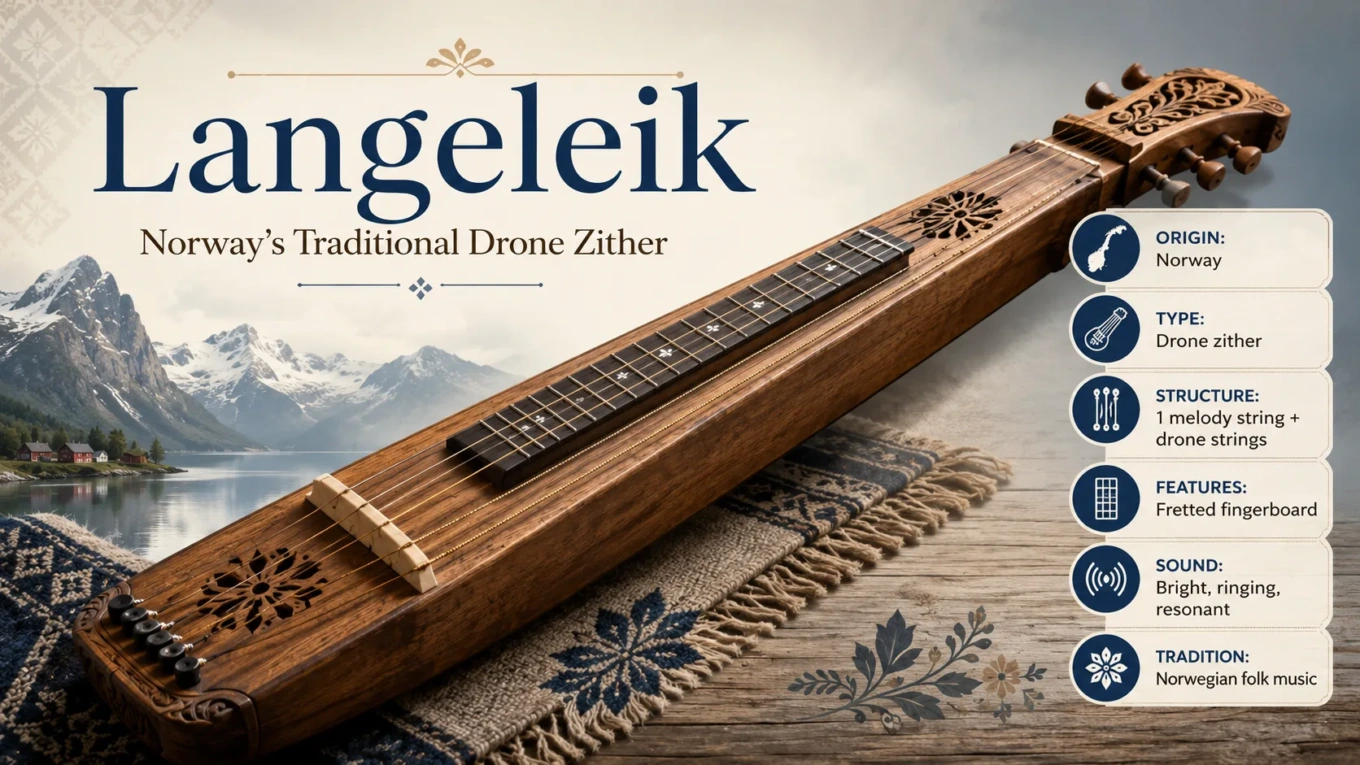
Langeleik: Norway’s Traditional Drone Zither Explained
The langeleik is a Norwegian drone zither: a long, narrow string instrument that sets one fretted melody line against several open drone strings. Its sound is not built around chord changes in the modern guitar sense. It is built around a steady tonal floor, a bright plucked rhythm, and a melody that moves over a small but expressive scale.
What Is a Langeleik?
The langeleik, also written as langleik, is a Norwegian zither[1] in which the strings run along the length of a resonating body rather than away from a neck. In broad instrument classification, it belongs to the drone zither[2] group because several strings sound as drones while one string carries most of the tune.
That makes it different from the concert zither, the kantele, the gusli, the guzheng, and the koto. Those instruments may also be classed as zithers in a broad chordophone[3] sense, but they do not share the same one-melody-string and drone-string playing logic that gives the langeleik its character.
| Feature | What It Means |
|---|---|
| Instrument type | Norwegian plucked drone zither |
| Body form | Long, narrow wooden soundbox[4], sometimes with a bottom and sometimes open underneath on older forms |
| String layout | Usually one melody string[5] with several drone strings[6] |
| Pitch layout | The melody string passes over frets[7]; many modern examples use a diatonic scale[8] |
| Playing method | Plucked or struck with a plectrum[9] while the left hand stops the melody string |
| Regional link | Strongly associated with Norway, especially Valdres and other areas where the tradition survived in local practice |
Names, Spellings, and Regional Use
The most common modern spelling is langeleik. Other forms include langleik, langhørpu, langspill, and langspel. These names point to a long, table-held string instrument rather than a small harp or lute.
The instrument is associated with Norwegian folk music, but it should not be treated as a single unchanging object. Older langeleiks, museum examples, and modern playing instruments may differ in outline, number of strings, tuning layout, decoration, and the way the tuning end is built. In some older instruments, the strings can be fixed in ways that do not match the more familiar modern form.
Classification Note: The word zither can be used in two ways. In a narrow European sense it may refer to the concert zither. In a wider organological sense it describes chordophones whose strings run along, over, or across a body without a separate neck. The langeleik fits the wider sense.
How the Langeleik Is Built
A langeleik is usually made as a wooden box or trough-like body, long enough to support a full melody string and several parallel drones. The body acts as the resonating chamber. Wood choice, wall thickness, and the fit between the top and sides can shape resonance[10], but there is no single recipe that defines every historical instrument.
Many examples have a thin wooden soundboard[11] and a narrow row of strings running from a tuning end to a tail end. Some are straight-sided. Others, especially later Valdres-related forms, can have a body that widens toward the middle or lower area. This wider outline can give the instrument more vibrating surface, though the actual sound still depends on the whole build.
The strings pass over one or more bridges[12]. At the head, tuning pegs[13] or metal tuning devices hold string tension. Older instruments may show pegs or string attachments placed in ways that look unfamiliar to players who know only modern folk-instrument models.
String Count and Layout
The most stable feature is the playing idea: one melody string and several drones. Store and museum descriptions often give the langeleik as having one melody string and a variable number of drone strings. Many documented Norwegian examples fall in the range of one melody string plus two to seven drones, while some modern descriptions use eight total strings or mention larger drone counts.
This variation matters. A visitor looking at a museum instrument should not assume that every langeleik has the same number of strings, the same peg arrangement, or the same scale. Historical instruments were practical objects, often shaped by local makers, available materials, and the tuning needs of the player.
Frets and the Melody String
The melody string is the only string normally stopped by the left hand. It passes across a row of frets, which create the available notes. On many modern langeleiks, the frets outline a major-type diatonic scale. Older instruments can be more complex because their fret positions may point to older local pitch systems rather than the standardized scale layout familiar from modern staff notation.
This is one reason the langeleik should not be described as a simple “Norwegian dulcimer” without explanation. It belongs to a family of related drone zithers, but its fret layout, regional repertoire, and playing habits have their own history.
Drone Strings and the Sound of the Instrument
The drone strings are usually played as open strings[14]. They do not need to be pressed to make different notes during the tune. Instead, they provide a steady pitch field around the melody.
This drone field shapes the musical feel of the langeleik. The melody does not float alone; it is held against a fixed background. A small melodic movement can sound full because the drones keep ringing under it. The effect is especially clear in dance tunes, where the right hand keeps a regular plucked motion while the left hand shapes the tune on the fretted string.
Listening Note: On a langeleik recording, listen first for the repeated drone color rather than the melody. After that, follow the melody string. The instrument often makes the rhythm, the harmony color, and the tune feel like one connected action.
Tuning, Scale, and Intonation
Langeleik tuning is not best described as one fixed universal tuning. Modern instruments are often taught in a major-scale layout, and written music may use a practical notated pitch even when the actual instrument sits at another pitch. Older instruments can show local intonation[15] habits that do not line up neatly with later European scale standards.
The drone strings may be tuned to support the main tonal center, often giving a simple harmonic bed rather than a full set of changing chords. Because of this, the langeleik suits melodies that stay close to the instrument’s tuning. It is less flexible for music that needs frequent modulation or a full chromatic scale[16].
This limitation is not a flaw in the design. It is part of the instrument’s musical identity. The langeleik offers depth through repetition, resonance, and small melodic turns rather than through rapid harmonic change.
How the Langeleik Is Played
The instrument is usually placed on a table, bench, lap support, or another stable surface. The right hand uses a plectrum to pluck or strike across the strings. The left hand stops the melody string at the frets, often using a small number of fingers to form the tune.
The drones may ring with each right-hand motion, while the melody string changes pitch under the left hand. This gives the player a paired task: keep the rhythmic pulse alive and place the melody notes clearly. Good playing depends on timing as much as finger placement.
Left-Hand Motion
The left hand does not need to form chord shapes in the way a guitar player would. Instead, it works along one fretted string. Players may press a note, release it, and use small ornaments or quick movements to give the line its shape. In some playing styles, hammer-on and pull-off actions can add notes between right-hand strokes.
Right-Hand Motion
The right hand supplies much of the energy. The plectrum can brush across the drones and melody string in a steady motion, or it can pick more selectively depending on the tune. The result is a crisp attack followed by the longer ring of the box and drones.
Repertoire and Musical Setting
The langeleik has been used for Norwegian dance tunes and listening pieces. Repertoire terms connected with the instrument include springar, halling, vals, and reinlender, though the exact local repertoire depends on region and player lineage.
Valdres is often named in connection with the living langeleik tradition, but the instrument’s documented history in Norway reaches beyond one valley. Older references and surviving instruments show a wider distribution before the instrument declined in many districts. Later makers and players helped keep the tradition visible, especially where local music teaching, museums, and folk-music archives supported it.
The langeleik is often a solo instrument. It can accompany singing or stand on its own in dance-related music, but its drone-based tuning means it does not always blend easily with instruments using broader harmonic movement. When paired with other instruments, the tuning and repertoire need to be chosen carefully.
Historical Shape and Later Standardization
Surviving Norwegian instruments and written references show that the langeleik is older than many casual descriptions suggest. A preserved example from the Gjøvik area bears the year 1524, and later sources place the instrument within a wider European family of fretted drone zithers. Its Norwegian history includes both broad use and local survival.
Over time, several forces changed the instrument. Fiddle traditions, new dance forms, changing musical taste, and standardized teaching models all affected where and how the langeleik was played. In the late nineteenth century, maker Øystein Rudi of Valdres is associated with a more standardized model using a curved body form, one tuning head, eight strings, and a major scale layout. That model helped shape how many people now picture the instrument.
Older instruments can be more irregular. Some have different scales, fewer strings, straighter bodies, open bottoms, or decoration that reflects local craft practice. For organology, this variety is part of the evidence, not a problem to be corrected.
How It Differs from Related Drone Zithers
The langeleik has relatives across northern and central Europe. The German Scheitholt, Swedish hummel, Icelandic langspil, French épinette des Vosges, and Appalachian dulcimer all share some broad features with drone zithers. They are not the same instrument.
| Instrument | Shared Feature | Main Difference |
|---|---|---|
| Langeleik | One melody line with drones | Norwegian tradition, local fret layouts, and repertoire tied to Norwegian dance and listening tunes |
| Hummel | Drone-zither body and plucked strings | Often has more melody strings and a different regional history in Sweden and nearby areas |
| Langspil | Northern drone-zither relation | Icelandic tradition; may be plucked, bowed, or played in other local ways |
| Appalachian Dulcimer | Fretted melody course with drones | American folk-instrument tradition, different body shapes, repertoire, and modern playing methods |
The comparison helps explain the langeleik without flattening it. It is fair to say that it belongs to a broader family of fretted drone zithers. It is not accurate to treat all members of that family as interchangeable.
Decoration, Craft, and Museum Context
Many historical langeleiks carry carved lines, painted ornament, names, dates, or regional decorative habits. Decoration can show ownership, local style, or a maker’s hand, but it should be read carefully. A decorated instrument is not automatically older, more playable, or more typical than a plainer one.
Museum records often classify the langeleik as a plucked zither or a chordophone-zither. That label is useful for comparing instruments across cultures, but it does not replace local naming. A museum may place a langeleik beside other zithers in a classification system, while musicians may describe it through repertoire, place, maker, and playing lineage.
Collector’s Note: An old langeleik should be examined for body cracks, loose joints, replaced pegs, later strings, altered fret positions, and signs of repair around the tuning end. Playability and historical value are not always the same thing.
What Beginners Should Know
The langeleik can look simple because the left hand mainly works on one melody string. The learning curve is still real. A beginner needs to hear how the drones fit the melody, how the right hand keeps time, and how the fretted notes speak against the open strings.
For learners coming from guitar or piano, the hardest part may be accepting that the instrument is not designed around changing chords. The tuning narrows the musical field, but it also gives the player a clear sound world. Small changes in rhythm, pressure, and ornament become easy to hear.
- Start with rhythm: The right hand creates the pulse that holds the tune together.
- Listen to the drones: They are not background noise; they define the tonal center.
- Check the scale: Older or handmade instruments may not match modern teaching materials.
- Tune gently: Old pegs and old soundboards can be fragile, especially on museum or family instruments.
Common Misunderstandings
“The Langeleik Is Just a Dulcimer”
The comparison is understandable, especially for readers who know the Appalachian dulcimer. Both can use a fretted melody string and drones. Still, the langeleik has its own Norwegian history, body forms, tuning habits, and repertoire. Calling it a dulcimer can be useful as a loose comparison, but not as a final definition.
“Every Langeleik Has the Same Number of Strings”
String counts vary. A modern teaching instrument may use a familiar layout, while older instruments may have fewer strings, different attachments, or non-standard features. The safer description is one melody string with several drones.
“The Frets Always Make a Modern Major Scale”
Many modern langeleiks use a major-scale layout, but older fret patterns can reflect other tonal habits. Historical pitch layout should be checked instrument by instrument.
FAQ
Is the langeleik a zither?
Yes. In broad instrument classification, the langeleik is a zither because its strings run along the body rather than on a separate neck. More specifically, it is a Norwegian plucked drone zither.
How many strings does a langeleik have?
There is no single number for every instrument. The common idea is one melody string plus several drone strings. Many described examples have one melody string and two to seven drones, while some modern forms use eight total strings.
Is the langeleik the same as an Appalachian dulcimer?
No. The two instruments are related in broad drone-zither logic, but they belong to different traditions. The langeleik is Norwegian, with its own local tunings, body forms, and repertoire.
Does the langeleik have frets?
Yes, the melody string normally passes over frets. These frets set the available melody notes. Modern examples often use a diatonic layout, while older instruments may show different pitch systems.
What does a langeleik sound like?
It has a plucked, ringing sound with a steady drone under the melody. The sound can feel rhythmic and focused because the melody string and open drones are activated together by the right hand.
Is the langeleik still played today?
Yes. It is a niche instrument, but it remains active in Norwegian folk-music settings, teaching projects, recordings, and museum-related cultural work, especially where local traditions have kept it visible.
Glossary of Technical Terms
Zither
A zither is a chordophone in which the strings run along, over, or across the body without a separate neck. In the langeleik, this means the strings lie over a long wooden body rather than extending from a guitar-like neck.
Drone Zither
A drone zither uses one or a few melody strings with other strings tuned to steady supporting pitches. The langeleik is a clear example because its drone strings keep ringing under the melody.
Chordophone
A chordophone is any instrument whose sound comes mainly from vibrating strings. The langeleik is a chordophone because its body supports and amplifies the vibration of its strings.
Soundbox
The soundbox is the hollow or partly hollow body that helps the strings sound louder and fuller. Langeleiks often use a long, narrow wooden soundbox, though older forms may differ in whether the underside is closed.
Melody String
The melody string is the string stopped by the player’s left hand to create the tune. On a langeleik, most melodic movement happens on this one string.
Drone Strings
Drone strings sound repeated or sustained supporting pitches. On the langeleik, they help create the fixed tonal background that sits under the melody.
Frets
Frets are raised markers or bars that set pitch positions under the melody string. On the langeleik, they guide the left hand to the notes available in the instrument’s scale.
Diatonic Scale
A diatonic scale uses a seven-note pattern familiar from many major and minor scale systems. Modern langeleiks often use a diatonic layout, though older instruments may not match later standardized patterns.
Plectrum
A plectrum is a pick used to pluck or strike the strings. Langeleik players use it in the right hand to drive both rhythm and string attack.
Resonance
Resonance is the way the body and air space of an instrument respond to string vibration. In a langeleik, the wooden body helps turn the string motion into a more audible ringing tone.
Soundboard
The soundboard is the top surface that receives vibration from the strings through the bridge. Its thickness, stiffness, and fit can affect how freely a langeleik speaks.
Bridge
A bridge supports the strings and helps pass their vibration into the body. On a langeleik, bridge placement and condition affect speaking length, tone, and tuning stability.
Tuning Pegs
Tuning pegs hold and adjust string tension. On older langeleiks, peg design and placement can vary, so tuning should be done with care.
Open Strings
Open strings are sounded without being pressed by the left hand. The langeleik’s drone strings are usually open strings, giving the instrument its steady tonal base.
Intonation
Intonation refers to the exact pitch placement of notes. Older langeleik fret patterns may show local intonation habits that differ from modern standardized scale systems.
Chromatic Scale
A chromatic scale includes all twelve semitones within an octave. The langeleik is not usually built for full chromatic movement, which is why it works best in music suited to its own tuning.