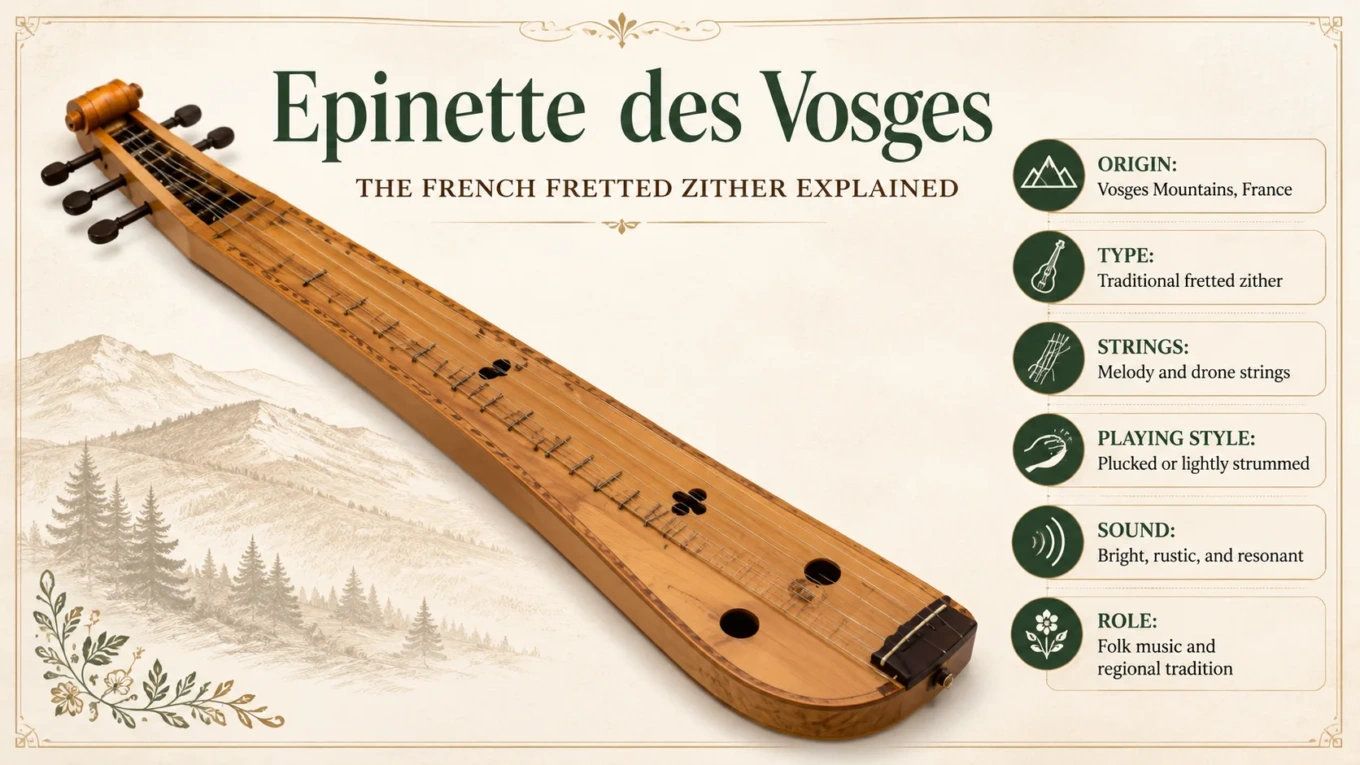
Epinette des Vosges: The French Fretted Zither Explained
The Épinette des Vosges is a narrow French fretted zither[1] from the Vosges region, built around a simple idea: a few melody strings are stopped against frets, while open drone strings keep a steady tonal ground. It belongs to the broader zither family[2], but it is not the same instrument as the concert zither, the autoharp, or the keyboard spinet sometimes called “épinette” in French.
Its sound is direct, bright, and rhythmic. A player can strum across all strings, pick only the melody pair, or let the drones ring under a tune. In many traditional forms, the instrument looks modest: a long wooden box, wire strings, simple metal frets, small decorative soundholes, and a playing logic that favors melody over a constant drone bed.
What Is the Épinette des Vosges?
The Épinette des Vosges is a French regional drone zither[3] associated mainly with the Vosges mountains in eastern France. In organological terms, it is a chordophone[4]: its sound comes from stretched strings. More specifically, it is a zither because the strings run along the body rather than over a separate neck attached to a resonator.
The instrument is usually plucked or strummed. Its frets sit under the melody strings, while the drone strings remain open. This layout is one of its clearest traits: melody and drone are physically close, but they do not behave in the same way.
The name is often written with the accent as Épinette des Vosges, but English-language searches also use Epinette des Vosges. The wording means that this is the épinette connected with the Vosges region, not a generic spinet or a small keyboard instrument.
| Feature | Usual Description |
|---|---|
| Instrument type | French fretted drone zither |
| Region | Vosges mountains, especially traditions around Val-d’Ajol and Gérardmer |
| Common string layout | Often five strings: two melody strings and three drones, though documented examples vary |
| Fret pattern | Usually diatonic on traditional forms; some later or adapted instruments add chromatic notes |
| Playing method | Strummed, plucked, or picked while the melody strings are stopped with fingers or a noter |
| Related instruments | Scheitholt, hummel, langeleik, langspil, Appalachian dulcimer |
Names, Region, and Spelling
The phrase des Vosges matters. It places the instrument in a regional craft and music setting rather than treating it as a general European zither. Historical examples are especially linked with areas such as Val-d’Ajol, Plombières-les-Bains, and Gérardmer, though the exact story of its earlier spread is not fully settled.
Two regional forms are often discussed: the Val-d’Ajol type and the Gérardmer or Hautes-Vosges type. The Val-d’Ajol instruments are commonly described as smaller and more standardized in their five-string form. Gérardmer-related instruments are often larger, with more variation in size and string count.
Some French sources also use words such as cithare à bourdons, meaning a drone zither. The French terms chanterelles[5] and bourdons[6] are useful because they describe the two main string functions: melody and drone.
Classification Note: The Épinette des Vosges is best understood as a fretted drone zither. The word “zither” is used here in the broad instrument-classification sense, not only in the narrow sense of the Alpine or concert zither.
Construction and Body Shape
A typical Épinette des Vosges has a long, narrow wooden soundbox[7]. The body may be rectangular, slightly tapered, or described in museum records as parallelepiped or trapezoidal. It is usually shallow, which helps explain the instrument’s focused and intimate sound rather than a large, booming projection.
The upper wooden plate acts as the soundboard[8]. This surface receives vibration from the strings through the bridge area and helps spread the sound through the wooden body. Museum examples often show pierced soundholes[9], sometimes in heart, clover, quatrefoil, or rosette-like forms.
Decoration is usually restrained. Some instruments have inlaid strips, carved ends, painted ornaments, or shaped soundholes. These details are not only decorative; they also help identify regional hands, makers, and workshop habits when the instrument appears in a museum collection.
Wood and Materials
Documented examples use wood and metal as the main materials. Some records mention maple, spruce, cherry, or light-colored local woods, but there is no single universal recipe. As with many regional zithers, available wood, maker preference, and local craft habits shaped the final instrument.
Wood choice can shape resonance[10], but the effect should not be overstated. Body depth, string tension, bridge fit, fret condition, and playing style all matter. A well-made small instrument can speak clearly even when built from plain materials.
Strings, Frets, and Hardware
Many classic examples have wire strings. The most familiar layout uses two melody strings[11] and three drone strings[12]. The two melody strings may be tuned together or treated as a close melodic pair, while the drones provide a continuous pitch background.
The frets[13] normally sit under the melody strings only. This is a major difference from many guitars and mandolins, where every course usually crosses a fretted fingerboard. On the Épinette des Vosges, the drones are not meant to be stopped for each note. They ring as open strings.
Historical instruments may have metal staple frets[14], fixed directly into the wood. The strings pass over a nut[15] and a bridge[16], then attach to pins, pegs, or other simple hardware depending on the instrument. Some museum examples show iron or piano-style tuning pins, while others use more traditional peg arrangements.
String Layout and Tuning
The Épinette des Vosges should not be described as having one fixed tuning for all players and all periods. Regional form, string count, repertoire, singer’s range, and maker design can all change the tuning. A safe general description is this: the melody strings carry the tune, and the drones are tuned to support the home pitch or modal center.
Traditional instruments are often diatonic[17], meaning the fret pattern favors the notes of a scale rather than every semitone. This suits folk tunes and makes the instrument easy to strum because many open and fretted notes fit the same tonal area.
Some modern or adapted instruments add extra frets for a chromatic[18] range. That allows more keys and accidentals, but it changes the playing feel. The older diatonic layout is part of the instrument’s identity; it shapes the way melodies fall under the hand.
Why the Drones Matter
The drones are not a background afterthought. They give the Épinette des Vosges its steady pulse and regional character. When the player strums across all the strings, the melody and drones blend into a compact sound. When the player strikes or plucks the melody strings separately, the drones can be used more sparingly.
An open string[19] keeps its full vibrating length. On this instrument, drone strings usually remain open, while the melody strings are shortened by the fretting hand. This split between open drone and stopped melody is the reason the instrument can feel both simple and surprisingly expressive.
How the Épinette des Vosges Is Played
The player usually sits with the instrument on a table or across the lap. The right hand strums or plucks. The left hand stops the melody strings against the frets. Because the instrument is narrow, the player can separate melody and drone areas more easily than on some other drone zithers.
Older playing styles may use a small smooth stick, reed, or similar tool called a noteur[20]. The noter presses the melody strings and can slide from note to note, creating a clear glissando[21]. Finger fretting is also used, especially when players want cleaner articulation, ornaments, or more control over individual notes.
Common Right-Hand Approaches
- Full strumming: The hand passes across melody and drone strings together, giving a strong rhythmic texture.
- Melody-focused strumming: The player aims mostly at the melody strings while letting drones enter more lightly.
- Picking: Individual strings are plucked for clearer tunes or slower pieces.
- Experimental methods: Some players strike or bow the strings, but these are not the main traditional identity of the instrument.
A pick, thumb, quill-like plectrum, or bare fingers may be used depending on the style. The sound changes quickly with the attack. A firm strum gives a nasal, ringing edge; lighter picking brings out the melody pair with less drone weight.
Sound and Listening Character
The Épinette des Vosges has a small but lively voice. Wire strings, a shallow soundbox, and open drones create a bright timbre. The melody can sound crisp, while the drones add a dry rhythmic shimmer beneath it.
When played with a noter, the melody may have sliding transitions. When played with fingers, the notes can feel cleaner and more separated. Neither method is automatically better; each brings out a different side of the instrument.
Listening Note: The ear should follow two layers at once: the tune on the fretted melody strings and the steady open drone. The character of the instrument comes from the tension between those layers.
Regional Forms: Val-d’Ajol and Gérardmer
Val-d’Ajol instruments are often the form most readers meet first. Museum examples by makers such as Amé Lambert and Auguste Fleurot show the compact body, five-string layout, decorated soundboard, and metal frets that many people now associate with the Épinette des Vosges.
The Gérardmer or Hautes-Vosges form is often described as larger and less uniform. Surviving and documented examples may vary in string count, body length, and detail. This variety is normal for regional instruments made by local makers, woodworkers, or players rather than by a single factory standard.
The two forms should not be forced into a single template. They share a broad playing idea, but their proportions and local histories differ. That difference is part of why museum records, collector descriptions, and folk-music sources sometimes give slightly different measurements or string counts.
History and Makers
The Épinette des Vosges is documented in the Vosges area from the early eighteenth century. Its deeper origin is less certain. Some older explanations connect it with wider European fretted drone zithers, while local tradition preserves its use through named communities, makers, and family instruments.
Amé Lambert of the Val-d’Ajol area is one of the best-known makers associated with the instrument. Auguste Fleurot and other regional makers also appear in museum and collection records. Their instruments help show how a modest folk zither can carry visible craft identity: body outline, fret count, soundhole shape, peg design, and decorative border all become clues.
Like many rural instruments, the Épinette des Vosges moved through periods of active local use, reduced visibility, and revival. Modern interest often comes from folk musicians, regional associations, museum collections, and luthiers who build playable examples from historical patterns.
How It Differs from Related Instruments
The Épinette des Vosges belongs to a wider European family of fretted drone zithers. Related instruments include the German scheitholt, the Flemish hummel, the Norwegian langeleik, the Icelandic langspil, and the Appalachian dulcimer. These instruments share a basic idea, but they are not interchangeable.
| Instrument | Main Link | Main Difference |
|---|---|---|
| Épinette des Vosges | French regional fretted drone zither | Strong association with Vosges forms, especially Val-d’Ajol and Gérardmer |
| Scheitholt | Central European fretted drone zither | Often treated as an older or parallel relative rather than a French regional type |
| Hummel | Northern European drone zither | Regional names, body forms, and playing habits differ from the Vosges tradition |
| Langeleik | Norwegian fretted drone zither | Has its own Norwegian tuning, decoration, repertoire, and dance-music setting |
| Appalachian dulcimer | American fretted zither relative | Often has a wider hourglass or teardrop body and a separate American folk history |
The concert zither is a different case. It is also a zither, but its layout, string count, fretboard design, and repertoire are very different. The autoharp is different again because chord bars mute unwanted strings. The Épinette des Vosges is simpler in mechanism and more drone-centered in use.
What Beginners Should Know
For a beginner, the Épinette des Vosges can feel approachable because the diatonic fret pattern reduces wrong-note choices within a suitable tuning. The drones also make simple tunes sound full without complex left-hand harmony.
The same simplicity can be limiting if the player expects guitar-like modulation or chromatic melody. A traditional diatonic épinette is strongest when the music fits its tuning. The instrument rewards rhythm, touch, and drone control more than chord changes.
Useful Learning Priorities
- Learn which strings are melody strings and which are drones.
- Start with one tuning and a small set of tunes that fit it.
- Practice steady strumming before adding ornaments.
- Try both noter and finger fretting if the instrument allows it.
- Listen for drone balance; too much force can cover the melody.
Collector’s and Care Notes
Old Épinette des Vosges instruments should be handled as regional craft objects, not only as playable string instruments. The wooden body can be shallow, the top can be delicate, and old frets or tuning pins may not tolerate modern string tension.
Before bringing an old instrument to pitch, check the top, bridge area, pegs, pin block, fret seating, and any cracks along the soundboard. A replacement string that is too heavy can damage a light body. For valuable or fragile examples, a luthier familiar with zithers or historical plucked instruments is the safest choice.
Luthier’s Note: The fret line under the melody strings is central to the instrument’s playability. Even a small shift in fret height, string gauge, or bridge position can change intonation[22] across the scale.
Modern instruments are easier to maintain, but they still need stable humidity, moderate tension, and careful tuning. The best setup is not always the loudest one. A clear melody, even drone response, and comfortable string height matter more than raw volume.
Common Misunderstandings
It Is Not a Keyboard Spinet
In French, épinette can also refer to a small keyboard instrument related to the spinet. The Épinette des Vosges is different. It is a plucked fretted zither with exposed strings and no keyboard action.
It Is Not Just a Small Guitar
The instrument may have frets, but it does not work like a guitar. There is no separate neck, and the drone strings are not fretted for chord shapes. The body itself carries the strings, which is why the zither classification fits.
It Does Not Have One Fixed String Count
Five strings are common in many descriptions, especially the two-melody and three-drone layout. Still, documented instruments vary. Some have fewer or more strings, and later makers may adapt the design for modern playing needs.
It Is Related to the Dulcimer, Not Identical to It
The Appalachian dulcimer and the Épinette des Vosges share the fretted drone-zither idea, but they developed in different musical settings. Body shape, repertoire, tuning habits, and regional identity should be kept separate.
FAQ
Is the Épinette des Vosges a zither?
Yes. It is a zither in the broad organological sense because its strings run along the body of the instrument. More precisely, it is a fretted drone zither.
How many strings does an Épinette des Vosges have?
Many well-known examples have five strings, often two melody strings and three drones. Other documented instruments vary, so five strings should be treated as common rather than universal.
Is the Épinette des Vosges the same as an Appalachian dulcimer?
No. They are related fretted drone zithers, but they belong to different regional traditions. The Épinette des Vosges is tied to eastern France, while the Appalachian dulcimer has its own American folk history.
Does the Épinette des Vosges have chromatic frets?
Traditional forms are usually diatonic. Some adapted or modern instruments add chromatic frets, but that changes the playing options and the feel of the instrument.
Can beginners learn the Épinette des Vosges?
Yes. A diatonic épinette can be friendly for simple tunes because the drone strings support the melody. Beginners still need to learn tuning, drone balance, and clean fretting.
What does the Épinette des Vosges sound like?
It usually has a bright, ringing, and rhythmic sound. The melody strings give the tune, while the drones add a steady tonal background.
Glossary of Technical Terms
[1] Fretted Zither: A zither with frets placed under one or more strings to create fixed pitches. On the Épinette des Vosges, the frets usually serve the melody strings, not the drones.
[2] Zither Family: A broad group of string instruments whose strings run along or across the body without a separate neck acting as the main string-bearing structure. The Épinette des Vosges belongs to this broad family, not to the concert zither type alone.
[3] Drone Zither: A zither in which some strings provide a steady pitch or tonal background while other strings carry the melody. This is central to the Épinette des Vosges playing style.
[4] Chordophone: An instrument that produces sound through vibrating strings. Zithers, lutes, harps, and bowed strings are all chordophones, but their structures differ.
[5] Chanterelles: A French term for melody strings. On the Épinette des Vosges, these are the strings most often stopped against the frets to play the tune.
[6] Bourdons: A French term for drone strings. They usually remain open and provide a repeated tonal base under the melody.
[7] Soundbox: The hollow body that helps amplify and color the vibration of the strings. On the Épinette des Vosges, it is usually long, narrow, and shallow.
[8] Soundboard: The top plate of the instrument that receives string vibration and helps project sound. Its thickness, wood, and condition affect response.
[9] Soundhole: An opening in the soundboard that allows air movement and often adds decoration. Épinette des Vosges examples may have heart, clover, or rosette-like openings.
[10] Resonance: The way an instrument body responds to string vibration. In a small zither, resonance depends on the body, bridge, string tension, and playing touch.
[11] Melody Strings: Strings used to play the tune. On the Épinette des Vosges, they are usually the strings that pass over the fretted area.
[12] Drone Strings: Strings that ring open to support the melody with a steady pitch. They give the instrument much of its rhythmic and tonal character.
[13] Frets: Raised markers or metal pieces that shorten a string when pressed, producing set notes. On this instrument, they are usually placed only under the melody strings.
[14] Staple Frets: Small metal fret pieces set into the wood, often seen on older fretted zithers. They are different from the continuous fretwire used on many modern guitars.
[15] Nut: The support point near the tuning end that sets string spacing and string height. It helps define the vibrating length of each open string.
[16] Bridge: The support that carries string vibration into the soundboard. Its fit and position affect volume, clarity, and tuning feel.
[17] Diatonic: A note layout based mainly on the notes of a scale rather than all twelve semitones. Traditional Épinette des Vosges fretting is commonly diatonic.
[18] Chromatic: A layout that includes semitone steps, allowing more notes outside a single diatonic scale. Some adapted épinettes add chromatic frets for wider repertoire.
[19] Open String: A string played without being stopped by the hand or noter. Drone strings on the Épinette des Vosges usually work as open strings.
[20] Noteur: A small smooth stick, reed, or similar tool used to stop the melody strings. It can create sliding melodic movement on fretted drone zithers.
[21] Glissando: A slide from one pitch to another. The noter technique can give the Épinette des Vosges a smooth sliding effect between fretted notes.
[22] Intonation: The accuracy of pitch across the fretted notes. On a fretted zither, fret position, string height, bridge placement, and string gauge all affect intonation.