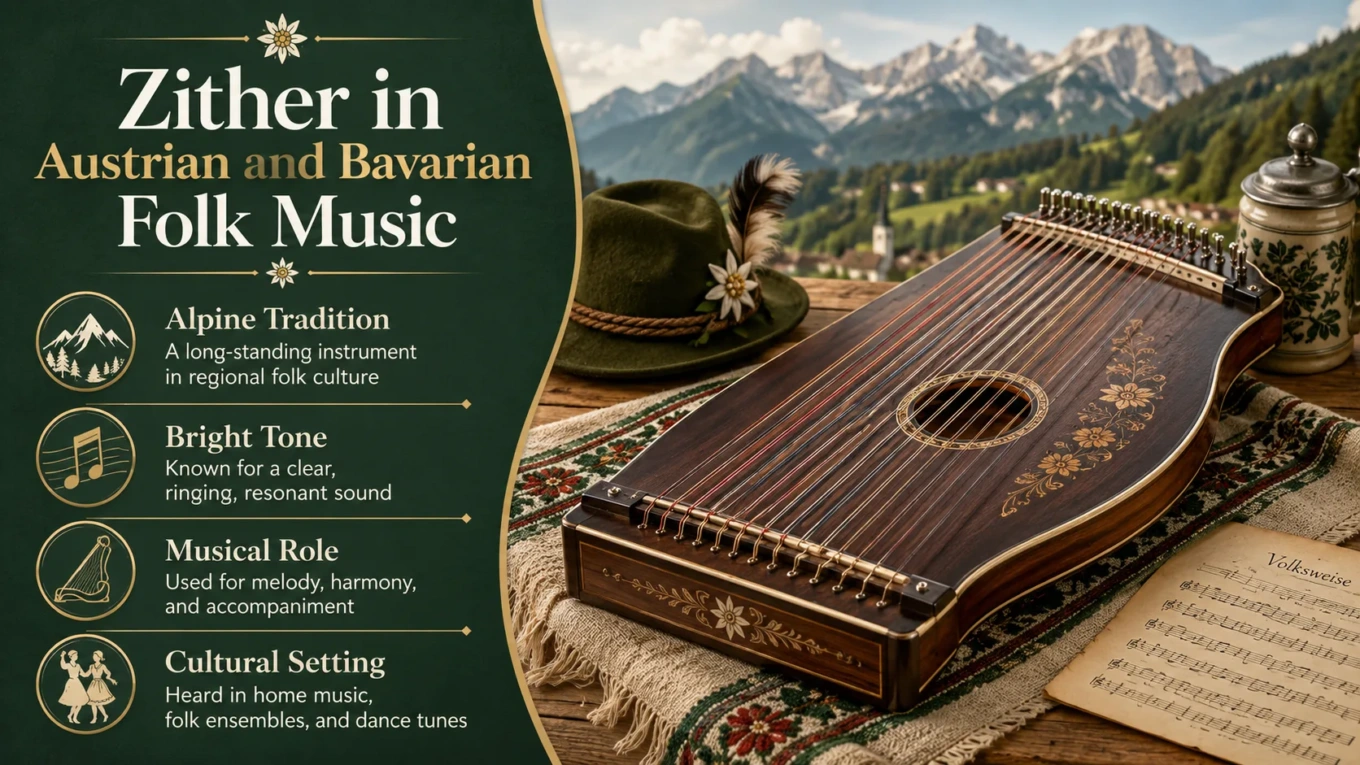
Zither in Austrian and Bavarian Folk Music
In Austrian and Bavarian folk music, the zither is not just a flat string instrument placed on a table. It is a compact melody-and-accompaniment instrument with a clear singing line, open harmonic strings, and a tone that can carry a dance tune without needing a large ensemble. In this regional setting, “zither” most often points to the concert zither[1] and the Alpine zither[2] rather than the whole global zither family[3].
The instrument belongs to the larger chordophone[4] class, but its musical role in the Austrian and Bavarian Alps is very specific. It can lead a melody, fill harmony, outline bass motion, and add a fine rhythmic shimmer. That blend explains why the zither became closely associated with house music, small regional ensembles, dance tunes, and the cultivated folk sound often heard in Alpine Volksmusik[5].
The Zither’s Place in Austrian and Bavarian Folk Music
Austrian and Bavarian folk music often favors small, clear textures: a tune stated plainly, a steady pulse, and accompaniment that supports without covering the melody. The zither fits that setting well because one player can produce several layers at once. The left hand shapes the tune on a fretted area, while the right hand plucks melody, harmony, and bass strings across the instrument.
This does not mean every regional ensemble uses the same zither, or that all Austrian and Bavarian traditions sound alike. Tyrol, Salzburg, Upper Bavaria, Lower Bavaria, Styria, and the Salzkammergut each have local styles, repertories, and ensemble habits. The zither sits within those differences rather than replacing them.
| Detail | What It Means in Austrian and Bavarian Folk Use |
|---|---|
| Common regional meaning of “zither” | Usually the fretted concert or Alpine zither, not every instrument in the broad zither family. |
| Main musical job | Melody with self-accompaniment, often in dance tunes, lyrical pieces, house music, and small string groups. |
| Playing position | Resting flat on a table, stand, or lap so the hands can reach both fretted and open strings. |
| Sound character | Bright, clear attack with a ringing bed of open strings; softer than brass or accordion but very articulate. |
| Typical ensemble setting | Solo zither, zither with guitar, or small Stubenmusik[6] groups with instruments chosen by region and occasion. |
| Important caution | String count, body outline, tuning, and local style can vary by maker, period, and regional practice. |
Why the Zither Works So Well in Alpine Folk Sound
The zither’s strength in this music comes from its layered layout. It can sing and accompany at the same time. A player may carry a waltz melody on the fretted strings, add inner chords on the open strings, and touch lower strings for bass movement. The result is not the thick sound of a piano or accordion. It is lighter, more transparent, and closely tied to plucked-string phrasing.
That clarity suits indoor music-making. In a small room, inn, family setting, or local gathering, the instrument can sound present without being forceful. In a larger ensemble, it often blends with guitar, harp, violin, or accordion, depending on the local tradition and arrangement.
Listening Note: In a good folk zither performance, the melody usually has a clean picked edge, while the open strings create a soft harmonic wash. The ear should be able to follow the tune without losing the dance pulse underneath.
Construction Details That Shape the Folk-Music Role
The Austrian and Bavarian concert zither is a box-like instrument with strings stretched across a broad soundboard[7]. The wooden body acts as a sound box[8], helping the plucked strings project into the room. Wood choice, body depth, and build quality can affect response, but no single wood recipe defines the tradition.
Most modern regional examples use a fretted fingerboard[9] for the hand that stops the tune. Near it are the melody strings[10]. Farther across the top are open strings[11] grouped by function: accompaniment strings[12], bass strings[13], and sometimes contrabass strings[14]. These string fields allow the zither to work like a small self-contained ensemble.
A bridge[15] transfers string vibration into the body. On well-set instruments, the melody strings speak quickly, while the open strings respond with enough sustain to support the harmony. That balance matters in folk music, because dance rhythm can become muddy if the lower strings ring too heavily.
Fretted Melody, Open Harmony
The player presses the melody strings against the frets to change pitch. This gives the zither a different musical logic from fretless board zithers such as the guqin or movable-bridge zithers such as the guzheng. In Austrian and Bavarian use, the fretted area helps the instrument play chromatic folk melodies, modulations, and more arranged pieces.
The open string field supplies harmony and bass. These strings are not usually stopped by the left hand during normal playing. They are chosen, plucked, or brushed by the right hand to support the tune. This is why the instrument can sound both delicate and full.
How the Zither Is Played in This Tradition
A common playing method uses a zither ring[16] on the right thumb to pluck the melody. The right fingers then handle many of the open strings. The left hand stops the fretted strings, often with a compact motion that keeps the melody smooth and controlled.
This technique lets the instrument do three jobs at once:
- Lead the tune with a picked melody that can cut through a small ensemble.
- Support harmony with arpeggiated or lightly plucked open strings.
- Mark rhythm with bass notes, repeated patterns, or short chordal gestures.
In folk settings, the right hand is not only decorative. It gives the music its shape. A waltz needs lift. A march needs clear placement. A slow air needs space between notes. Skilled zither players adjust sustain, attack, and bass movement to match the dance or song type.
Tuning, Stringing, and Regional Practice
Many concert zithers use five fretted melody strings and a larger number of open diapason strings[17]. Documented instruments may have different total string counts, especially across older folk forms, concert instruments, harp zithers, and maker-specific designs. It is safer to think in functional groups rather than a fixed number: fretted melody strings, open accompaniment, bass, and optional deeper bass strings.
Two tuning names often appear in discussions of Austrian and Bavarian zither playing: Munich tuning[18] and Viennese tuning[19]. These labels refer especially to the fretted melody-string setup, though full tuning systems also involve the open strings. Written pitch names may vary by source and octave notation, so players usually rely on an instrument-specific tuning chart or a teacher familiar with the regional system.
Luthier’s Note: Old zithers should not be restrung by string count alone. Scale length, peg condition, bridge height, neck angle in the fretted area, and the intended tuning all affect safe string choice.
Austrian Folk Context
In Austria, the zither appears in several overlapping settings: Alpine folk music, house music, arranged salon pieces, Viennese song culture, and teaching repertory. These settings should not be treated as identical. A zither used for a rural-style dance tune may be played with a different touch from one used for a polished concert arrangement.
In Tyrolean and Salzburg-area contexts, the instrument often belongs to a plucked-string sound that values clear melody and controlled resonance. In Viennese and urban Austrian contexts, the zither also developed a more arranged repertory, sometimes closer to salon music than village dance. Austrian zither history therefore moves between domestic music-making, folk use, and cultivated performance.
The public image of the Austrian zither was also shaped by recorded and film music, especially the sharp, memorable solo sound associated with mid-20th-century Vienna. That famous sound is not the whole folk tradition, but it shows how strongly one zither can define an atmosphere with only plucked strings and controlled rhythm.
Bavarian Folk Context
In Bavaria, especially Upper Bavaria and Alpine districts, the zither is closely tied to regional string music and local dance repertory. It may appear as a solo instrument, in zither duos, with guitar, or in mixed small ensembles. The instrument’s voice fits the Bavarian taste for clean melody, steady pulse, and compact group sound.
Bavarian use also connects strongly with the history of the modern concert zither. Munich and Mittenwald were important places for zither making, teaching, and repertory during the 19th century. This helped move the instrument between folk practice, urban middle-class music, and formal zither clubs.
The Bavarian sound is not one fixed style. A gentle house-music piece, a dance tune, and a more arranged zither solo can all use the same family of instruments while asking for different touch, tempo, and articulation.
Dance Tunes, Songs, and Ensemble Jobs
The zither often supports music built around dance meters and singable melodies. It can handle Ländler[20] rhythms, waltzes, polkas, marches, and local tune types, depending on the region and group. It can also support the rhythmic turns of a Zwiefacher[21], where the player must keep close attention to meter changes.
In a small ensemble, the zither may take several roles:
- Melodic lead: The fretted strings carry the tune while other instruments support.
- Inner voice: The zither adds arpeggios, passing tones, and light harmony under a violin, clarinet, or voice.
- Rhythmic support: Bass strings and repeated open-string patterns help mark the dance feel.
- Solo color: A short zither introduction or interlude can set the character of a tune before the full group enters.
The instrument works best when the arrangement leaves room for it. If too many louder instruments cover the same range, the zither loses its fine detail. Good folk arrangements often give it space in the middle and upper register.
Sound, Timbre, and Playing Feel
The zither’s tone in Austrian and Bavarian folk music is bright but not harsh when played well. The melody attack is clear because the thumb ring gives each note a defined edge. The open strings add shimmer, but the player must control how long they ring.
Compared with a guitar, the zither can produce a more separated melody-and-harmony texture because the fretted and open string fields sit in different areas. Compared with a hammered dulcimer, its attack is more directly plucked and less percussive. Compared with a harp, it has a tighter, table-supported voice and a more compact bass response.
Vibrato and ornamentation are possible on the fretted strings, but folk style often values clean phrasing over display. The best playing sounds relaxed because the hands divide the labor efficiently.
Salzburg, Mittenwald, and Body Shapes
Two historic body names often appear in central European zither discussion: the Salzburg zither[22] and the Mittenwald zither[23]. These terms refer to body outlines, not to two completely separate musical cultures. The Salzburg outline is commonly described with a rounded side away from the player, while the Mittenwald outline is often described with rounded sides on both edges.
Players may care more about setup, tone, tuning, and hand comfort than the name of the outline. Still, these body labels matter for instrument history because they show how regional making centers shaped the visual identity of the concert zither.
How It Differs from Related Zithers
The Austrian and Bavarian folk zither should not be confused with the chord zither[24]. A chord zither usually has marked chord groups and open melody strings; it is often easier to approach as a home instrument, but it uses a different playing logic. The concert zither asks the player to stop melody strings on a fretboard while managing a broad open-string field.
It also differs from the hammered dulcimer[25], even though both may be classified within the wider zither family in organological language. The hammered dulcimer is struck with small hammers. The Austrian and Bavarian concert zither is plucked, with a fretted melody section and open accompaniment strings.
The comparison matters because the word “zither” can be broad or narrow. In this regional folk-music topic, the narrow meaning is usually the right one.
Why the Zither Became More Than a Folk Instrument
The zither’s folk roots did not keep it out of more formal music-making. During the 19th century, makers, teachers, and performers refined the instrument, expanded its stringing, and helped it enter parlors, clubs, and concert settings. Vienna, Munich, Salzburg, and other German-speaking centers all contributed to this movement in different ways.
This upward movement can create confusion. A concert zither may be used for folk music, salon music, teaching pieces, or virtuosic repertory. The same instrument type can cross settings. The difference lies in arrangement, touch, ornamentation, and social use.
What Beginners Should Know
For a beginner interested in Austrian or Bavarian folk zither, the instrument can be rewarding but demanding. It is not played like a guitar, even though it has a fretted section. It is not played like a harp, even though many strings are open. The two-hand coordination is the center of the learning process.
Beginners should pay attention to four practical points:
- Tuning system: Munich and Viennese setups are not interchangeable without knowing the instrument and repertory.
- Right-hand pattern: Folk style depends on clean thumb-ring melody and steady finger-plucked support.
- Instrument condition: Older zithers may need careful inspection before full tension is restored.
- Repertory choice: Simple waltzes and slow tunes often teach better control than fast display pieces.
A teacher or experienced player familiar with Alpine zither tradition can save time, especially with tuning charts, string choice, and right-hand economy.
Care and Collecting Notes
Many older Austrian and Bavarian zithers survive in family homes, local collections, and antique shops. Some are playable after service; others are better treated as historical objects. A clean exterior does not prove that the instrument is safe to tune. Peg fit, cracks, loose bridges, warped tops, and missing string gauges matter more than decorative condition.
Collector’s Note: Labels such as “Salzburg,” “Mittenwald,” “harp zither,” or “concert zither” should be checked against the instrument’s body shape, string layout, scale length, and hardware. Family stories are valuable, but the physical setup tells the most reliable story.
For active playing, replacement strings should match the intended tuning and scale length. For display, stable humidity, gentle cleaning, and low stress on weakened parts are safer than forcing a full restoration.
FAQ
Is the zither a traditional Austrian instrument?
Yes, in the sense that the concert and Alpine zither became strongly associated with Austrian folk, house, and salon music. It is not exclusive to Austria, because Bavaria and other German-speaking Alpine regions also played a major role in its development and use.
Is the zither a traditional Bavarian instrument?
Yes. Bavaria, especially its southern and Alpine areas, has a long link with the fretted zither in folk music, local ensembles, teaching, and instrument making. Munich and Mittenwald are often mentioned in the history of the modern concert zither.
What kind of zither is used in Austrian and Bavarian folk music?
The instrument is usually a fretted concert or Alpine zither with melody strings over a fingerboard and many open strings for accompaniment and bass. Older folk forms and modern maker designs can differ in string count and outline.
Is Austrian and Bavarian zither music the same?
No. They overlap in instrument type, tuning language, and Alpine repertory, but local style varies by region, ensemble, dance type, and teaching tradition. Austrian, Viennese, Tyrolean, Salzburg, and Bavarian settings should not be flattened into one sound.
Is the zither easy to learn for folk music?
It is approachable with simple tunes, but it is not an easy instrument to master. The main challenge is coordinating fretted melody, thumb-ring attack, and open-string accompaniment without losing rhythm.
Does every Austrian or Bavarian folk ensemble include a zither?
No. Many ensembles use guitar, harp, hammered dulcimer, violin, accordion, clarinet, brass, or voice without zither. The zither is a valued regional color, not a required instrument in every group.
Glossary of Technical Terms
Concert Zither
A fretted European zither with melody strings over a fingerboard and additional open strings for accompaniment and bass. In Austrian and Bavarian contexts, this is often the instrument meant when people simply say “zither.”
Alpine Zither
A regional form of European fretted zither associated with Alpine music cultures. It is closely related to the concert zither, though body shape, stringing, and setup can vary.
Zither Family
A broad group of chordophones in which strings run across or along a body without a separate neck in the guitar or violin sense. The term includes many unrelated regional instruments, so local context matters.
Chordophone
An instrument class in which sound is made by vibrating strings. Zithers, lutes, harps, fiddles, and dulcimers are all chordophones, but their structures and playing methods differ.
Volksmusik
A German term often used for regional folk music, including singing, dance music, and instrumental traditions. In zither context, it points to local Austrian and Bavarian repertory rather than only formal concert pieces.
Stubenmusik
Small-scale indoor folk music, often played in intimate rooms or social settings. Zither, guitar, harp, hammered dulcimer, and other soft instruments may appear depending on region and group.
Soundboard
The top vibrating surface of the instrument. On a zither, it helps turn string vibration into audible sound and affects response, sustain, and projection.
Sound Box
The resonating body of the instrument. In a concert zither, the box-like body supports the soundboard and helps amplify the plucked strings.
Fretted Fingerboard
The area where melody strings are pressed against metal frets to produce different pitches. This gives the Austrian and Bavarian concert zither a melodic system closer to fretted instruments than to open-only zithers.
Melody Strings
The strings used to play the main tune. On a concert zither, these usually run over the fretted fingerboard and are plucked with the thumb ring.
Open Strings
Strings played without being stopped by the left hand. On the concert zither, open strings supply much of the accompaniment, bass, and resonance.
Accompaniment Strings
Open strings used to fill harmony and rhythmic patterns. They help one zither player support the melody without needing a separate chord instrument.
Bass Strings
Lower open strings used for bass notes and harmonic grounding. In folk playing, they can help mark dance rhythm and phrase direction.
Contrabass Strings
Extra low strings found on some zithers. They extend the bass range, though their number and arrangement vary by instrument type and maker.
Bridge
The part that supports strings and transfers their vibration into the soundboard. Bridge height, fit, and material can affect tone and playability.
Zither Ring
A ring-shaped plectrum worn on the thumb, commonly used to pluck the melody strings of the concert zither. It gives the melody a clear attack.
Diapason Strings
A term often used for the open accompaniment and bass strings on the zither. These strings expand the instrument beyond the fretted melody section.
Munich Tuning
A common concert zither tuning tradition associated with the fretted melody-string setup and the wider open-string layout. Players should check the exact chart for their instrument because notation and stringing details can vary.
Viennese Tuning
A tuning tradition linked with Vienna and Austrian zither practice. It differs from Munich tuning especially in the fretted melody-string arrangement and is often discussed in relation to specific repertory and instrument setup.
Ländler
A regional dance type in triple meter associated with Austrian and southern German traditions. On zither, it often needs a gentle lift and clear bass placement.
Zwiefacher
A southern German and Alpine dance type known for shifting between duple and triple groupings. Zither accompaniment must follow the meter changes cleanly.
Salzburg Zither
A concert zither body style often described with a rounded side away from the player. The term refers to body outline and historical making style rather than a completely separate instrument family.
Mittenwald Zither
A concert zither body style associated with Mittenwald, often described with rounded sides on both edges. It reflects a regional making tradition within the broader central European zither history.
Chord Zither
A different zither type with open strings arranged for preset chords and melody. It should not be confused with the fretted Austrian and Bavarian concert zither used in much Alpine folk music.
Hammered Dulcimer
A struck string instrument in the wider zither family. It is played with small hammers, unlike the Austrian and Bavarian concert zither, which is plucked and uses a fretted melody section.