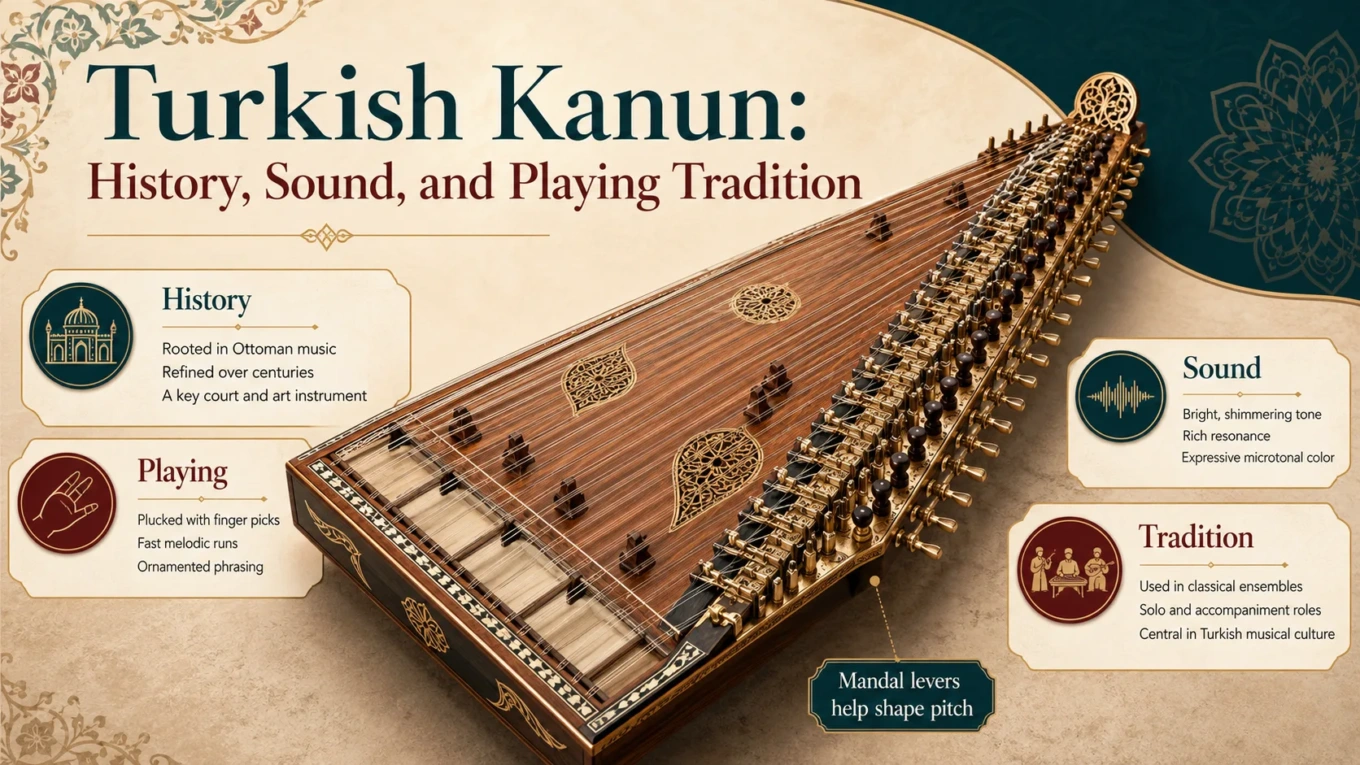
Turkish Kanun: History, Sound, and Playing Tradition
The Turkish kanun is a low, trapezoidal instrument with many strings stretched across a flat body, played with small picks on both index fingers. In organology it is a plucked zither[1]: the strings run across the body itself rather than along a separate neck. What makes the Turkish form especially refined is its mandal system, which lets the player adjust small pitch steps during performance and shape the modal language of Turkish art music with unusual precision.
What Is the Turkish Kanun?
The Turkish kanun is a large chordophone[2] used in Turkish classical music, Ottoman-derived ensemble traditions, solo performance, and many contemporary settings. It belongs to the wider qanun family found across the Middle East, North Africa, parts of the eastern Mediterranean, and nearby musical cultures, but the Turkish kanun has its own setup, tuning habits, mandal layout, repertoire, and playing style.
The instrument is usually placed flat on the player’s lap or on a small table. The player plucks the strings with two plectra attached to metal rings on the index fingers. Because the notes fade more quickly than bowed or wind instruments, kanun players use tremolo, repeated plucking, arpeggios, and ornamental figures to create sustained musical lines.
In the broad zither family, the kanun is best understood as a plucked box or board-like zither with a shallow resonating structure, grouped strings, a bridge system, and pitch-changing levers. It is not the same instrument as the European concert zither, the hammered dulcimer, the santur, or the psaltery, although these instruments may overlap in classification language.
| Feature | Typical Turkish Kanun Description |
|---|---|
| Instrument family | Plucked zither within the chordophone family |
| Body form | Shallow trapezoidal body with a wooden frame and resonating surface |
| String layout | Usually 24 to 27 courses, often with three strings per course; exact designs vary |
| Pitch system | Mandal levers allow fine pitch changes for Turkish makam music |
| Playing method | Plucked with plectra fixed to rings on both index fingers |
| Musical role | Melody, ornamentation, accompaniment, modulation, taksim, and ensemble color |
Names, Spelling, and the Word Kanun
In Turkish, the instrument is written kanun. In English and other transliterations, readers may also see qanun, qānūn, kanoun, or related spellings. These forms often point to the same instrument family, but they do not always refer to the same regional design.
The name is commonly linked to the Greek word kanon, meaning rule, measure, or law. That connection is more than a word-history detail. In earlier musical thought, a single-string measuring device could show the relationship between string length and pitch. The modern kanun is a performing instrument, yet its layout still reflects the close relationship between string length, interval, tuning, and rule-based pitch organization.
Classification Note: The Turkish kanun may be called a zither in organology, but this does not mean it behaves like every instrument called a zither in everyday language. Its grouped strings, mandal levers, skin-supported bridge area, and makam-based playing practice give it a distinct identity.
History and Development
The kanun has a long ancestry connected with Middle Eastern and Mediterranean string instruments, but the modern Turkish kanun should not be treated as a frozen survival from a single ancient model. Museum records and instrument descriptions often separate the older use of the name from the later trapezoidal plucked zither familiar today.
By the Ottoman period and especially in later Turkish classical practice, the kanun became closely associated with refined urban ensemble music. Its clear attack, broad range, and ability to follow modal pitch shades made it useful beside instruments such as the oud, tanbur, ney, kemençe, violin, and voice.
A major change came with the development and spread of the mandal[3] system. Earlier qanun-type instruments could be retuned or adjusted, but the modern Turkish lever layout allowed pitch changes to be made during performance with far greater speed. This helped the kanun serve Turkish makam[4] music, where melodic movement and pitch shading matter as much as the named notes.
Modern makers continue to refine the instrument. Course count, lever count, string material, body size, and decorative work differ by maker and by the needs of the player. Older museum examples may have fewer strings or smaller bodies than many instruments used on stage today.
Body Shape and Resonating Structure
The Turkish kanun has a shallow, trapezoidal resonating body[5]. The short strings sit toward the narrow side for higher pitches, while longer strings extend across the broader area for lower pitches. This shape is practical: it lets many string lengths fit across a compact playing surface.
The upper face includes a wooden soundboard[6] and a skin or parchment area under the bridge line. On many traditional and museum examples, the bridge feet rest over a stretched membrane rather than only over solid wood. This gives the sound a bright attack with a responsive, slightly elastic quality.
The body must be light enough to vibrate, but stable enough to hold many strings under tension. A well-made kanun does not rely on mass alone. It relies on balance: a shallow box, controlled string pressure, a bridge system that transfers energy cleanly, and a resonating surface that speaks quickly.
Strings, Courses, and Range
The kanun’s strings are grouped into courses[7]. A course is a set of strings tuned to the same pitch and played together as one note. Many Turkish kanuns have three strings per course, though some low courses may use fewer strings depending on the maker and model.
Modern Turkish instruments often have around 24 to 27 courses. This can produce totals such as 72, 75, or more strings, but no single number should be treated as the only correct standard. Museum examples, student instruments, concert instruments, custom builds, and regional forms may differ.
Older instruments used gut strings in some contexts. Modern kanuns commonly use nylon or other synthetic strings, with wound strings sometimes used for lower notes. The change from gut to modern materials affects stability, response, maintenance, and playing feel, but the final sound still depends on the whole instrument rather than one material alone.
Bridge, Skin, and Sound Transfer
The kanun bridge is long and low compared with the tall bridges of some bowed instruments. It supports many strings and transfers their vibration into the resonating surface. In many kanuns, the bridge feet press onto a skin or parchment section rather than directly onto a fully wooden plate.
This detail helps explain the kanun’s tone. The sound starts with a clean pluck, then opens into a short, shimmering resonance. The grouped strings create a slight chorus effect, especially when the three strings in a course are tuned with care but not treated as a single mechanical wire.
Luthier’s Note: Wood choice can shape resonance, but it does not work alone. Body depth, bridge pressure, membrane tension, string choice, and lever accuracy all affect how a Turkish kanun responds under the hands.
The Mandal System and Microtonal Control
The mandal system is one of the clearest differences between the Turkish kanun and many older or simpler plucked zithers. Mandals are small metal levers placed near the tuning side of the instrument. By raising or lowering selected levers, the player changes the effective speaking length of a string course and shifts pitch by small steps.
These pitch steps support microtones[8], intervals smaller than a Western semitone. In Turkish makam music, these fine pitch areas are not decorative extras. They help define the character of a makam, the direction of a phrase, and the relationship between stable notes and expressive passing tones.
Many Turkish-made kanuns use a mandal logic associated with a 72-part division of the octave. This does not mean that every performance reduces makam practice to a mechanical grid. The levers give the player a practical map, while the musical line still depends on ear training, repertoire, phrase direction, and taste.
On some measured modern Turkish instruments, one lever step can fall near 17 cents, while six steps can approach a semitone. Exact values depend on maker, setup, string length, lever position, and the specific instrument. For that reason, serious players learn not only the lever names but also the behavior of their own kanun.
Tuning and the Logic of Makam
Kanun tuning is not only a matter of matching open strings to a tuner. The open string[9] layout gives the instrument its base map, while mandals prepare the pitches needed for different makam settings. A player must know which courses form the current pitch environment and which levers must be moved before or during a passage.
In Turkish practice, makam is not simply a scale. It includes characteristic tones, phrase direction, melodic emphasis, cadential behavior, and ornaments. The Turkish term seyir[10] refers to this melodic path or progression. A kanun player therefore tunes and sets mandals with the expected musical path in mind.
This is why the kanun is often valued in Turkish music theory and performance. Its fixed lever positions can show pitch relationships clearly, while the hands can still bring rhythm, attack, ornament, and timing into the phrase.
How the Turkish Kanun Is Played
The player usually sits with the instrument resting across the knees or placed on a table. Both hands are active. The right hand often carries melodic motion, while the left hand may answer, thicken the texture, prepare ornaments, change mandals, or support bass notes. Skilled players do not divide the hands in a rigid way; the instrument invites crossing, echoing, and rapid alternation.
The plectra are attached to metal rings worn on the index fingers. This setup gives the attack clarity and speed. The angle of the wrist, the depth of the pluck, and the closeness to the bridge all affect the tone. Plucking nearer the bridge gives a more pointed sound. Plucking farther inward can soften the attack.
Because each note is plucked, long tones need technique. A player may use tremolo[11] to keep a note alive, or use repeated notes to make a phrase feel vocal. Fast runs, broken chords, octave figures, and ornamental turns are common in advanced playing.
Mandal Changes During Performance
Mandal changes are part of the instrument’s language. The left hand may flip a lever shortly before a note sounds, or change a pitch while another hand continues the phrase. In slow passages, this can create subtle modal color. In faster music, it demands exact planning.
The movement should not sound like a mechanical interruption. A good player makes the lever change serve the melodic line, so the listener hears a natural shift in makam color rather than the action of hardware.
Glissando, Ornament, and Taksim
The kanun can produce flowing ornaments that suit Turkish melodic practice. A glissando[12] may sweep across several courses, while smaller turns can imitate the inflection of sung melody. Fingernail effects, muted strokes, octave gestures, and rhythmic bass figures also appear in modern performance language.
In taksim[13], the player presents a free, improvised exploration of makam. The kanun is well suited to taksim because it can show pitch relationships clearly while still allowing flexible timing, ornament, silence, and register contrast.
What the Turkish Kanun Sounds Like
The Turkish kanun has a bright, ringing tone with a fast response. The sound is clean at the start of the note, then quickly opens into a layered resonance created by multiple strings per course. It can sound delicate in a slow solo, sharp and articulate in fast passages, and full when the player uses wide arpeggios or tremolo.
Its tone does not sustain like a bowed instrument, so the player shapes continuity through technique. Repeated plucks can make a single pitch feel held. Alternating hands can make ornaments smooth. Mandal changes can shift the emotional color of a line without changing the instrument’s basic voice.
Listening Note: A good way to hear the Turkish kanun is to listen for three layers: the clean pluck, the shimmer of the grouped strings, and the pitch color created by mandal settings. The instrument is not only fast; it is exact in how it places notes inside a makam.
Role in Turkish Music Tradition
In Turkish classical music, the kanun often acts as both a melodic and supporting instrument. It can double a vocal line, answer another instrument, outline a makam, add rhythmic sparkle, or fill the texture with arpeggiated patterns. Its clear pitch layout also makes it useful in teaching and rehearsal settings.
In ensemble playing, the kanun must listen carefully. It can easily cover quieter instruments if played too heavily. Skilled players use touch and register to fit the group, leaving space for the voice, ney, oud, tanbur, or bowed instruments.
The kanun also has a strong solo tradition. Solo performers use the full range of the instrument, including bass support, upper-register brilliance, tremolo, octave passages, and rapid mandal work. Modern players have expanded the technique further, but the instrument still depends on a disciplined sense of makam and phrase.
Turkish Kanun and Related Instruments
The Turkish kanun is related to the Arabic qanun, but the two should not be treated as identical in every detail. Regional instruments can differ in size, tuning approach, lever layout, repertoire, tone preference, and playing idiom. Some Arabic qanuns use different lever arrangements or pitch habits suited to Arabic maqam practice.
The santur and hammered dulcimer are also zither-family instruments in many classification systems, but their sound is produced by striking strings with small hammers rather than plucking with finger plectra. That difference changes the attack, phrasing, sustain, and technique.
The psaltery is a useful comparison because some historical descriptions place the qanun near trapezoidal psalteries. Still, the Turkish kanun’s mandal system and makam role make it much more than a simple historical psaltery with extra strings.
| Instrument | Sound Production | Main Difference from Turkish Kanun |
|---|---|---|
| Arabic Qanun | Plucked with finger plectra | Closely related, but tuning habits, lever systems, and repertoire may differ by region |
| Santur | Struck with light hammers | Hammered attack and different performance logic |
| Hammered Dulcimer | Struck with hammers | Often linked to folk and regional traditions with different tuning and layout |
| Psaltery | Usually plucked or sometimes bowed | Often simpler in mechanism; lacks the Turkish kanun’s modern mandal system |
| Concert Zither | Plucked, with melody and accompaniment areas | European design with fretted melody strings on many models |
Materials, Decoration, and Craft
Turkish kanuns are usually built with a wooden body, a carefully prepared soundboard, a bridge system, tuning pegs, metal mandals, and many strings. Decorative work may include mother-of-pearl, shell, bone, hardwood inlay, or patterned rosettes. Historic museum examples may contain materials that are no longer favored or are avoided in modern ethical making.
Craft quality matters because the kanun asks for precision across many parts at once. Pegs must hold tuning. Mandals must move cleanly and return to reliable pitch positions. The bridge must transfer vibration evenly. The body must remain stable under string tension.
A decorative kanun is not automatically a good musical instrument. For players, the more important tests are tuning stability, even tone across the range, clean mandal action, comfortable string spacing, and a balanced response from low to high courses.
Care, Stability, and Everyday Use
The Turkish kanun is sensitive to climate, string condition, and mechanical setup. Changes in humidity and temperature can affect tuning, the wooden body, and the skin or parchment area. Players usually expect to tune regularly, especially before performance or recording.
The many strings make tuning slower than on smaller instruments. A beginner may first learn to tune the open courses, then gradually learn how mandal settings relate to makam practice. Fine setup work is best handled by an experienced maker or repairer, especially when lever alignment, peg fit, or bridge pressure is involved.
For storage, the instrument should be protected from direct heat, damp rooms, and sudden climate changes. The aim is not to make the kanun fragile in the player’s mind, but to respect it as a precise acoustic object with many moving and vibrating parts.
What Beginners Should Know
The Turkish kanun can be approached by beginners, but it is not a simple “press and play” zither. The right hand must learn clean plucking. The left hand must learn both plucking and mandal control. The ear must learn pitch shades that may not match standard piano thinking.
A new player usually benefits from learning three areas together:
- Basic touch: clear plucks, relaxed wrists, even tone, and controlled tremolo.
- Tuning awareness: open courses, octave checking, and careful listening between paired or tripled strings.
- Makam behavior: not only which notes appear, but how phrases move and where they settle.
Reading staff notation can help, but Turkish kanun playing also depends on listening, imitation, and style knowledge. The instrument rewards patience because small changes in hand angle, plectrum depth, and mandal timing can change the whole phrase.
Common Misunderstandings
One common mistake is to describe the kanun only as a “Middle Eastern harp.” It is not a harp in structure. Its strings run across a shallow body, so zither classification is more accurate.
Another mistake is to treat all qanuns as the same. Turkish, Arabic, Armenian, Greek, and other regional uses may share ancestry and instrument logic, but local tuning systems, repertoire, and construction details can vary.
A third mistake is to reduce the kanun to its mandals. The levers are central to the modern Turkish instrument, but the sound still comes from touch, string response, body resonance, bridge behavior, and musical phrasing.
Glossary of Technical Terms
[1] Plucked Zither
A zither whose strings are plucked rather than bowed or struck. In the Turkish kanun, the strings run across the body and are sounded with plectra attached to the player’s index fingers.
[2] Chordophone
A musical instrument that produces sound through vibrating strings. Zithers, lutes, harps, lyres, and bowed string instruments all belong to this wider category, even though their structures differ.
[3] Mandal
A small lever used on the kanun to change the speaking length of a string course and adjust pitch. In Turkish kanun playing, mandals allow quick movement between pitch shades used in makam music.
[4] Makam
A modal system used in Turkish classical music and related traditions. A makam is not only a scale; it includes characteristic pitches, phrase direction, cadences, and melodic behavior.
[5] Resonating Body
The part of an instrument that receives string vibration and helps project sound. On the kanun, the shallow body, soundboard, membrane area, and bridge system all contribute to resonance.
[6] Soundboard
The vibrating top surface of a string instrument. In the kanun, the soundboard works with the bridge and skin or parchment section to shape the instrument’s bright, quick response.
[7] Course
A group of strings treated as one note. Turkish kanun courses are often made of three strings tuned together, which gives the note extra volume and shimmer.
[8] Microtone
An interval smaller than a Western semitone. Turkish kanun mandals help players reach the fine pitch areas needed for makam performance.
[9] Open String
A string sounded without stopping it against a fingerboard or fret. On the kanun, open string courses form the basic pitch map before mandals adjust selected notes.
[10] Seyir
The characteristic melodic path of a makam. It describes how a melody moves, which tones are emphasized, and how phrases settle.
[11] Tremolo
A rapid repetition of a note or small group of notes. Kanun players use tremolo to sustain sound and give plucked notes a longer musical presence.
[12] Glissando
A sliding or sweeping gesture across pitches. On the kanun, glissando can be made by moving across several courses or by using special finger and plectrum effects.
[13] Taksim
A free, improvised solo exploration of a makam. Kanun taksim often shows the player’s control of pitch, register, ornament, silence, and mandal changes.
FAQ
Is the Turkish kanun a type of zither?
Yes. In instrument classification, the Turkish kanun is a plucked zither because its strings run across the body rather than along a separate neck. It is also a chordophone because its sound comes from vibrating strings.
How many strings does a Turkish kanun have?
Many Turkish kanuns have around 24 to 27 courses, often with three strings per course. This can produce totals such as 72, 75, or more strings, depending on the maker and model.
What are mandals on a kanun?
Mandals are small levers that change pitch by altering the speaking length of a string course. They let the player prepare or change the microtonal pitch shades needed in Turkish makam music.
Is the Turkish kanun the same as the Arabic qanun?
They are closely related, but they are not always identical. Turkish and Arabic instruments may differ in lever layout, tuning approach, repertoire, playing style, and regional tone preference.
Why does the kanun sound so bright?
Its brightness comes from plucked string attack, grouped courses, a shallow resonating body, and the bridge system. The skin or parchment area under the bridge can also shape the quick, ringing response.
Is the Turkish kanun hard to learn?
Basic melodies can be learned gradually, but expressive playing takes time. A player must develop clean plectrum technique, tuning awareness, mandal control, and an ear for makam movement.