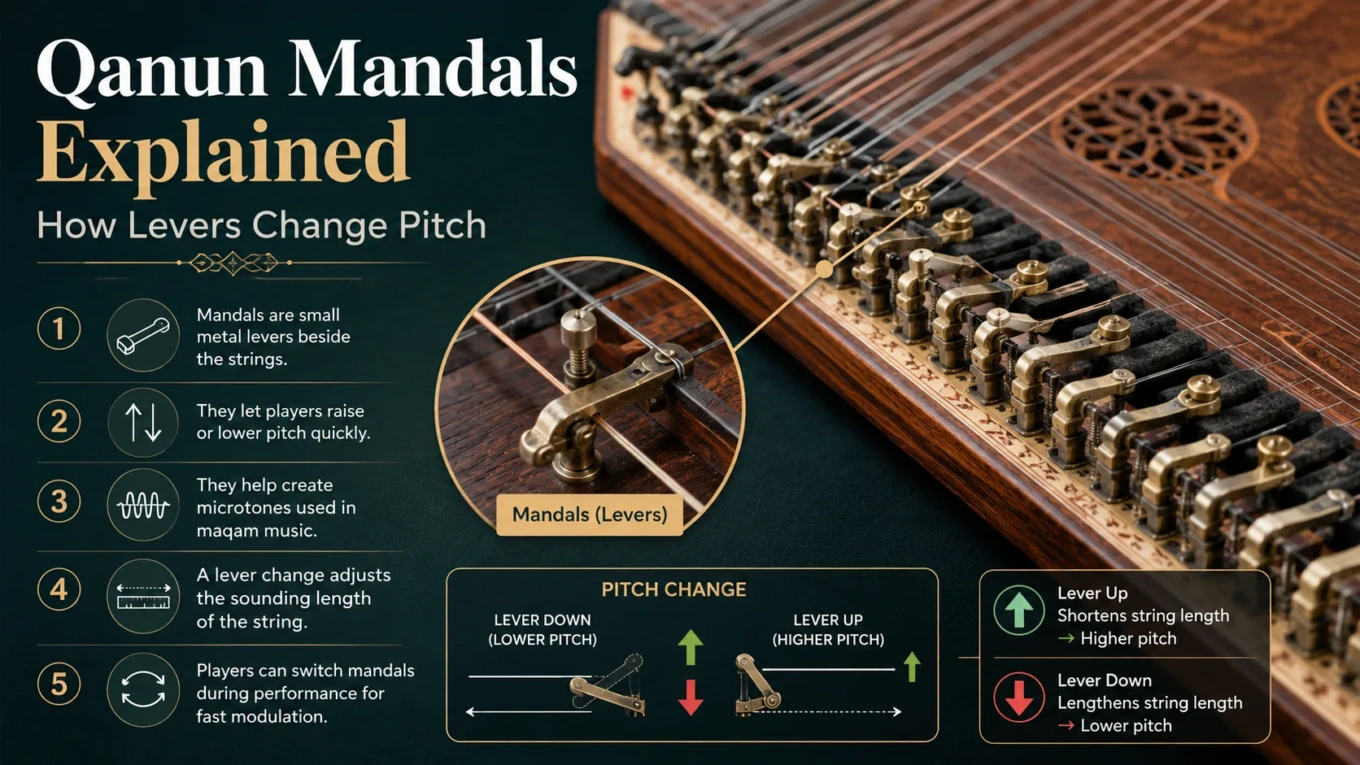
Qanun Mandals Explained: How Levers Change Pitch
Qanun mandals are the small metal levers that let a qanun change pitch while it is being played. They sit on the player’s left side of the instrument, near the tuning area of this trapezoidal plucked zither[1]. A raised or lowered mandal[2] changes the note of a string group, or course[3], by a small interval. That is why the qanun can move through microtonal[4] pitch shades without stopping the music for full retuning.
The mandal system is easy to see but hard to understand at first. It is not a row of decorative plates, and it is not the same as the tuning pegs. Its job is narrower: it gives the player a fast, repeatable way to raise selected notes by prepared steps. The sound still comes from the strings, the soundboard[5], and the long bridge[6] area; the mandals only decide which pitch a course will give at that moment.
Qanun Mandals and the Pitch Problem They Solve
The qanun has many open strings spread across a flat, trapezoidal body. Unlike a lute, violin, or guitar, it has no neck where the player can press a string against fixed frets. Unlike a harp, it places many short, close string groups under both hands. The player plucks rather than stops the string along a fingerboard.
That creates a practical problem. Modal music often needs notes that sit between the twelve familiar piano keys. A player may also need to change a pitch during a phrase, not only before the piece begins. Mandals solve this by making small pitch shifts available at the left end of each course.
In Turkish usage the levers are commonly called mandal or mandallar. In Arabic contexts, names such as ʿurab, orab, or related spellings may appear. The spelling changes by language and transliteration, but the basic idea is the same: a small metal lever selects a prepared pitch position for a course.
Main Parts Around the Mandal System
The mandals are part of a wider pitch-control area. A course must be tuned, guided, lifted cleanly, and allowed to vibrate freely. The table below separates the parts that beginners often confuse.
| Part | Where It Sits | What It Does |
|---|---|---|
| Mandal | Near the player’s left side, under or beside the strings | Selects a prepared higher pitch for a course |
| Course | Across the body, usually as a group of matching strings | Sounds one musical note when plucked |
| Tuning Peg | At the tuning side of the instrument | Sets the base tuning of a string or course |
| Bridge | Near the skin or soundboard area on the opposite side | Transfers string vibration into the body |
| Soundboard | Flat upper surface of the body | Helps project the vibration as audible tone |
How a Mandal Raises a Note
A qanun course begins as an open string[7] system. When no lever is engaged for that pitch step, the string vibrates across its longer prepared path. When the player raises a mandal, the lever changes the string’s contact point near the tuning side. This shortens the effective vibrating length[8] of the string and raises the pitch.
The same rule appears across string instruments: a shorter active string length gives a higher note, assuming the string and tension remain otherwise usable. On the qanun, the player does not need to press the string down with a fingertip. The small lever has already been placed by the maker in a measured position, so it can repeat the same pitch step again and again.
- The course is first tuned to a base note with a tuning peg[9].
- A mandal is raised when the player wants a higher prepared version of that note.
- The shortened active string length produces the new pitch until the lever is lowered or another lever position is chosen.
This is why mandals feel so different from ordinary tuning. A tuning peg sets the starting pitch and is adjusted with care. A mandal is a performance control. It can be moved quickly, sometimes during a phrase, because it is made for fast pitch selection rather than long retuning.
Luthier’s Note: A clean mandal must lift the course firmly enough to define pitch, but not so harshly that it chokes the tone or creates a harsh click. The height, angle, spacing, and metal finish all matter. Even a small alignment problem can make one course feel unstable or noisy.
Why Qanun Uses Levers Instead of Frets
Frets work well on instruments with a neck, where one hand can stop a string while the other hand plucks or bows. The qanun is different. Both hands work over many open courses, and the instrument must keep its strings free for fast plucking patterns, tremolo effects, and chord-like textures.
Mandals let the qanun stay flat and open while still offering controlled pitch changes. The player can prepare a set of levers before starting, then change a few of them while playing. This keeps the instrument responsive without turning it into a fretted zither.
The result is a pitch system built into the hardware. The player does not need to slide bridges during a piece, and does not need to bend every pitch by hand. Some expressive pitch shading can still be done by touch, but the mandal system gives the main pitch positions a stable mechanical reference.
Courses, Unison Strings, and Why One Note May Use Several Strings
Many modern qanuns group their strings into courses of matching pitch, often with three strings sounding together. The exact number of courses and strings can vary by maker, region, and period. Older museum instruments and modern stage instruments do not always share the same count.
A course gives the qanun much of its bright, ringing character. When the strings in a course are tuned cleanly together, they speak as one note with extra body and shimmer. If one string in the course drifts, the player may hear beating or a cloudy pitch. Mandals can only do their job well when the course itself is already in tune.
Because of this, qanun pitch control has two layers:
- Base tuning: the course is tuned with pegs before performance or during setup.
- Mandal selection: the player raises or lowers levers to choose prepared pitch steps while playing.
These layers should not be treated as the same operation. A mandal can correct the modal position of a note, but it is not meant to replace careful tuning.
Microtones, Maqam, Makam, and Regional Layouts
The qanun is closely associated with modal traditions that use intervals smaller than the Western semitone. In Arabic music, this is often discussed through maqam[10]. In Turkish music, related but distinct practice is usually discussed through makam[11]. Both terms refer to more than a scale; they also involve melodic behavior, characteristic phrases, and pitch tendencies.
Mandals help the qanun handle these pitch needs. Some Arabic qanun layouts are described through quarter-tone thinking, while many Turkish kanuns use a finer set of small pitch steps often called commas[12]. Armenian, Arabic, Turkish, and other regional instruments may place their levers differently, and some modern makers adjust the layout to suit a player’s repertoire.
It is safer to think of the mandal system as a prepared pitch map rather than a single worldwide standard. A qanun may offer many lever positions, but not every theoretical pitch division is necessarily present on every instrument. Physical space, string length, musical tradition, and player preference all shape the layout.
Classification Note: In broad instrument classification, the qanun is a zither because its strings run across the body rather than along a separate neck. In everyday music language, however, “zither” can also mean a narrower European instrument. For the qanun, the broad organological meaning is the useful one.
Why the Same Lever Does Not Mean the Same Interval Everywhere
A mandal is a measured mechanical stop, but the musical meaning of that stop depends on the instrument’s tuning plan. A lever may represent a quarter-tone step on one qanun, a smaller comma step on another, or a half-step position in a different regional setup. The metal part may look similar, but the pitch logic behind it can differ.
This is where temperament[13] matters. Some qanuns are planned with equal divisions for teaching, tuning convenience, or ensemble work. Others reflect a maker’s preferred modal practice. A player moving from one regional style to another may find that the lever pattern feels unfamiliar even when the body shape looks the same.
The mandal layout also affects memory. Skilled players do not think only in isolated levers. They learn rows, patterns, and hand movements. A familiar lever pattern becomes a physical map for the piece.
What Happens During Performance
Before playing, a qanun player often sets a group of mandals for the starting mode. This prepares the main pitch field. During the performance, the player may raise or lower selected levers to support modulation[14], a temporary pitch color, or transposition[15] into another tonal center.
The movement is small but precise. The left hand can pluck and also reach the levers, so the performer must plan fingerings and lever changes together. A late lever change can blur the phrase. A noisy lever can distract from the line. Clean mandal use is part of qanun technique, not only part of the instrument’s construction.
Good players make the movement almost invisible. The listener hears a smooth change of color or a new pitch area rather than a mechanical action.
How Mandals Shape Tone and Feel
The mandal mainly changes pitch, but it can also affect the feel of the note. A course resting cleanly on a raised lever should still ring freely. If the contact is uneven, the note may lose clarity, buzz, or sound slightly muted. This is one reason fine setup matters on a qanun.
The main body of the sound still depends on the strings, the bridge, the skin or wooden areas of the soundboard, and the overall resonance[16] of the instrument. Mandals do not create the qanun’s ringing voice by themselves. They decide which prepared pitch reaches that resonant body.
There is also a tactile side. Levers should move smoothly but not loosely. If they resist too much, fast pitch changes become tiring. If they move too freely, they may slip out of position. The best action is firm, quiet, and predictable.
Tuning Pegs and Mandals: Two Different Jobs
A tuning peg sets the pitch foundation. Turning it changes string tension and brings the string into tune. This is usually done before playing, with careful listening or a tuner, because even a small movement can affect the course.
A mandal does not replace that work. It assumes the string is already tuned. The lever then changes the active length of the string to reach a prepared higher pitch. If the base tuning is wrong, every mandal position on that course will also be wrong.
This is a common beginner mistake: treating mandals as a cure for poor tuning. They are better understood as pitch selectors. The pegs give the course its foundation; the mandals give it its usable modal positions.
How the Player Plucks While Changing Levers
The qanun is usually plucked with small finger-mounted plectra[17], often on the index fingers. The hands work close to the string plane, so lever changes must fit between plucked notes. This is one reason qanun technique can look economical from the outside while being demanding in practice.
A player may set several levers before a passage, then change one or two during the phrase. In slower music, the movement can be expressive and deliberate. In faster music, it becomes a matter of timing and muscle memory. The sound should remain fluid even when the left hand is managing several jobs.
For this reason, mandal study is not separate from repertoire. Scales teach the positions, but pieces teach when and why to move them.
Why Mandal Counts Vary
There is no single mandal count that defines every qanun. Counts change with the number of courses, the regional tuning plan, the range of the instrument, and the maker’s design. A modern Turkish kanun, an Arabic qanun, and an older museum qanun may all show different lever patterns.
More levers do not automatically mean a better instrument. Extra positions can offer more pitch choices, but they also make the layout denser. The player must be able to find the needed positions quickly, and the maker must keep the levers stable across the instrument’s range.
A practical qanun layout balances pitch range, modal needs, hand access, and mechanical reliability. The best design is not only the one with the most hardware; it is the one that serves the music cleanly.
How Mandals Differ from Related Zither Pitch Systems
The qanun belongs to the wider zither family, but its mandal system gives it a special kind of pitch control. Other zithers solve pitch in different ways.
- Guzheng and koto: pitch is shaped mainly through movable bridges and left-hand pressure after plucking.
- Gayageum: movable bridges set the scale, and hand pressure can bend or ornament notes.
- Concert zither: fretted melody strings and open accompaniment strings create a different playing logic.
- Autoharp: chord bars mute unwanted strings rather than raising pitches by microtonal steps.
- Santur and hammered dulcimer: pitch is organized through courses and bridges, but the strings are struck rather than controlled by mandal levers.
The qanun’s levers are therefore not just a convenience. They are part of what lets the instrument speak fluently in modal repertories where small pitch changes are part of the musical language.
Beginner Notes for Understanding Mandals
For a new listener or student, the mandal system becomes clearer when separated into three simple ideas: base tuning, prepared pitch steps, and performance timing.
- Learn what note each open course gives before relying on the levers.
- Watch how players set groups of mandals before a scale or piece.
- Listen for clean unison within each course.
- Notice that a lever change often prepares a melodic turn before the note is plucked.
- Avoid forcing stiff mandals; resistance can point to setup or maintenance needs.
The mandals may look like a dense row of metal parts, but their purpose is direct. They let a qanun player choose small pitch shifts fast enough for real music.
Glossary of Technical Terms
Plucked Zither
A plucked zither is a chordophone whose strings run across the body and are sounded by plucking. In the qanun, this means the strings lie over the resonating body rather than along a separate neck.
Mandal
A mandal is a small metal lever used on qanun and kanun instruments to select a prepared pitch position. It raises the pitch of a course by changing the active string length near the tuning side.
Course
A course is a string group treated as one musical note. On many qanuns, a course contains several strings tuned together so the note sounds fuller and brighter.
Microtonal
Microtonal pitch uses intervals smaller than the usual Western semitone. Qanun mandals make these small steps practical during modal performance.
Soundboard
The soundboard is the vibrating upper surface of the instrument body. On the qanun, it helps project the energy sent through the bridge and strings.
Bridge
The bridge supports the strings and transfers their vibration into the body. Qanun bridges work with the soundboard and skin-supported areas to shape projection and response.
Open String
An open string sounds without being stopped by a finger or fret. The qanun is built around open courses whose pitches are adjusted by tuning and mandal positions.
Effective Vibrating Length
The effective vibrating length is the part of a string that actively vibrates to create the note. A raised mandal shortens this length and raises pitch.
Tuning Peg
A tuning peg adjusts the string’s base tension and pitch. It is used for tuning setup, while mandals are used for fast pitch selection during playing.
Maqam
Maqam is a modal system used in many Arabic musical traditions. It includes pitch material, melodic movement, characteristic phrases, and expressive pitch behavior.
Makam
Makam is the Turkish modal tradition related to, but not identical with, Arabic maqam practice. Qanun mandals help players reach the pitch positions needed for makam performance.
Comma
A comma is a very small pitch interval used in some tuning descriptions. Turkish kanun practice often discusses fine pitch steps through comma-based language.
Temperament
Temperament is the way pitches are divided and adjusted within a tuning system. Different qanun traditions may use different lever layouts because they follow different pitch plans.
Modulation
Modulation is movement from one pitch area or modal center to another. Qanun players use mandals to prepare or carry out these changes during a piece.
Transposition
Transposition means moving a musical pattern to a different pitch level. On qanun, mandals help the instrument support this without retuning every course from scratch.
Resonance
Resonance is the way the instrument body strengthens and colors string vibration. Mandals choose pitch, while the body and bridge help turn that pitch into a ringing tone.
Plectra
Plectra are small picks used to pluck strings. Qanun players commonly use finger-mounted plectra, which lets both hands work quickly across the courses.
FAQ
What do qanun mandals do?
Qanun mandals raise selected notes by small prepared steps. They change the active vibrating length of a course, allowing the player to reach microtonal pitch positions during performance.
Are mandals the same as tuning pegs?
No. Tuning pegs set the base pitch of the strings. Mandals are performance levers that select alternate pitch positions after the course has already been tuned.
Does every qanun have the same mandal layout?
No. Mandal layouts vary by regional style, maker, number of courses, and the pitch system the instrument is built to serve. Arabic, Turkish, Armenian, and other qanun traditions may use different lever patterns.
Do mandals make the qanun a fretted instrument?
No. The qanun remains an open-string zither. Mandals act as mechanical pitch selectors near the tuning side; they do not create a fretted fingerboard like a guitar or concert zither.
Can a qanun play quarter tones?
Many qanuns can play quarter-tone positions, especially in Arabic contexts. Some Turkish kanuns use finer pitch steps as well. The exact options depend on the instrument’s lever layout.
Why do qanun players move mandals while playing?
Players move mandals to prepare modal changes, adjust pitch color, or move into another tonal area. The movement lets the qanun follow maqam or makam practice without stopping for full retuning.