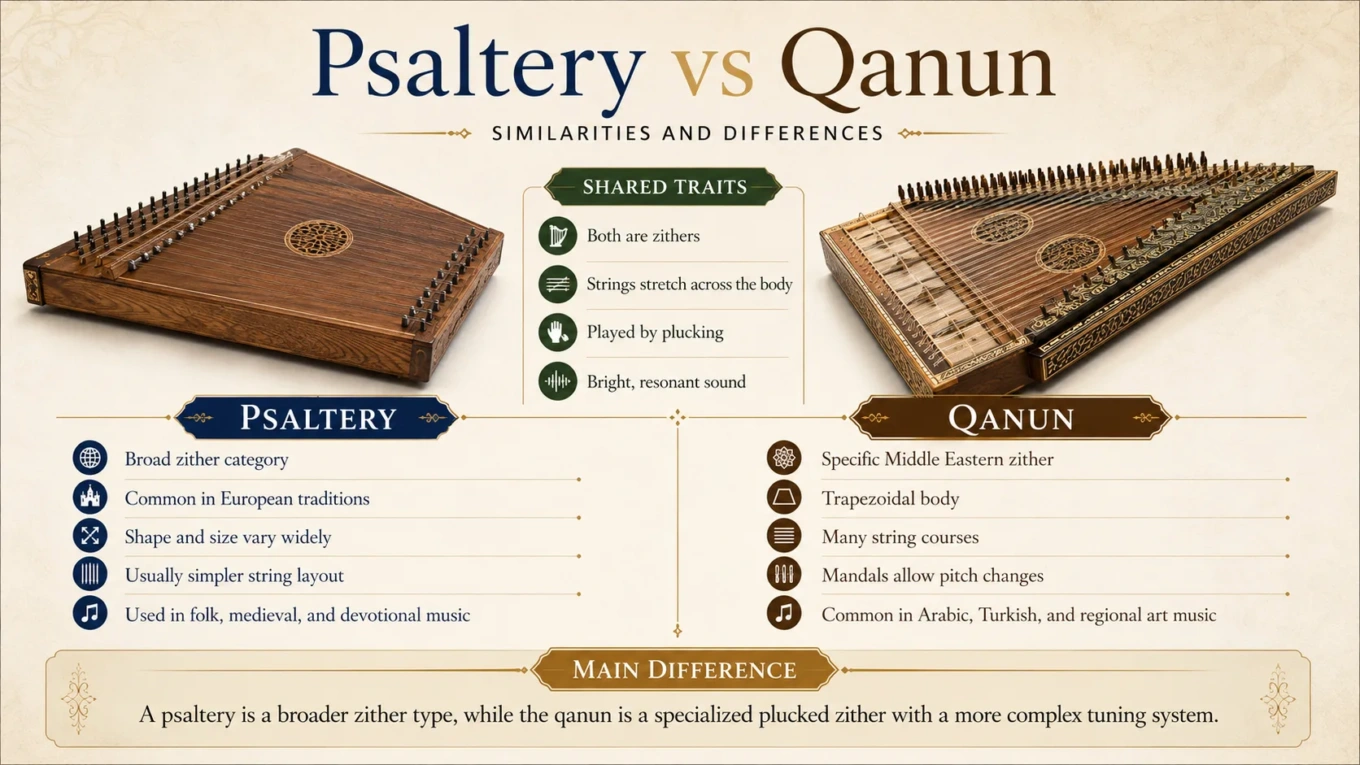
Psaltery vs Qanun: Similarities and Differences
Psaltery and qanun are closely related because both place many strings over a flat resonating body, yet they do not serve the same musical purpose. The psaltery is best understood as a broad historical name for several plucked box zithers, while the qanun is a living Middle Eastern and Mediterranean instrument with a highly developed bridge, string-course, and pitch-adjustment system.
Psaltery vs Qanun: The Basic Difference
A psaltery is usually a plucked box zither[1] with strings stretched across a shallow resonating body. The word can refer to medieval European instruments, later folk forms, museum objects, and some modern recreations. Its exact shape, number of strings, and tuning can vary widely.
A qanun is also a plucked zither, but it is not just a generic psaltery. It is a specialized trapezoidal instrument used in Arabic, Turkish, Armenian, Greek, Persian, and related musical settings. Modern qanuns normally use grouped strings, movable pitch levers, and a bridge system designed for fast melodic work and fine pitch control.
The simplest distinction is this: psaltery is a wider historical category, while qanun is a named regional instrument with a more standardized performance practice.
| Feature | Psaltery | Qanun |
|---|---|---|
| Instrument Type | Plucked box zither or related historical zither form | Plucked trapezoidal zither used in Middle Eastern and Mediterranean traditions |
| Main Identity | Broad historical and organological term | Specific named instrument |
| Body Shape | Often trapezoidal, rectangular, wing-shaped, or irregular depending on period and region | Usually trapezoidal, with a wide bass side and narrow treble side |
| Pitch Control | Usually fixed tuning once set | Often uses small levers to alter pitch during performance |
| Playing Method | Fingers, quill, or plectrum depending on the form | Finger-mounted plectra are common in many modern traditions |
| Musical Role | Historical, devotional, folk, early music, or educational use depending on type | Melodic, modal, solo, and ensemble use in living traditions |
Why They Are Often Confused
The confusion starts with classification. In the broad organological sense, both instruments belong to the chordophone[2] family because their sound comes from vibrating strings. More narrowly, both can be described as zithers because their strings run across the body rather than along a separate neck.
Older sources sometimes use the word psaltery for plucked trapezoidal zithers in general. Because the qanun is also trapezoidal and plucked, it may be described as a kind of psaltery in museum or reference language. That does not mean every psaltery is a qanun, and it does not mean the qanun should be reduced to a medieval European instrument.
Classification Note: A qanun may be called a psaltery in a broad descriptive sense, especially when the word psaltery means “plucked box zither.” In musical practice, however, qanun refers to a distinct instrument with its own regional names, construction details, and playing techniques.
Shared Zither Features
Psaltery and qanun share several physical traits. Both use a shallow resonating body, many strings, and a layout that allows the player to see the string field from above. The player does not shorten the strings with a neck or fingerboard in the way a violin, lute, or guitar player does.
In both instruments, the body supports the strings and helps amplify their vibration. The top plate functions as a soundboard[3], while the hollow body works as a resonator[4]. The strings pass over or near bridges, pins, or bearing points that help define pitch and transmit vibration into the body.
The shared traits include:
- Strings stretched across a flat or shallow body
- No long neck used for stopping the strings
- Open strings that produce fixed pitches unless adjusted by tuning or mechanism
- Plucked playing in most traditional forms
- A close link to board and box zither classification
Body Shape and Construction
The psaltery has no single body plan. Museum examples and historical depictions show trapezoidal, rectangular, triangular, wing-shaped, and “pig’s head” outlines. Some are narrow and portable; others are wider table-like instruments. The body is often a shallow wooden box, though the exact wood, thickness, decoration, and internal bracing vary by maker and period.
The qanun has a more recognizable outline. It is usually a flat trapezoid with the longer side carrying lower-pitched strings and the shorter side carrying higher-pitched strings. Many qanuns combine a wooden soundboard with one or more skin or membrane sections beneath the bridge area. This construction helps shape the instrument’s bright attack and quick response.
On both instruments, the body is not only a frame for the strings. It shapes volume, sustain, and clarity. Wood choice can shape resonance, but it should not be treated as the only cause of tone. String material, bridge design, body depth, tension, and playing technique all matter.
Strings and Courses
A major difference appears in the way the strings are organized. Many psalteries have one string per pitch, though some forms may use paired or grouped strings. Historical examples are not uniform, so a psaltery should not be described as having one fixed string count.
The qanun usually uses courses[5], meaning two or three strings may sound together for one pitch. In many modern Turkish and Arabic qanuns, triple courses are common, though details vary by maker and regional style. This gives the qanun a full, shimmering sound because several strings vibrate together when one pitch is played.
String materials also differ by period and instrument. Older psalteries may be associated with metal strings in many medieval and early music contexts, while some modern recreations use steel, brass, bronze, nylon, or other materials depending on desired tone. Modern qanuns often use nylon, PVF, or similar synthetic strings, with regional and maker variation.
Bridge Systems and Pitch Layout
The bridge system is one of the clearest differences between psaltery and qanun. A psaltery may have simple fixed bridges, hitch pins, tuning pins, or bearing points. Once tuned, each open string normally keeps its assigned pitch until the player retunes the instrument.
The qanun uses a more elaborate bridge[6] and pitch-adjustment system. Many modern qanuns include small metal levers called mandals[7]. These levers allow the player to raise or lower the pitch of a course by small steps while playing. This is one reason the qanun works so well in modal music that needs fine pitch changes.
Not every older qanun had the same lever system found on many modern instruments. Some historical and regional instruments relied more on tuning, hand technique, or simpler hardware. Still, the modern mandal system is one of the best-known features separating qanun from simpler psaltery forms.
Luthier’s Note: A psaltery often asks the maker to balance string tension, box depth, and clear open-string tone. A qanun adds another layer: the bridge, skin sections, string courses, and levers must work together so pitch changes remain stable and playable.
Playing Technique
The psaltery may be played with fingers, a quill, or a small plectrum depending on the historical or modern form. Some modern bowed psalteries are played with a bow, but that is a different branch of the psaltery name and should not be confused with the older plucked psaltery tradition.
The qanun is usually plucked with plectra[8] attached to the player’s index fingers, often with rings. This allows rapid alternation between hands, ornamented melodic lines, and clean attacks across grouped strings. The player may also use fingers for special effects, depending on style and training.
Another difference is the role of the left hand. On a simple psaltery, the left hand may pluck lower or inner strings, but it usually does not operate a complex pitch system during performance. On a qanun, the left hand can pluck while also managing mandals, making pitch alteration part of the playing technique rather than a separate tuning task.
Tuning and Modal Use
A psaltery is usually tuned to a selected scale or pitch layout before playing. Some instruments are arranged diatonically, while others may be chromatic or follow a different pattern. The tuning depends on the instrument’s design and repertoire.
The qanun is more closely tied to modal music[9]. In Arabic, Turkish, and related traditions, the instrument often supports melodic systems that require small pitch adjustments. The mandals help the player move between tonal areas, adjust scale degrees, and match the pitch language of a given mode.
This makes the qanun more flexible during performance than many psalteries. The psaltery can still be expressive, but its pitch world is often more fixed once tuning is set.
Sound and Listening Differences
A plucked psaltery often has a clear, bell-like sound. Metal strings can add brightness and long sustain, while softer strings may give a warmer response. Because psalteries vary so much, no single tone describes every example.
The qanun has a fast, articulate attack with a bright but layered tone. Triple courses can create a rich shimmer, while the body and membrane-supported bridge area help produce a lively response. Ornamentation, tremolo, and quick melodic turns are central to many qanun styles.
Listening Note: When comparing recordings, listen for pitch motion. A psaltery often sounds like fixed open strings arranged across a box. A qanun often sounds more fluid because the player can alter pitch color and scale degrees during the musical line.
Historical and Regional Identity
The psaltery name appears across several historical contexts. In European art and early music sources, it is often linked with medieval and Renaissance plucked zithers. In some modern settings, psaltery may also refer to folk instruments, educational instruments, or reconstructions inspired by old images and surviving objects.
The qanun is strongly associated with Middle Eastern, North African, Turkish, Armenian, Greek, and neighboring musical traditions. Spelling varies: qanun, kanun, qānūn, and other transliterations may appear depending on language and region. The instrument is used in classical, folk, ensemble, and solo settings.
Because both instruments have long histories and many regional forms, direct ancestry should be discussed with care. It is safer to say that the qanun belongs to the wider family of plucked zithers related in form to psalteries, rather than claiming that every qanun is simply a later version of one specific psaltery type.
Are They the Same Instrument?
No. They overlap in classification, but they are not the same instrument in practical use.
The psaltery is a broader name. It can describe a family of plucked box zithers with many historical forms. A qanun is a specific instrument with its own construction habits, playing methods, regional identity, and pitch-control system.
A museum label might describe a qanun as a “plucked zither” or even as a type of psaltery. A musician, however, will usually treat the qanun as its own instrument, not as a generic psaltery.
Similarities Worth Knowing
The strongest similarities are structural. Both instruments place strings over a resonating body and are normally played by plucking. Both can have trapezoidal bodies. Both can use open strings arranged in a pitch field that the player reads visually from above.
They also share a place in the wider story of zithers. Neither depends on a neck in the way a lute or guitar does. The body and string plane are part of the same playing surface, which is one reason the terms zither and psaltery often appear near each other in classification systems.
Differences That Matter Most
The differences are more important for players than for classification labels.
- Specificity: Psaltery is a broad term; qanun is a named instrument.
- Pitch System: Many psalteries use fixed open-string pitches; many qanuns use mandals for pitch changes.
- String Grouping: Psalteries may use single or paired strings; qanuns often use courses of multiple strings per pitch.
- Technique: Psaltery playing can be simple or varied; qanun technique often includes fast plucking, ornament, and lever changes.
- Repertoire: Psaltery is often linked with early music, folk use, or reconstruction; qanun remains active in many living modal traditions.
- Construction Detail: Qanuns often include membrane sections and a specialized bridge system; many psalteries have simpler box construction.
How Museums and Musicians Describe Them
Museums often use classification language such as “chordophone,” “zither,” or “plucked box zither.” This is useful because it describes how an object produces sound. A psaltery in a collection may be labeled by shape, region, material, and playing method.
Musicians tend to use tradition-based names. A qanun player usually does not describe the instrument mainly as a psaltery during practical discussion. Terms such as tuning, maqam, mandals, courses, and right-hand or left-hand technique matter more in performance.
Both approaches are valid, but they answer different questions. Classification explains the instrument’s physical type. Musical naming explains how it functions in a tradition.
Common Misunderstandings
“A Qanun Is Just a Psaltery”
This is too narrow. A qanun can be described as a plucked zither related to psaltery forms, but its lever system, course layout, regional tuning habits, and repertoire make it a distinct instrument.
“Every Psaltery Looks Like a Qanun”
Psalteries can be trapezoidal, but they may also be rectangular, wing-shaped, triangular, or built in other outlines. Shape alone does not identify a qanun.
“Both Instruments Use the Same Tuning”
They do not have one shared tuning. Psaltery tuning depends on form and repertoire. Qanun tuning depends on regional practice, course layout, and the modal system used by the performer.
“Bowed Psaltery and Qanun Are Close Equivalents”
A bowed psaltery is a modern bowed instrument type. It should not be treated as the same comparison as an older plucked psaltery and qanun. The playing logic is different.
What Beginners Should Know
A beginner comparing psaltery and qanun should first decide whether the goal is historical curiosity, early music, folk playing, or living Middle Eastern and Mediterranean repertoire.
A simple psaltery can be easier to understand at first because each string often corresponds to a fixed pitch. It can suit melody playing, modal drones, early music projects, or educational use depending on design.
A qanun usually asks for more specialized study. The player must learn string layout, course response, hand coordination, tuning habits, and mandal use. It offers more pitch flexibility, but that flexibility comes with a steeper learning curve.
Care and Setup Differences
Both instruments need stable tuning and careful handling. Many strings mean that temperature and humidity changes can affect pitch. The tuning pins or pegs should hold securely, and the soundboard should remain free from cracks, lifting, or warping.
A qanun adds extra setup concerns. Mandals must move cleanly and return accurate pitches. Bridge pressure, membrane condition, and course balance can affect tone and tuning stability. A psaltery may be simpler to maintain, but old or handmade examples still require care.
Collector’s Note: For older psalteries, labels and images can be misleading because the same word has covered many forms. For qanuns, inspect the lever system, bridge area, string courses, and body condition before making assumptions about age, region, or playability.
Best Way to Tell Them Apart
The fastest way to identify the difference is to look for the pitch-control hardware. A trapezoidal plucked zither with rows of small metal levers near the tuning side is likely a qanun or kanun. A simpler plucked box zither without that system may be a psaltery or another related zither.
Next, look at the cultural and musical context. If the instrument is used in Arabic, Turkish, Armenian, Greek, or related modal repertoire and uses courses with mandals, qanun is the more accurate name. If the instrument is a medieval-style or general plucked box zither, psaltery may be the better term.
Glossary of Technical Terms
- Box Zither: A zither with a hollow box-like body that supports and amplifies the strings. Psalteries and qanuns are often described this way because their strings run over a resonating body rather than along a neck.
- Chordophone: An instrument whose sound comes from vibrating strings. Zithers, lutes, harps, and bowed strings all belong to this broad sound-producing group.
- Soundboard: The top vibrating surface of a string instrument. In zithers, it helps transfer string vibration into audible sound.
- Resonator: The part of an instrument that strengthens and shapes sound after the string vibrates. In psalteries and qanuns, the shallow body acts as a resonator.
- Course: A group of two or more strings tuned to the same or related pitch and played as one note. Many qanuns use courses to create a fuller tone.
- Bridge: A support that holds strings at the correct height and helps pass vibration into the soundboard. Bridge design strongly affects attack, sustain, and clarity.
- Mandal: A small pitch lever used on many modern qanuns and Turkish kanuns. Raising or lowering a mandal changes the pitch of a string course by a small step.
- Plectrum: A small pick used to pluck strings. Qanun players commonly use plectra attached to finger rings, while psalteries may use fingers, quills, or picks depending on type.
- Modal Music: Music organized around modes rather than only major and minor scales. Qanun playing often uses modal pitch systems that may need fine pitch adjustment during performance.
FAQ
Is a qanun a type of psaltery?
In broad classification language, a qanun may be described as a plucked psaltery-like zither. In musical practice, it is treated as a distinct instrument with its own name, construction, tuning habits, and playing technique.
Is a psaltery the same as a zither?
A psaltery is usually a kind of zither, especially when it has strings stretched across a resonating box. The word zither is broader and can include many other instruments, such as qanun, guzheng, koto, kantele, and autoharp in different classification contexts.
Which instrument is easier for beginners, psaltery or qanun?
A simple psaltery is often easier to begin because the pitch layout can be more fixed and direct. Qanun can be harder because the player must learn courses, hand coordination, tuning practice, and mandal changes.
Does every qanun have mandals?
Many modern qanuns use mandals, but historical and regional instruments have not all used the same mechanism. The number, placement, and tuning function of the levers can vary by maker and tradition.
Why do psaltery and qanun both have trapezoidal shapes?
The trapezoidal shape helps arrange longer bass strings and shorter treble strings across one flat body. This shape is useful for many plucked zithers, but it does not make all trapezoidal instruments the same.
Can psaltery music be played on a qanun?
Some simple melodies can be adapted, but the instruments are built for different musical settings. A qanun can play fixed-pitch melodies, yet its course layout and mandal system are especially suited to modal traditions and ornamented melodic playing.