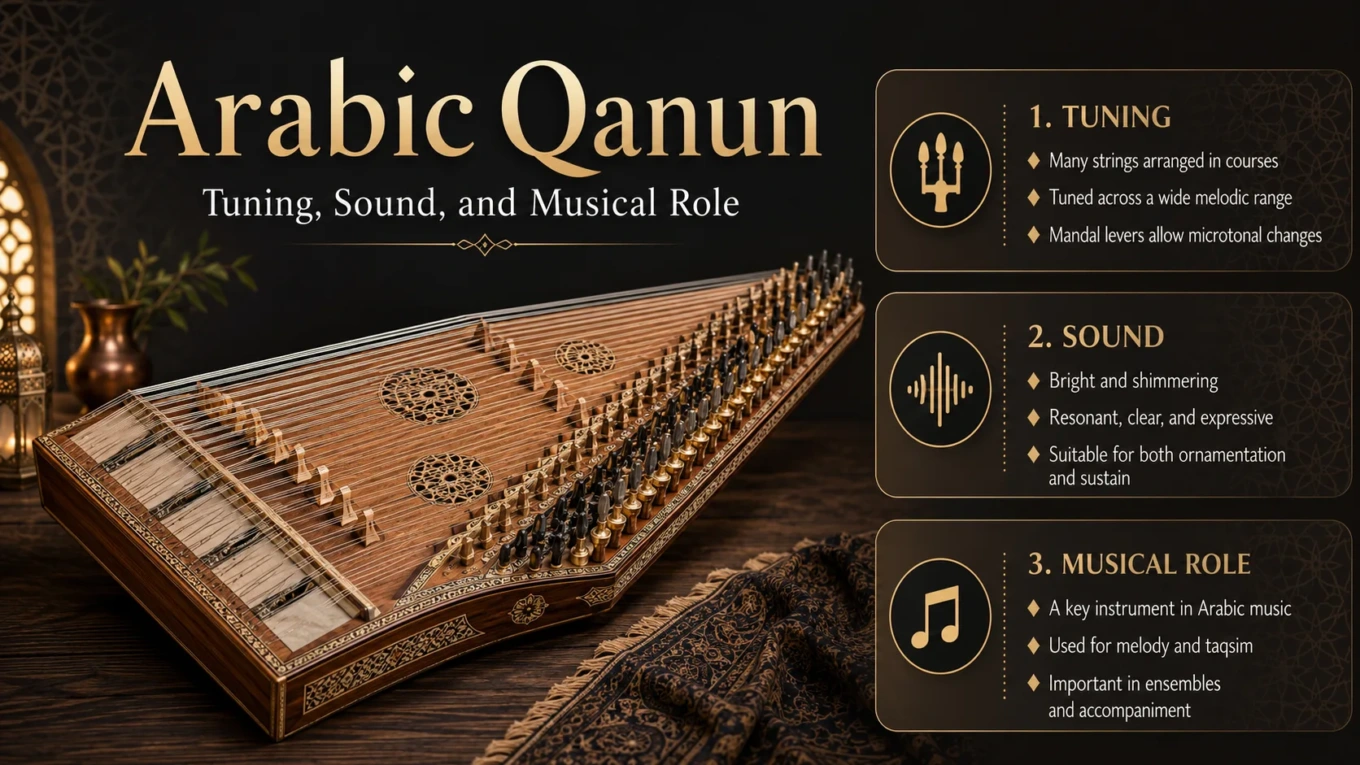
Arabic Qanun: Tuning, Sound, and Musical Role
The Arabic qanun is a trapezoidal plucked box zither[1] known for clear attack, ringing sustain, and highly flexible pitch control. Its musical identity comes from three linked features: groups of strings tuned in courses, a resonant body with a thin soundboard[2], and a lever system that lets the player adjust pitch for Arabic maqam performance while the music is still moving.
Unlike a lute, the qanun has no neck. Unlike a harp, its strings run across a flat body rather than rising from a frame. In the broad organological sense, it belongs to the zither family because its strings are stretched across the body of the instrument itself. In Arabic music, however, the word qanun does not mean any zither. It refers to this specific plucked instrument, with its own tuning practice, tone color, and ensemble role.
What Makes the Arabic Qanun Distinct
The Arabic qanun is usually associated with Arab art music traditions in regions such as Egypt, the Levant, Iraq, and parts of North Africa. Its exact build can vary by maker, school, and period, but the core design is recognizable: a shallow trapezoidal wooden body, many strings arranged in repeated groups, a bridge system resting near skin or membrane panels, and small pitch-changing levers placed near one side of the instrument.
Most modern Arabic qanuns use triple-string courses[3]. A course is a set of strings tuned to the same pitch and played as one note. This gives the qanun its bright, doubled shimmer. When a player plucks one course, several strings sound together, producing a fuller tone than a single string could provide.
The instrument is often called qanun, qānūn, or sometimes kanoun in English-language writing. Turkish sources often use kanun. These spellings can point to closely related instruments, but Arabic and Turkish models are not always tuned or configured in exactly the same way.
Main Details Worth Knowing
| Feature | Typical Detail |
|---|---|
| Instrument family | Plucked zither, often described as a box zither or psaltery-type chordophone |
| Body shape | Shallow trapezoidal wooden body with a broad soundboard |
| String layout | Many courses, commonly with three strings per course; exact number varies |
| Pitch control | Small levers, often called mandals, alter the sounding pitch of selected courses |
| Playing method | Plucked with plectra worn on the index fingers, often while the instrument rests on the lap or a table |
| Musical role | Melodic line, ornamentation, improvisation, ensemble color, and support for vocal music |
Body Shape and Sound-Producing Parts
The qanun’s trapezoidal body is not only a visual marker. It also supports a wide spread of string lengths. Lower notes need longer vibrating string length, while higher notes can use shorter lengths. The shape allows those different lengths to sit across one flat instrument without adding a neck or fingerboard.
Arabic qanuns are usually built from wood, with the top acting as the main resonating surface. The maker must balance lightness and strength. A soundboard that is too heavy may limit response; one that is too thin may lack stability under string tension. The result is a carefully judged structure rather than a simple wooden box.
Bridge, Skin Panels, and Resonance
The strings pass over a long bridge[4], which transfers vibration into the body. In many qanuns, part of the bridge system rests over skin or parchment-like membrane[5] panels. This feature helps shape the quick response and crisp projection associated with the instrument.
The wooden body then amplifies and colors the vibration. The sound is not only the sound of metal, nylon, gut, or synthetic strings. It is also the sound of the strings acting through the bridge, the skin panels, the soundboard, and the air inside the shallow body.
Luthier’s Note: Small changes in bridge height, skin tension, string material, and soundboard thickness can affect the playing feel. These details may not be obvious from a distance, but they matter to tuning stability, attack, and the balance between low and high courses.
Strings and Courses
A modern Arabic qanun commonly has many sets of three strings tuned in unison[6]. The three-string course gives each note a dense, ringing surface. If the strings in a course are not tuned closely together, the tone may wobble or sound unclear. Skilled players and tuners listen carefully for this beating effect while tuning.
Exact string counts should be treated with care. Some instruments have around 24, 25, 26, or more courses, and many modern forms use three strings per course. Older instruments, regional models, and custom-built qanuns may differ. A fixed number should not be presented as universal.
How Arabic Qanun Tuning Works
Arabic qanun tuning begins with the open courses, but it does not end there. Each course is tuned with a peg, then shaped in performance by small metal levers. These levers are often called mandals[7], though terminology can vary by language and tradition.
The tuning peg sets the basic pitch of a course. The mandal changes the effective vibrating length of the string, raising or lowering the pitch by a small amount. This allows the player to prepare and adjust pitches for different maqamat without stopping the performance.
Maqam and Microtonal Pitch
Arabic music often uses maqam[8], a modal system that includes characteristic pitch relationships, melodic movement, phrase shapes, and ornamentation. The qanun’s tuning system is built to serve that modal language. It is not simply a Western chromatic instrument with extra decoration.
Many Arabic qanuns are discussed through a quarter-tone-oriented pitch layout, but real musical practice is more flexible than a simple “24 equal notes per octave” explanation suggests. A microtonal interval[9] may be shaped by regional style, teacher lineage, ensemble habit, singer preference, and the chosen maqam.
This is why the qanun can sound precise without sounding mechanical. The lever system gives the player a practical map, but the ear still guides the music.
Why There Is No Single Arabic Qanun Tuning
Arabic qanun tuning depends on musical context. A player may tune to a singer, to an ensemble pitch reference, to a concert setting, or to the tonal center of a specific piece. Some players set the open strings in a practical base pattern, then use levers to reach the needed scale degrees. Others prepare the instrument more closely around the maqam of the performance.
Several details can vary:
- The number of levers assigned to each course
- The pitch steps available on a given instrument
- The reference pitch used by the ensemble
- The way microtonal notes are placed for a specific maqam
- The player’s approach to modulation between related maqamat
The important point is that tuning is both mechanical and musical. The pegs, strings, and mandals provide the tools; the player’s ear decides how those tools serve the phrase.
The Sound of the Arabic Qanun
The Arabic qanun has a clear, bright, and highly articulate sound. A note begins with a sharp plucked attack, then opens into a ringing sustain. Because several strings sound in each course, the tone can have a fine shimmer even when the player performs a single melodic line.
The instrument can also sound delicate. Fast passagework remains clean because each plucked note speaks quickly. Slow phrases can carry warmth when the player uses controlled repetition, gentle dynamics, and subtle pitch preparation.
Attack, Sustain, and Color
The qanun is plucked with a plectrum[10], often attached to a ring worn on each index finger. This gives the player a clean attack and allows rapid alternation between the hands. The hands can divide melodic patterns, decorate a phrase, or create repeated notes with great speed.
Its sustain is long enough to fill the musical space, but not so heavy that it hides detail. This balance makes the qanun useful in both solo passages and ensemble textures. It can lead a melody without covering the singer, and it can add brilliance without turning the music into dense harmony.
Listening Note: A well-played Arabic qanun often sounds like a line of small, clear pulses rather than a wash of chords. Listen for the way the player connects those pulses into a vocal-like melody.
Ornamentation and Tremolo
Arabic qanun playing often uses ornamentation[11] such as turns, repeated notes, slides created by lever changes, and quick decorative figures around a main pitch. These ornaments are not random additions. They help define style and shape the movement of a maqam.
A common effect is tremolo[12], where the player repeats a note rapidly to sustain it or intensify a phrase. Since the qanun does not bow strings like a violin, tremolo gives the player a way to lengthen the musical gesture after the first pluck.
The Musical Role of the Arabic Qanun
The Arabic qanun is both a melodic and coloristic instrument. It can state a melody clearly, answer a singer, support an ensemble, or present an improvised solo. Its wide pitch range and lever system make it especially useful when the music moves between related maqamat.
It is not mainly a chord-strumming instrument in the Western sense. Players may use arpeggios, broken textures, and occasional chordal touches, but the qanun’s main language is melodic. Its strength lies in line, articulation, tuning nuance, and rhythmic clarity.
Role in the Takht
In the Arabic takht[13], the qanun often appears beside instruments such as the oud, nay, violin, and riqq. Each instrument brings a different kind of expression. The oud offers a warm plucked sound with flexible phrasing. The nay gives breath and pitch shading. The violin can sustain and bend notes. The qanun adds a bright, precise, plucked voice with fast ornamental reach.
Within this setting, the qanun can help clarify the melodic outline. It can double a main melody, fill short spaces between vocal lines, and create a sparkling response after a phrase. Because its pitch system can be changed quickly with levers, it can follow modulations that would be difficult on a fixed-pitch zither.
Role in Taqsim
The qanun is also used for taqsim[14], an improvised solo that explores a maqam. In taqsim, the player may begin with a clear tonal center, unfold characteristic phrases, touch related areas, and return with a sense of modal balance.
The lever system matters here. A player can prepare a microtonal pitch just before it appears, then shift again for the next turn of the phrase. The audience may not see every lever movement, but those small mechanical actions help the melody follow Arabic modal practice.
Role with Singers
In vocal music, the qanun often supports the singer without competing for attention. It can echo a sung phrase, introduce a maqam, or add short connecting figures. Its clean attack helps mark rhythmic placement, while its ringing tone can soften the space around the voice.
The instrument must remain sensitive to the singer’s intonation. In many performances, the qanun player listens closely and adjusts pitch color, ornamentation, and density. A heavy hand can make the instrument feel rigid; a responsive hand lets it breathe with the vocal line.
Arabic Qanun and Related Instruments
The qanun is often compared with other zithers and plucked instruments, but each comparison needs limits. The qanun shares a broad zither identity with instruments such as the psaltery, koto, guzheng, and santur in the sense that its strings run across the body. It does not share the same tuning system, construction logic, or musical role with all of them.
The santur is also a zither-family instrument in many classification systems, but it is struck with light hammers rather than plucked with finger plectra. The oud is central to Arabic music, but it is a lute, not a zither, because it has a neck and a different string-bearing structure. The Turkish kanun is closely related to the Arabic qanun, yet lever patterns, tuning practice, dimensions, and tonal preferences may differ by maker and tradition.
Classification Note: Calling the qanun a zither is correct in broad instrument classification. Calling every zither a qanun is not correct. The Arabic qanun is one member of a much wider family of stringed instruments.
What Beginners Should Know
Beginners often notice the number of strings first. The harder part is learning how the strings, levers, and maqam system work together. A new player must learn to tune courses cleanly, control both plectra, and understand when to prepare lever changes before a note arrives.
Early study usually centers on posture, hand position, basic plucking, simple scales, and listening. The player also needs patience with tuning. Since each course may have three strings, one written note may require several strings to be tuned accurately. This is part of the instrument’s daily discipline.
Common Learning Challenges
- Tuning accuracy: Triple courses must be aligned closely enough to sound clear.
- Lever awareness: The left side of the instrument must be read almost like a second keyboard of pitch choices.
- Hand balance: Both hands need clean attack, even tone, and relaxed motion.
- Maqam listening: The player must hear the character of the maqam, not only memorize lever positions.
- Ornament control: Decorative figures should support the phrase rather than cover it.
The qanun rewards careful listening. Mechanical tuning charts help, but Arabic qanun playing cannot be reduced to charts alone.
Care and Tuning Stability
The qanun is sensitive to humidity, temperature, string condition, peg fit, and skin tension. A dry room may affect tuning response. A damp room may change the feel of the skin panels. Players often need to tune before practice or performance, especially after moving the instrument between spaces.
Strings should be replaced when they lose clarity, become unstable, or show wear. Pegs need smooth but secure movement. Mandals should move cleanly without buzzing. Any persistent rattle, weak course, or uneven response may point to a setup issue rather than a playing problem.
Because the bridge, skin panels, and soundboard work together, repair work should be handled with care. The qanun is not only a set of strings on a board; it is a balanced acoustic system.
Glossary of Technical Terms
- Box Zither: A zither with a hollow resonating body shaped like a box or shallow case. In the qanun, the strings run across this body rather than along a separate neck.
- Soundboard: The main vibrating top surface of a stringed instrument. On the qanun, it helps turn string vibration into audible tone.
- Course: A group of strings treated as one musical note. Arabic qanuns often use three strings per course, tuned together.
- Bridge: The part that supports the strings and transfers their vibration into the body. On the qanun, the bridge is central to attack, volume, and response.
- Membrane: A skin or parchment-like vibrating panel used in some qanun construction. It affects the quickness and color of the sound near the bridge area.
- Unison: Two or more strings tuned to the same pitch. In a qanun course, unison tuning gives the note a fuller and brighter tone.
- Mandal: A small metal lever used to adjust the pitch of a course. The term is common in kanun and qanun contexts, though naming can vary by language and region.
- Maqam: A modal system used in Arabic music. It includes pitch relationships, melodic movement, characteristic phrases, and performance behavior.
- Microtonal Interval: A pitch distance smaller or differently placed than the standard Western semitone. Arabic qanun tuning uses such pitch areas to serve maqam practice.
- Plectrum: A small pick used to pluck strings. Qanun players commonly use plectra attached to rings on the index fingers.
- Ornamentation: Decorative musical movement around a main note or phrase. On the qanun, ornaments help shape style, rhythm, and maqam expression.
- Tremolo: Rapid repetition of a note. Qanun players use tremolo to sustain sound and intensify a phrase after the initial pluck.
- Takht: A small Arabic ensemble often associated with instruments such as oud, qanun, nay, violin, and riqq. The qanun adds a bright plucked melodic voice to this setting.
- Taqsim: An improvised instrumental solo that explores a maqam. Qanun taqsim often shows the player’s control of tuning, phrasing, and lever changes.
FAQ
Is the Arabic qanun a zither?
Yes. In broad instrument classification, the Arabic qanun is a plucked zither because its strings run across the body of the instrument. In everyday musical language, however, qanun refers to this specific Arabic and Middle Eastern instrument, not to all zithers.
How is the Arabic qanun tuned?
The strings are tuned in courses, often with three strings sounding as one note. Tuning pegs set the base pitch, while small levers allow the player to adjust notes for maqam-based performance. Exact tuning practice varies by instrument, teacher, region, and musical setting.
Does the Arabic qanun use quarter tones?
Many Arabic qanuns are built to support quarter-tone-oriented pitch choices, but real performance is not always equal or fixed in a simple mathematical way. The player’s ear, the maqam, and the ensemble context all shape the final pitch placement.
What does the Arabic qanun sound like?
It has a clear, bright, ringing sound with a sharp plucked attack. Because several strings are tuned together in each course, single notes can shimmer while still staying precise and articulate.
What is the qanun’s role in Arabic music?
The qanun often carries melody, supports singers, answers phrases, adds ornamental detail, and performs taqsim. In ensemble settings, it brings a bright plucked voice that can follow maqam changes with fine pitch control.
Is Arabic qanun the same as Turkish kanun?
They are closely related, but they are not always identical. Arabic and Turkish instruments may differ in size, lever layout, tuning habits, tonal preference, and repertory. A player usually chooses the form that best fits the musical tradition being studied.