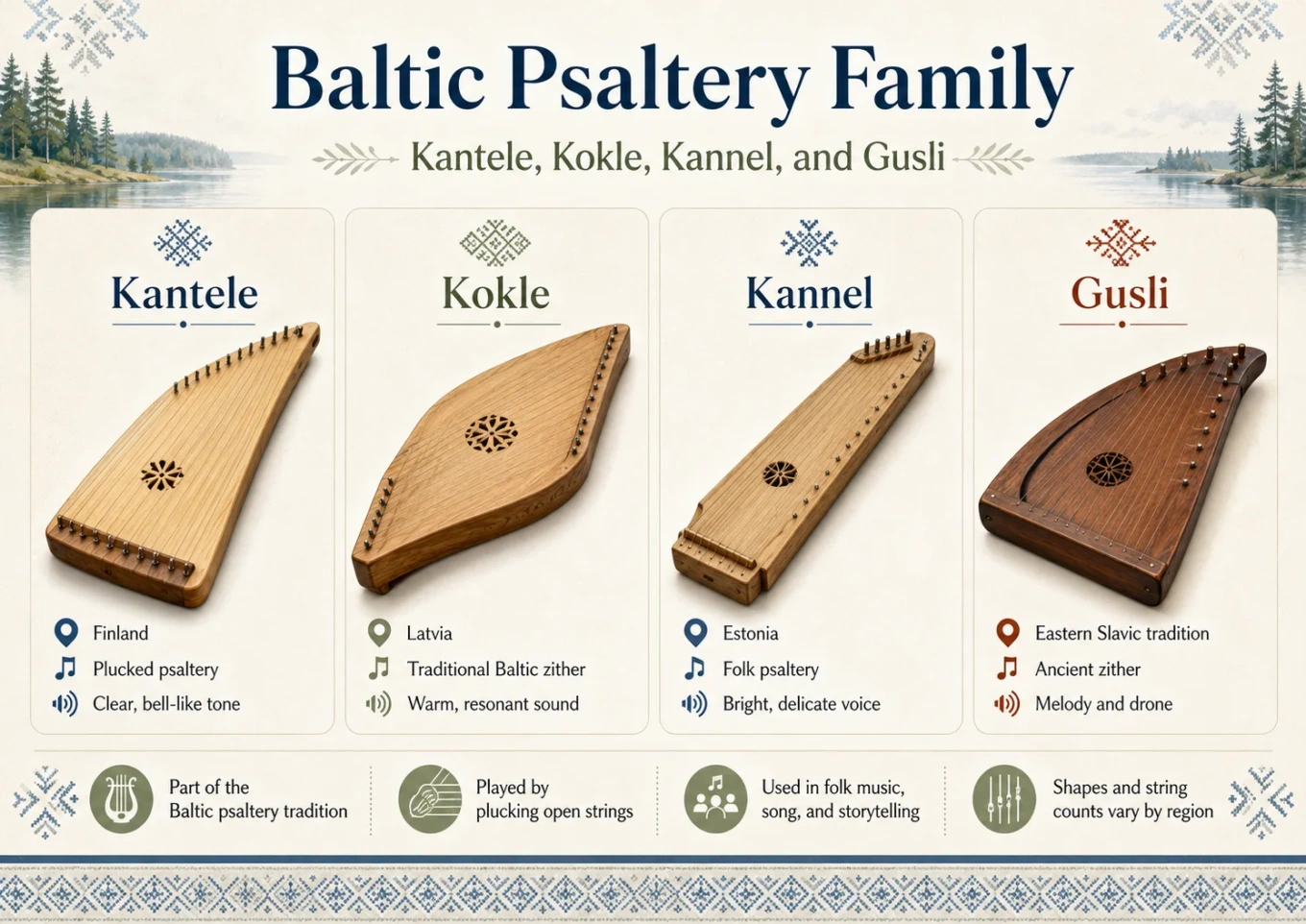
Baltic Psaltery Family: Kantele, Kokle, Kannel, and Gusli
The Baltic psaltery family is a northern group of plucked string instruments built around a simple idea: strings run across a shallow wooden body and sound as open strings. In organology, these instruments sit within the wider zither[1] and chordophone[2] category, yet their shapes, names, tunings, and playing habits differ by language area. Kantele, kokle, kannel, kanklės, and several forms of gusli are related by construction logic, not by being one identical instrument under different names.
Baltic Psaltery Family Meaning
The phrase Baltic psaltery family is often used for a set of northern European and northwestern Eurasian plucked zithers associated with Finland, Karelia, Estonia, Latvia, Lithuania, and nearby Slavic regions. The main instruments usually named in this group are the Finnish and Karelian kantele, the Latvian kokle, the Estonian kannel, the Lithuanian kanklės, and the Russian and East Slavic gusli.
The word psaltery[3] can create confusion because it has also been used for many other plucked box or board instruments in Europe. Here it does not mean that each regional instrument came from one fixed medieval model. It points to a practical family resemblance: a wooden body, a row of strings, no neck, and a playing style based mainly on plucking rather than pressing strings against a fingerboard.
Classification Note: “Baltic psaltery” is a useful museum and comparative term, but musicians usually use the local name: kantele, kokle, kannel, kanklės, or gusli. The local name gives a better clue to repertoire, tuning practice, and instrument form.
Main Instruments in the Family
These instruments share a broad construction type, but each name belongs to its own language and music setting. Modern concert versions may look far more complex than small older forms, especially when they include many strings, levers, dampers, or expanded tuning systems.
| Instrument Name | Main Regional Association | Common Family Description | Notes on Form |
|---|---|---|---|
| Kantele | Finland and Karelia | Finnic plucked zither | Ranges from small five-string forms to large concert instruments. |
| Kokle | Latvia | Latvian Baltic psaltery | Often a carved wooden body with a fan-like string layout in traditional forms. |
| Kannel | Estonia | Estonian plucked zither | Includes small folk forms and larger developed instruments. |
| Kanklės | Lithuania | Lithuanian Baltic psaltery | Closely related in family type, though local forms and playing habits vary. |
| Gusli | Russia and East Slavic regions | Slavic plucked zither | Includes wing-shaped, helmet-shaped, and table-like forms. |
Kantele
The kantele is one of the best-known members of the family. Small kanteles are often linked with five, ten, or other modest string counts, while modern concert kanteles may carry many more strings and use levers or other devices to support chromatic[4] playing. The instrument is usually played flat across the lap or on a table.
Older kantele forms often use open string[5] sound: the player plucks strings tuned to the desired scale instead of stopping them with frets. The sound is clear, direct, and quick to decay compared with larger harps or hammered instruments. On larger instruments, the expanded body and string count allow wider range, denser harmony, and more formal concert repertoire.
Kokle
The kokle is the Latvian form of the Baltic psaltery. Traditional kokles are commonly described as wooden plucked zithers with strings stretched across a shallow soundboard[6]. Many examples have a tapered outline, with one side wider than the other, though exact shape depends on regional style and maker practice.
The kokle is often played by plucking melody notes while other strings provide harmonic support. Some players damp unwanted strings with one hand while sounding selected strings with the other. This gives the instrument a controlled, ringing texture rather than an uncontrolled wash of sound.
Kannel
The kannel is the Estonian member of the family. Like the kantele and kokle, it belongs to the group of plucked, fretless zithers, but Estonian practice includes more than one form. Small village instruments, larger folk models, and modern concert kannels should not be treated as the same object with only a different number of strings.
In many forms, the kannel keeps the same basic playing logic: each string is tuned to a pitch, and the player chooses tones by plucking or damping. Modern developed kannels may add technical features that help with modulation, ensemble use, or stage performance.
Kanklės
The kanklės is the Lithuanian name often included when the Baltic psaltery family is described as a regional group. Although the current topic often lists kantele, kokle, kannel, and gusli, leaving out kanklės can make the family look incomplete. Kanklės forms show close links to the same plucked zither idea: strings run over a wooden body, and pitch choice depends mainly on tuning rather than fretting.
Traditional forms vary by region and period. Some are small and narrow, while later or developed instruments may be larger and more suited to arranged repertoire. As with the other instruments in the family, one should not assume a single standard string count or body size.
Why Kanklės Has Special Relevance in 2026
Lithuania’s Ethnic Culture Council designated 2026 as the Year of the Kanklės. The designation accompanies the 120th anniversary of the kanklės ensemble founded in Skriaudžiai in 1906, an ensemble that became an important center for Lithuanian group kanklės playing and the continuation of the local Suvalkija (Sūduva) tradition.
The anniversary also coincides with a new heritage recognition. In 2026, Skriaudžiai Kanklės: a Century-Old Music-Making Tradition was added to Lithuania’s national Inventory of Intangible Cultural Heritage. The listing concerns the living Skriaudžiai music-making tradition rather than treating every regional form of kanklės as one identical practice.
Kanklės Year programming continues through late summer. The Ethnic Culture Council’s third-quarter program covers June through September 2026, with festivals, concerts, and folklore events in different parts of Lithuania. This places the instrument’s regional forms, ensemble traditions, teaching, and present-day performance alongside the historical family relationship described here.
2026 Heritage Context: The year designation, the Skriaudžiai ensemble’s 120th anniversary, and the national heritage listing refer to related but distinct developments. The heritage entry specifically recognizes the Skriaudžiai music-making tradition.
Gusli
Gusli is not a single shape. The name can refer to several East Slavic plucked zithers, including wing-shaped gusli, helmet-shaped gusli, and larger table-style instruments. Some forms resemble the Baltic psaltery family closely, while others have their own construction path and performance setting.
Gusli is often included in discussions of Baltic psalteries because of shared northern plucked-zither features: open strings, a resonating body[7], and a playing method based on plucking and damping. Still, it is better to describe gusli as a related Slavic zither type rather than simply a Baltic instrument.
Why These Instruments Are Classed Together
The family link rests on organology[8]. These instruments are usually neckless, with strings stretched across the body rather than along a separate neck. The player does not shorten the string with a fingerboard as on a violin, guitar, or lute. Instead, each string normally gives one main pitch.
That construction places many small kantele, kokle, kannel, kanklės, and gusli forms near the board zither[9] or box zither[10] side of the zither family. The distinction depends on how the wooden body works. A simple board-like instrument relies on a plank or carved body for resonance, while a box-like instrument has a hollow sound chamber that supports a fuller tone.
- No neck: the strings sit on or over the body, not on a separate projecting neck.
- No fretted fingerboard: most traditional forms use fixed pitches from open strings.
- Plucked sound: fingers, nails, or a small plectrum[11] set the strings vibrating.
- Damping matters: the player often controls resonance by touching strings that should not ring.
- Regional tuning: scales and pitch layouts vary by local practice, repertoire, and instrument size.
Construction: Body, Strings, and Resonance
The body is more than a holder for strings. It shapes volume, sustain, and the balance between bright attack and warmer resonance. Many traditional examples use carved wood, sometimes from a single piece or a joined body depending on local craft. Modern instruments may use refined soundbox construction, metal tuning hardware, and carefully selected woods.
Wooden Body
Small Baltic psalteries often have a shallow body that can be held in the lap. A maker may carve or assemble the body so that it is light enough to vibrate but strong enough to hold string tension. Wood choice can shape resonance, but the effect depends on the whole instrument: body thickness, soundboard stiffness, string material, bridge[12] design, and the player’s touch all matter.
Soundboard and Soundholes
The soundboard receives vibration from the strings and spreads it through the wooden body. Some instruments include soundholes[13], rosettes, or decorative openings. These openings are not only visual details; they can also affect how air moves inside the body. Their exact acoustic role depends on the instrument’s size and internal volume.
Strings and Tuning Hardware
Strings may be attached to pins, hitch points, or other fixtures at one end and adjusted with tuning pins[14] at the other. Older strings could be made from gut, metal, or other materials depending on period and region; many modern instruments use metal strings. The number of strings can range from a handful on small traditional instruments to several dozen on developed concert forms.
Because these are usually heterochord[15] instruments, the strings are separate from the wooden body rather than being cut from the body itself. This separates them from idiochord tube zithers, where the sounding strings may be formed from the same material as the tube.
Luthier’s Note: A small change in string height, bridge contact, or soundboard thickness can alter the playing feel. On these instruments, a clean response often depends on modest tension, even string spacing, and a body that vibrates without feeling weak.
Tuning and String Layout
Many traditional Baltic psaltery forms are tuned to a diatonic[16] scale. This means the instrument is set up for a scale pattern rather than every possible chromatic note. A small kantele or kokle may be tuned to fit one mode, song, or tonal center. To play in another pitch area, the player may retune selected strings.
The layout is often practical rather than symmetrical. Lower strings may sit toward one side and higher strings toward the other. In some forms the string fan widens across the body, giving the instrument its recognizable sloping or wing-like outline.
Drone and Melody Functions
Some playing styles use drone string[17] effects, where one or more strings continue to support the tonal center. Other strings act as melody string[18] lines. This does not mean the instrument has a fixed “drone section” in every tradition. The role of each string can shift with tuning and repertoire.
Courses and Single Strings
Most small forms use single strings rather than paired courses[19]. Some larger or later instruments may use more complex layouts, but the basic family sound is often tied to the clarity of single open strings. That clarity helps the player shape melody, repeated tones, and ringing accompaniment without needing frets.
Playing Method and Hand Technique
The basic sound comes from plucking. The player may use fingertips, nails, or a small pick depending on the instrument and local practice. The instrument usually rests horizontally, either on the lap, across a table, or on a stand. This position lets both hands reach the strings from above.
There are two broad approaches. One approach plucks selected strings directly, letting the needed tones ring. Another approach strums across a group of strings while the opposite hand damps the notes that should remain silent. Both methods use the same instrument logic but create a different musical feel.
Plucking
Direct plucking gives a clean, separated tone. It is useful for melody lines, simple arpeggios, and clear rhythmic figures. On small instruments, every movement is exposed; uneven touch or poor damping can be heard easily.
Damping
Damping[20] is central to the sound. Without it, open strings can continue ringing and blur the harmony. Skilled players control decay by touching strings lightly after plucking or by blocking unwanted strings before a strum.
Modern Concert Technique
Modern concert kanteles, kannels, and related developed instruments may include more strings, chromatic aids, and broader technique. They can support arranged music, ensemble work, and new compositions. These instruments still belong to the same broad zither family, but their mechanics and repertoire can be far removed from small folk forms.
Sound: What to Listen For
The Baltic psaltery family is known for a bright attack, clear pitch, and ringing decay. Small instruments can sound intimate and dry, while larger hollow-bodied instruments can produce a wider resonance. The tone is usually less forceful than a hammered dulcimer and less sustained than a harp, but it can be very precise.
Listening Note: Listen for how the player manages silence. The beauty of these instruments often comes not only from ringing strings, but from the exact moment when a string is stopped.
Open-string tuning also shapes the mood of the instrument. If the tuning fits the piece well, the instrument can sound natural and flowing. If the tuning does not fit, the player must retune, avoid certain tones, or use a larger modern instrument with more pitch options.
How the Family Differs from Harps, Dulcimers, and Concert Zithers
Baltic psalteries can look like small harps laid flat, but they are not harps in the strict organological sense. A harp has strings running from a neck or frame to a resonator, usually at an angle to the soundboard. In Baltic psalteries, the strings run across the body in zither fashion.
They also differ from hammered dulcimers. A hammered dulcimer is usually struck with small hammers, while kantele, kokle, kannel, kanklės, and many gusli forms are primarily plucked. Both may be classed within the wider zither area, but their playing action and sound behavior differ.
The European concert zither is another separate case. It has a more specialized layout, often with fretted melody strings and open accompaniment strings. Baltic psalteries are usually fretless[21], and their pitch system depends more directly on the tuning of each string.
Names and Translation Issues
English descriptions sometimes flatten these instruments into “Baltic psaltery,” “folk zither,” or “plucked psaltery.” Those terms help readers compare instruments, but they can hide local identity. A kantele is not merely a Finnish kokle, and a kokle is not merely a Latvian kantele. The shared family type does not erase differences in repertoire, craft style, and musical use.
Gusli needs special care in translation. It may be grouped with Baltic psalteries in comparative writing, but the name points to Slavic traditions and several instrument forms. Some gusli forms are very close to the family shape discussed here; others deserve a more specific description.
Museum and Heritage Context
Museums often describe these instruments by region, name, body shape, string count, and material. A catalog entry may call an object a plucked zither, psaltery, board zither, or folk instrument depending on the cataloging system. The most useful descriptions combine the local name with the structural type.
For example, “Latvian kokle, plucked box zither” tells more than either “kokle” or “psaltery” alone. It gives the cultural name and the construction class. This is helpful because two instruments can look similar in a display case but belong to different song traditions and playing methods.
Collector’s Note: Older examples should be read through their construction details: body shape, string anchors, tuning pins, wear marks, and repair history. A decorative carving may help locate a regional style, but it should not be used alone to identify the instrument.
What Beginners Should Know
A small kantele, kokle, kannel, or related psaltery can be approachable because the open strings produce clear notes right away. The main challenge is not fingerboard technique. It is tuning, damping, rhythm, and learning how the string layout maps to melody.
- String count changes the task: five or ten strings feel very different from a large concert instrument.
- Tuning is part of playing: many pieces depend on the instrument being set to the right scale.
- Damping keeps the sound clean: beginners often let too many strings ring at once.
- Local repertoire matters: the same family type can support different musical habits by region.
- Modern instruments vary: levers, extra strings, and concert designs can change the learning path.
Glossary of Technical Terms
Zither: A string instrument type where the strings run along or across the body without a separate neck. In this family, the term is used in the broad organological sense, not only for the European concert zither.
Chordophone: A musical instrument that produces sound from vibrating strings. Baltic psalteries are chordophones because their tone comes from plucked strings set into motion.
Psaltery: A plucked string instrument name used for several historical and regional zithers. In the Baltic psaltery family, it refers to neckless plucked instruments such as kantele, kokle, kannel, kanklės, and related gusli forms.
Chromatic: A pitch system that can access semitones beyond a simple diatonic scale. Some modern concert instruments add mechanisms or extra strings to make chromatic playing easier.
Open String: A string sounded at its full length without being stopped against a fret or fingerboard. Baltic psalteries rely heavily on open strings, so tuning sets the available notes.
Soundboard: The vibrating top surface that helps project string sound. On these instruments, string vibration passes into the soundboard and body to create audible resonance.
Resonating Body: The wooden structure that supports and amplifies the vibrating strings. Its size, shape, and stiffness affect sustain and tone color.
Organology: The study and classification of musical instruments. Organology helps explain why kantele, kokle, kannel, kanklės, and some gusli forms are compared as related zithers.
Board Zither: A zither form where strings are stretched over a board-like body. Some small Baltic psaltery forms are described this way when the body is shallow and not strongly box-like.
Box Zither: A zither with a hollow box body that supports the strings and increases resonance. Many larger or developed psaltery-family instruments are closer to this type.
Plectrum: A small pick used to pluck strings. Some players use fingers or nails instead, depending on the instrument and local style.
Bridge: A support that transfers string vibration into the body. In Baltic psalteries, bridge design and contact quality can affect clarity, volume, and sustain.
Soundhole: An opening in the body or soundboard that can help air movement and projection. It may also carry decorative meaning in regional instrument making.
Tuning Pin: A metal or wooden pin used to adjust string tension. Turning the pin raises or lowers the pitch of its string.
Heterochord: A construction type where the strings are separate from the body material. Baltic psalteries are generally heterochord instruments because their strings are attached to the body rather than cut from it.
Diatonic: A scale layout built around a set of seven main scale tones rather than all semitones. Many smaller Baltic psalteries are tuned diatonically for specific songs or modes.
Drone String: A string used to sustain or repeat a tonal center. In this family, drone use depends on tuning and playing style rather than a universal instrument layout.
Melody String: A string used to carry the main tune. Since each open string has its own pitch, melody playing depends on moving across the tuned string row.
Course: A group of one or more strings treated as one pitch unit. Many small Baltic psalteries use single strings, while some other string instruments use paired or grouped courses.
Damping: The act of stopping a string from ringing. Damping is central to clean playing on open-string zithers because nearby strings can continue sounding after they are plucked or strummed.
Fretless: Without raised frets or a fretted fingerboard. In fretless psalteries, pitch comes from the tuning of each string rather than from pressing strings at different fret positions.