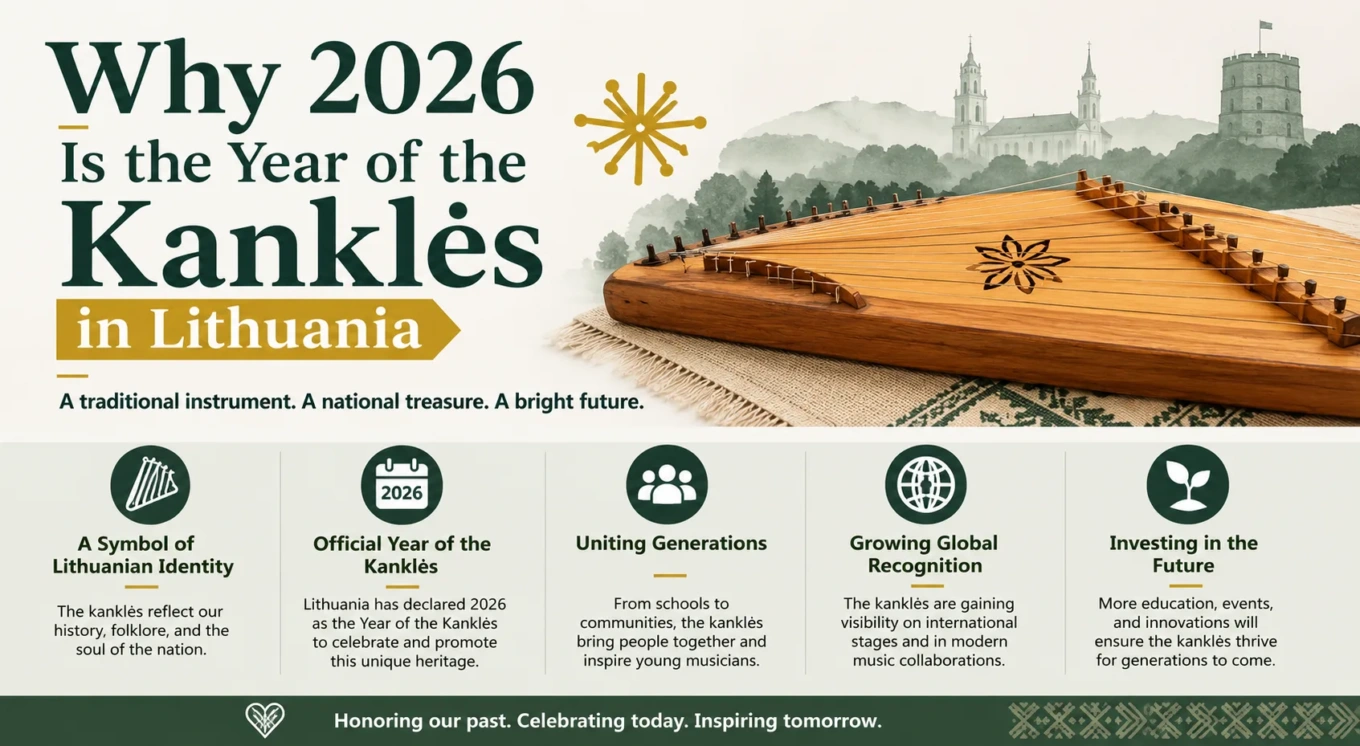
Why 2026 Is the Year of the Kanklės in Lithuania
Lithuania’s 2026 Year of the Kanklės is built around a precise anniversary: 120 years since Pranas Puskunigis formed the first kanklės ensemble in Skriaudžiai in 1906. The anniversary alone does not explain the scale of the year. A national commemorative program, a new heritage listing for the Skriaudžiai tradition, Skriaudžiai’s role as a 2026 Small Cultural Capital, and a calendar that places traditional, academic, craft, and contemporary kanklės practice side by side have all converged in the same year.
The Ethnic Culture Council declared 2026 the commemorative Year of the Kanklės, extending the attention given to the Skriaudžiai ensemble’s 120th anniversary. The distinction is useful: 2026 is not simply the birthday of an old ensemble. It is a year devoted to the instrument, its players, its makers, its regional forms, and the knowledge that keeps kanklės music active.
Why 2026 Became the Year of the Kanklės
Four developments explain why 2026 carries more weight than a single anniversary concert.
| 2026 Marker | What Happened | Why It Changes the Year |
|---|---|---|
| 120th anniversary | The Skriaudžiai ensemble founded in 1906 reaches 120 years. | The date connects present-day playing directly with Lithuania’s earliest organized kanklės ensemble tradition. |
| Kanklės Year | The Ethnic Culture Council designated 2026 as the commemorative Year of the Kanklės. | The focus expands from one ensemble to performance, education, craft, regional traditions, and public events across Lithuania. |
| Living heritage | The Skriaudžiai century-old music-making tradition received its own place in Lithuania’s national inventory of intangible cultural heritage. | The recognized value is the continuing practice, not only surviving instruments. |
| Skriaudžiai in focus | Skriaudžiai is one of Lithuania’s Small Cultural Capitals for 2026. | The village where the 1906 ensemble began also hosts a wider program of performances and cultural activity. |
Heritage Note: the 2026 recognition of the Skriaudžiai tradition belongs to Lithuania’s national intangible cultural heritage inventory. It should not be described as a UNESCO inscription. The broader element “Kanklės and kankliavimas in Lithuania” was already listed nationally as an element entered in 2024; the 2026 entry gives the Skriaudžiai music-making tradition its own documented place.
1906 Changed the Social Life of the Instrument
Kanklės existed long before 1906. What began in Skriaudžiai that year was different: Pranas Puskunigis gathered players into an organized ensemble. That changed the setting in which the instrument could be heard, taught, arranged, and presented to an audience.
Puskunigis was already a kanklės player when he came to Skriaudžiai as an organist. He became one of the instrument’s best-known teachers and promoters, founded several ensembles, prepared music for players, and helped move kanklės playing from a mostly local and domestic practice toward organized public performance. The Skriaudžiai group endured and is now regarded as Lithuania’s oldest continuing kanklės ensemble.
That continuity explains the logic of the 120th anniversary. The date does not mark the invention of the kanklės, nor the first known Lithuanian instrument. It marks a durable change in how kanklės music was organized and passed on.
- Before the ensemble model: kanklės playing was strongly tied to local players, households, regional styles, and small-scale music making.
- After 1906: group performance offered a repeatable model for teaching, arranging repertoire, and presenting the instrument in public.
- By the later twentieth century: traditional regional instruments continued alongside modified concert forms used in music schools and professional performance.
- In 2026: all of these layers can be heard within the same commemorative year.
Why Skriaudžiai Sits at the Center of the Story
Skriaudžiai is not merely the location attached to the anniversary. The local tradition has survived through players, families, teachers, makers, repertoire, and repeated ensemble activity. That is why the 2026 heritage recognition is described as a century-old music-making tradition rather than as the preservation of one historic object.
This distinction is especially important for an instrument. A museum can preserve a nineteenth- or twentieth-century kanklės, record its dimensions, document its maker, and stabilize its materials. A living tradition requires something else: someone must know how the strings are tuned, how the instrument is held or placed, how its repertoire is shaped, how regional playing habits differ, and how a new player learns those decisions.
Skriaudžiai also became one of Lithuania’s Small Cultural Capitals for 2026. That places the 120-year ensemble history inside a broader local cultural program rather than treating it as a detached anniversary.
The Kanklės Being Celebrated Is Not One Standard Model
In English, kanklės is often described as a Lithuanian zither. Organologically, it belongs among plucked Baltic zithers and can be described as a type of board zither[1]: its strings run over a resonating body rather than along a separate neck as on a guitar or lute.
That classification is useful, but it does not mean that every Lithuanian kanklės has the same outline, string count, decoration, tuning, or playing method. Museum collections document strong regional variation. Traditional examples may have relatively few strings, while later and modified forms can carry many more. Kaunas City Museum notes examples ranging from four strings to twenty or more across its discussion of regional and later forms.
Traditional instruments commonly use a hollowed wooden body covered by a soundboard[2]. Together these parts form the resonating body[3] that supports the vibration of the strings. Older descriptions record metal strings as well as historical use of gut. The strings are generally sounded as open strings[4], without a fingerboard and frets defining notes in the manner of a fretted lute.
Players may pluck with the fingers or use a plectrum[5], depending on the instrument and tradition. The resulting technique is closely tied to tuning and repertoire, so a single universal “kanklės technique” would flatten the regional and historical differences that 2026 is meant to bring into view.
Regional Forms Still Matter
Older documented regional patterns show why string count should never be presented as a fixed specification. Lithuanian National Culture Centre material describes north-eastern Aukštaitija examples with about five to seven strings, western and Žemaitija examples with about seven to nine, and Suvalkija examples with about nine to twelve. Museum collections also contain instruments outside those ranges, especially when later developments are included.
Body shape changes with region as well. Some Aukštaitija examples are described as boat-like, western forms can be flatter with a strongly sloping end, and Suvalkija instruments may have a rounded narrow end. Ornament also varies. These are not decorative trivia; shape, cavity volume, soundboard area, string length, and string layout all affect how an individual instrument responds.
Luthier’s Note: wood choice, cavity shape, sound holes, soundboard thickness, string material, and string tension can all shape response and resonance. Their effects should be judged on the individual instrument. A decorative feature does not automatically improve the sound, and regional construction should not be reduced to a single “best” design.
Traditional, Concert, and Amplified Kanklės Now Share the Same Cultural Space
One reason the 2026 program is useful for understanding the instrument is that it does not present kanklės as a frozen historical object. Lithuania has both regional traditional forms and the modified concert kanklės[6] developed for a wider professional repertoire.
| Form or Context | Main Character | Typical Musical Use |
|---|---|---|
| Traditional regional kanklės | Regional body forms, string layouts, tunings, and playing habits | Folk repertoire, local styles, solo or ensemble music making |
| Concert kanklės | A modified instrument developed for extended range and arranged or composed repertoire | Music schools, academic performance, solo and ensemble concert music |
| Amplified kanklės | A kanklės used with electronic amplification and, in some cases, effects | Contemporary composition, experimental performance, amplified stages |
Research at the Lithuanian Academy of Music and Theatre describes a 1964 concert model with a range given as C–c4 and notes that it was shaped for more demanding composed repertoire. Contemporary players have also explored techniques far beyond ordinary plucking: playing behind the bridge[7], damping strings, striking strings, using bows, changing tuning during a piece, and producing glissando[8] effects.
These methods do not replace regional practice. They show another branch of the instrument’s life. A traditional five- or seven-string instrument used for regional repertoire and a modern concert instrument belong to the same Lithuanian kanklės story while serving very different musical purposes.
2026 Treats Heritage as Playing, Making, and Teaching
The national Year of the Kanklės action plan reaches beyond concerts. It includes public programs, educational activity, material devoted to instrument makers, festivals, museum participation, and events centered on playing traditions. That breadth fits the way musical heritage actually survives.
Instrument making deserves particular attention. Traditional kanklės are wooden acoustic instruments whose final behavior depends on the relationship between body, soundboard, stringing, fittings, and setup. A maker is therefore not simply reproducing an outline. The work includes selecting and seasoning material, shaping the cavity, controlling thickness, fitting string anchors and tuning hardware, and balancing durability with acoustic response.
Contemporary maker and restorer Skalmantas Barkauskas has described learning from museum instruments, making replicas, restoring older examples, and teaching others to build. His comments also point to a practical acoustic issue: heavy decorative cutting can reduce usable soundboard or cavity area, so ornament and resonance have to be considered together rather than treated as separate parts of the craft.
This is one of the strongest reasons to describe kanklės heritage as knowledge rather than as an inventory of objects. An instrument can survive physically while the choices needed to build, tune, and play it disappear.
The 2026 Calendar Shows How Broad the Kanklės Tradition Has Become
The commemorative year has been structured through events in museums, festivals, communities, and performance venues rather than through one central ceremony.
- March 6: the official opening event in Vilnius brought traditional and academic kanklės playing into the same program, with the 120-year Skriaudžiai ensemble taking part.
- May 26–31: the Skamba Skamba Kankliai festival included a conference devoted to the Year of the Kanklės, workshops, performances, and a concert centered on the instrument.
- June 7: Skriaudžiai hosted an extended kanklės music concert connected with the anniversary and its Small Cultural Capital program.
- September 6: an anniversary event for the Skriaudžiai ensemble is scheduled in Skriaudžiai as one of the major later events of the year.
The calendar also makes room for very different kinds of kanklės practice. Traditional and academic playing appeared together at the opening event, while the wider year includes festivals, craft activity, ensemble performance, and contemporary concert practice. The result is a better picture of the instrument than a single heritage concert could provide.
Why the Heritage Listings Need to Be Read Carefully
There are two related national heritage entries that can easily be confused.
“Kanklės and kankliavimas in Lithuania” is the broader national element. It treats kanklės playing as a Lithuanian performance tradition with regional forms and communities.
“Skriaudžiai ‘Kanklės’: a century-old music-making tradition” is the local tradition documented separately in 2026. Its value lies in continuity: the ensemble, local repertoire, characteristic playing practice, family memory, and the transfer of knowledge from one generation to another.
The second listing therefore does not say that Skriaudžiai owns or represents every Lithuanian kanklės tradition. It recognizes a particular community whose documented line of practice reaches back to the ensemble formed in 1906.
Why the Kanklės Became More Than a Folk Instrument
The rise of organized kanklės ensembles in the early twentieth century coincided with a period when Lithuanian musicians, teachers, cultural societies, and instrument makers were giving local instruments a more visible public role. Kanklės acquired associations with Lithuanian cultural identity, and instruments were sometimes decorated with national motifs and symbols.
Museum collections make this shift tangible. They preserve not only regional folk instruments but also later instruments whose decoration, increased string counts, ensemble use, and documented ownership show how kanklės moved into public cultural life. That history helps explain why an ensemble anniversary could expand into a nationwide commemorative year more than a century later.
The instrument’s identity, however, is not created by symbolism alone. Its recognizability still comes from physical and musical traits: a shallow resonating body, strings stretched across that body, direct plucking, local tuning systems, regional construction, and a repertoire shaped around those resources.
What to Listen for During the Year of the Kanklės
A listener can learn more from the 2026 performances by noticing which type of kanklės is being played rather than expecting one standard sound.
- String count: fewer-string traditional instruments can create a very different musical texture from larger concert instruments.
- Attack: finger plucking and plectrum playing produce different articulation.
- Resonance: body size, soundboard, stringing, tuning, and playing force affect sustain and projection.
- Texture: a solo regional instrument, a kanklės ensemble, and a concert kanklės arrangement use the available strings differently.
- Timbre[9]: the balance of brightness, warmth, attack, and sustain changes markedly between small traditional instruments, concert forms, and amplified performance.
Listening Note: hearing “kanklės” on a program does not tell the listener exactly what instrument will appear. Regional traditional kanklės and concert kanklės can differ enough in range, construction, technique, and repertoire that the performance context is part of the identification.
What 2026 Can Leave Behind
The most useful measure of the Year of the Kanklės will come after the anniversary calendar ends. A commemorative year can create visibility, but a living instrument tradition needs repeated practice.
Several forms of continuity can be observed beyond 2026: whether children and adult beginners continue learning; whether regional playing styles remain teachable; whether makers can pass on construction skills; whether museums keep documenting instruments and makers; whether new repertoire is written for concert and amplified kanklės; and whether community ensembles remain active without depending on an anniversary.
The 120-year Skriaudžiai line makes that point clearly. The reason 1906 still carries meaning is not that an ensemble once existed. It is that the ensemble tradition continued long enough for people in 2026 to play, teach, hear, document, and reinterpret it.
Frequently Asked Questions
Why was 2026 declared the Year of the Kanklės in Lithuania?
2026 marks 120 years since Pranas Puskunigis formed the first kanklės ensemble in Skriaudžiai in 1906. The Ethnic Culture Council used the anniversary as the basis for a wider commemorative year devoted to the instrument and its playing traditions.
Did the Lithuanian Parliament declare 2026 the Year of the Kanklės?
The Year of the Kanklės designation came from the Ethnic Culture Council. The Lithuanian Parliament had separately included the 120th anniversary of the Skriaudžiai ensemble among the anniversaries and events marked for 2026.
Was the kanklės invented in 1906?
No. Kanklės are much older than the Skriaudžiai ensemble. The year 1906 marks the formation of Lithuania’s first kanklės ensemble, not the creation of the instrument.
Is there one standard Lithuanian kanklės?
No. Traditional kanklės vary by region in body shape, string count, decoration, tuning, and playing practice. Later concert forms were modified for a wider range and different repertoire.
Is the 2026 Skriaudžiai heritage recognition a UNESCO listing?
No. It is part of Lithuania’s national inventory of intangible cultural heritage. The recognition concerns a living music-making tradition centered on Skriaudžiai.
What is the difference between traditional and concert kanklės?
Traditional kanklės preserve regional forms and playing practices, while concert kanklės are modified instruments developed for extended range and concert repertoire. They are related, but their construction, technique, and musical setting can differ substantially.
Glossary of Technical Terms
[1] Board zither: a zither type in which the strings extend across a board-like or shallow resonating body rather than along a separate neck. Kanklės belong within this broad organological area, though regional construction varies.
[2] Soundboard: the thin wooden surface that receives string vibration and helps transfer it to the instrument’s body and surrounding air. Its dimensions, stiffness, openings, and construction influence how a particular kanklės responds.
[3] Resonating body: the wooden structure and enclosed or hollowed space that supports and reinforces string vibration. In traditional kanklės, the body may be carved from a single block and closed with a separate soundboard.
[4] Open string: a string sounded at its full vibrating length without being stopped against a fingerboard or fret. Traditional kanklės rely heavily on separately tuned open strings.
[5] Plectrum: a small object used to pluck a string. Some kanklės traditions use a plectrum, while others rely more directly on the fingers.
[6] Concert kanklės: a modified Lithuanian kanklės developed for an expanded musical range and concert repertoire. Its construction and playing resources differ from many smaller regional traditional instruments.
[7] Bridge: a component that supports strings and helps define their vibrating length while transmitting vibration into the instrument. Contemporary concert-kanklės techniques may also use the area behind the bridge for special effects.
[8] Glissando: a continuous or rapidly connected sweep across pitches. On kanklės it can be produced in several ways, from sweeping across strings to experimental concert techniques involving altered string contact.
[9] Timbre: the sound quality that lets two instruments playing similar pitches remain distinguishable. On kanklės it is shaped by construction, strings, tuning, plucking method, resonance, and performance technique.