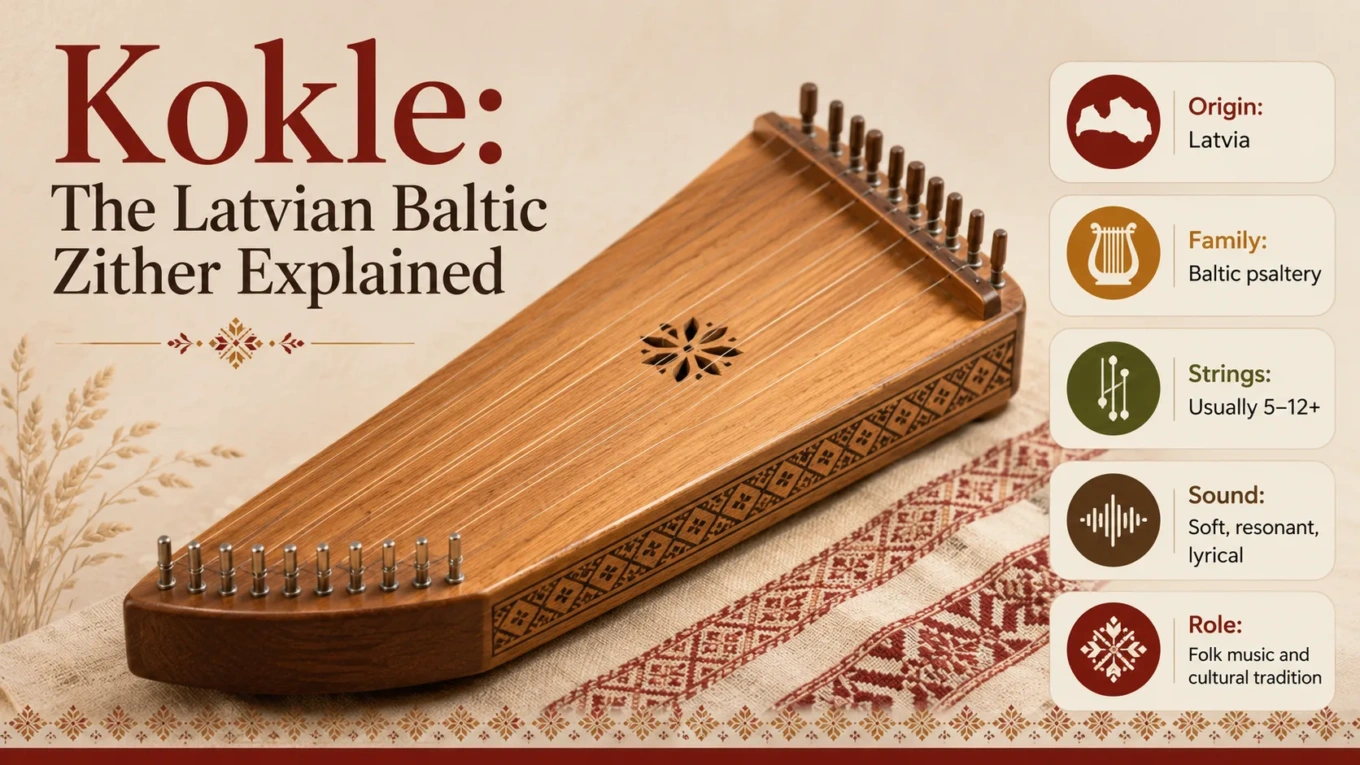
Kokle: The Latvian Baltic Zither Explained
The kokle is a Latvian plucked zither[1]: its strings run across a resonant wooden body rather than over a neck. In organology, it is a chordophone[2] and belongs to the Baltic psaltery[3] family, alongside related instruments such as the Lithuanian kanklės, Estonian kannel, Finnish kantele, Livonian kāndla, and some northwestern Russian gusli forms. Its shape is simple, but its playing logic is precise: the right hand sets the strings ringing, while the left hand often controls which strings are allowed to sound.
What Is a Kokle?
A kokle is the Latvian form of a Baltic plucked box zither[4]. Traditional examples usually have a hollow wooden body, a thin wooden soundboard[5], and a set of open strings[6] stretched across the top.
The instrument is not played like a guitar, violin, or harp. It has no neck to shorten the strings by fingering, and traditional kokles do not rely on frets or a fingerboard. Each string has its own pitch. Musical shape comes from tuning, strumming, plucking, and selective damping.
In English, the instrument may appear as kokle in the singular and kokles in plural or as a general name. Latvian sources also distinguish between traditional etnokokle forms and modernized concert instruments.
Main Details Worth Knowing
| Feature | Typical Description |
|---|---|
| Instrument family | Latvian Baltic psaltery; a plucked zither-type chordophone. |
| Body shape | Usually hollow, low, and asymmetrical or trapezoidal, with regional variation. |
| Traditional construction | Often carved from a single block of wood, with a separate thin soundboard attached. |
| Strings | Traditional examples often have a modest number of single strings; regional and modern instruments vary widely. |
| Bridge system | Many traditional kokles have strings that do not rest on a raised bridge, unlike many other zithers. |
| Playing method | Usually plucked or strummed with the right hand, while the left hand mutes unwanted strings. |
| Modern form | Concert kokles may have more strings, a bridge, levers, dampers, and a larger body. |
Names, Regions, and Baltic Family Context
The word kokle is closely tied to Latvian language and musical culture. Regional forms and spellings have been documented in different parts of Latvia, especially Kurzeme and Latgale. These regional names are not just spelling details; they often point to differences in body shape, number of strings, decoration, and playing position.
The kokle shares a broad family relationship with several neighboring Baltic and Finnic zithers. The Lithuanian kanklės, Estonian kannel, Finnish kantele, and Latvian kokle are not identical instruments, but they show a shared idea: a shallow resonant body with open strings placed across it.
Classification Note: Calling the kokle a zither does not mean it is the same as the Alpine concert zither. Here, zither is used in the broader organological sense: the strings are stretched across the body of the instrument, not along a separate neck.
Construction: Body, Soundboard, and String Layout
The Carved Wooden Body
Traditional kokles are often described as carved instruments. In many older forms, the bottom, sides, and frame are hollowed from a single piece of wood. A thin soundboard is then fitted over the hollowed body. This construction gives the kokle a trough-like or box-like resonating chamber without the deeper body of a guitar or lute.
Wood choice, body thickness, and the fit of the soundboard can shape the instrument’s response. A lighter body may speak quickly, while a heavier body may feel more stable under the hands. These effects depend on the whole build, not on one wood species alone.
Strings, Pegs, and the String Holder
The strings are held under tension between tuning pegs[7] and a string holder[8]. On many traditional kokles, the strings spread slightly in a fan-shaped layout rather than running in a fully parallel row. This helps fit different string lengths onto the angled body.
Older and traditional-style instruments may use a smaller number of strings, while modern and concert forms may use many more. It is safer to think of the kokle as a family of related Latvian instruments rather than one fixed string count.
Why the Lack of a Bridge Matters
Many traditional kokles differ from several other zithers because their strings do not sit on a raised bridge[9]. Instead, the strings pass close to the soundboard and transfer energy in a more direct but gentle way.
This helps explain the kokle’s intimate sound. The tone can be clear, soft, and detailed rather than loud and projecting. In small rooms, that softness is part of the instrument’s character.
Regional Forms: Kurzeme and Latgale
Two traditional Latvian regional forms are often discussed: the smaller Kurzeme kokle and the larger Latgale kokle. These names refer to broad regional tendencies, not rigid manufacturing rules.
| Form | Typical Traits | Playing Position |
|---|---|---|
| Kurzeme Kokle | Often smaller, with fewer strings and carved decoration such as sun, wave, or zigzag motifs. | Commonly placed across the lap or on a table. |
| Latgale Kokle | Often larger, sometimes with more strings and a wing-like extension beyond the peg line. | May be held lengthwise against the body, depending on the instrument. |
| Mixed or Transitional Forms | Some instruments combine features, especially in areas where regional styles overlap. | Position depends on body size, balance, and player habit. |
The regional distinction is useful, but it should not be treated as a strict rulebook. Folk instruments often preserve local maker choices, family habits, and small workshop differences.
Tuning and Musical Logic
Traditional kokles are commonly associated with diatonic tuning[10]. This means the strings are set to a scale rather than arranged like a chromatic piano keyboard. The player works within that tuning and shapes melody, harmony, and rhythmic movement through touch.
Because the strings are open, the tuning decides much of what the instrument can do comfortably. A melody may be picked string by string. A song may also be supported by strumming across several strings while the left hand silences those that do not belong to the desired sound.
This playing logic is one reason the kokle can sound both melodic and chordal. The player is not forming guitar-like chord shapes on a neck. The hands work closer to the surface of the instrument: one hand releases sound, the other hand controls it.
How the Kokle Is Played
Traditional kokle technique often uses right-hand strumming or plucking with the fingers, especially the index finger. The left hand performs muting[11] by lightly touching strings that should remain silent.
This creates a distinctive effect. When the right hand sweeps across the strings, only selected pitches ring out. The result can resemble an arpeggiated chord[12], but the sound is made through damping and release rather than by pressing strings against frets.
- Right hand: plucks, brushes, or strums the strings.
- Left hand: mutes unwanted strings or sometimes plucks selected notes.
- Lap position: common for smaller kokles.
- Table position: useful when the instrument is larger or when a stable surface is preferred.
- Body-supported position: associated with some Latgale-style playing habits.
The kokle rewards careful listening. A small change in finger angle can alter attack, sustain, and balance between strings.
Sound, Resonance, and Listening Details
The kokle’s resonance[13] comes from the relationship between strings, soundboard, hollow body, and sound holes. A well-made kokle does not need to be loud to be expressive. Its appeal often lies in the way notes bloom, fade, and overlap.
Traditional instruments may have small decorative sound holes arranged in patterns. These are not only visual details. On some carved Baltic psalteries, the placement and spread of sound holes can influence how the air cavity and soundboard respond. The effect depends on the whole instrument, so it should not be reduced to one decorative feature.
Listening Note: A kokle often sounds best when the listener pays attention to decay rather than volume. The end of each note can reveal the quality of the woodwork, string tension, and hand control.
Traditional Kokle and Modern Concert Kokle
The traditional kokle and the modern concert kokle[14] share a name and cultural link, but their construction and musical reach are different.
A traditional kokle is usually simpler: fewer strings, open tuning, direct hand control, and a body suited to folk song, solo playing, and small ensemble use. A concert kokle is a modernized instrument developed for broader repertoire, formal music education, and ensemble performance.
Concert kokles may use a glued body, more strings, a bridge, dampers, and a lever mechanism[15] for changing pitch. These features allow the player to work in more keys and handle repertoire that would be difficult on a small traditional kokle.
| Aspect | Traditional Kokle | Concert Kokle |
|---|---|---|
| Body | Often carved, shallow, and lap-friendly. | Larger, often built for stage use and seated performance. |
| String Count | Usually modest, with regional variation. | Much higher, often in the range used for formal concert playing. |
| Pitch Control | Mostly controlled through tuning and hand technique. | May include levers or other devices for pitch changes. |
| Sound | Close, clear, and intimate. | Broader and more adaptable for arranged music. |
How It Differs from Related Instruments
Kokle and Kanklės
The Latvian kokle and Lithuanian kanklės are close relatives within the Baltic psaltery family. Both are plucked zithers with open strings and a resonating body. Differences appear in regional construction, decoration, tuning habits, repertoire, and naming traditions.
Kokle and Kantele
The Finnish kantele is another related northern zither, but it belongs to its own musical setting. Small kanteles and traditional kokles can look similar to new observers, yet their playing traditions and regional histories should not be treated as interchangeable.
Kokle and Estonian Kannel
The Estonian kannel shares the Baltic-Finnic zither idea: open strings over a resonant body. As with the kokle, there are older small forms and later expanded instruments. The family resemblance is real, but the local names and playing cultures matter.
Kokle and Alpine Concert Zither
The Alpine concert zither is a fretted European instrument with melody strings and accompaniment strings. The kokle does not use that same playing system. Traditional kokle technique depends more on open strings, damping, and strumming across selected pitches.
Kokle and Autoharp
An autoharp is also a zither in the broad organological sense, but it uses chord bars to mute groups of strings. The kokle has no automatic chord-bar system. Its damping is done by the player’s hand.
Historical and Heritage Context
Kokle history is documented through archaeology, written references, museum instruments, craft knowledge, and living performance. Full surviving early instruments are rare, so careful wording matters. A small decorated wooden fragment from a 13th-century archaeological setting is often discussed as early evidence connected with kokle tradition, while written references appear in the early 17th century.
Museum collections also preserve older kokles, including early 18th-century examples associated with western Latvia. These instruments help show how regional forms differed before modern standardization.
The kokle is also part of Latvia’s cultural memory. It appears in folk music, song culture, amateur ensembles, formal music education, and contemporary performance. Its inclusion in the Latvian Culture Canon reflects that broad cultural role without reducing the instrument to a museum object.
Decoration, Symbol, and Craft
Kokles are often decorated with carved or pierced motifs. Sun-like patterns, small circular holes, wave forms, zigzags, crosses, and star-like arrangements may appear on traditional instruments. These designs can be decorative, symbolic, acoustic, or all three, depending on the example.
A good luthier[16] treats the kokle as a whole object. Body weight, soundboard thickness, string length, peg fit, string tension, and hand feel must work together. A beautiful instrument that is hard to tune or weak in response is not successful as a musical tool.
Luthier’s Note: On a traditional kokle, small details can matter more than visible size. A clean peg fit, even soundboard response, and stable string anchoring often shape the playing experience more than ornament alone.
What Beginners Should Know
A beginner should first decide which kind of kokle is being discussed. A small traditional kokle and a concert kokle are not used in exactly the same way. The smaller instrument is often better for learning basic hand technique, folk melodies, damping, and open-string awareness. The concert form asks for a more formal study path.
Basic learning usually starts with tuning, right-hand stroke control, and left-hand muting. The hardest early skill is often not plucking a string, but stopping the wrong strings from ringing.
- Learn the open-string tuning before trying fast patterns.
- Practice muting slowly, with the hand relaxed.
- Listen for uneven string volume after each tuning change.
- Keep the instrument away from extreme dryness, heat, and dampness.
- Do not assume that every kokle tutorial fits every kokle type.
Care and Handling
A kokle is sensitive to tension and humidity because its soundboard and body are part of the acoustic system. Sudden dryness can make wooden parts shrink. Excess dampness can soften response and disturb tuning. A stable indoor environment is usually safer than frequent changes.
Tuning pegs should turn firmly but not harshly. If a peg slips, forcing it may damage the peg hole. If a string breaks, the replacement should match the instrument’s scale length and intended tension. Concert kokles need even more care because their mechanisms add moving parts.
Collector’s Note: Older kokles should be described by construction, region, string layout, and condition rather than by age alone. A damaged soundboard, replaced pegs, or altered stringing can change both value and musical behavior.
Common Misunderstandings About the Kokle
It Is Not Simply a Small Harp
The kokle may look harp-like to unfamiliar eyes because it has many visible strings. Its structure is different. A harp has strings rising from a frame, while a kokle places its strings across a resonant body.
It Is Not the Same as Every Baltic Zither
The kokle belongs to a wider family, but each related instrument has its own name, region, construction habits, and repertoire. Using one name for all of them erases useful detail.
It Does Not Have One Fixed Number of Strings
Traditional, regional, diaspora, zither-influenced, and concert forms may all differ. A single number cannot describe the whole kokle tradition.
It Is Not Always a Museum Instrument
The kokle is preserved in collections, but it is also played in schools, ensembles, festivals, recordings, and contemporary projects. Its older form and modern use exist side by side.
FAQ
Is the kokle a zither?
Yes. The kokle is a zither in the broad organological sense because its strings run across the body of the instrument. It should not be confused with the Alpine concert zither, which has a different structure and playing system.
How many strings does a kokle have?
There is no single fixed number. Traditional regional kokles often have fewer strings, while modern concert kokles may have many more. The number depends on period, region, maker, and instrument type.
Is the kokle played with a pick?
Many traditional techniques use the fingers, especially right-hand strumming or plucking with the index finger. Some players may use different approaches, but hand damping remains central to the traditional playing logic.
What is the difference between a kokle and a concert kokle?
A traditional kokle is usually smaller, simpler, and based on open-string hand technique. A concert kokle is a modernized instrument with more strings and often pitch-changing mechanisms, suited to arranged repertoire and formal performance.
Is the kokle the same as the kantele?
No. The kokle and kantele are related Baltic psaltery instruments, but they belong to different regional traditions. Their names, construction details, tunings, and playing contexts should be kept distinct.
Can a beginner learn kokle without reading music?
Yes, especially on a small traditional-style kokle. Many learners begin through listening, simple melodies, and hand patterns. Reading music becomes more useful when moving toward arranged repertoire or concert kokle study.
Glossary of Technical Terms
Zither: A string instrument in which the strings run across the body rather than along a separate neck. In this article, the term is used in its broad instrument-classification sense, not only for the Alpine concert zither.
Chordophone: An instrument whose sound is produced by vibrating strings. The kokle is a chordophone because its musical tone comes from plucked or strummed strings.
Baltic Psaltery: A family of northern and Baltic plucked zithers that includes the Latvian kokle and related instruments such as kanklės, kannel, kantele, and some gusli forms.
Box Zither: A zither with a resonating box or hollow body under the strings. The kokle fits this idea because its wooden body acts as the main resonator.
Soundboard: The thin top plate of a string instrument that helps turn string vibration into audible sound. On a kokle, the soundboard is central to tone, sustain, and response.
Open Strings: Strings that sound at their full tuned length without being stopped by fingers against a fingerboard. Traditional kokle playing depends heavily on open strings and selective damping.
Tuning Pegs: Pegs or pins used to tighten or loosen strings. On a kokle, they set the pitch of each string and must hold tension reliably.
String Holder: The part of the instrument where the far ends of the strings are anchored. In many kokles, this may be a rod or similar fixture at the narrow end of the body.
Bridge: A raised support that transfers string vibration to the body on many string instruments. Many traditional kokles are notable because the strings do not rest on a raised bridge in the usual way.
Diatonic Tuning: A tuning based on the notes of a scale rather than all chromatic half steps. Many traditional kokles use scale-based open strings, which shape the instrument’s natural melodies and harmonies.
Muting: The act of stopping selected strings from ringing. Kokle players often use the left hand to mute unwanted strings while the right hand strums or plucks.
Arpeggiated Chord: A chord whose notes are sounded one after another rather than all at the exact same moment. Kokle strumming can create this effect when only selected strings are allowed to ring.
Resonance: The way an instrument’s body, air cavity, and soundboard respond to string vibration. In a kokle, resonance affects warmth, sustain, and how clearly each string speaks.
Concert Kokle: A modernized Latvian kokle built for wider repertoire and formal performance. It often has more strings and added mechanisms compared with traditional regional kokles.
Lever Mechanism: A device that changes a string’s sounding pitch by altering its effective length or tension path. On concert kokles, levers help the player access more keys than a simple fixed tuning allows.
Luthier: A maker or repairer of string instruments. In kokle making, a luthier balances woodwork, string tension, peg fit, soundboard response, and playing comfort.