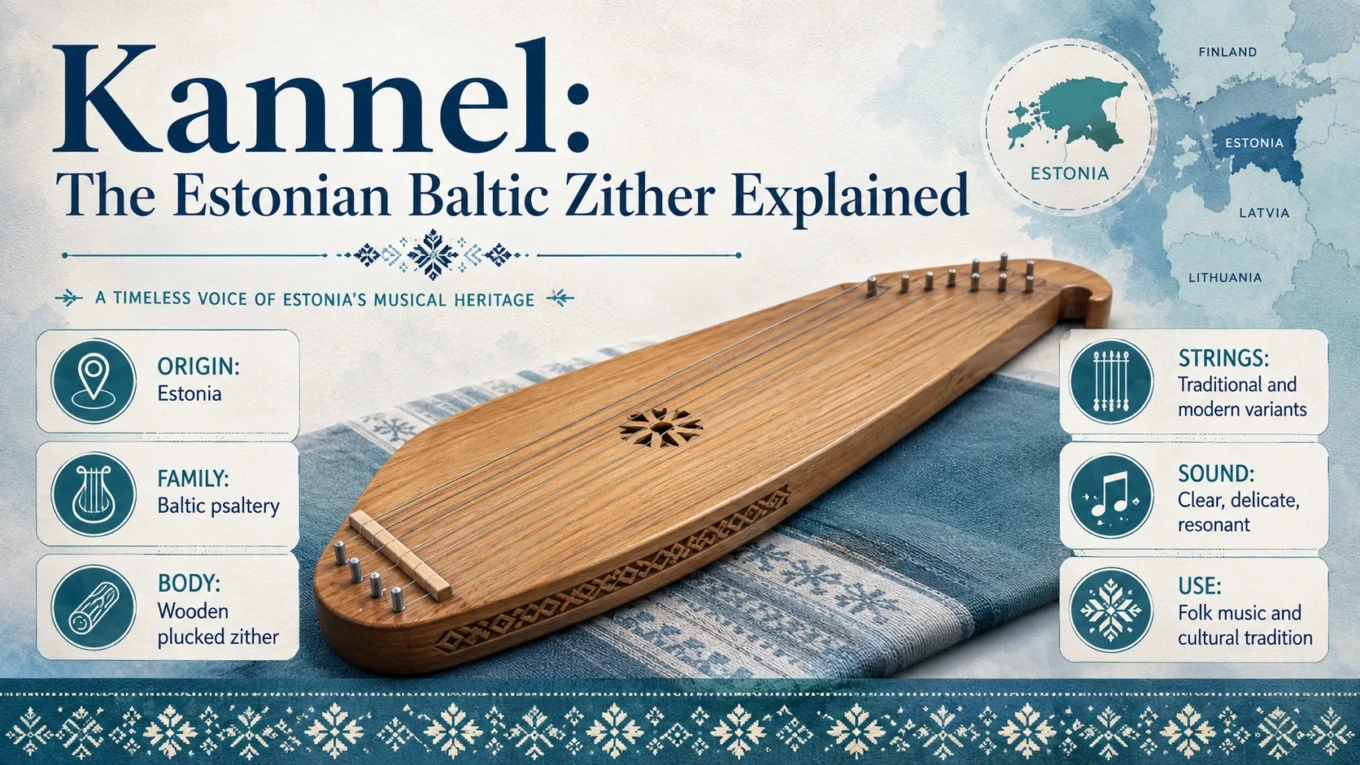
Kannel: The Estonian Baltic Zither Explained
Kannel is the Estonian member of the Baltic zither tradition: a plucked chordophone[1] whose strings run across a wooden body rather than along a separate neck. In its older folk forms it is a small, direct instrument with a clear outline, open strings, and a close link to song and dance. In its newer concert form, the kannel can become a large chromatic instrument with a wide pitch range and a very different playing technique.
What a Kannel Is
The kannel is best understood as an Estonian Baltic psaltery[2], not as a harp, guitar, dulcimer, or autoharp. It belongs to the broad zither family because the strings are stretched across the body of the instrument and are not carried by a projecting neck.
Many older and folk-style kannels are box zithers[3] or closely related board-and-box forms. The wooden body acts as a resonating body[4], while the top plate works as a soundboard[5]. Each string normally gives one pitch when plucked, so the player builds melody and harmony from a set of open strings[6].
The word kannel can point to several related Estonian instruments. A small six- or seven-string folk kannel, a larger village kannel, and a modern chromatic concert kannel are not identical tools, even though they share a name and a playing lineage. The clearest way to describe the kannel is therefore by form: small folk kannel, larger folk or village kannel, and chromatic kannel.
Names, Spelling, and Baltic Relatives
Kannel is the Estonian name. The genitive form kandle appears in compounds and descriptive phrases, so English readers may meet forms such as kandle music or kandle player. The instrument is often translated as “Estonian zither,” “Estonian psaltery,” or “Baltic psaltery.”
Those translations are useful, but each one has a limit. “Zither” tells the reader how the strings relate to the body. “Psaltery” points to an older European naming habit for plucked board or box zithers. “Baltic” places the kannel beside Finnish kantele, Latvian kokle or kokles, Lithuanian kanklės, Livonian kāndla, and some related northern and eastern psaltery traditions.
These instruments are related, but they should not be treated as one object with different flags attached. Each tradition has its own vocabulary, repertoire, construction habits, and modern development.
Main Details Worth Knowing
| Feature | Typical Description | Why It Matters |
|---|---|---|
| Instrument family | Plucked zither and Baltic psaltery | The strings lie across the body, not along a neck. |
| Older folk forms | Often small, with five to seven strings in archaic descriptions; later examples may have more | String count varies by period, region, and maker. |
| Tuning | Often diatonic tuning[7] on traditional forms | The instrument favors a set scale or mode rather than every semitone. |
| Playing method | Usually plucked with fingers; some styles use muting | The player shapes rhythm and harmony through touch, not fretting. |
| Modern concert form | Chromatic kannel with many strings, often cross-strung | It allows music in many keys and suits solo, chamber, and composed music. |
| Common confusion | Hiiu kannel is not the same instrument | Despite the name, Hiiu kannel refers to a bowed lyre type, not the usual plucked kannel. |
Construction: Body, Soundboard, and Strings
A kannel does not need a long neck, frets, or a fingerboard. Its basic idea is direct: a wooden body supports a set of strings, and the player plucks the strings above the sounding surface.
Older small kannels are often described as hollowed from a single piece of wood. Later and larger instruments may use a built-up body, with sides, back, and a separate top. In both cases, the body must be light enough to respond and firm enough to hold string tension. This balance matters more than decorative shape.
The outline is commonly trapezoidal, wing-like, or asymmetrical. One end may be wider, giving the lower strings more length and space. The upper plate may include sound holes, carved details, or a plain surface, depending on local style and maker choice.
Luthier’s Note: Wood choice can shape resonance, but it does not create a single fixed kannel sound. Spruce is often valued for soundboards in many stringed instruments, while alder, ash, maple, birch, or other local woods may appear in bodies, pegs, and structural parts. The maker’s thicknessing, string length, bridge placement, and setup also shape the result.
Small Folk Kannel
The small folk kannel is the form many beginners picture first. It may have only a handful of strings and a compact body that rests on the lap or on a table. Older descriptions often point to five, six, or seven strings, while modern teaching instruments may use more.
This type is usually tuned to a limited scale. That does not make it simple in a musical sense. A small number of strings can still support melody, repeated rhythmic figures, and a drone[8] effect when one pitch is allowed to ring under changing notes.
Larger Folk and Village Kannel
Larger folk kannels expanded the pitch set and made it easier to accompany singing, dance melodies, and social music. These instruments may have more strings, a broader body, and a louder response. Some later Estonian folk zithers also used chordal or mechanical ideas, but those should not be projected backward onto the oldest small kannels.
The term rahvakannel can be used in a broad folk-instrument sense. It may refer to practical village instruments rather than a single fixed model. For that reason, string counts and layouts should always be read as examples, not rules.
Modern Chromatic Kannel
The chromatic kannel[9] is a newer concert instrument. It was developed to give kannel players access to all semitones without retuning for each piece. Documented modern examples often have dozens of strings; professional chromatic instruments are commonly described with around 46 or 50 strings, though exact designs can differ.
Many chromatic kannels are cross-strung[10]. Instead of placing one simple row of strings in scale order, the string layout crosses two pitch sets so the player can reach chromatic notes with both hands. This gives the concert kannel a much larger pitch field and a different playing technique from a small six-string folk kannel.
How the Kannel Produces Sound
When a string is plucked, it vibrates between two fixed points. That vibration passes into the bridge area, the top plate, and the wooden body. The soundboard spreads the energy through a larger surface, while the body contributes to the instrument’s resonance.
The result is a clean attack followed by sustain[11]. On a small kannel, the sound can be close and dry, with each note easy to hear. On a larger folk or concert instrument, notes may ring longer and blend more readily, especially when several strings sound at once.
The kannel’s timbre[12] depends on string material, body size, top thickness, playing touch, and tuning. Steel strings can give a bright edge. A softer attack from the finger pad can make the same instrument sound rounder than a hard pluck.
Listening Note: The first part of a plucked note makes the pitch clear, while the ringing tail reveals more of the instrument’s resonance and the interaction between neighboring strings. When several strings are left ringing, their overtones can blend into a sustained harmonic texture.
Tuning and String Layout
Traditional kannel tuning is not one universal recipe. It depends on the number of strings, the scale used by the player, the region, and the function of the instrument. Small kannels are often tuned to a diatonic or modal set, which allows folk melodies to sit naturally under the fingers.
Because the strings are open, tuning is part of the instrument’s musical design. A player does not press a string against a fret to create a new pitch. Instead, the available pitches are set before playing. This gives the kannel a clear scale identity.
Some players arrange the lowest string or strings to support a tonal center. In that setting, a drone note can anchor a tune. Other players tune for a specific melody or song. On larger instruments, the wider pitch range may support fuller accompaniment.
Chromatic kannels solve a different problem. They give the performer access to semitones without the same retuning limits found on a small diatonic instrument. This also changes the physical logic of playing: the performer must learn a larger map of pitches, hand movement, damping, and resonance control.
How the Kannel Is Played
The small kannel is often played on the lap or on a table. The player plucks with bare fingers, usually using both hands. One hand may carry a melody while the other adds drones, repeated tones, or simple accompaniment. Another approach is to strum or brush across several strings while muting the strings that should not sound.
Muting is part of the instrument’s voice. Since open strings can ring freely, the player controls both sounding and stopped strings. A finger can stop a ringing string, block unwanted notes during a strum, or let a note remain as part of the harmony.
On the chromatic kannel, playing technique becomes more demanding. The hands move across a wider field, and the player must manage many pitches that can overlap. Professional performers use damping, controlled attack, and precise hand placement to keep the texture clear.
The kannel is not a fretted instrument. A fretted string[13] changes pitch when pressed against a fret; a kannel string normally keeps the pitch given by tuning. This is one reason the instrument feels different from a guitar, lute, or concert zither with a fingerboard.
Sound and Musical Role
The kannel’s sound is often clear and ringing. Small kannels can support solo tunes, children’s learning, folk song, and quiet domestic music. Larger folk kannels can carry dance rhythms and fuller accompaniment. The chromatic kannel is also used for composed music, chamber settings, early-music projects, and works written specifically for its layout.
The instrument has a strong place in Estonian cultural memory. Its name appears in folk-song collections, national literature, and public teaching contexts. Alongside that cultural role, it remains a practical string instrument whose sound depends on tuning, construction, touch, and control of resonance.
A good kannel performance does not rely only on speed. The player’s timing, touch, muting, and choice of ringing strings shape the music. On a small instrument, even a short melody can sound full when the tuning supports it well.
Kannel, Kantele, Kokles, Kanklės, and Gusli
The kannel belongs in the same broad northern psaltery family as the Finnish kantele, Latvian kokles, Lithuanian kanklės, and related gusli traditions. The family resemblance is visible in features such as a shallow body, multiple open strings, plucked playing, and scale-based layouts.
The differences are just as useful. Names, tunings, string counts, body outlines, repertoire, and modern teaching traditions vary. Finnish kantele culture, for example, includes both small five-string instruments and large concert kanteles. The Estonian kannel has its own development, including the modern chromatic kannel with its cross-strung layout.
For English readers, the term “Baltic zither” is helpful when it points to a family of related instruments. It becomes less useful when it erases local forms. A kannel is not merely a kantele under another name, even though the instruments share older roots and related playing ideas.
Why Hiiu Kannel Causes Confusion
Hiiu kannel looks as if it should mean a regional kannel from Hiiumaa, and the name can mislead English readers. In practice, Hiiu kannel usually refers to a bowed lyre type related to the talharpa and jouhikko, not to the conventional plucked Estonian zither.
This matters for classification. The usual kannel is a plucked zither. Hiiu kannel is bowed, has a different body logic, and belongs to a different performance practice. The shared word kannel reflects naming history, not identical construction.
Classification Note: When identifying a kannel, the sound-producing method is more useful than the shared name. Plucked open strings stretched across a zither body indicate the conventional Estonian kannel, while a bowed, lyre-like instrument points to Hiiu kannel.
What Beginners Should Know
A small kannel is often more approachable than it looks. Because the strings are tuned to a scale, many notes will already belong together. This helps beginners play simple melodies and repeated patterns without needing fretting technique.
The main early skills are tuning, clean plucking, muting, and steady rhythm. Tuning takes patience, especially on steel strings. A small change at the tuning pin can make a noticeable pitch change, so the player should turn slowly and listen carefully.
Beginners should not assume that every kannel tutorial fits every kannel. A six-string folk kannel, a twelve-string teaching instrument, and a chromatic concert kannel require different techniques. The tuning chart supplied by the maker or teacher is more useful than a generic scale diagram.
Buying, Collecting, and Care
For a playable kannel, condition matters more than decoration. Check whether the body is stable, the soundboard is not badly cracked, and the tuning pins[14] hold tension. Loose pins, corroded strings, open seams, or a warped top may need careful repair.
Older instruments should be treated gently. Sudden humidity changes can stress the wood, and old strings may break when brought up to pitch too quickly. If an instrument has been silent for years, gradual tuning and inspection are safer than forcing it to concert pitch in one session.
Collectors should note the type of kannel, not only the name. A small hollowed-body kannel, a larger village zither, a factory-made folk zither, and a chromatic concert kannel represent different forms and periods. The label “Estonian kannel” is the start of identification, not the end.
FAQ
Is the kannel a zither?
Yes. The kannel is a zither because its strings run across the body of the instrument rather than along a separate neck. More specifically, it is an Estonian member of the Baltic psaltery tradition.
How many strings does a kannel have?
There is no single number. Older small kannels are often described with five to seven strings, while later folk and teaching instruments may have more. Modern chromatic kannels often have dozens of strings.
Is kannel the same as Finnish kantele?
No. Kannel and kantele are closely related Baltic-Finnic zither traditions, but they are not the same instrument in every detail. Their names, repertoires, construction habits, and modern concert forms differ.
Does a kannel have frets?
Traditional plucked kannel forms do not use frets in the guitar sense. The pitches are usually made by tuning open strings, so the player chooses notes by plucking the correct string rather than pressing a string against a fret.
What is the difference between kannel and Hiiu kannel?
The usual kannel is a plucked zither. Hiiu kannel is a bowed lyre type associated with northern coastal traditions. The names are related, but the instruments are built and played in different ways.
Can a beginner learn the kannel?
Yes, especially on a small diatonic kannel. The limited scale can help simple melodies sound clear early on. The main challenges are accurate tuning, controlled plucking, and learning how to mute ringing strings.
Glossary of Technical Terms
Chordophone
A chordophone is an instrument that makes sound from vibrating strings. In the kannel, the strings are stretched across a body, placing it in the zither branch of chordophones.
Baltic Psaltery
Baltic psaltery is a useful family term for related plucked zithers such as kannel, kantele, kokles, and kanklės. It points to shared construction ideas without making all regional instruments identical.
Box Zither
A box zither has a resonating body shaped like a shallow box, with strings stretched across it. Many kannels fit this description, though older and local forms can vary in construction.
Resonating Body
The resonating body is the wooden structure that helps make string vibration louder and fuller. On a kannel, body size, wood thickness, and internal air space affect how notes develop and fade.
Soundboard
The soundboard is the top plate that receives vibration from the strings. A responsive soundboard helps the kannel project sound while keeping the note clear.
Open Strings
Open strings sound at their tuned pitch without being stopped by a finger or fret. Kannel playing depends heavily on these ready-made pitches.
Diatonic Tuning
Diatonic tuning uses the main notes of a scale rather than every chromatic semitone. Many traditional kannels use this kind of pitch set, which supports modal and folk melodies.
Drone
A drone is a sustained or repeated pitch that supports a melody. On a kannel, a lower open string may serve as a tonal anchor when the tuning and tune allow it.
Chromatic Kannel
A chromatic kannel is a modern Estonian concert form with enough strings to provide access to chromatic pitches. It allows music in many keys and requires a wider playing technique than a small folk kannel.
Cross-Strung
Cross-strung means that two sets of strings cross each other at an angle. On a chromatic kannel, this layout helps place diatonic and chromatic pitches within reach of both hands.
Sustain
Sustain is the length of time a note continues after it is plucked. Kannel sustain can be short and dry on small instruments or longer and more blended on larger instruments.
Timbre
Timbre is the tone color of an instrument. On a kannel, timbre is shaped by strings, wood, body size, tuning, and the player’s touch.
Fretted String
A fretted string changes pitch when the player presses it against a fret. The usual plucked kannel does not work this way; its pitches come from tuned open strings.
Tuning Pins
Tuning pins hold the strings and allow pitch adjustment. On a kannel, stable tuning pins are essential because each open string must keep its assigned pitch.