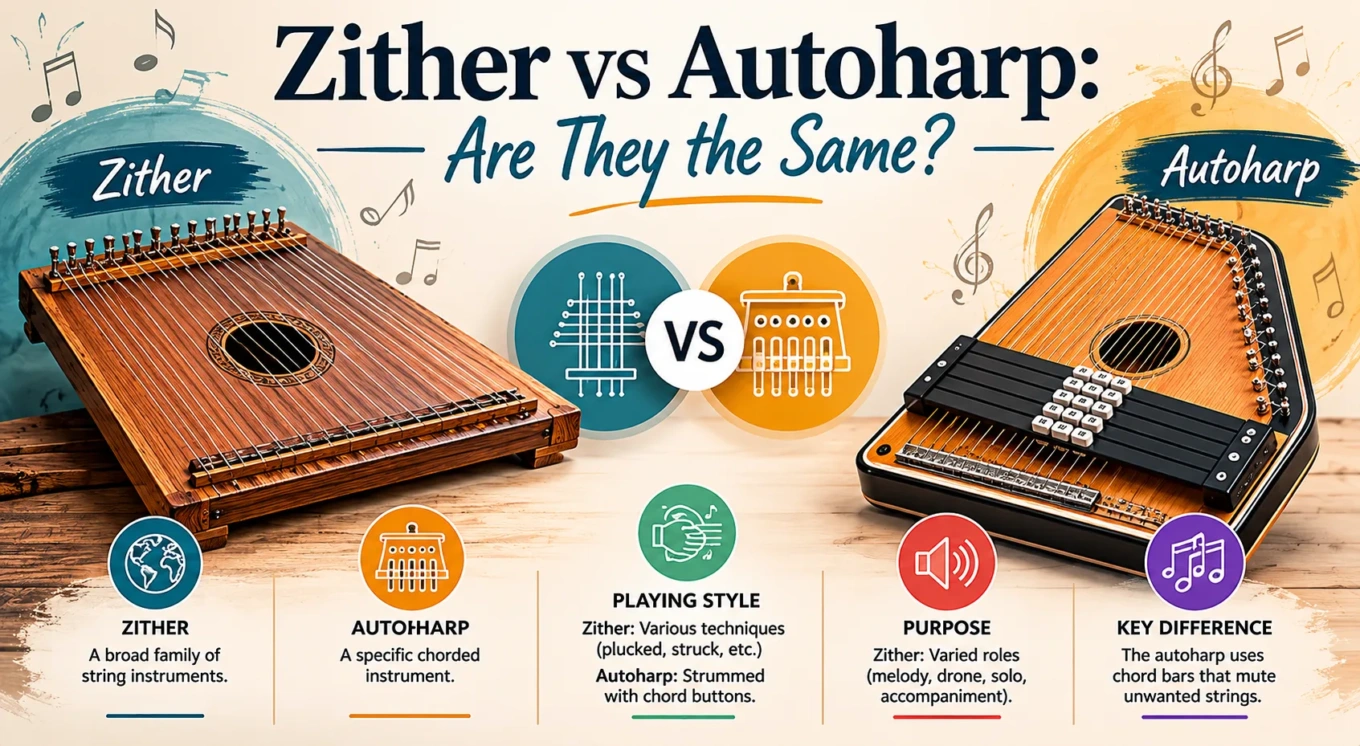
Zither vs Autoharp: Are They the Same?
An autoharp is a type of zither, but it is not the same thing as every instrument called a zither. The word zither[1] can describe a wide family of string instruments whose strings run across a body or board. The autoharp is a narrower, modern instrument within that family, known for its chord buttons, felt muting system, and easy chordal accompaniment.
This distinction matters because “zither” is used in two ways. In a broad organological sense, it names a family of chordophones[2]. In a narrower European musical context, it may refer to the concert zither, Alpine zither, or related fret-and-open-string instruments. The autoharp belongs to the first meaning, but it should not be confused with the second.
Zither vs Autoharp: The Direct Answer
An autoharp is a kind of zither, usually described as a chorded box zither, but “zither” is the larger category. Calling an autoharp a zither is correct in a family-classification sense. Calling every zither an autoharp is not correct.
A concert zither, guzheng, koto, kantele, qanun, psaltery, and autoharp all relate to the wider zither idea in different ways. They do not share one single shape, sound, tuning method, or playing style. The autoharp is set apart by its chord bars[3], which press felt or foam pads against selected strings so that only the notes of a chosen chord ring clearly.
| Feature | Zither | Autoharp |
|---|---|---|
| Meaning | A broad instrument family, or in some contexts a specific European instrument. | A specific chorded instrument within the zither family. |
| Body Type | May be a board, box, tube, trough, frame, or other regional form. | Usually a shallow wooden box zither[4] body. |
| Chord System | Often no automatic chord mechanism; depends on instrument type. | Uses labeled chord bars with a mechanical muting system. |
| Playing Method | May be plucked, struck, bowed, strummed, or picked. | Usually strummed or picked while pressing chord buttons. |
| Typical Role | Varies by tradition: melody, drone, accompaniment, solo, ensemble, or ritual use. | Commonly used for song accompaniment, folk music, hymn playing, and chordal texture. |
Why the Names Cause Confusion
The confusion begins with the flexible use of the word zither. In museum catalogues and instrument classification, a zither is not defined by a harp-like frame or a violin-like neck. It is usually understood as a string instrument where the strings are stretched across the body that supports them.
That broad idea includes many forms. Some are plucked with bare fingers. Some use a plectrum[5]. Some are struck with small hammers. Some use moveable bridges. Some have frets. Some have no frets at all.
The autoharp entered English-language instrument culture with a name that sounds as if it belongs to the harp family. Structurally, however, it does not work like a harp. Its strings lie across a resonating body, and the player does not stop the string against a fingerboard in the manner of a guitar or violin. For that reason, reference works commonly place it among zithers, not harps.
Classification Note: The word “harp” in autoharp is partly misleading. The instrument is classified by structure and playing mechanism, not only by the sound of its name. In physical form, it is closer to a chorded zither than to a frame harp.
What a Zither Is in the Broad Sense
A zither, in the broad sense, is a string instrument whose strings are stretched over a body, board, tube, box, or similar support. The body is not merely a handle; it is part of the instrument’s sounding structure. Many zithers rely on a soundboard[6] to help spread string vibration into audible sound.
This broad family contains instruments with very different designs:
- Board zithers, where strings run across a flat or slightly curved board.
- Box zithers, where a hollow body supports the strings and adds resonance[7].
- Tube zithers, where a tube-like body acts as the string support.
- Fretted zithers, where some strings are stopped against frets for melody.
- Chorded zithers, where grouped strings or mechanisms support chord playing.
The concert zither, guzheng, koto, kantele, gusli, qanun, psaltery, hammered dulcimer, and autoharp may all appear in discussions of the zither family. Their construction and musical behavior differ so much that the family name alone does not tell a player how the instrument is tuned, held, or played.
What an Autoharp Is
The autoharp is a shallow wooden instrument with many metal strings stretched across a resonating body. It usually has a set of labeled chord bars mounted above the strings. When the player presses one bar, pads underneath mute the strings that do not belong to that chord. The remaining strings ring when strummed or picked.
This makes the autoharp especially suited to chordal accompaniment. A singer can press a button marked C, G, D, A minor, or another available chord, then strum across the strings. The mechanism filters the sound.
The most visible parts of an autoharp include:
- a wooden body with a resonating chamber;
- metal strings arranged across the top;
- tuning pins[8] along one or more edges;
- chord bars with felt or foam dampers[9];
- buttons labeled with chord names;
- a playing area where the right hand strums or picks the strings.
Many modern autoharps have 36 or 37 strings, but this should not be treated as a rule for every example. Older instruments, custom builds, and altered instruments may differ. Chord-bar layouts also vary. Some are built for broad chromatic use, while others are set up for a smaller range of keys with a clearer, more open sound.
How the Autoharp Differs from the Concert Zither
The concert zither is often what English speakers mean when they say “a zither” in a European or Alpine setting. It has a different playing logic from the autoharp.
A typical concert zither has a set of fretted strings[10] for melody and a larger field of open strings[11] for accompaniment. The player usually places the instrument on a table and uses both hands for separate musical roles. One hand may stop melody notes on the fretboard while the other plucks bass, harmony, or accompaniment strings.
The autoharp does not use that same fretboard logic. It uses chord bars to select harmony. Although skilled players can pick melodies on an autoharp, the instrument’s most recognizable feature is still its push-button chord system.
| Detail | Concert Zither | Autoharp |
|---|---|---|
| Main Mechanism | Fretted melody strings plus open accompaniment strings. | Chord bars that mute unwanted strings. |
| Playing Surface | Usually placed flat on a table. | May be played on a table, on the lap, or against the body. |
| Melody Handling | Melody often played on fretted strings. | Melody can be picked, but chords are mechanically selected. |
| Common Association | Central European and Alpine zither traditions. | Folk, hymn, parlor, and country-related accompaniment contexts. |
The Chord-Bar System: The Autoharp’s Defining Feature
The chord-bar system is what makes the autoharp easy to recognize. It turns a field of many strings into controlled harmony. When no bar is pressed, many strings may be free to ring. When a bar is pressed, its pads block the strings outside the selected chord.
This differs from the way many zithers create harmony. A guzheng or koto uses movable bridges and hand pressure to shape pitch and ornament. A concert zither separates melody and accompaniment areas. A hammered dulcimer uses light hammers to strike strings arranged over bridges. The autoharp uses selective muting.
That muting action shapes both technique and sound. A clean autoharp chord depends on the condition of the pads, the alignment of the bars, the pressure of the player’s hand, and the tuning of many strings. A worn pad may let an unwanted note ring. A poorly adjusted bar can make a chord cloudy.
Luthier’s Note: On an autoharp, the sound does not depend only on strings and wood. The chord-bar assembly is part of the musical system. Felt condition, spring action, bar height, and button layout all affect playability.
Strings, Tuning, and Chord Layout
Autoharp strings are usually arranged so that strumming across them gives a full chord when the correct bar is pressed. The instrument is normally tuned to a fixed layout rather than retuned for each song. Players may use electronic tuners, tuning wrenches, and careful reference pitches to keep the instrument stable.
Because an autoharp has many strings, tuning takes patience. A small change in one area can reveal beating or roughness in another chord. Players often tune by individual string names, then check common chords by ear.
Some autoharps are chromatic[12], allowing use in several keys. Others are diatonic[13], with strings and chord bars optimized for a smaller pitch set. Diatonic setups can offer a strong ringing quality because fewer unwanted notes need to be muted, but they are less flexible for songs that move far outside the chosen key area.
Why Chord Names Do Not Tell the Whole Story
The buttons on an autoharp may display familiar chord labels, but the actual voicing depends on the instrument’s string layout. Two autoharps can share a “G” button and still produce slightly different spacing, register balance, or string response.
This is one reason older instruments should be examined carefully before tuning. Replacement strings, changed chord bars, missing pads, or past repairs can alter the intended setup.
Sound and Playing Feel
The autoharp has a bright, blended sound when strummed. Because several strings ring together, the ear hears shimmer as well as chord identity. The body adds warmth and projection, while the muting system controls which notes stay active.
A concert zither can sound more separated in texture, especially when melody strings and accompaniment strings are used independently. A guzheng or koto may offer wider pitch bending and ornament from hand pressure near the bridges. A hammered dulcimer has a struck attack. The autoharp sits apart because its chord mechanism encourages broad strums, rhythmic pulse, and quick harmony changes.
Players may use bare fingers, flat picks, or fingerpicks[14]. Fingerpicking can bring out melody lines, while broad strumming supports singing. The instrument can be simple at first contact but quite subtle in touch, damping, and timing.
Listening Note: A clean autoharp sound often has two layers: the immediate attack of the pick or fingers, and the after-ring of several strings inside the selected chord. The beauty of the instrument often comes from how well those layers stay clear rather than muddy.
Body, Materials, and Resonance
Most autoharps use a wooden body with a top that functions as the vibrating surface. Some tops are solid wood, while others use laminated construction. Materials and workmanship can shape response, but it is safer to think in terms of the whole instrument rather than one wood species alone.
The body must support string tension, hold tuning pins securely, and allow the soundboard to vibrate. If the body is warped, cracked, or loose at the joints, the sound and tuning stability may suffer. On older instruments, pin grip and chord-bar condition often matter as much as outward appearance.
Decoration varies. Some autoharps are plain working instruments. Others include decals, painted decoration, shaped bodies, or decorative rosettes. Museum and collector descriptions may focus on maker, date, body shape, chord-bar count, string count, and condition.
Are Autoharps Easier Than Other Zithers?
The autoharp can be easier for basic chord accompaniment because the chord buttons do much of the harmonic selection. A beginner can support simple songs without learning a fretboard. That does not mean the instrument has no depth.
Good autoharp playing requires:
- accurate tuning across many strings;
- clean chord changes;
- controlled strumming or picking;
- awareness of rhythm and damping;
- careful listening for unwanted ringing strings.
Compared with a concert zither, the autoharp may feel more approachable for song accompaniment. Compared with a guzheng or koto, it offers less direct pitch bending but faster chord access. Compared with a hammered dulcimer, it removes the hammering technique but adds chord-bar coordination.
Why Museums May Use Different Labels
Museum records may describe an autoharp as “autoharp,” “chorded zither,” “box zither,” “American zither,” or a maker-specific trade name. These labels reflect different goals. A player wants a practical name. A curator may want a structural classification. A collector may care about brand, patent history, or regional manufacture.
Older parlor instruments add another layer of difficulty. The late nineteenth and early twentieth centuries saw many zither-like instruments sold for home music-making. Some had chord bars. Some had printed song guides. Some used trade names that are no longer common. Not every “zither” from that period is an autoharp, and not every chorded instrument has the same mechanism.
Collector’s Note: When identifying an old instrument, look at the chord mechanism first. A true autoharp-type instrument has bars or buttons that mute selected strings to form chords. A plain fretless zither or guitar zither may look related but work differently.
Autoharp, Chord Zither, and Guitar Zither
The phrase “chord zither” can cause extra confusion. Some chord zithers are not autoharps. They may have groups of strings laid out for simple chord strumming, sometimes with printed labels or melody guides, but without the autoharp’s spring-loaded muting bars.
Guitar zithers are another related category. They often have chord groups and melody strings laid out across a flat or shallow body. They may guide the player visually rather than mechanically. The autoharp differs because pressing a chord button physically damps the strings that should not sound.
For identification, the practical question is simple: does the instrument use chord bars with damping pads? If yes, it is in autoharp territory. If no, it may still be a zither, but it should be described more carefully.
How It Differs from Other Well-Known Zithers
The autoharp shares the zither family with many instruments, but it should not be grouped too loosely with them. The comparison below keeps the focus on playing logic rather than cultural ranking.
- Guzheng: A Chinese plucked zither with movable bridges and expressive pitch shaping by the left hand. It does not use chord buttons.
- Koto: A Japanese zither with movable bridges and a refined plucked tradition. Its tuning and ornament systems differ from the autoharp.
- Kantele: A Finnish and Karelian zither family with forms ranging from small traditional instruments to modern concert models.
- Qanun: A Middle Eastern and Eastern Mediterranean plucked zither with many courses and fine pitch-adjusting levers in many modern forms.
- Hammered Dulcimer: A struck zither where strings are sounded with small hammers rather than chord-bar muting.
- Psaltery: A plucked or sometimes bowed zither-like instrument, often simpler in mechanism than an autoharp.
The autoharp is therefore best understood as a mechanically chorded member of the zither family, not as the model for the whole family.
Buying or Identifying One: What to Check
For a player or collector, the name on the instrument is only the start. Condition and structure matter more than a neat label.
- Chord bars: Press each button and check whether it moves freely and returns properly.
- Damping pads: Look for missing, hardened, or uneven felt or foam.
- Strings: Check for rust, missing strings, uneven replacements, or unclear string gauges.
- Tuning pins: Loose pins can make tuning unstable.
- Body condition: Look for cracks, open seams, or warping near string tension areas.
- Setup type: Notice whether the instrument is chromatic, diatonic, or modified.
An old autoharp can be charming but may need work before it is musically reliable. A visually attractive instrument is not always ready to tune to pitch. When in doubt, a repairer familiar with zithers, autoharps, or folk instruments can give safer guidance than guesswork.
Care and Tuning Considerations
The autoharp responds to humidity, string tension, and mechanical wear. It should be kept away from extreme dryness, damp storage, and direct heat. Sudden changes can affect tuning stability and wooden joints.
Tuning should be done gradually, especially on older instruments. Bringing every string up too quickly can stress the body and pins. Players often tune in passes: first near pitch, then closer, then with chord checks.
The chord-bar assembly also needs attention. Dust, worn felt, weak springs, and misaligned bars can make the instrument sound out of tune even when the strings are accurate. A clean chord depends on both tuning and muting.
What the Difference Means for Beginners
A beginner asking “zither or autoharp?” is often asking two different questions: what family does the instrument belong to, and which instrument should be learned first?
If the goal is to accompany singing with quick chords, the autoharp is often the more direct choice. If the goal is Alpine zither music, fingerboard melody, and independent accompaniment patterns, a concert zither is the more fitting instrument. If the goal is East Asian zither repertoire, then guzheng, koto, gayageum, or related instruments should be studied on their own terms.
The useful rule is this: zither names describe structure; individual instruments describe technique. The autoharp is one instrument with its own technique, not a shortcut for understanding every zither.
Glossary of Technical Terms
Zither: A string instrument in which the strings run across a body, board, box, tube, or similar support. In this context, the word can refer to a wide family rather than only the European concert zither.
Chordophone: A musical instrument that produces sound from vibrating strings. Zithers, harps, lutes, and bowed string instruments are all chordophones, but their structures differ.
Chord Bars: Labeled bars on an autoharp that the player presses to select a chord. Pads underneath the bar mute strings that do not belong to that chord.
Box Zither: A zither with a hollow box-like body that supports the strings and helps project sound. The autoharp is commonly treated as a chorded form of box zither.
Plectrum: A small pick used to pluck or strum strings. Autoharp players may use a flat pick, while other zither traditions may use different plectra or finger techniques.
Soundboard: The vibrating top surface that helps turn string vibration into audible sound. In many zithers, the quality and condition of the soundboard affect response and projection.
Resonance: The way an instrument body responds to and amplifies string vibration. In box zithers and autoharps, the body adds fullness and sustain to the string sound.
Tuning Pins: Metal pins that hold string tension and allow pitch adjustment. Autoharps have many tuning pins, so stable tuning depends on both pin grip and careful string adjustment.
Dampers: Felt, foam, or similar pads that stop selected strings from ringing. On an autoharp, dampers are attached to chord bars and create clean chords by muting unwanted notes.
Fretted Strings: Strings that can be stopped against frets to change pitch. Concert zithers commonly use fretted melody strings, while autoharps do not rely on a fretted melody section in the same way.
Open Strings: Strings sounded without being pressed against frets. Many zithers use open strings for drones, accompaniment, harmony, or melody depending on the instrument.
Chromatic: A pitch layout that includes all twelve notes of the Western octave. A chromatic autoharp can support more keys but may have a denser muting pattern.
Diatonic: A pitch layout centered on the notes of a scale or limited set of keys. Diatonic autoharps can sound open and ringing but offer less flexibility for remote key changes.
Fingerpicks: Small picks worn on the fingers to pluck strings with more clarity and volume. Autoharp players may use them for melody picking or stronger rhythmic attack.
FAQ
Is an autoharp a zither?
Yes. An autoharp is generally classified as a type of zither, more specifically a chorded box zither. It is one member of the wider zither family, not a separate harp-family instrument.
Is a zither the same as an autoharp?
No. “Zither” is the broader term. An autoharp is a specific instrument with chord bars and dampers, while other zithers may use frets, movable bridges, hammers, bare fingers, or other playing systems.
Why is it called an autoharp if it is not a harp?
The name comes from historical trade and naming practice rather than strict instrument structure. In classification, the autoharp fits better among zithers because its strings stretch across a resonating body rather than rising from a harp frame.
Can an autoharp play melodies, or only chords?
It can play melodies, especially in the hands of skilled players who pick individual strings and manage chord buttons carefully. Its most familiar role, however, is chordal accompaniment for singing and folk-style playing.
Does every zither have chord buttons?
No. Chord buttons are specific to autoharps and some related chorded instruments. Many zithers, such as guzheng, koto, kantele, qanun, and concert zither, use different systems for pitch, harmony, and expression.
Which is easier for beginners: zither or autoharp?
For simple song accompaniment, the autoharp is often easier at the start because the chord bars select harmony quickly. Other zithers may require more direct control of melody strings, bridges, frets, hammers, or regional tuning systems.