Zither vs Dulcimer: What Is the Difference?
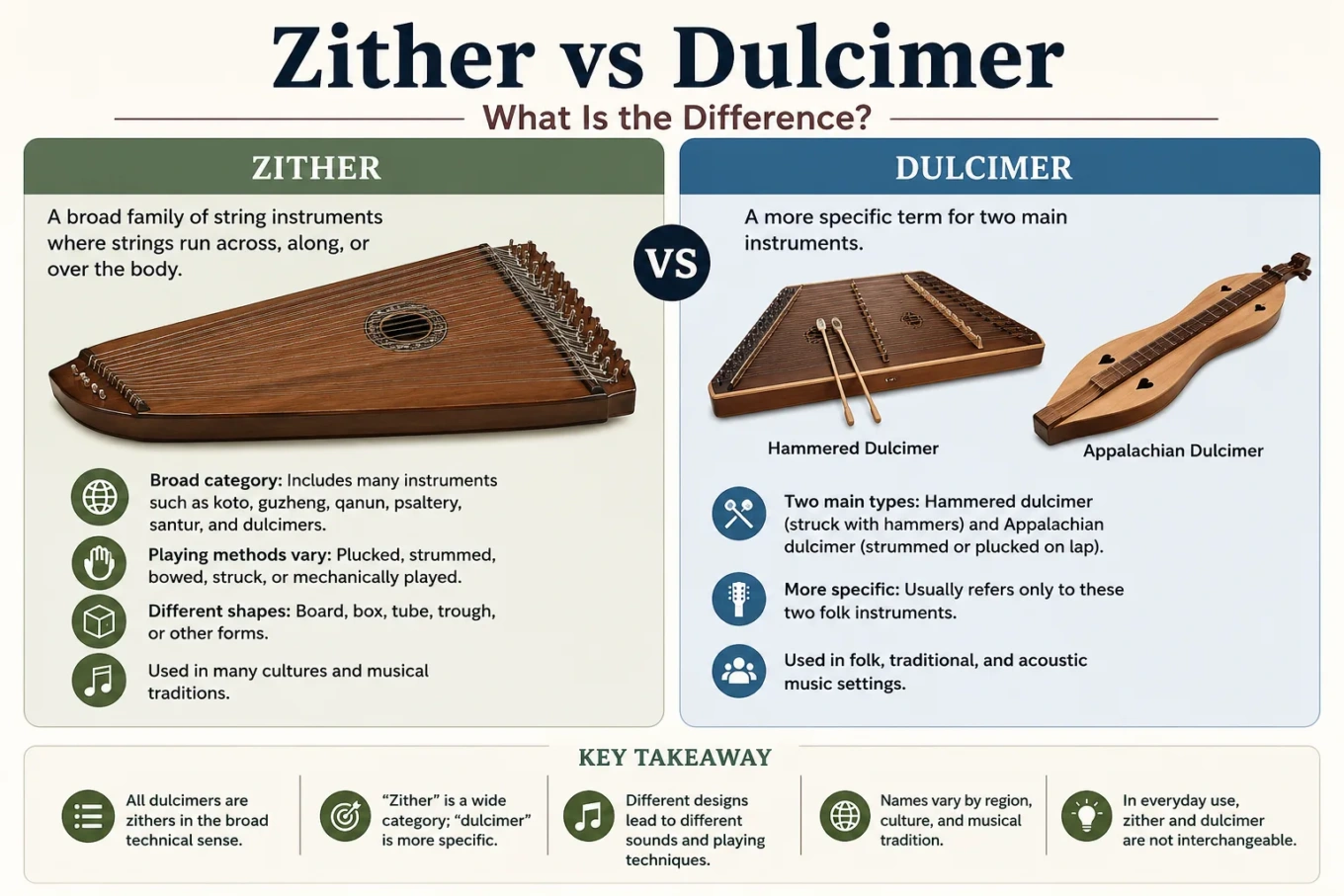
The difference between a zither and a dulcimer depends on how the words are being used. In broad instrument classification, some dulcimers are types of zither[1]. In everyday musical language, however, “zither” often points to a wider family of string instruments, while “dulcimer” usually points to either a hammered dulcimer or an Appalachian mountain dulcimer.
That is the source of the confusion: one word names a large structural family, while the other often names specific folk instruments with their own playing methods, body forms, and musical traditions.
Zither vs Dulcimer: The Basic Difference
A zither is usually understood as a chordophone[2] in which the strings run across, along, or over the body of the instrument rather than projecting from a separate neck. The word can describe a broad family that includes instruments such as the concert zither, kantele, guzheng, koto, qanun, psaltery, santur, hammered dulcimer, and Appalachian dulcimer, depending on the classification system being used.
A dulcimer[3] is more specific. The name is most often used for two different instruments:
- Hammered dulcimer: a trapezoidal or rectangular instrument with many strings struck by small hammers.
- Appalachian dulcimer: a narrow fretted lap instrument, usually strummed or plucked.
Both are associated with the zither family, but they are not the same instrument as a European concert zither, a guzheng, a koto, or an autoharp.
| Feature | Zither | Dulcimer |
|---|---|---|
| Meaning | A broad family name, or sometimes a specific European instrument | A narrower name, usually for hammered or Appalachian forms |
| Playing Method | May be plucked, strummed, bowed, struck, or mechanically sounded | Usually struck with hammers or strummed/plucked on the lap |
| Body Form | Varies widely: board, box, tube, trough, or other forms | Usually a shallow sound box or narrow fretted body |
| Frets | Some have frets, many do not | Appalachian dulcimers have frets; hammered dulcimers do not |
| Musical Role | Depends on the regional instrument and tradition | Often used for folk melody, accompaniment, dance music, and solo playing |
Why the Names Overlap
The overlap comes from organology, the study of musical instruments. In many classification systems, zithers are instruments whose strings are stretched across a body or string-bearing surface, without the neck-and-body layout seen on guitars, lutes, or violins.
A dulcimer can fit that description. The hammered dulcimer has strings stretched across a shallow soundboard[4] and resonating body[5]. The Appalachian dulcimer has a long body with a fretted fingerboard running along the top. Neither has a projecting neck in the guitar sense.
So, a dulcimer can be a zither in the broad technical sense. But the words are not interchangeable in ordinary use.
Classification Note: “Zither” can mean either a wide structural category or a particular European instrument. “Dulcimer” usually names a specific instrument type. This is why a dulcimer may be called a zither in a museum catalogue, while a musician may still treat “zither” and “dulcimer” as different names in daily speech.
What Is a Zither?
A zither is not one single shape. It is better understood as a family of instruments linked by string layout. The strings are carried by the body itself, or by a body-like support, rather than by a separate neck.
Some zithers are simple boards with strings. Others have hollow wooden boxes, arched soundboards, movable bridges, chord bars, fretted sections, or dozens of strings arranged for melody and accompaniment. A concert zither looks and works very differently from a guzheng, and both differ from a hammered dulcimer.
The word also has a narrower meaning in European music. In that setting, “zither” often means the Alpine or concert zither, a flat, many-stringed instrument with fretted strings[6] for melody and open strings[7] for accompaniment.
Common Zither Features
- Strings lie across, along, or over the main body.
- The body often helps amplify the vibrating strings.
- Some zithers are plucked with fingers, nails, or picks.
- Some are struck with hammers.
- Some use frets, while others use movable bridges or open strings only.
- Many regional forms have their own names and playing habits.
What Is a Dulcimer?
The word “dulcimer” is not as tidy as it first appears. In English, it may refer to a hammered dulcimer, an Appalachian dulcimer, or a related regional instrument. These instruments share a name but differ in structure and playing method.
Hammered Dulcimer
The hammered dulcimer is usually a shallow trapezoidal or rectangular box with many metal strings. The player strikes the strings with light handheld hammers. This puts it close to instruments such as the santur, santouri, hackbrett, yangqin, and cimbalom, though each of those names belongs to its own regional setting.
Its strings are often grouped in courses[8], meaning two or more strings may sound the same pitch together. Bridges divide or guide the strings, and the player moves across the layout to find different notes.
Appalachian Dulcimer
The Appalachian dulcimer, also called the mountain dulcimer or lap dulcimer, is usually a narrow wooden instrument played across the lap. It has a raised fingerboard with frets. Many examples use a small number of strings arranged for melody and drone.
In many playing styles, one string or string course carries the tune as a melody string[9], while one or more drone strings[10] sound steady notes beneath it. Modern players also use chordal styles, fingerpicking, capos, extra frets, and varied tunings.
The Main Structural Difference
The clearest difference is not age, origin, or tone. It is structure and playing logic.
A zither, in the broad sense, is a structural category. A dulcimer is a named instrument type within or near that category. The dulcimer’s design tells the player how to make music in a more specific way: strike many open strings with hammers, or strum a fretted lap instrument with drones and melody.
Body Shape
Zithers may be long, flat, box-like, curved, rectangular, trapezoidal, half-tube shaped, or board-like. The body shape depends on the regional instrument and craft tradition.
Hammered dulcimers usually have a wide shallow body, often trapezoidal. Appalachian dulcimers are slimmer and longer, with the fingerboard centered along the top.
String Layout
Zithers may have a few strings or many. Some place each string over its own bridge. Others use grouped strings, chord strings, bass strings, or sympathetic strings.
Hammered dulcimers usually arrange strings in courses across bridges. Appalachian dulcimers use fewer strings, often with one or two melody strings and one or more drone strings. Exact string numbers and tunings vary by maker, region, and playing style.
Bridge System
A bridge[11] transfers string vibration to the body and helps set the speaking length of the string. Some zithers, such as guzheng and koto, use movable bridges[12]. Concert zithers and Appalachian dulcimers use fretted or fixed layouts. Hammered dulcimers use bridge patterns that divide and organize the string field.
This matters for touch. A movable bridge zither invites pitch bending and bridge-by-bridge tuning. A hammered dulcimer invites fast note patterns across courses. A mountain dulcimer invites strumming, drones, and fretted melody work.
Playing Method: Plucked, Strummed, or Struck
“Zither” does not tell the player exactly how the instrument is sounded. One zither may be plucked with bare fingers. Another may use fingerpicks. Another may be struck with hammers. Another may use mechanical chord bars.
“Dulcimer” gives a better clue, but only after the type is known.
- Hammered dulcimer: struck with small hammers.
- Appalachian dulcimer: usually strummed or plucked.
- Concert zither: often plucked, with melody and accompaniment sections.
- Autoharp: strummed while chord bars mute selected strings.
- Guzheng or koto: plucked, often with picks or prepared fingernails depending on tradition.
A plectrum[13], fingerpick, hammer, or bare finger changes the attack of the note. The same string length can feel bright and crisp when struck, rounded when plucked, and flowing when brushed in a strummed pattern.
Tuning and Pitch Layout
Tuning[14] is another place where the difference becomes practical. A zither may use many tuning systems, depending on the instrument. There is no single “zither tuning.”
Hammered dulcimers are often arranged so the player can move through scale patterns across the bridges. The layout can be logical once learned, but it is not the same as a fretted fingerboard.
Appalachian dulcimers often use modal or open tunings. Many modern players use tunings such as D-A-D or D-A-A, but these are not universal rules. The frets often support diatonic fretting[15], though modern instruments may include extra frets for wider note choice.
Concert zithers use a more complex arrangement, with fretted melody strings and open accompaniment strings. Other zithers, such as guzheng or koto, use movable bridges to set the scale and allow pitch shaping after the string is plucked.
Sound and Listening Differences
The zither family covers a wide sound range. Some instruments produce a dry, intimate tone. Others have bright metallic shimmer, long sustain[16], or a deep humming accompaniment.
A hammered dulcimer often has a bell-like attack because the string is struck. Notes can sparkle and decay quickly or linger, depending on stringing, body size, hammer material, and room acoustics.
An Appalachian dulcimer has a more direct, singing quality. Drone strings can give the music a steady tonal center. The sound is often less dense than a hammered dulcimer, but it can be warm, rhythmic, and clear.
A concert zither can combine melody, bass, and chordal accompaniment in one instrument. Other zithers, such as the guqin or kantele, have their own tone ideals and techniques. They should not be folded into one generic “zither sound.”
Listening Note: The fastest way to hear the difference is to compare attack. Hammered dulcimer notes begin with a small strike. Appalachian dulcimer notes often begin with a strum or pluck. Many plucked zithers begin with a sharper finger or pick attack, followed by resonance from the body.
Is a Hammered Dulcimer a Zither?
Yes, in many organological descriptions, the hammered dulcimer is treated as a type of zither. More precisely, it is often described as a struck board zither or box zither. Its strings run across a resonating body and are sounded with hammers.
That does not mean every zither is a hammered dulcimer. The hammered dulcimer is one branch of a much larger group.
It also should not be confused with the psaltery, even though the two are related in shape and history. A psaltery[17] is usually plucked, while a hammered dulcimer is struck. The difference is not only in shape; it is in the way the strings are brought into motion.
Is an Appalachian Dulcimer a Zither?
Yes, the Appalachian dulcimer is commonly described as a fretted zither or fretted box zither. It has a body under the strings and a fingerboard running along the top, but it does not have a separate neck like a guitar.
Its playing logic is distinct. The player usually lays it across the lap, presses the melody string or strings against frets, and lets other strings ring as drones or chord tones. This makes it easier to begin than many many-stringed zithers, though advanced playing can be very refined.
The name “dulcimer” can mislead readers because the hammered dulcimer and Appalachian dulcimer do not look or work the same way. The shared name does not make them one instrument.
Where the Confusion Starts
Several naming habits create confusion:
- “Zither” has broad and narrow meanings. It can mean a family, or it can mean the European concert zither.
- “Dulcimer” has more than one common meaning. It may refer to hammered dulcimer or Appalachian dulcimer.
- Museum labels and musician language do not always match. A museum may group instruments by structure, while players often use tradition-based names.
- Regional instruments may share structure without sharing identity. Santur, yangqin, cimbalom, and hammered dulcimer are related in broad form, but they belong to different musical settings.
A careful answer must keep both classification and cultural name in view.
Concert Zither and Dulcimer Compared
The concert zither[18] gives a useful comparison because many people think of it when they hear “zither.” It is a European instrument with a flat body, fretted melody strings, and open accompaniment strings. The player plucks the strings rather than striking them with hammers.
A hammered dulcimer, by contrast, is usually played with two hammers over many open string courses. It does not use a fretted melody section. The player finds notes by moving across the string layout.
An Appalachian dulcimer differs from both. It has frets, but it is simpler in layout than a concert zither and is commonly used for melody with drone accompaniment. Its narrow lap-held body gives it a playing posture and musical feel of its own.
Autoharp, Dulcimer, and Zither
The autoharp[19] is another source of confusion. It is often linked to the zither family because its strings lie across a body. But it has chord bars that mute unwanted strings when pressed.
A dulcimer does not usually work this way. A hammered dulcimer is struck string by string or course by course. An Appalachian dulcimer uses frets and drones. The autoharp uses a mechanical chord system, which gives it a different musical logic.
Materials and Construction Feel
Most dulcimers and many zithers use wood for the body, but the effect of wood choice should be described with care. Wood species, thickness, bracing, string tension, bridge placement, body depth, and workmanship all shape the final sound. No single wood name guarantees a fixed tone.
Hammered dulcimers need a soundboard and frame that can handle many strings under tension. The bridge layout must be stable and clear. Appalachian dulcimers rely on the relationship between body cavity, fingerboard, fret placement, and string height.
Other zithers may use different construction ideas. Some have movable bridges set on a long soundboard. Some are built as hollow boxes. Some have chord mechanisms. Some regional instruments use materials and proportions that reflect local craft traditions.
Luthier’s Note: Two instruments with the same name can feel very different under the hand. String tension, bridge height, fret accuracy, soundboard response, and body stiffness often matter more than a label such as “zither” or “dulcimer.”
Which One Is Easier for Beginners?
For many beginners, the Appalachian dulcimer is the easiest starting point among the instruments discussed here. Its fretted layout, small number of strings, and drone-based playing can make simple tunes accessible fairly quickly.
The hammered dulcimer can also be approachable, especially for players who enjoy patterns, but it requires learning the note layout across bridges. Tuning many strings also takes patience.
The concert zither is usually more demanding at the beginning because it combines fretted melody playing with open-string accompaniment. Other zithers vary widely. A simple kantele, for example, may be easier to begin than a large concert instrument or a many-stringed bridge zither.
The best choice depends on the player’s goal:
- Choose an Appalachian dulcimer for lap playing, drones, folk tunes, and a compact fretted instrument.
- Choose a hammered dulcimer for struck strings, bright ringing tone, and patterned melodic playing.
- Choose a concert zither for European zither repertoire and a more complex plucked layout.
- Choose another regional zither only after listening closely to its music and learning how it is tuned and played.
How Museums and Musicians Describe Them
Museums often use structural terms. A catalogue may describe an object as a box zither, board zither, struck zither, fretted zither, or plucked zither. These labels help compare instruments across regions without forcing them into one tradition.
Musicians usually use names tied to repertoire and practice. A player says hammered dulcimer, mountain dulcimer, concert zither, koto, guzheng, or santur because each name points to a playing culture, a sound, and a technique.
Both ways of speaking are useful. Classification explains how instruments are built. Musical names explain how people actually know and play them.
Practical Care Differences
Care also differs. A hammered dulcimer has many strings and often needs careful tuning across courses. Changes in humidity and temperature can affect tuning stability and wood movement.
An Appalachian dulcimer has fewer strings, so tuning is usually simpler. Fret condition, string height, and the straightness of the fingerboard matter for clean notes.
Many zithers need attention to bridge placement, string condition, and soundboard health. Instruments with movable bridges need special care because bridge position affects pitch and tone. Instruments with frets need accurate fret placement and comfortable action.
The Short Answer in Plain Terms
A zither is a broad instrument family, or sometimes a specific European plucked instrument. A dulcimer is a more specific instrument name. The hammered dulcimer and Appalachian dulcimer can both be described as zithers in broad classification, but they are not the same as the concert zither or other regional zithers.
The practical difference is simple: “zither” describes structure; “dulcimer” usually describes a named instrument with a particular playing method.
Glossary of Technical Terms
Zither: A string instrument type in which the strings are supported by the body or a body-like string carrier. The word can name a broad family or, in some contexts, a specific European instrument.
Chordophone: An instrument that produces sound from vibrating strings. Zithers, lutes, harps, lyres, and bowed string instruments are all chordophones, but their body structures differ.
Dulcimer: A name used for several string instruments, especially the hammered dulcimer and Appalachian dulcimer. Some dulcimers are classified as zithers because their strings lie across or along the body.
Soundboard: The vibrating top surface that helps project string sound. In zithers and dulcimers, the soundboard works with bridges and body depth to shape volume and response.
Resonating Body: The part of an instrument that supports and amplifies string vibration. On many zithers, this may be a shallow wooden box, board, or hollow body.
Fretted String: A string whose sounding length can be shortened by pressing it against frets. Appalachian dulcimers and concert zithers use fretted areas, but many other zithers do not.
Open String: A string sounded without being pressed against a fret. Many zithers use open strings for drones, accompaniment, bass notes, or scale tones.
Course: A group of two or more strings treated as one musical unit. Hammered dulcimers often use courses to give notes extra volume and shimmer.
Melody String: A string or string course used mainly to play the tune. On many Appalachian dulcimers, the melody string is fretted while other strings ring more steadily.
Drone String: A string that sounds a steady pitch while the melody changes. Drone strings are common in Appalachian dulcimer playing and in several other zither traditions.
Bridge: A piece that supports the strings and transfers vibration to the body. Bridge design affects string height, tone, tuning layout, and playing feel.
Movable Bridge: A bridge that can be repositioned to change pitch or scale layout. Some long zithers use movable bridges, while hammered dulcimers and Appalachian dulcimers usually rely on fixed layouts.
Plectrum: A pick used to pluck or strum strings. Zither-family instruments may be played with plectra, fingerpicks, bare fingers, hammers, or other tools depending on the tradition.
Tuning: The chosen pitches of an instrument’s strings. Zithers and dulcimers use many tunings, and there is no single tuning shared by the whole family.
Diatonic Fretting: A fret pattern that mainly supports the notes of a seven-note scale rather than every chromatic pitch. Many Appalachian dulcimers use this layout, though modern instruments may add extra frets.
Sustain: The length of time a note continues after it is sounded. Hammered dulcimers often have a ringing sustain, while other zithers may have shorter or more controlled decay.
Psaltery: A plucked zither-like instrument with strings stretched over a soundboard. It is often compared with the hammered dulcimer, but the usual playing method is different.
Concert Zither: A European zither with fretted melody strings and open accompaniment strings. It is one of the reasons the word “zither” can mean a specific instrument as well as a broader family.
Autoharp: A chorded zither with bars that mute selected strings. It belongs near the zither family structurally, but its chord mechanism separates it from dulcimers and concert zithers.
FAQ
What is the difference between a zither and a dulcimer?
A zither is a broad category of string instruments, while a dulcimer is usually a specific instrument type. Hammered dulcimers and Appalachian dulcimers can be classified as zithers, but not every zither is a dulcimer.
Is a hammered dulcimer a zither?
Yes. In many classification systems, the hammered dulcimer is a struck zither because its strings run across a resonating body and are sounded with hammers.
Is an Appalachian dulcimer the same as a zither?
It is a type of fretted zither, but it is not the same as a concert zither. The Appalachian dulcimer has its own lap-held playing style, fret layout, drone use, and folk repertoire.
Why do hammered dulcimer and mountain dulcimer share the same name?
The shared name comes from historical naming habits, not from identical construction. A hammered dulcimer is struck with hammers, while a mountain dulcimer is usually strummed or plucked on the lap.
Does every zither have frets?
No. Some zithers have frets, such as the concert zither and Appalachian dulcimer. Many others use open strings, movable bridges, or fixed bridge layouts without frets.
Which is easier to learn: zither or dulcimer?
It depends on the instrument meant by “zither.” For many beginners, the Appalachian dulcimer is easier to start because it has fewer strings and a clear fretted layout. Hammered dulcimer and concert zither usually require more tuning and layout study.